a standing ovation for daraxonrasib at asco. over 40k oncologists, entrepreneurs, investors, and patient advocates together celebrating revmed's breakthru in the fight against pancreatic cancer. u never forget these moments. it's what innovation is all about.
It's time to lead, not leave. This is our country too, and Albertans should be at the table shaping our future, not leaving it to the elites who spent the last decade trying to remake Canada without us.
For all our federalist friends who insist we must stay in the flawed and toxic relationship within Confederation I quote the great philosopher Cicero:
"Any man can make mistakes, but only an idiot persists in his error."
Let's not risk our children's futures by making promises that can only be fulfilled by others (re: the rest of Canada who has consistently shown they don't want to change anything of substance ).
@jkenney@KenBoessenkool@shandro@LeelaAheer
As if to prove the point, at 58:40 of the debate between @jkenney and @ikwilson, Keith says this referendum will likely result in splitting the UCP and the NDP winning the next election.
An NDP government doesn’t matter to separatists, because they have an opportunity and this is “existential” for separatists.
https://t.co/evGU7iyEPI
Two former Conservative Finance Ministers, both part of Lead Not Leave, speak forcefully for Alberta in Canada.
Varcoe: 'Canada is not a lost cause' — Former Alberta finance ministers say don't hold separation referendum - Calgary Herald https://t.co/amPrtvORbp
@CoryBMorgan Noted. So you are predicating your independence on the expectation that future Albertans will be dual citizens of Canada, thus able to maintain work and mobility rights in the rest of the country.
President Zelenskyy revealed data from Russia’s internal documents that show mounting wartime losses for Russia.
Oil production is falling. Banks are collapsing. The budget deficit is soaring.
🧵 1/5
Separatists also love to quote the Quebec Secession Reference:
“The democratic principle identified above would demand that considerable weight be given to a clear expression by the people of Quebec of their will to secede from Canada…”
They’ve never answered how a referendum which will end up with about 30% turnout will be “a clear expression” of anything.
And with no government party with a mandate to negotiate separation, how do separatists even think this should be given any weight, let alone “considerable” weight.
Nothing in Justice Leonard’s decision prohibits separatists from running a separatist party with a separatist platform in the next general election. Democracy lives through long established processes for democratic participation.
Why won’t separatists run on a separatist platform in a general election?
Nothing in Justice Leonard’s decision prohibits separatists from running a separatist party with a separatist platform in the next general election. Democracy lives through long established processes for democratic participation.
Why won’t separatists run on a separatist platform in a general election?
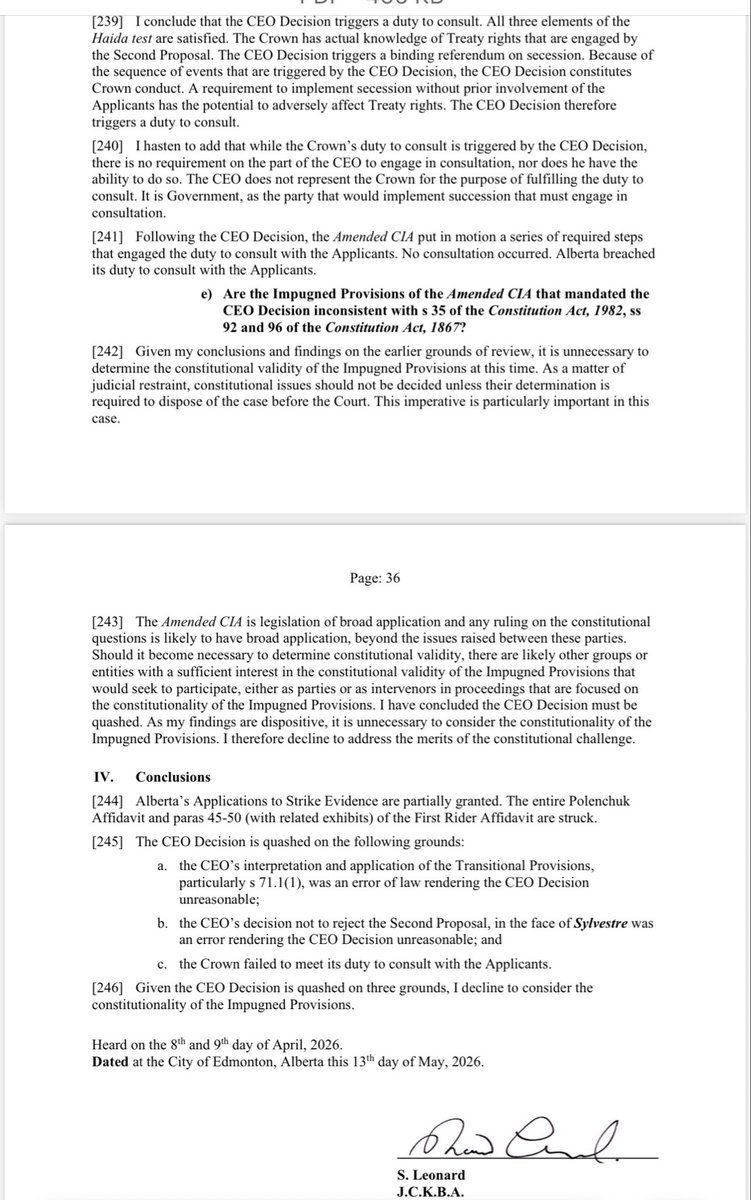
Today’s ruling by Justice Leonard essentially found that the citizen-led independence petition process cannot proceed because the government did not fulfill certain constitutional responsibilities owed to First Nations.
But here is the important point: the Alberta government did not initiate this petition process. Citizens did, through a lawful statutory mechanism created by the Legislature itself. So how does a court conclude that the government failed to fulfill duties that had not yet even arisen or been carried out, particularly when the government itself had not initiated the referendum process?
It is also important to understand that the Alberta government has always had the ability to call a referendum on independence at any time if it chose to do so. That is not in dispute, and it was not the legal question before the Court in this case. Nothing in today’s ruling prevents the Alberta government from calling the very same referendum itself tomorrow.
So think about that carefully.
A citizen-led democratic process established by law is effectively halted, not because citizens failed to follow the legislated process, but because of obligations assigned to government itself. Yet the government retains the full ability to ask the same question directly.
Courts and those in government must always have regard to the overall interests of justice, including democratic participation, the integrity of legislated statutory processes, and public confidence in lawful democratic frameworks established by the Legislature.
I figured it would be appropriate to reflect on a few words from the Supreme Court of Canada:
“…liberal democracy demands the free expression of political opinion” and political speech lies at the core of the Charter’s guarantee of freedom of expression. The Court further affirmed that freedom of expression includes “the right to attempt to persuade through peaceful interchange.” — Harper v. Canada
The Supreme Court of Canada has also held that:
“…the right of each citizen to participate in the political life of the country is one that is of fundamental importance in a free and democratic society.” — Figueroa v. Canada
And in the Reference re Secession of Quebec, the Supreme Court of Canada recognized that democracy is grounded in the participation and democratic will of the people, and that a clear expression of the will of citizens carries constitutional and political significance that cannot simply be ignored. Specifically, the Court confirmed:
“The democratic principle identified above would demand that considerable weight be given to a clear expression by the people of Quebec of their will to secede from Canada…” — Reference re Secession of Quebec
So how does any of this truly reconcile with a situation where government itself can ask citizens a question through a referendum process, but a group of citizens following a lawful statutory process established by the Legislature is not permitted to ask the question?
What message does that send when citizens engage in lawful democratic participation, comply with the very process created by government, and yet their voices are disregarded or treated as something to be feared?
Democracy is not strengthened when lawful citizen participation is restrained or silenced. In this case, it was not government stopping the process, but the Court. That reality raises profound questions about the role institutions play in democratic participation and how citizen engagement is treated when it touches controversial political issues.
After all, citizens do not hold institutional power. Their power is their voice. And if even that voice can be restrained after citizens lawfully engage in the exact democratic process created for them, what meaningful role are citizens truly left with in shaping the political future of their province and country?
What do you think? Should lawful citizen participation be encouraged, even when institutions disagree with the message?
BREAKING: My read of Justice Leonard’s decision: it does not prohibit an Alberta independence referendum. The ruling is much narrower and merely technical. It says Bill 14’s transition provisions did not revive or validate the Sylvestre independence citizen-initiative petition after the earlier proposal had already been rejected.
The decision today points to a cleaner lawful route: the secession referendum needs to be initiated by Alberta’s Cabinet under the Referendum Act, not through the Citizen Initiative Act. It also makes clear that the Government must consult First Nations before the vote, in case there is a potential impact on Treaty and traditional rights.
That means the ball is now in the Smith government’s court to set the secession question for the October 2026 referendum (just like the Supreme Court of Canada envisioned in the 1998 Reference Case).
If King Charles, Mark Carney and @jkenney have their way this will be happening in Alberta soon.
This is reason #1035 for why Albertans need to leave Canada.
This is one of the most jaw-dropping, chilling interviews I have seen. Watch this Rabbi from London, respond to question about the terror stabbing in Golders Green!
Putin is a weak loser.
He just lost his closest European ally.
He lost his dictator friends in Venezuela and Syria.
His allies in the Iranian theocracy are in tatters.
His stooges lost elections in Moldova & Romania. He lost the support of Armenia, and it’s only a matter of time before the Georgian people throw off their corrupt pro Putin regime.
He lost his effort to stop NATO expansion, pushing Finland & Sweden into the alliance.
He has lost over 1.3 million Russians to battlefield casualties.
And now he is losing his war against Ukraine, falling back in many areas & controlling less Ukrainian territory than he did 4 years ago.