And ... we have a winner!
My method when writing the post in 2024 was: I wrote it in Chinese, used qwen2.5 locally to translate it to English, then manually fixed all the bugs in the translation.
Notice that the stylistic hints that his AI picked up on were intellectual habits and style of math and algorithm explanation, which bypassed my obfuscation strategy (which only covered prose) completely.
https://t.co/d04MwOjkHP
"Pokemon" is short for "pocket monsters".
"Digimon" is short for "digital monsters".
Therefore, "salmon" is short for "saltwater monsters".
(You might object: salmon spend a big part of their life in freshwater. But pokemon spend a big part of their life outside pockets too!)
[X] I affirm the direction set out in the mandate, will help translate it into thoroughly reasoned strategies for my domain, and will maintain an exclusive and energetic focus on the mission-critical tasks necessary for its implementation, from today until my last day at the EF.
One thing that it is worth re-thinking is our perspective on when, and how, it makes sense to build "democratic things". This includes:
* DAOs and voting mechanisms in DAOs
* Quadratic and other funding gadgets
* ZKpassport voting use cases, incl freedomtool type stuff, incl attempts to deploy it for local governance, etc
* Voting systems inside social media
* Attempts at "let's build and push for a brighter and freer political system for my country"
Lately I am getting the feeling that there is less enthusiasm about these things than before. The "authoritarian wave" (a phenomenon that is often viewed as being about nation-state politics, but actually it stretches far beyond that, eg. see the phenomenon of companies lately becoming less "multi-stakeholder" and more founder-centric, and recent disillusionment with social media) is not just a matter of some malevolent strongmen smelling an opportunity to exert their will unopposed and seizing it. It's also a matter of genuine disillusionment with democratic things (of various types, not just nation-state, also corporate, nonprofit, social media).
Defense of democratic things lately has the vibe of actually being conservatism: it's about fighting to preserve an existing order, and ward off hostile attempts to push the order toward a different order (or chaos) that favors a few people's interests at the expense of others, and not about appreciating positive benefits of the existing order. But conservatism is progressivism driving at the speed limit, and so if that's all that there is, it will inevitably lose, it will just take longer.
There is an unfortunate irony to this, because it comes at the same time as we have much more powerful tools to build more effective democratic things: ZK, AI, much stronger cybersecurity, decades of research and experience. But to do so effectively we need to diagnose the present situation. I will break this down into a few parts.
## Stable era and chaotic era
In the 00s and 10s, it was common to dream about things like: creating a global UBI, moving a country wholesale to a better political system like ranked-choice voting or quadratic voting, building a large-scale DAO that could eventually provide billions of dollars to global public goods that current systems miss (eg. open source software).
Today, all of these dreams seem more unrealistic than ever. I see the main difference why as being that the 00s and 10s were a stable era, and the 20s are a chaotic era. In a stable era, more coordination is possible and imaginable, and so people naturally ask questions like "what would be a more perfect order?", and work towards it. In a chaotic era, the average intervention into the order is not a principled act of mechanism design, it's raw selfish power-grabbing, and so there is much less room to think about such questions. It's difficult to imagine eg. moving the United States to quadratic voting or ranked choice voting, when the country cannot even successfully ban gerrymandering.
What do chaotic era democratic things look like? At a large scale, they do not look like hard binding mechanisms for making decisions. Rather, they look like tools for consensus-finding. They look like tools for identifying possible shifts to the order that would satisfy large cross-cutting groups of people, and presenting those possible shifts to change-making actors (yes, including centralized actors, even selfish actors), to make it clear to them that those particular shifts would be easier for them to accomplish, because they would have a lot of support and legitimacy. https://t.co/EJ0MH39onA style ideas are good here, anonymous voting is good, also perhaps assurance contract-style ideas: votes or statements that are anonymous at first, but that flip into being public (and hence publicly commit everyone at the same time) once they reach a certain threshold of support.
This does not create a perfect order, but it gives highly distributed groups *a voice*. It gives actors with hard power something to listen to, and a credible claim that if they adjust their plans based on it, those plans are more likely to get widespread support and succeed.
The Iran war is a good example here. My biggest fear in the ongoing situation has been that while the IRGC is unambiguously awful and murderous, there is an obvious divergence between US/Israel interests, and interests of Iranian common people: while both would be satisfied by a beautiful peaceful democratic Iran, the former would also be satisfied by the perhaps easier target of Iran becoming a low-threat low-capability wasteland, whereas for the latter that would be ruinous. How can Iranian people have a collective voice that carries hard power - not just in some future order that they create, but now, literally this week, while the situation is chaos?
Some "sanctuary technology" is sanctuary money. Other times, it's sanctuary communication. But we need sanctuary tools for collective voice too.
Over the past year, many people I talk to have expressed worry about two topics:
* Various aspects of the way the world is going: government control and surveillance, wars, corporate power and surveillance, tech enshittification / corposlop, social media becoming a memetic warzone, AI and how it interplays with all of the above...
* The brute reality that Ethereum seems to be absent from meaningfully improving the lives of people subject to these things, even on the dimensions we deeply care about (eg. freedom, privacy, security of digital life, community self-organization)
It is easy to bond over the first, to commiserate over the fact that beauty and good in the world seems to be receding and darkness advancing, and uncaring powerful people in high places are making this happen. But ultimately, it is easy to acknowledge problems, the hard thing is actually shining a light forward, coming up with a concrete plan that makes the situation better.
The second has been weighing heavily on my mind, and on the minds of many of our brightest and most idealistic Ethereans. I personally never felt any upset or fear when political memecoins went on Solana, or various zero-sum gambling applications go on whatever 250 millisecond block chain strikes their fancy. But it *does* weigh on me that, through all of the various low-grade online memetic wars, international overreaches of corporate and government power, and other issues of the last few years, Ethereum has been playing a very limited role in making people's lives better. What *are* the liberating technologies? Starlink is the most obvious one. Locally-running open-weights LLMs are another. Signal is a third. Community Notes is a fourth, tackling the problem from a different angle.
One response is to say "stop dreaming big, we need to hunker down and accept that finance is our lane and laser-focus on that". But this is ultimately hollow. Financial freedom and security is critical. But it seems obvious that, while adding a perfectly free and open and sovereign and debasement-proof financial system would fix some things, but it would leave the bulk of our deep worries about the world unaddressed. It's okay for individuals to laser-focus on finance, but we need to be part of some greater whole that has things to say about the other problems too.
At the same time, Ethereum cannot fix the world. Ethereum is the "wrong-shaped tool" for that: beyond a certain point, "fixing the world" implies a form of power projection that is more like a centralized political entity than like a decentralized technology community.
So what can we do? I think that we in Ethereum should conceptualize ourselves as being part of an ecosystem building "sanctuary technologies": free open-source technologies that let people live, work, talk to each other, manage risk and build wealth, and collaborate on shared goals, in a way that optimizes for robustness to outside pressures.
The goal is not to remake the world in Ethereum's image, where all finance is disintermediated, all governance happens through DAOs, and everyone gets a blockchain-based UBI delivered straight to their social-recovery wallet. The goal is the opposite: it's de-totalization. It's to reduce the stakes of the war in heaven by preventing the winner from having total victory (ie. total control over other human beings), and preventing the loser from suffering total defeat. To create digital islands of stability in a chaotic era. To enable interdependence that cannot be weaponized.
Ethereum's role is to create "digital space" where different entities can cooperate and interact. Communications channels enable interaction, but communication channels are not "space": they do not let you create single unique objects that canonically represent some social arrangement that changes over time. Money is one important example. Multisigs that can change their members, showing persistence exceeding that of any one person or one public key, are another. Various market and governance structures are a third. There are more.
I think now is the time to double down, with greater clarity. Do not try to be Apple or Google, seeing crypto as a tech sector that enables efficiency or shininess. Instead, build our part of the sanctuary tech ecosystem - the "shared digital space with no owner" that enables both open finance and much more. More actively build toward a full-stack ecosystem: both upward to the wallet and application layer (incl AI as interface) and downward to the OS, hardware, even physical/bio security levels.
Ultimately, tech is worthless without users. But look for users, both individual and institutional, for whom sanctuary tech is exactly the thing they need. Optimize payments, defi, decentralized social, and other applications precisely for those users, and those goals, which centralized tech will not serve. We have many allies, including many outside of "crypto". It's time we work together with an open mind and move forward.
This is a good post on the impact of surveillance in Iran:
https://t.co/1kT3SrsCyO
It's worth reading.
IMO one mistake that freedom advocates often make is that we talk about privacy violation and surveillance as "dystopian", using the word as a semantic stop sign: we know it means "bad", we nod along, and don't really go further to clarify why it's bad. I worry that this approach is long-run unhealthy: when we criticize various companies and countries for being "dystopian" and stop there, then to someone who's not already in the same memeplex, it sounds like we're basically criticizing companies and countries for not complying with our culture's aesthetic preferences. Which is ... duh, companies and countries are *supposed* to not comply with each other's aesthetic preferences, that's the whole point of the "pluralism" thing.
What the above article makes clear so well is that "dystopian" surveillance is not bad because it's "dystopian", it's bad because it makes a concrete property of the world worse: the power balance between individual and state. Surveillance enables an outcome where basically everyone other than police and security forces has no opportunity whatsoever to challenge the political status quo without being punished. This means an outcome where a political regime can remain in power forever, without satisfying more than a very small coalition of people who have the eyes and the guns (now drones).
The Dictator's Handbook talks about "large coalition" and "small coalition" governments; large coalition governments are the ones that are more pro-human, because they, well, have to keep a large coalition happy. Small coalition ones are the really nasty ones. Here is the near-term dark outcome of dictatorship + automated warfare + surveillance: a regime can literally survive with a coalition of size 1, because an army of all-seeing eyes and robots can defeat the entire populace in battle if needed. In Iran, we see what *just* dictatorship with surveillance can do, once you add automated police, you get to the unholy trifecta.
I don't know of a good solution to this. Privacy technology, as well as more work on censorship-resistant internet (I think we should strive for at least basic-quality internet, eg. 1 Mbps, being a global human right outside the domain of nation-state sovereignty), can help somewhat to reduce the possibility of total government control. But what else?
---
BTW one implicit frame in the article I take some issue with is framing Iran + Russia + China as the unique antagonists (both in surveillance they do internally, and in the technology they export to other countries). They do a lot of dystopian shit of both types. However, Israeli and US tech companies, and undoubtedly tech companies from other Western nations, also do a lot of dystopian shit.
Perhaps one key difference between the surveillance described above, and the Western type, is:
* The surveillance in the above article is about exercising *great control over a medium area*: you can see everything, but it requires active participation of the government of the territory being surveilled.
* The Israeli / US / Western flavor is about exercising *medium control over a great area*: there are more limits to how much they can do, but their surveillance is global: they know what people are doing even in countries and territories they have no presence in.
The distinction is not absolute: Israeli surveillance backstops a lot of its human rights abuse in Palestine, US surveillance reinforces ICE abuses (see the recent article about Homeland Security demanding social media firms reveal names of anti-ICE protesters), etc, and "transnational repression" is done by anti-Western countries. But *on average*, the above seems to be the pattern.
The two are differently scary. The former for the reasons I described above. The latter because it allows global projection of power: a politician or civil servant in one country now has to worry about being blackmailed, droned or otherwise attacked from other countries. The USA has shown willingness to go after individual EU officials, ICC officials (see recent articles on both), and others. Ultimately, I suspect that even democratic governments will want more privacy to protect themselves, and we will have to have deep conversations about what "democratic accountability" means: how can a civil servant be accountable to the people, but not accountable to foreign spooks?
My high-level frame is: privacy generally helps whoever is weaker. "Weaker" does not mean "moral": sometimes the weaker side is criminal. But in the 21st century, we are at serious risk of stronger factions using modern technologies to establish unbreakable lock-in to power. And so on average, reducing the gradient of power, giving the weak a fighting chance, is something that the world desperately needs.
��🇺🤝🇨🇳 We extend our warmest greetings & sincere congratulations to our esteemed colleagues at the Embassy of the People's Republic of China for the upcoming New Year.
We wish you a year ahead filled with peace, prosperity & great success.
Happy New Year! Gong Xi Fa Cai!
看到这条推文的中国朋友们:
这个人(@IRIMFA_SPOX / 伊斯梅尔·巴盖伊)和他所代表的政权,直接参与了对超过4万名无辜伊朗人的屠杀。
双手沾满鲜血,却在这里送“新年祝福”,祝健康幸福?这完全是虚伪至极。
一个屠杀自己人民的政权、压制自由、输出恐怖的政权,是和平、人性与基本尊严的敌人,而不是值得温暖问候的朋友。
真正的善意从正义开始,而不是在#中国新年期间的空洞话语。
#伊朗屠杀 #拒绝伊斯兰政权
To Chinese friends who saw this post:
This person (@IRIMFA_SPOX / Esmaeil Baghaei) and the regime he represents have directly participated in the massacre of more than 40,000 innocent Iranians.
Hands drenched in blood, yet here he is sending “New Year greetings” and wishing health and happiness? This is hypocrisy at its absolute worst.
A regime that massacres its own people, suppresses freedom, and exports terrorism is the enemy of peace, humanity, and basic dignity — not a friend deserving of warm greetings.
True goodwill begins with justice, not with empty words during #ChineseNewYear.
#IranMassacre #RejectIslamicRegime
#IranRevolution2026
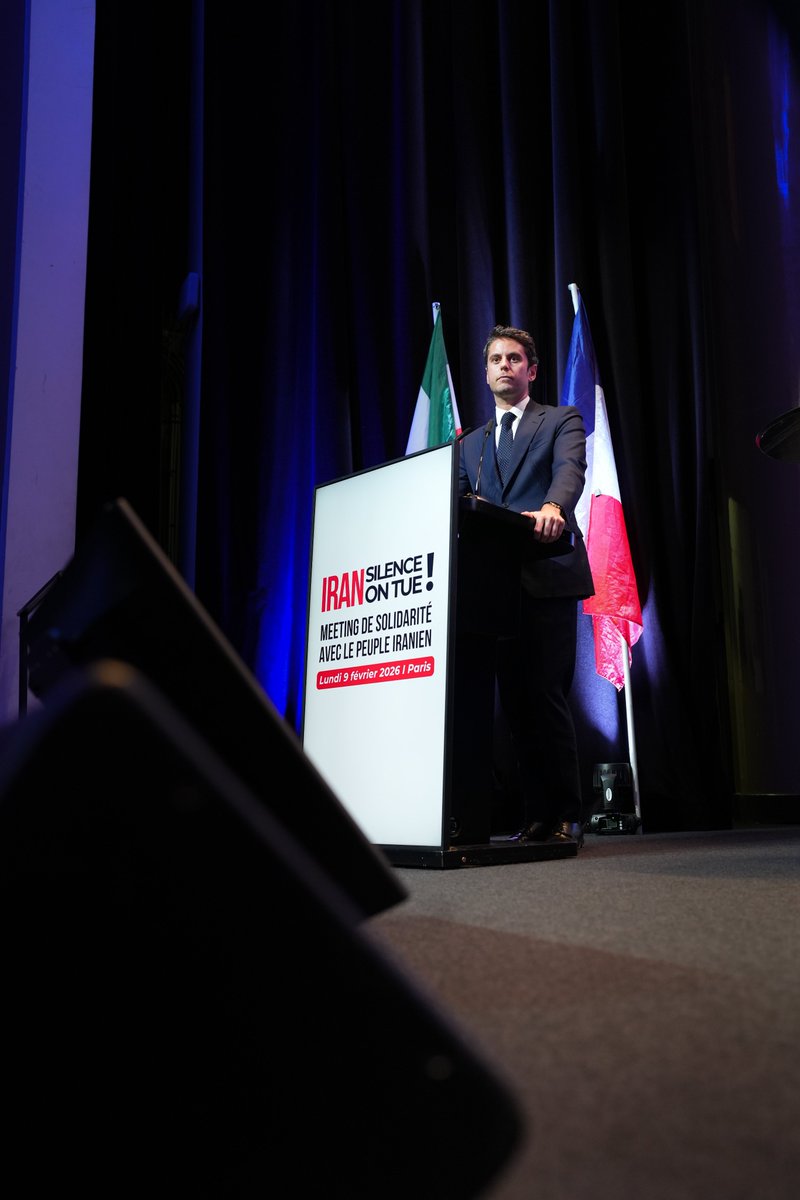
Le régime des mollahs tue, massacre et pille l’Iran depuis trop longtemps.
Il doit chuter. Il doit chuter et vite car c'est la liberté que ce régime assassine. C'est sur l'espoir que ses sbires ouvrent le feu. Ce sont des innocents qui sont égorgés.
Face à la barbarie, oui, la France a une responsabilité.
Partout où la liberté se lève, oui, la France a une responsabilité.
Elle doit mener une initiative internationale pour rassembler tous les pays prêts à exercer une pression maximale sur l'Iran. Pour renforcer encore les sanctions prises contre les mollahs et leurs exécutants.
C'est le message que j'ai adressé ce soir à la communauté iranienne rassemblée aujourd'hui à Paris.