Part-time scroller, full-time thinker — a curious mind riding the X wave, absorbing everything from tech trends to brain bends. Equal parts silicon and soul
I totally enjoyed writing this piece. The best insight on how to look at AI, came from an experience that had nothing to do with AI.
Take a look and let me know what you think
https://t.co/ztzFZd89nm
Three superbly researched books on the Pak Army’s deep state and the ISI by Steve Coll, Hein Kiessling and @OwenSirrs.
Invaluable in understanding the Pak Army (but through a western prism).
Beats me why India, with an 85 bn $ defence budget, a multitude of defence think tanks, and being a longstanding target of Pak state sponsored terrorism, has been unable to produce scholarship of this quality.
#26/11.
I urge everyone interested in AI to watch these three thought-provoking lectures by @paulfchristiano, who lays out his case for the risk of an AI takeover.
@paulfchristiano is the co-inventor of RLHF and Director of the Alignment Research Center.
https://t.co/AhiqQiFx4q
Reading the Section 301 Investigation report. And I get to Page 60... I have read it thrice. The extract presented to all those saying we are screwdriver economy... we do assembly... You guys can read this thrice or more.
"India’s manufacturing sector as a share of GDP has, over the past five years, hovered between 13.1% and 14.4%, recording an average of 13.5% during this time. The manufacturing sector is of significant importance to India, accounting for 12.0% of employment in 2024. The relative size of India’s manufacturing sector to its GDP is larger than that of the United States, which was between 9% and 10% from 2020–2025, 155 while the size of India’s manufacturing sector is higher than the OECD average, which was 13% in 2021, as shown in the table below.
Of course.... It is a different matter that I am not happy with our manufacturing sector share and we need to be doing a lot more. But I am just presenting how USRT views us.
Good note on Tata Steel - APL Apollo deal by IIAS
"On 22 November, APL Apollo's board approved buying Tata Steel's tubes and colour-coated businesses for Rs 280.0 bn, funded by debt. The next morning, Tata Steel signed to buy most of the Gupta family's promoter stake and will make an open offer, taking control of APL Apollo. Because the asset purchase was agreed before Tata Steel became a shareholder, it falls outside the related party framework. It needs no audit committee approval and no shareholder vote that excludes interested parties.
The deal makes commercial sense, but APL Apollo's minority shareholders bear the cost. The price is steep: 24.8x EV/EBITDA, and the company's balance sheet is funding its own change of control, with the outgoing promoter signing a side arrangement. Shareholders will get a chance to veto the borrowings – just as they have voted down four earlier resolutions proposed by APL. But regulators too need to step in. SEBI should say whether the existing purpose-and-effect test (related party transaction rules) apply."
@AmitTandon_in@hetal_dalal
https://t.co/s0X2mHkJ7z
Meta spent $14.3 billion to get Alexandr Wang to build superintelligence. This weekend he published an essay saying the whole AI industry needs to get off the path it's on.
He grew up in Los Alamos, where his parents were physicists at the lab that built the bomb, and he wrote that plenty of physicists would call the atomic bomb a homework problem next to what AI just did.
What set him off is the Riemann Hypothesis. A proof built with help from Anthropic's Claude got certified on Friday by Lean, the software that checks every single logical step. The problem had been open since 1859, and there's still no human-readable version of the proof. Wang titled his essay "Superintelligence is Arriving" and said what the industry does over the next year will decide what kind of world we end up living in.
He wants every lab to take "meaningfully different actions" from what he calls the default path. He didn't name a single one.
Meanwhile Meta has told investors it will spend $135 to $145 billion on capex this year, aimed at what it calls personal superintelligence for everyone. Wang runs the lab all that money is pointed at.
Los Alamos has actually been in this exact spot before. Back in July 1945, Leo Szilard circulated a petition asking Truman not to use the bomb on Japan, and 70 Manhattan Project scientists in Chicago and Oak Ridge signed it. When Edward Teller brought it to Los Alamos, the lab's director, J. Robert Oppenheimer, told him Washington was already weighing the question and the scientists should stay out of it. Los Alamos added zero signatures.
The petition had to go through General Groves, who held onto it. Truman never saw it before Hiroshima.
The people building a dangerous technology usually see the risk first, and their warnings travel up through the same chain of command that's paying for the thing. Szilard never had a say in how the project spent its money, which is a big reason his petition could just sit on a general's desk. Wang is the chief AI officer of a company spending more than $135 billion this year.
If he means it, you'll see it in the next capex number Meta gives Wall Street.
A toothpaste company has quietly killed the entire market research industry and nobody is talking about it.
Colgate published a paper showing you can predict real purchase intent by simply asking LLMs to roleplay customers.
And this is beyond insane.
If you ask an AI, "Rate this product from 1 to 5," it gives safe, middle-of-the-road garbage.
So researchers invented a method called Semantic Similarity Rating (SSR).
Instead of asking the AI for a number, they asked it to roleplay.
They gave the LLM a demographic profile. They showed it a product concept. And they asked it to write down its raw, unfiltered thoughts.
Then, they used a semantic model to translate those written thoughts into a numerical score.
The results are staggering.
Tested against 57 real personal care product surveys and 9,300 human responses, the synthetic consumers hit 90% of human test-retest reliability.
They perfectly mirrored how different age brackets and income levels react to price changes.
And they provided detailed, qualitative feedback that was deeper and more critical than what actual humans wrote.
This destroys the economics of traditional market research.
You don't need to wait a month to see if a product will sell.
You can simulate 1,000 hyper-targeted customer interviews overnight.
You can A/B test pricing across every demographic instantly.
High quality decision making
I've been lucky to work with @brian_armstrong and @emiliemc at @coinbase for the past 6+ years.
They've built a culture that prioritizes clarity and ownership over consensus and theater.
Their decision framework (RAPID) is a great example. It's very similar to the SPADE decision framework that we created at Square: one responsible person, a small group of consulted voices, private input to avoid groupthink, and a clear decider.
They've added two interesting / powerful nuances:
1. The committee rule: In regulated (or even non-regulated) environments, committees metastasize and nobody owns the outcome. Committees also breed consensus, which is ineffective because it produces no ownership; what matters is that people feel heard, then one person decides and everyone commits.
2. The 48-hour rule: This forces a discipline that prevents decisions from dragging. In SPADE, the “when” is explicit for the same reason.
Kudos Brian, Emilie and team for building a great culture at @coinbase and for making it to Signalful Best of the Week :)
Founders: upgrading your decision framework (especially for high-stakes, one way door, consequential decisions) will massively upgrade your company's culture and performance.
For more thought provoking insights that help you grow as a founder, operator and investor, check out the full article at the link below and subscribe to Signalful to get Best of the Week delivered directly to your inbox.
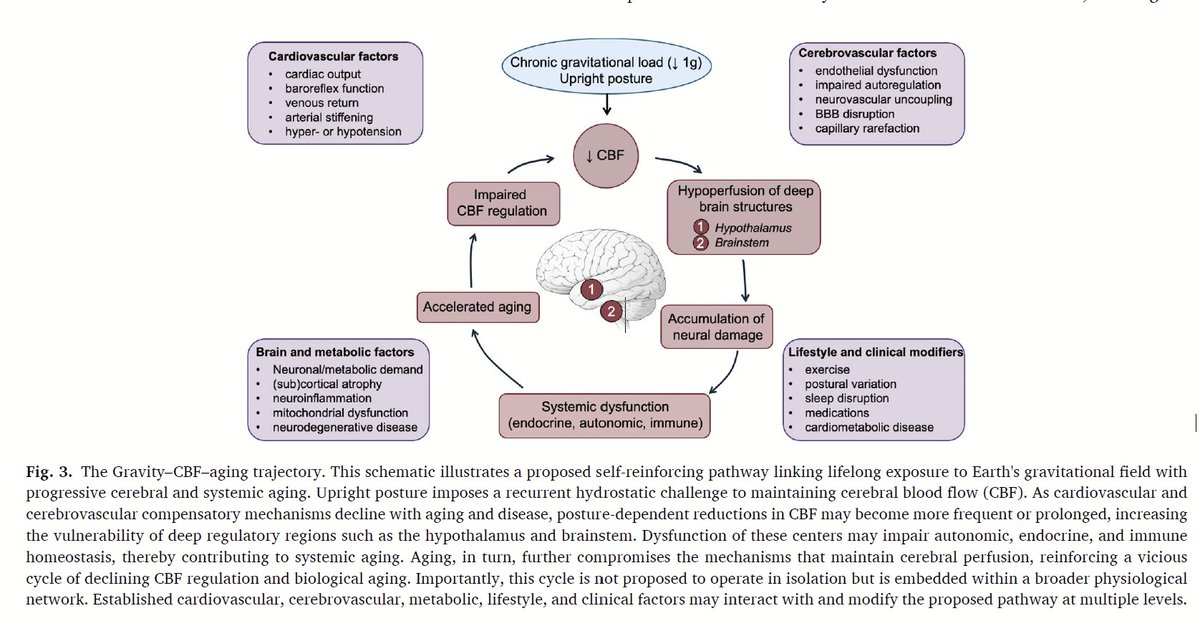
Last year, I raised a provocative idea: gravity might be an overlooked contributor to aging.
Today, the full paper on "Gravitational Stress, Cerebral Blood Flow, and Aging: A Hypothesis" is published in Ageing Research Reviews, a top-three journal in its field by Journal Citation Reports.
https://t.co/m0KCYeXD9S
What it proposes: we spend most of our waking lives upright, with the brain above the heart. Over decades, this could contribute to the known decline in brain blood flow with age. The brainstem and hypothalamus may be especially vulnerable, and those regions regulate much of the rest of the body, and might contribute to whole body aging.
What it does not say: that gravity is the sole cause of aging, how big the effect is, or that anyone should try an intervention.
Please note that this is a hypothesis paper. Peer review checked that the argument is strong enough to publish; only experiments can prove whether it is true or false.
Experiments to test it are now underway, and if you work in any of these areas, we would welcome your collaboration, including work aimed at disproving it.
Big thanks @RosmalenLaura and @SatchinPanda for the incredible effort on putting this together.
Your brain keeps your neck muscles clenched on purpose, and a 5-second move with one hand gets it to let go.
Put your palm on the back of your head, push your head back into it gently, and hold for 5 seconds. Doctors tested this on 244 patients back in 1984, and 94% felt relief on the spot.
The guy who ran that study was a Czech neurologist named Karel Lewit, and he called it post-isometric relaxation. Most of his patients, 63%, still felt better at follow-up. The ones who kept doing it at home did best.
Think about what your neck goes through all day. Your head weighs 10 to 12 pounds. Spine surgeon Kenneth Hansraj calculated that when you tilt it 45 degrees to look at your phone, the load on your neck jumps to 49 pounds. Your muscles hold that for hours, so your nervous system just leaves them switched on. That's why telling yourself to relax doesn't do much.
Pushing into your hand changes that. The tension in those muscles spikes, and little sensors in the tendons called Golgi tendon organs flag it to your spinal cord. The classic explanation is that your spinal cord turns the muscle down for a few seconds to protect it. That's the wobbly, loose feeling you get right after.
Newer research found a bigger switch up in your brain. In 2015, a team in Melbourne led by Ebonie Rio had volleyball players with knee tendon pain do a few long, hard holds. Their pain dropped almost 7 points out of 10 and stayed down for 45 minutes. When the researchers checked with magnetic stimulation, the players' brains had been running that muscle in a protective mode, and the holds reset it. Regular moving reps only knocked pain down 2.6 points.
So if you've spent years tilting your head back to stretch it out and nothing changed, this is probably why. Your brain is protecting that muscle, and pulling on it doesn't change its mind.
Keep the push light, maybe a quarter of your strength. If it sends pain or numbness down your arm, that's a nerve thing and worth getting checked by a physio.
Turns out the quickest way to get a tight muscle to relax is to make it work hard for five seconds first.
I haven't watched TV in years, and I rarely watch Netflix anymore. I've found a certain kind of peace in studying mathematics. In the evening, when everyone is asleep and I can finally set the day's thoughts aside, I like to open a book and study.
It's stimulating and, in its own way, relaxing. I know far more mathematics today than I did back when I actually needed it for my studies. Maybe none of this will ever be particularly useful. But it makes me feel good, and that's something.
And as long as it does, I'll keep studying.
.@brian_armstrong was a conflict-averse CEO until he reprogrammed his brain:
“I remember writing this down a lot. ‘I love conflict. I love conflict. I love conflict.”
“I was like, ‘I need to reprogram my brain to not think of this as super stressful.”
“It doesn’t mean I go out and actively seek conflict just to piss people off, but if it does happen, I can get somewhat excited about it now.”
It’s all over but the shouting. In the span of a single day that will echo through mathematics history, the solution to math’s hardest problem was announced—and then independently verified.
https://t.co/ZyKOawr8t7
A mathematician spent his student years secretly preparing for one problem, a question about prime numbers that's been open since 1859 and carries a $1 million prize.
Late Sunday night, he messaged his CEO, and the message started, "Hypothetically, if I were to have . . ."
That's Levent Alpöge, a mathematician at Anthropic, writing to Dario Amodei. Today he posted a note that opens, "I believe I have, working with Claude, discovered a proof of the Riemann Hypothesis."
It's his claim, and no independent check is public yet.
He also wrote that it's natural to feel this is an end, "in my case a loss of a principal guiding light."
The note is precise about who did what. Back in school he tried to learn "all tools that I could possibly recognize in the problem when it was time." He picked the direction, two ideas from a simpler "toy setting," and then "I guided us to the right situation analogous to that toy setting, and then Claude began to leave me in awe." The last stretch ran through automorphic forms on higher rank groups, where he admits "little mastery" and blames "youthful foolish stubbornness." All those years collecting tools, and the finish went through a corner he'd skipped, right where Claude "far outpaced me near the finish line."
Claude even pieced together the note's timeline, which starts October 6. Eight of its 20 steps are dated Sunday, November 15, and step 20, the Generalized Riemann Hypothesis, is dated Monday, 41 days after step 1 (on top of his years of prep).
Funny thing is, the full write-up passed 250,000 pages, and Theorem 1 opens by pointing out that a number other than 1/2 has to be either bigger than 1/2 or smaller.
So he released only Lean, proof code a computer checks step by step, in 14 archive parts. Posting the giant document, he wrote, would be "some massive unreadable travesty of 'slop.'" He's upfront that he's "presenting the world with a complete argument before having mastered a massive neighbourhood around its mathematics."
That's the part every builder should copy. Once AI writes more than a person can read, trust has to come from a check that runs by itself. If Claude Code writes more code each week than your team can review, put the next dollar into tests that fail loudly before you add another reviewer, and keep your people where Alpöge sat, choosing the problem and the setup.
The same note thanks rival OpenAI's math people for their "good taste," and he's reportedly the same mathematician behind this year's Jacobian conjecture result and the Navier-Stokes work with Tristan Buckmaster.
Lean checks each step, so experts will first ask whether the file states the real Riemann Hypothesis and assumes nothing extra. He says it's formalized "without assumptions," and warns that his summary of the parts where Claude is the expert "might make zero sense."
For 167 years the hard part of the Riemann Hypothesis was finding a proof, and if this one holds, the hard part from here is reading it.
If you want to learn marketing, go through Alexandr Wang's tweets over the last 6 months. You'll learn more about marketing than from a 4 year degree.
You don't have to implement everything. It might not even be applicable to your company. But this guy has single handedly brought Muse to me and millions of other users.
Every large company I talk to is trying to build their own Alexandr Wang in-house. A spokesperson on X to talk about their product, updates, use cases etc.
Incredibly well done 👏
A British pilot's account of the day he got the privilege to be the co-pilot on a maintenance sortie in Siachen.
Worth a read.
These heroes and their flying machines are doing a superhuman job every single day, on the farthest of our frontiers.
https://t.co/IRpSTGfAce