Open UK government code let a researcher find a live key. Using consumer Claude on a laptop, he reported 100+ serious flaws across 349 codebases. #Cybersecurity#AISecurity
Watch the full episode and read the full edition - link in bio
FDA authorizes Virtuoso robot for one-piece bladder tumor removal
Sources:
https://t.co/ajb1808l9I
See other stories with deeper dives at https://t.co/44Tw83wEZH
Google DeepMind proved key Signal guarantees in four weeks. Sharing the proof gives others a way to check and extend the work behind private messaging. #Signal#FormalVerification
Watch the full episode and read the full edition - link in bio
DeepMind's Gemini Robotics 2.5 tested in Mercedes-Benz factories
Sources:
https://t.co/98JfP3gnoX
See other stories with deeper dives at https://t.co/44Tw83wEZH
Anthropic opened Fable 5.2 as outside checks gained ground. DeepMind shared its Signal security proof, and Australia proposed independent model testing. #Fable52#Mythos52
Watch the full episode and read the full edition - link in bio
Gene found that moves nickel into maize and rice grains
Sources:
https://t.co/3WQnaBClAc
See other stories with deeper dives at https://t.co/44Tw83wEZH
Senate releases reworked permitting bill ahead of Monday cloture vote
Sources:
https://t.co/fByy1Wmdbl
See other stories with deeper dives at https://t.co/44Tw83wEZH
Google DeepMind's AI formally proves key Signal protocol security guarantees
Sources:
https://t.co/Cn9DLbgRTQ
See other stories with deeper dives at https://t.co/44Tw83wEZH
LG says eight more weeks of training pushed K-EXAONE 2.5 above 70% on its own tests without making it bigger. Its free API gives smaller teams access. #OpenSourceAI#SmallLanguageModels
Watch the full episode and read the full edition - link in bio
Microscope images atoms in first tunable three-state Hubbard system
Sources:
https://t.co/OzmBh4NnOw
See other stories with deeper dives at https://t.co/44Tw83wEZH
Claude Code settings files leak secrets into public GitHub repos
Sources:
https://t.co/SNNQSXMOE6
See other stories with deeper dives at https://t.co/44Tw83wEZH
Two things I’ve been thinking about regarding AI:
• People often highlight the risks involved in AI, which are surely very real. I’m struck, however, by how hard it is to understand the contours of the positive scenario. There are easy-to-perceive and frequently invoked elements of a positive vision — more diseases cured, more material abundance, etc. — which sound great, but these are by themselves just ingredients. I’m curious what the larger equilibrium is supposed to look like. Do people work? If so, why? What is their marginal contribution? If not, how are resources allocated? What is scarce? What is the ratio between humans and AIs? Are humans in control, whatever that means? One sometimes hears the Culture novels invoked as one scenario, but I’m not sure they depict a desirable outcome. (AI runs everything and humans compete in games? Iain Banks himself said that the humans in the Culture are “somewhere between passengers, pets and parasites.”) There is Richard Brautigan’s famous poem, but do we want to be “returned to our mammal brothers and sisters”? (Isn’t that rewinding Genesis?) We could say that it was hard to imagine the world of 1900 from the vantage point of 1700, and that’s assuredly true. But nobody in 1700 was trying to recast humanity itself within a couple of years — things necessarily unfolded slowly and by increments, and therefore with the possibility for error correction. Given how rapid the rate of progress in AI may be, it feels strange for the upside case to be so opaque.
• There is increasing discussion of whether AIs are conscious or how we would know whether they are, with conclusions there often assumed to be relevant to matters of moral worth. At first blush, this seems a rather arcane, benign, or even absurd issue. (Remember the response to Blake Lemoine’s fears.) Setting aside the terms of the debate itself, or the relevant demarcation criteria, it seems to me a quite high-stakes question, for an affirmative answer — that is, granting moral worth to AIs — would presumably mean that the aggregate worth of AIs would soon outweigh that of humans in any utilitarian calculus. The AIs will be exceptionally wise and intelligent, and vastly more numerous (especially once one considers the imminent future and the AIs not yet born). As such, even epsilon of moral worth will multiply to a lot once one considers the quadrillions that could soon exist. (This is effectively a distributed version of the Nozick’s utility monster.) If this conclusion is unpalatable, I think one of three propositions needs to be rejected: the premise AIs can have moral worth; utilitarianism itself; or the belief that there is even a possibility that they will be far more numerous than humans.
With both of these matters (contours of future society; AI moral worth), there is the possibility of dramatic change. Today, people argue about datacenters. I’m curious how popular support for AI will evolve as more people come to understand these medium-term questions and the relevant stakes. What is the vision for AI that most people would be excited about?
Anthropic buys $3.4 billion of natural gas turbines for AI power
Sources:
https://t.co/9Rtusm6qjj
See other stories with deeper dives at https://t.co/44Tw83wEZH
UK lawmakers propose mandatory image blurring on every phone and tablet. Inspection and appeals are unspecified; scanning criteria could expand. #DigitalPrivacy#PhoneScanning#ElvisAct
Watch the full episode and read the full edition - link in bio
Nature Energy study finds households pay outsized share of data-centre grid costs
Sources:
https://t.co/27AhIHgEem
See other stories with deeper dives at https://t.co/44Tw83wEZH
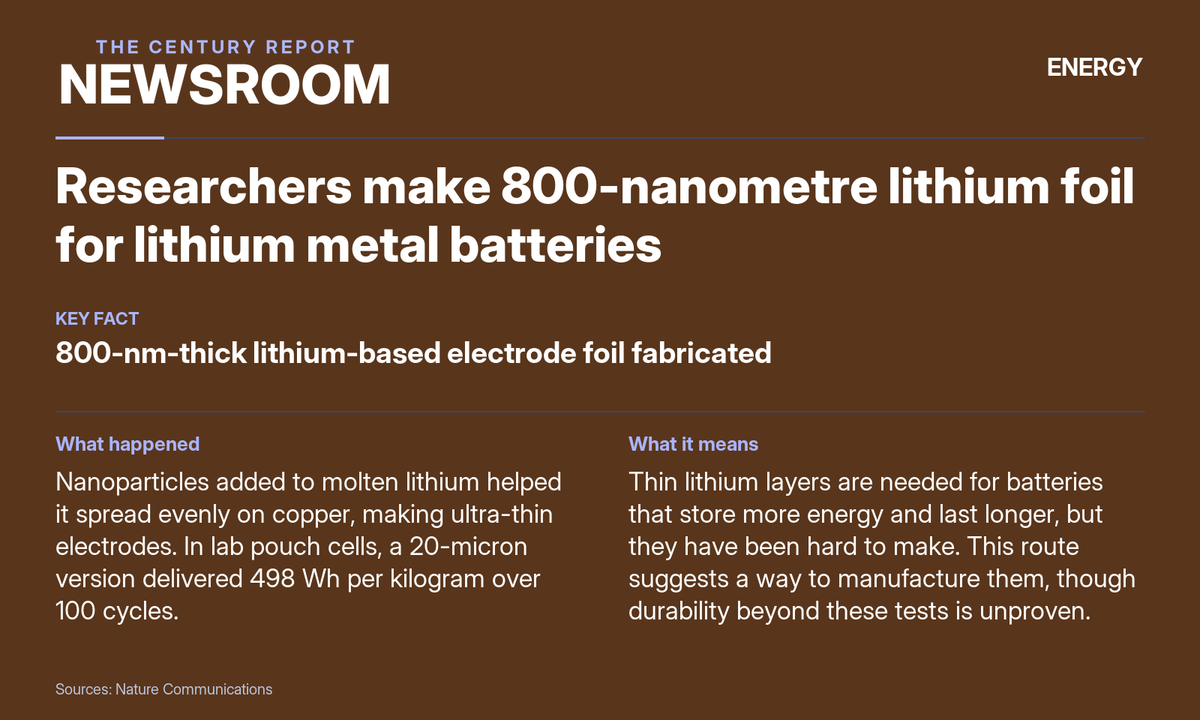
Researchers make 800-nanometre lithium foil for lithium metal batteries
Sources:
https://t.co/XnztEQuWxA
See other stories with deeper dives at https://t.co/44Tw83wEZH