Tick-tock, tick-tock! ⏰ Only 24 hours left to join the @HanaNetwork $HANA TGE Early Access subscription phase. 🚀
Don't miss your last call for early access to the future of Web4! 💎 This is your chance to secure your allocation and be part of the Hypercasual Finance revolution. 🌐
Head over to [https://t.co/2unZZjexWE](https://t.co/2unZZjexWE) before it's too late! Subscription phase ends on June 24th at 7:00 AM. ⏳
Are you ready to join the @HanaNetwork community and experience the future of finance? 💰 Don't let this opportunity slip away!
#HANA #Web4 #HypercasualFinance #Crypto #Blockchain #TGE #EarlyAccess #LimitedTime #DeFi #Hanafuda
Gm Syndicate, fam! 🌅
November has been a defining month for @syndicateio and honestly the infrastructure shift happening here is something most people are still sleeping on. Commons Chain launched October 1 and we're now seeing exactly what programmable sequencing means in practice.
The staking mechanism went live with 80 million $SYND distributed over 48 thirty-day epochs. What makes this different from traditional staking is the three-pool structure. You have the Base Pool giving steady returns based on your stake amount and duration. Then the Performance Pool rewards you based on the actual success of the appchains you back. Finally the Appchain Pool directly funds appchains based on fees generated and stake they attract.
This creates real skin in the game. You're not just passively earning yield. You're actively allocating capital to appchains you believe in and getting rewarded when they succeed. The October 31 requirement that stakers must allocate 100 percent of their stake to specific appchains reinforced this alignment. No more sitting on the sidelines.
The DUNA structure giving token holders full control over treasury spending and network upgrades isn't just governance theater. This is real ownership. Over 50 percent of total supply supports community and ecosystem growth. The infrastructure is designed from day one for builders to actually own and control what they're building on.
What excites me most is seeing prediction market appchain designs coming through with enshrined oracles at the sequencer level. Automatic settlement without external dependencies. Fair ordering through random time-weighting. MEV flowing back to participants instead of being extracted. This is what programmable sequencing enables that was impossible before.
Are you staking on Commons Chain yet or still watching from the sidelines? The performance pool mechanics reward early believers who identify winning appchains before everyone else does.
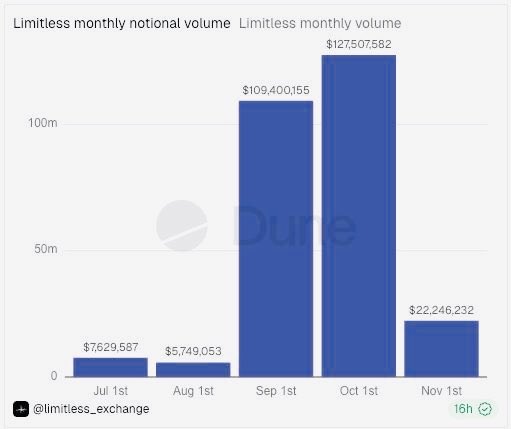
Watching @trylimitless hit $12M just six days into November is wild. October already set records at $127M, and they're acting like that momentum is just the baseline.
What interests me most isn't just the number - it's the consistency. Real volume backed by actual usage, not hype cycles. The infrastructure holds up, users keep coming back, and the network effect keeps compounding.
Partnerships like @BitgetWallet's integration with Limitless matter because they remove friction. When your DeFi platform works seamlessly across wallet ecosystems, adoption accelerates. That's what we're seeing play out here.
This is what sustainable growth looks like. 🌊🩵
Finally got into the @anoma testnet!
Big thanks to @sheikhsilicon for the invite code you’re a real one 👊
Let’s explore what Intent-Centric really means 👀
✍️ NEW DEAL: OneFootball Club x @megaphone_hq
From viral campaigns to the community sale allowlist, Megaphone has become essential infrastructure for our onchain community growth and to reward football fans globally.
What this means 👇
This breakdown on @anoma's modular design and the scalability trilemma is a must-read for anyone following blockchain architecture. Finally tackling the core constraints that have held the industry back
#Anoma#KaitoAI
Rise and shine, intent enjoyers ☀️
@anoma’s modular design isn’t just smart it’s the endgame for the scalability trilemma.
The scalability trilemma trade-offs between decentralization, security, and speed has plagued blockchain since inception.
Ethereum struggles with high fees, Solana faces reliability issues, and Cosmos requires complex cross-chain management. Traditional monolithic blockchains inevitably sacrifice one feature for another.
Anoma’s modular blockchain design permanently solves this trilemma. It separates execution, consensus, and data availability into modular components, each optimized independently. Anoma’s intent layer further unbundles user interactions from chain execution. Users privately declare intents; execution happens wherever optimal fast chains, private chains, or decentralized layers.
By modularizing blockchain architecture, Anoma simultaneously achieves decentralization, speed, and security without compromise. Execution layers can prioritize speed; consensus layers maintain decentralization; privacy layers ensure security and confidentiality. Users and developers choose modular components precisely matching their needs without sacrificing essential properties.
Modularity doesn’t just slightly improve blockchain it completely eliminates traditional constraints. It enables scalable, flexible, composable, and secure blockchain experiences previously unimaginable.
Anoma’s modular blockchain design finally resolves blockchain’s oldest challenge the scalability trilemma. It represents blockchain’s next evolutionary leap, permanently reshaping blockchain architecture and user experience.
#Anoma
“@anoma Doesn’t Just Offer Privacy It Reinvents the Economics of Privacy Itself
Privacy solutions often struggle economically limited liquidity, isolated assets, high transaction costs, and niche usage. Zcash and Monero, while groundbreaking, remain limited to niche cases due to inflexibility and restricted composability.
Anoma reinvents privacy economics completely. Its MASP (Multi-Asset Shielded Pool) unites multiple asset classes—ETH, BTC, NFTs, stablecoins into a single composable privacy pool. This composability isn’t just technically impressive; it fundamentally transforms privacy economics.
Liquidity pools become deeper, more efficient, and more attractive. Traders experience fewer frictions, lower costs, and greater flexibility. Privacy transforms from niche functionality into a mainstream default—because using privacy no longer incurs steep economic trade-offs.
Additionally, @anoma’s intent-driven execution dramatically improves efficiency. Matching intents privately off-chain reduces on-chain congestion, lowers gas fees, and delivers instant execution without liquidity fragmentation or MEV front-running.
By making privacy economically viable, Anoma positions privacy to become mainstream. Privacy becomes profitable, not expensive. Users adopt privacy naturally, driven by economic incentives, not just ideological preferences.
@anoma fundamentally rewrites blockchain’s privacy economics, making private, composable finance economically irresistible, scalable, and practical. Privacy finally becomes a mass-market standard.


 before it's too late! Subscription phase ends on June 24th at 7:00 AM. ⏳
Are you ready to join the @HanaNetwork community and experience the future of finance? 💰 Don't let this opportunity slip away!
#HANA #Web4 #HypercasualFinance #Crypto #Blockchain #TGE #EarlyAccess #LimitedTime #DeFi #Hanafuda](https://pbs.twimg.com/media/GuIbPheW8AAgPaS.png)