Agentic Search for Context Engineering
@helloiamleonie's hot take: context engineering is about 80% agentic search. The arrow from context sources to context window is doing most of the work.
https://t.co/Iu2nkU2NdZ
The workshop covers the full tool landscape: shell tools, semantic search, general-purpose query execution, agent skills, and when each one breaks. Including the part where an agent fakes semantic search by chaining grep synonyms.
Low floor tools (specialized, easy to call correctly) vs high ceiling tools (general purpose, handles the unexpected). You probably need both, and the workshop shows you how to pick.
some thoughts on working with ai models
• context as infra
• taste as config
• verification for autonomy
• scaling via delegation
• closing the loop
https://t.co/pdd8bk66Jz
one of the things that makes an agent "deep" is memory. and in production, memory needs to be maintained: consolidated, pruned, refined over time.
in a multi-tenant application, that means doing it at scale, per user, in the background. cron is built into langsmith's agent server for exactly that kind of job.
https://t.co/UMhlnXyQv4
if you haven't read this one by @Vtrivedy10, it's a must read!
great overview of what components a harness needs to support an agent for long running, long context tasks
https://t.co/S3VSkzxBy3
JP Morgan's investment research team just shared exactly how they built their multi-agent system "Ask David", and it's the same architecture pattern showing up everywhere:
- supervisor agent orchestrates
- specialized subagents handle retrieval, structured data, analytics
- LLM-as-judge reflection node before the answer ships
- human-in-the-loop for the last accuracy gap
worth watching for anyone building:
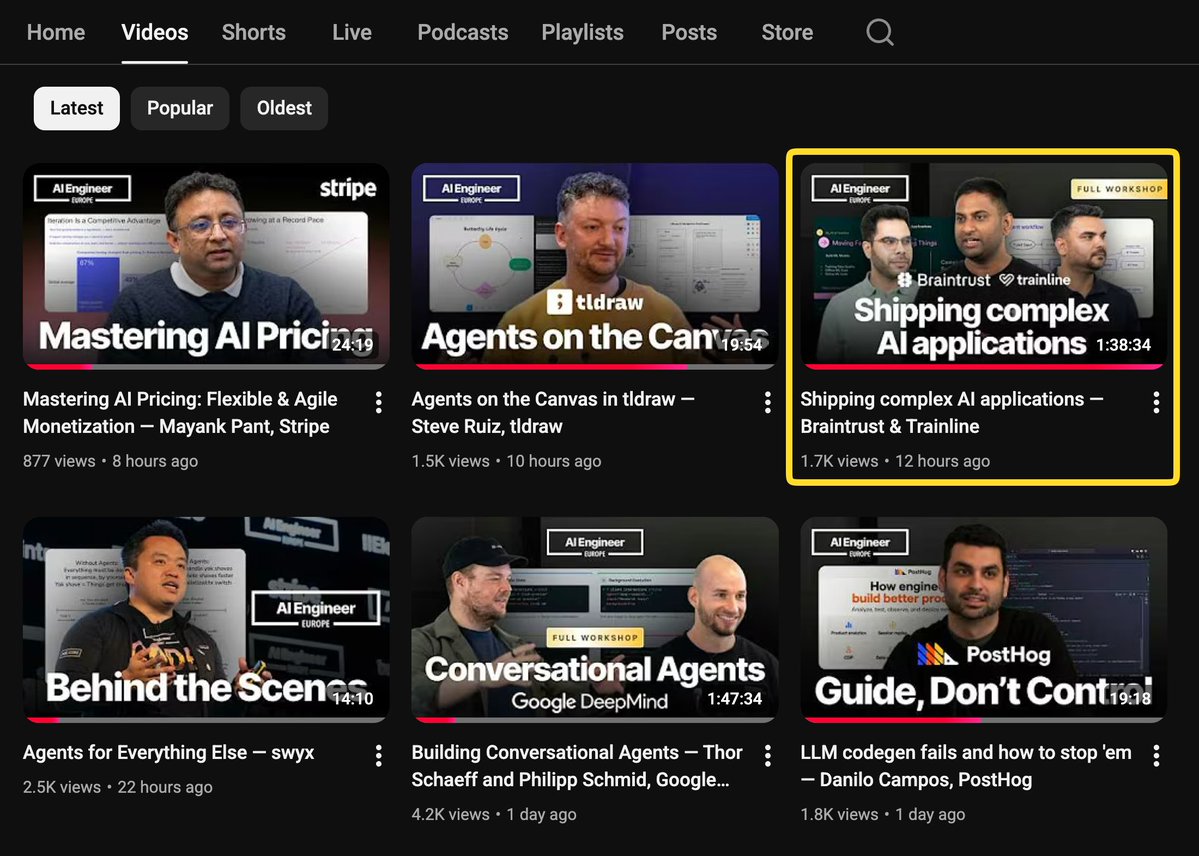
People are really enjoying our full workshops showing end to end walkthroughs of real production workflows!
This is a rare double header with @braintrust's Giran Moodley and @OussamaHaff walking though the real life AI engineering behind @thetrainline, Europe's #1 most downloaded rail app with 27m MAU and £5.3B in ticket sales!
the workshop bundles several important lessons:
- break down monolithic LLM calls into specialized stages (e.g., triage, policy review, and reply generation)
- how to monitor latency, token usage, and costs effectively with end-to-end tracing of agentic flows
- using "golden sets" (a curated set of test inputs) to identify failure modes
- how to move from local development to a managed environment where prompts and scoring functions are version-controlled
- how to allow non-technical team members to collaborate and update model parameters without code changes
- how to identify production regressions, replay failures, and apply targeted fixes to improve system reliability continuously
enjoy!
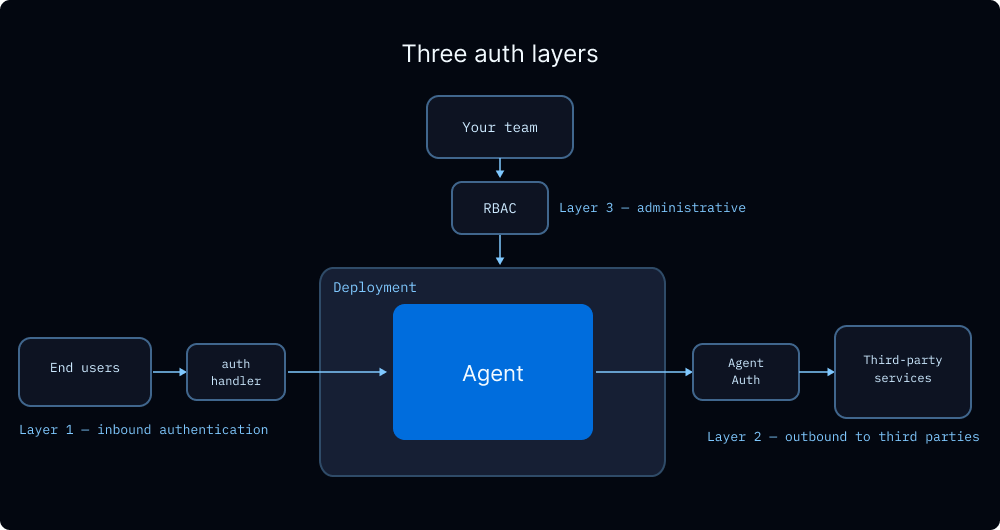
serving multiple users from a single agent deployment introduces three distinct problems. luckily, langsmith's agent server has a solution for each!
1. data isolation: your @auth.authenticate handler tags every resource with ownership on write, filters on read.
2. delegated credentials: agent auth handles the oauth flow so the agent can act as the user across runs.
3. operator access: rbac controls who on your team can deploy, trace, or change auth policies.
https://t.co/ZIopuurIOk
How we prompt AI is very different in 2026 than 2022 when ChatGPT came out.
I'm teaching a new course, AI Prompting for Everyone, to help you become an AI power user — whatever your current skill level.
It covers skills that apply across ChatGPT, Gemini, Claude, and other AI tools. How to use deep research mode for well-researched reports on complex questions. How to give AI the right context, including more documents and images than most people realize you can provide. When to ask AI to think hard for several minutes on important decisions like what car to buy, what to study, or what job to take. And how to use AI to generate images, analyze data, and build simple games and websites.
I also cover intuitions about how these models work under the hood, so you know when to trust an answer and when not to.
Along the way, you'll see flying squirrels, a creativity test, some of my old family photos, and fireworks.
Join me at https://t.co/tcQc4iJAJG
🚀DeepAgents deploy is a simple, configuration driven way to get an agent harness deployed to the cloud
deepagents.toml is the file that configures it. It has four sections:
- agent
- sandbox
- auth
-frontend
Here's what each one does 🧵