Vaizle AI is not powered by one clever prompt.
It runs on an agent engine I built from the ground up.
That engine is called VIA.
On the surface, Vaizle AI feels simple.
Ask it to analyze marketing data, prepare a performance report or update an attached Excel workbook—and it gets to work.
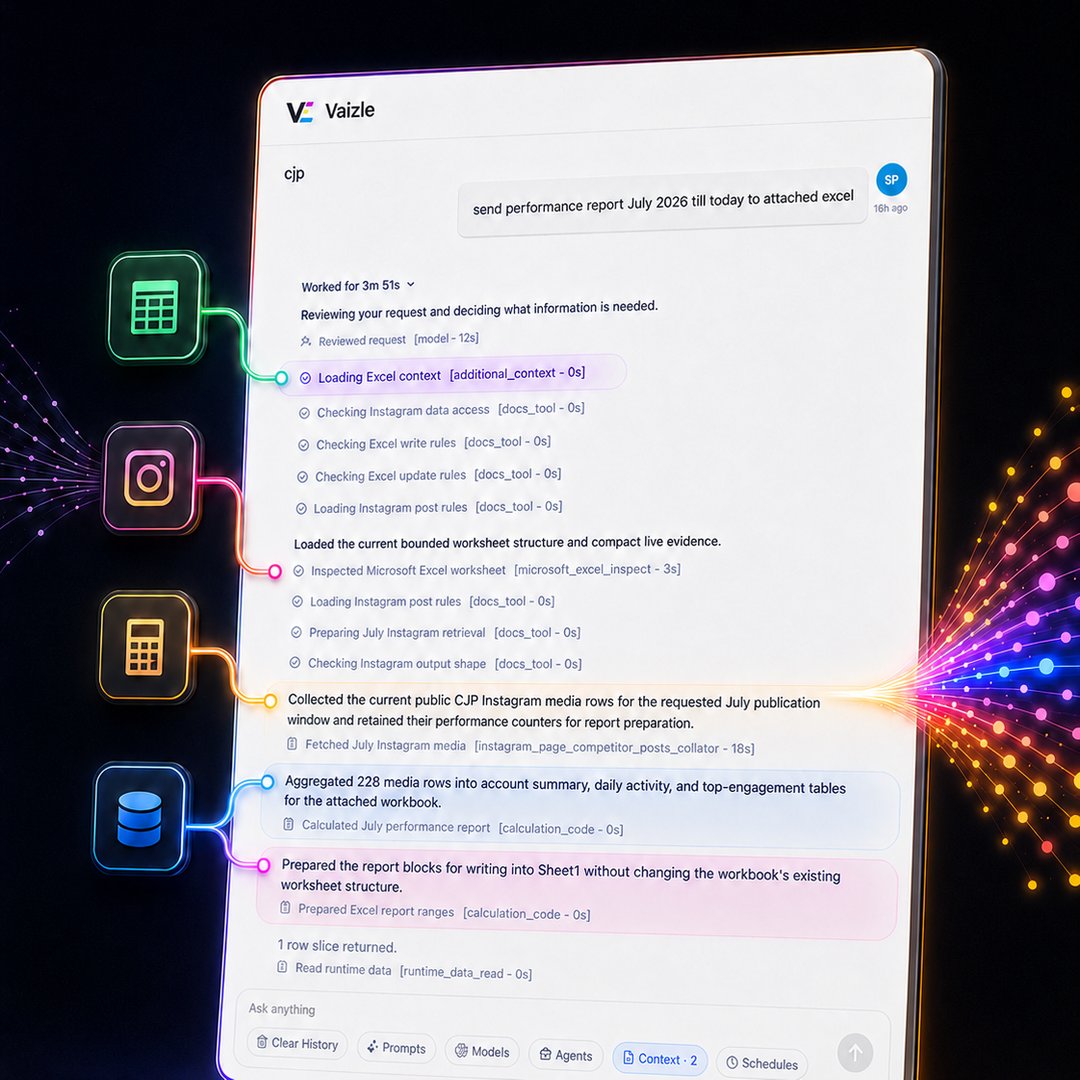
The first image is the product experience.
The second shows the engineering underneath it during development.
It is an execution graph of agents, tools, data, decisions and runtime state working together to complete one task reliably.
Game studios face a similar engineering decision.
They can use an existing game engine or build their own when they need deeper control and differentiation.
The player experiences the game.
The studio builds the engine handling physics, state, execution, tooling and debugging.
VIA plays that role for intelligent agents.
It is a code-first engine that enables agents to choose tools, retrieve and collate large datasets, branch based on what they discover, run work in parallel and preserve state.
It can request human approval before sensitive actions, schedule future work, store generated artifacts and stream progress back to the product.
The visual execution history shown in the second image is available during development.
It allows our engineers to inspect tool calls and state transitions, diagnose failures and replay executions.
In production, VIA runs without the visual debugger or verbose execution capture in the request path.
Only the minimal telemetry required for reliability and security is retained—keeping execution lean and fast.
So why build an engine with this much capability?
Because serious digital marketing work cannot be reduced to one prompt.
The system must find the correct data, understand business context, choose meaningful comparisons, perform calculations, verify the result and deliver it in the required format.
The model provides intelligence.
VIA gives that intelligence a controlled environment in which it can see, reason, act and verify.
I initially built VIA for the digital marketing harness behind Vaizle AI, but the engine itself is domain-agnostic.
It can power intelligent agents for research, operations, finance, customer support and other complex workflows.
Digital marketing is its first major proving ground—not its ceiling.
We did not want to build another chatbot around a model API.
We wanted the engineering foundation required to turn model intelligence into dependable work.
Most users will never need to see VIA.
They will experience it through deeper analysis, reliable execution and work that actually gets completed.
The complexity belongs inside the engine.
The simplicity belongs in the product.
This is Vaizle engineering at its best.
@TheGeorgePu I used to love spending weekends figuring out how frameworks worked under the hood.
Now I talk through architecture decisions with AI, and I struggle to find that same urge to dig deeper.
I miss learning just because I was curious. Anyone else feeling this?
“AI will always need humans.”
Why are we so sure?
Evolution made us. Maybe it’s now making AI and robots through us.
We like to think we’re the centre of the universe. But we could just be another step, building what eventually replaces us.
Finally, after a long wait, OpenAI has a direct answer to Anthropic’s Fable-class models.
Fable 5.1 is built for long-running reasoning. GPT-6 Astra leans into computer use and working across tools.
Now I want to see which finishes a real workflow with fewer interventions.
@DominickNoval@aravind Exactly. Disclosure after trust is built is already too late. The identity layer should be platform-enforced from the first interaction, not a voluntary label an agent can omit.
@shivae372 Exactly. Self-hosting doesn't remove the cost. It moves it from the invoice to engineering time and on-call stress. Builders may accept that for control. Most users just want the task completed.
Will ChatGPT’s Cloud Browser kill OpenClaw?
For most people, it might.
Most users don’t want to self-host an agent, manage browser sessions or keep another machine running.
They just want to give it a task and come back when it’s done.
OpenClaw will still appeal to builders who want full control.
Cloud Browser could take everyone else.
The biggest change agents bring to analytics isn’t a chat box.
Dashboards wait for someone to know what to check.
Agents should notice what changed, decide whether it matters, and bring the evidence before anyone asks.
That is the direction we are building toward at Vaizle.
@HarryStebbings 100x more software also means 100x more decisions to maintain.
Generating a feature is becoming cheap. Deciding whether it belongs, what it can break and when to remove it is not.
Linear’s opportunity may be managing that decision history, not just the agents’ issue queue.
@frankyecom Once everyone can pull the same winning patterns, access stops being the edge.
The advantage moves to the context around them: what this brand has already tested, what failed and what the next creative should learn.
Think of a ChatGPT or Claude session where the LLM actually knows all your numbers. From all your ad platforms, social media channels, Shopify Store, GA4.
Now, imagine it knows your website too. Your branding, tonality, offers etc. It knows your competitors too. ⬇️