A young statistician saved their lives.
His insight (and how it can change yours):
During World War II, the U.S. wanted to add reinforcement armor to specific areas of its planes.
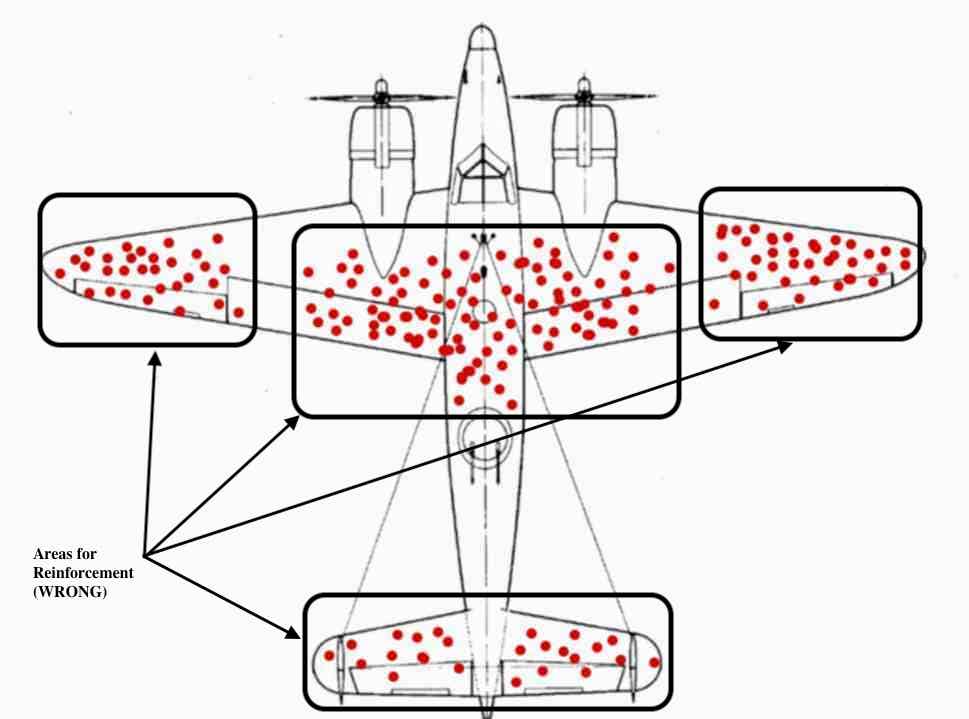
Analysts examined returning bombers and plotted the bullet holes and damage on them (as in the image below).
Based on this analysis, they came to the conclusion that adding armor to the tail, body, and wings would improve their odds of survival.
But a young statistician named Abraham Wald noted that this would be a tragic mistake.
By only plotting data on the planes that returned, they were systematically omitting the data on a critical, informative subset:
The planes that were damaged and unable to return.
Abraham Wald recognized a key fact:
• "Seen" planes had sustained damage that was survivable.
• "Unseen" planes had sustained damage that was not survivable.
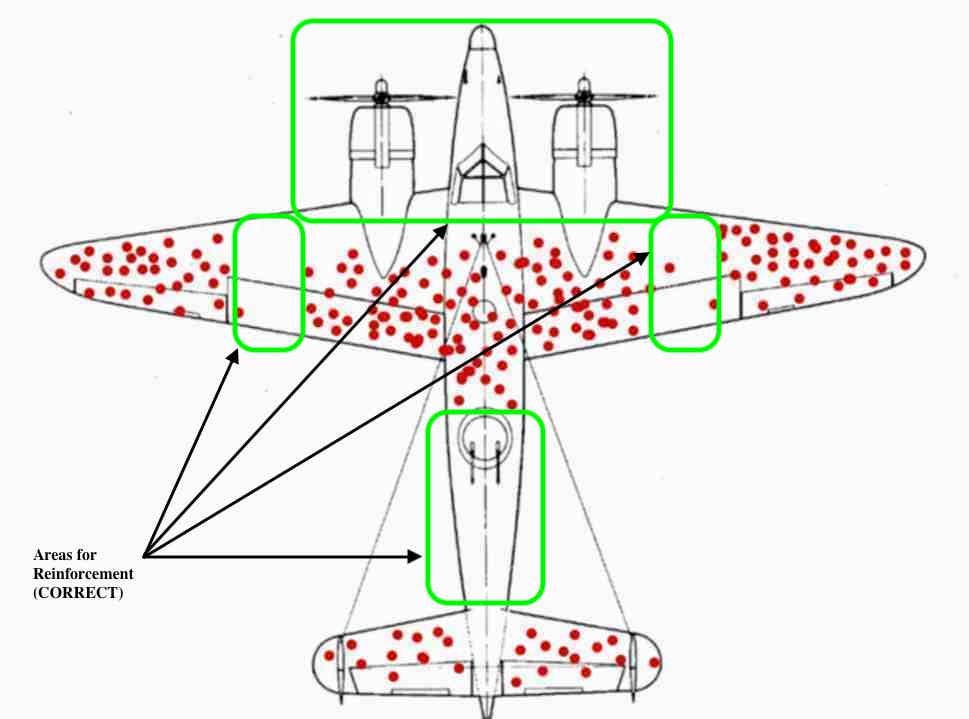
Wald concluded that armor should be added to the *unharmed* regions of the returning planes (the areas without bullet holes on the image below).
His profound logic:
Where the survivors were unharmed was actually where the planes were most vulnerable.
Based on his insight, the military reinforced the engine and other vulnerable parts, significantly improving the safety of the crews during combat and saving thousands of lives.
Abraham Wald had identified a cognitive bias called "Survivorship Bias":
The error resulting from systematically focusing on survivors (successes) and ignoring casualties (failures) that causes us to miss the true base rates of survival (the actual probability of success) and arrive at flawed conclusions.
We see examples of Survivorship Bias all around us:
1. We read books on the common traits of successful people, but fail to consider all of the unsuccessful people who possessed those same traits.
2. We applaud the belief when we hear that an entrepreneur took out a second mortgage and succeeded, but fail to consider all of the entrepreneurs who did the same and went bankrupt.
3. We study the cultural strategies of the most successful companies, but fail to consider all of the companies that followed those same strategies and fell apart.
When we fail to consider the range of outcomes and the hidden evidence, we develop a skewed (and often incorrect) view of reality.
It cannot be avoided altogether, because the vast majority of books and history are written by and about the survivors and victors, but wherever possible, consider the unseen evidence.
Remember: What is unseen often has just as much value as what is seen.
***
If you enjoyed this or learned something, follow me @SahilBloom for more in future!
Best daughter of the year ❤️🧡
Pls follow: @ApstFortune
Go Dammy Extraction 2 Hadi Sirika Dwayne Johnson Chomzy what is 12k Hilda Baci Qudus Dami Abati Emefiele Moriah #earthquake chicken republic Opay Ajaokuta Yorubas Ruth Igbos Chef Dammy Mr. Peter Obi Seun Mercy Johnson
In the photograph captured during the March against Fear in 1966, civil rights activist James Meredith endured a heinous act of violence. He was shot in the head, back, and neck by an unidentified sniper who ambushed him while leading the march aimed at raising awareness about racism. Let us delve into Meredith's inspiring story:
Before the incident, James Meredith had already established himself as a notable figure. As a veteran air force pilot, he made history by becoming the first black man to be admitted to the University of Mississippi in 1962. Initially accepted, his admission was later revoked upon the discovery of his race. However, the U.S. Court intervened and ruled that the university had unlawfully discriminated against Meredith, thereby granting him access to the institution. On his first day at the university, Meredith was accompanied by law enforcement officers due to the high threat level posed by racist individuals in the area.
In 1966, Meredith orchestrated a march known as the "March Against Fear," in which he initially stood as the sole participant. Spanning an impressive distance of 220 miles, the march aimed to shed light on racism and encourage African Americans to exercise their right to vote for politicians supporting their civil rights in the upcoming elections.
On June 6, 1966, the second day of the march, as Meredith crossed the Mississippi border, he fell victim to an ambush orchestrated by a white man named Aubrey Novell. From a concealed position in a wooded area, Novell fired three shots at Meredith, inflicting severe injuries. It is important to note that despite police and FBI surveillance, this brutal attack managed to occur.
Fortunately, James Meredith survived the ambush. On June 26, civil rights leader Martin Luther King Jr. and other activists, along with thousands of participants, took charge of the march and successfully completed it. Meredith, determined and resilient, managed to rejoin the marchers shortly before its conclusion. Throughout the march, the group faced various forms of hostility, including attacks, harassment, and threats from both civilians and law enforcement personnel.
In the aftermath of the attack, Aubrey Novell was found guilty of assault; however, the punishment he received was lenient, with a mere two-year prison sentence. This outcome sparked further discussions and debates about the need for more stringent measures against racially motivated violence.
Remarkably, James Meredith is still alive today, at the age of 89, carrying with him the memories of his courageous actions and unwavering commitment to the fight for equality and justice.