I started as a mechanical engineering student at @Uni_Mumbai, doing CAD and graphics design, learning the basics.
@Vertiv gave me my first shot, four years learning how the physical world actually gets built. Then I bet on myself: moved across the world for a masters in industrial engineering at @TAMU.
@Tesla taught me that impossible timelines are just timelines. @amazon taught me what scale truly demands.
Each chapter taught me one job, deeply.
Then @maticrobots@mehul@navneetdalal@anshuman_builds did something no one else had: trusted me with all of them at once.
NPI is where I live. Taking a design that exists only in engineering conversations, and building every process needed to make it real: supplier readiness, change management, production planning, quality systems. When there is no playbook, you write one. I have written many here.
And inventory. Thousands of parts across multiple warehouses, every unit accounted for, without a traditional ERP. We built our own systems from scratch. Knowing exactly what you have and where it is sounds simple. At scale, it is everything.
Jack of all trades, master of none, but oftentimes better than a master of one. In hardware, units do not die inside departments. They die in the gaps between them. Own the whole chain and there are no gaps.
Today Cues is out in the world, and I have watched these robots roll off the line thinking: this one is mine. From a classroom in Mumbai to this. Grateful does not begin to cover it. #PhysicalAI
It took us 9 years, 11 prototypes, and our life savings to learn that every great product has the same design process.
Matic is now decisively the best home robot for families (I'm biased)
A 500-word thread and video on the Universal Design Process behind every great product:
This is where the Matic happens
I took @firstround on a tour of our HQ
> Matic-themed movie posters
> Furniture from Facebook Marketplace
> A brand-new production line
Trust isn't built by promises. It's built by consistent actions.
📚 Children's Books × Business | Lesson 10 of 10
My final lesson from Awkward by Svetlana Chmakova @svetlania is about trust.
Throughout the story, relationships improve not simply because people say the right things, but because they begin showing up differently for one another.
That reminded me of Zappos.
Zappos became famous for turning its promise of exceptional customer service into actual operating decisions including free shipping both ways, a generous return policy, and investing heavily in employees who could genuinely help customers.
My takeaway: Trust isn't built by what a company promises. It's built by what people consistently experience.
📖 Business case: Harvard Business Review — How I Did It: Zappos's CEO on Going to Extremes for Customers
https://t.co/LzXyUFQhxm
#Leadership #CustomerExperience
Critique ideas, not people. Candor makes creative work stronger.
📚 Children's Books × Business | Lesson 9 of 10
While reading Awkward by Svetlana Chmakova, I noticed how much the story revolves around creative work, different perspectives, and learning to work with people who don't see things exactly the same way.
It reminded me of Pixar.
At Pixar, unfinished work is shared with colleagues for candid feedback. People learn from each other, while the creator still retains ownership of the final decisions.
My takeaway: Critique ideas, not people. Candor makes creative work stronger.
📖 Business case: Harvard Business Review — How Pixar Fosters Collective Creativity
https://t.co/udSprtnHld
#Pixar #Leadership
Most of the industry started with humanoid hands. We started with eyes, the way nature builds a child. 500M sqft and 400K miles inside real homes later, phase two begins: manipulation. The evolution is the revolution @maticrobots
After 9 years. 16K+ family homes. 500M sqft inside real homes covered, we know home robots are being built in wrong order.
So we built Matic the way nature grows a child.
Finally, sharing our vision:
1. Why robots get stuck at the demo
2. Why labs can't ship robots
3. Why we started with eyes, not hands
4. The 99.999% rule in robotics
5. Where Matic is going next
1. Why most robots get stuck at demos
Robot demos look brilliant in a room arranged around its limitations: familiar lighting, predictable furniture, nothing troublesome on the floor.
A family’s home makes no such accommodations. There are cables, toys, shifting rugs and, occasionally, dog poop. Yes, humanoids will need to avoid that too.
Repeating a task under familiar conditions of uncluttered floors is not the same as handling an unfamiliar home with all its chaos.
2. Why labs can't ship robots
SLAM (Simultaneous Localization and Mapping) is how a robot maps its surroundings and locates itself within them. Ask most academics and they'll tell you it's a solved problem.
But real homes are the most chaotic spaces that exist.
There are glass doors that look like open doorways, mirrors, stairs, rugs, charging cables, and Legos placed all around.
So ask yourself: if indoor mapping and navigation is "solved," where are the robots? Why aren't airports, hotels and grocery stores full of them?
Calling it “solved” misses the question families actually care about: can I leave this thing alone and trust it?
3. Why we started with eyes, not hands
Nature doesn't give birth to a fully working human. We took our cue from how nature develops humans: capabilities built on one another.
Children learn to see before they learn to grab, and to grab before they learn to plan and handle the unexpected.
Perception comes first. Manipulation follows. More complex responsibilities come after that. At every stage, the robot must earn the next job by doing its current one well enough.
Before asking a robot to pick up a sock, we wanted it to understand where it was, where the sock was, and how to reach it.
Most of the industry started at the top, with humanoids. We started at the bottom, with a robot whose job is to see and move through a home precisely with 1cm accuracy in any lighting condition.
Floor cleaning gave that foundation an immediately useful job. It forced us to confront navigation, clutter, privacy and everyday reliability before reaching for more complex chores.
The floor cleaner isn’t a detour from our larger ambition. It is how we’re building toward it.
4. The 99.999% rule in robotics
At 90%, one in ten decisions is wrong, and a robot makes thousands in a single clean. That's the robot that bumps, gets lost, and falls down the stairs.
Every extra nine is a new mountain. The failures get rarer, harder to find, and exponentially harder to fix. They barely even happen until they happen in your home.
Matic's visual SLAM runs at 99.999% in 16K+ homes. We’re the ONLY unsupervised home robot at scale with pure vision-only full autonomy. If you ask us, the gap between 80% and 99.999% is where our 9 years of engineering went.
We close that gap inside real homes. When Matic handles something imperfectly, it saves a short clip and keeps it on the device. It only leaves if the family chooses to share it. If they do, it gets labeled, fed back into the model, and every Matic gets smarter, including theirs.
Families control what leaves their homes. We do the work of making the product better.
Better robots earn trust > trust brings more homes > and more homes teach the robot more.
5. Where Matic is going next
Phase one was perception and it's nearly done. Matic has covered 500 million square feet, 400K miles in thousands of real lived-in homes.
Now phase two is going to be about manipulation. And our idea is to build a robot that doesn't just move through your home, but acts in it to eliminate even more chores.
Each step must be useful today, not justified by something we promise tomorrow. The evolution of Matic is the revolution.
The goal isn’t to put the most impressive humanoid in your living room.
It’s giving your family time and energy back through robots that earn your trust, protect your privacy, and help without becoming another responsibility.
More time for each other. Less work getting in the way.
That’s Matic.
Get yours today at https://t.co/tEo81BKSmA
@mehul The 99.999% section is my daily life. The gap between 80% and 99.999% is not glamorous work, it is thousands of small fixes found in real homes. Nine years went exactly there and you can feel it on the production floor!!
An apology matters. But what you do after the apology matters even more.
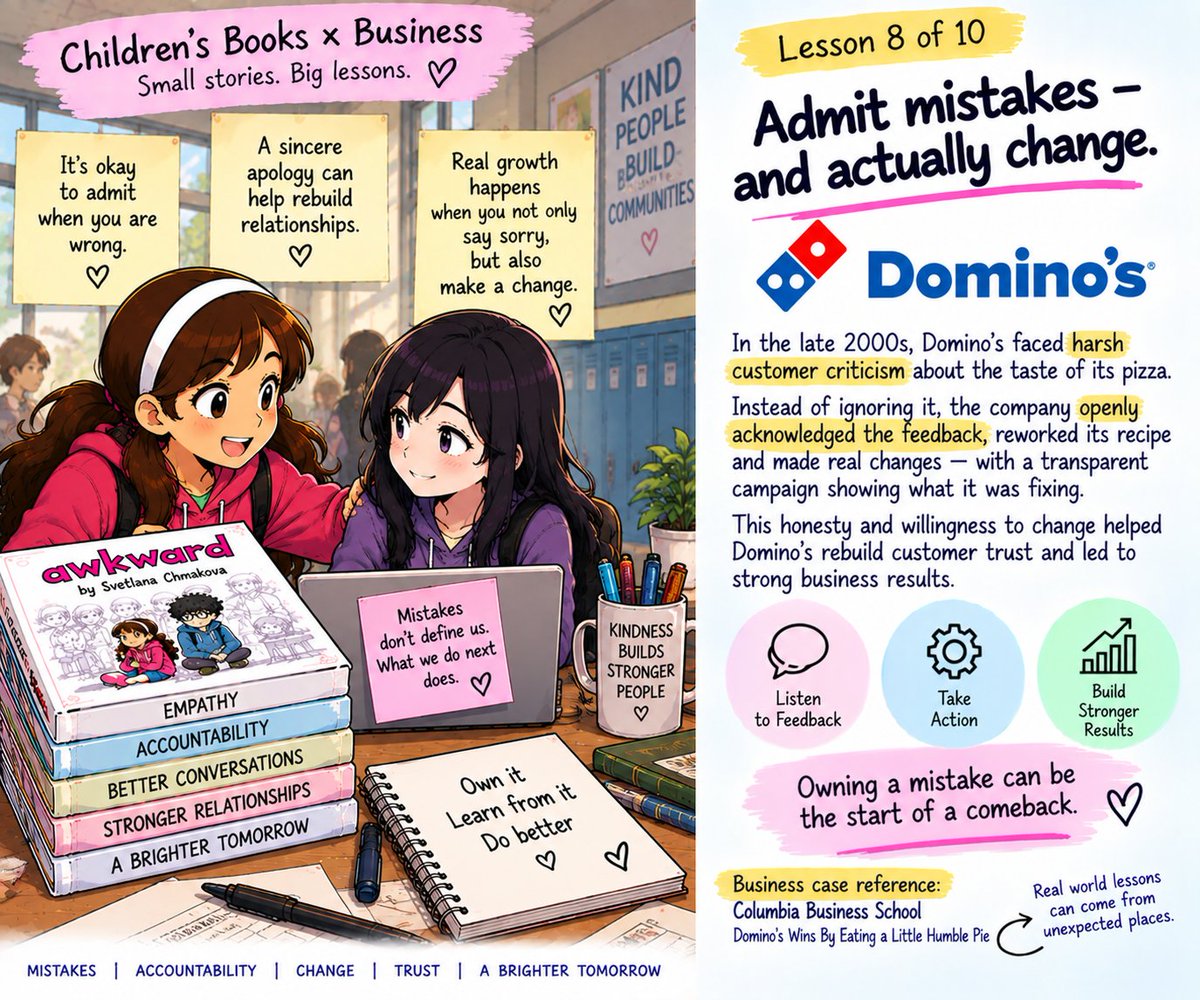
📚 Children's Books × Business | Lesson 8 of 10
While reading Awkward by Svetlana Chmakova, Peppi's struggle to apologize to Jaime stood out to me.
She knows she made a mistake. But the real growth comes when she finally owns it and makes amends.
It reminded me of Domino's Pizza Turnaround.
Domino's publicly acknowledged harsh criticism of its pizza, rebuilt its core recipe, and made that change the centerpiece of its campaign. The result? Columbia Business School reported a 14.3% increase in U.S. same store sales in Q1 2010 versus Q1 2009.
My takeaway: Owning a mistake can be the start of a comeback.
📖 Business case: Columbia Business School — Domino's Wins By Eating a Little Humble Pie
https://t.co/cxsYh1d0Ob
#Leadership #Dominos
Been blown away by @maticrobots
Same playbook as Tesla: cameras only, no lidar.
Best vacuum/mop combo I’ve used.
6 months risk-free: https://t.co/PTjgMg2rq4
Innovate, but don't lose your core.
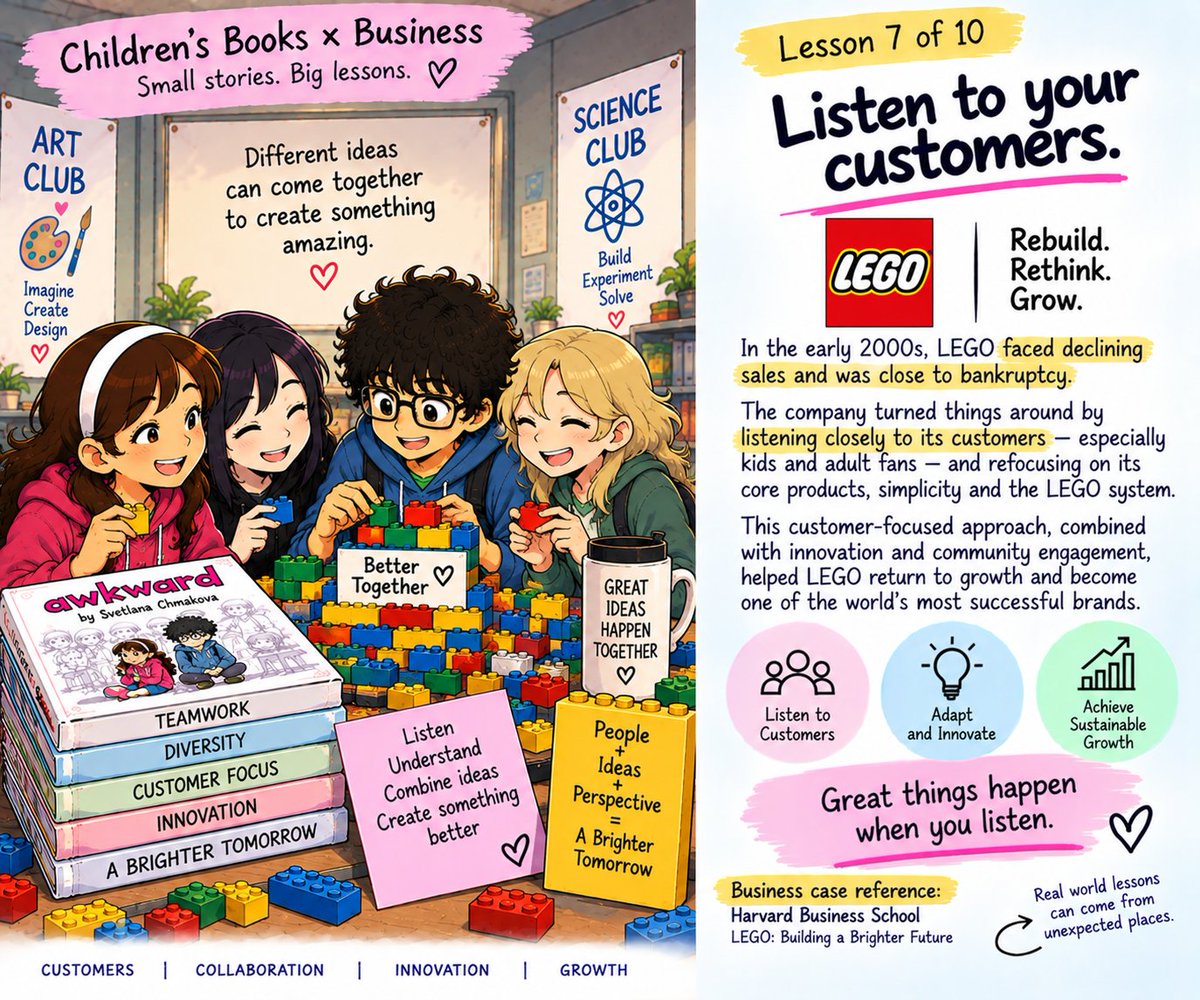
📚 Children's Books × Business | Lesson 7 of 10
Reading Awkward by Svetlana Chmakova made me think about something interesting: the Art Club and Science Club don't become stronger by giving up what makes each of them different.
Their different strengths become useful when they work together toward something bigger.
That reminded me of LEGO's turnaround. LEGO had expanded innovation in many directions, but some efforts failed. Its comeback required bringing innovation back into alignment with strategy.
My takeaway: Innovate, but don't lose your core. Growth works better when you know what should change and what shouldn't.
📖 Business case: Harvard Business Review — Innovating a Turnaround at LEGO
https://t.co/zTYCjDgmIf
#Innovation #LEGO
Past success can become a blind spot. Stay willing to question the assumptions that got you here.
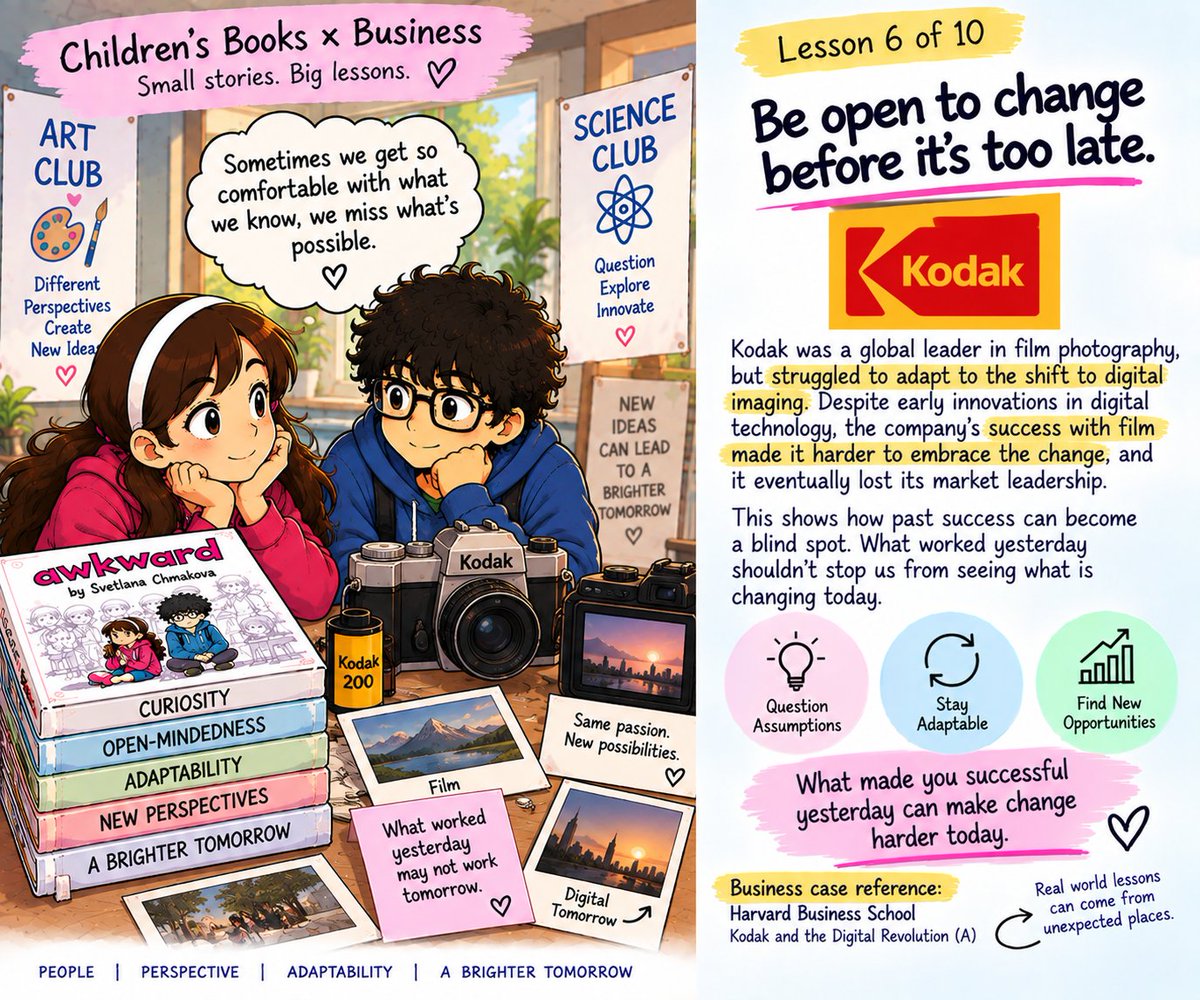
📚 Children's Books × Business | Lesson 6 of 10
While reading Awkward by Svetlana Chmakova, I noticed how strongly the Art and Science Clubs define themselves by what they already believe they are — even seeing each other as opposites.
Only when those assumptions begin to change do new possibilities appear.
It reminded me of Kodak. Digital imaging disrupted the business model that had made Kodak enormously successful, creating a difficult challenge: adapting to a technology that threatened the company's existing model.
My takeaway: Past success can become a blind spot. What worked yesterday shouldn't stop us from seeing what is changing today.
📖 Business case: Harvard Business School — Kodak and the Digital Revolution
https://t.co/Irc1dy33o8
#Strategy #Innovation
People respond to the systems we create around them.
📚 Children's Books × Business | Lesson 5 of 10
While reading the book Awkward by Svetlana Chmakova, I noticed how competition for limited opportunities can intensify rivalry between groups.
It reminded me of a much more serious real-world example: Wells Fargo's sales-practices Enforcement Case.
Aggressive sales goals and compensation incentives created pressure that contributed to employees opening unauthorized customer accounts.
My takeaway: Incentives shape behavior. Be very careful what you choose to reward.
📖 Business case: CFPB — Wells Fargo Sales Practices Enforcement Case
https://t.co/7wdE74p6px
#Leadership #BusinessEthics
People do their best work when they can be themselves. And teams make their best decisions when those same people feel safe to disagree.
📚 Children's Books × Business | Lesson 4 of 10
While reading the book Awkward by Svetlana Chmakova, I noticed another lesson: it's easier to be yourself when you find your people.
It reminded me of Netflix, where a culture of freedom and responsibility trusts people to be themselves and speak openly. That trust runs both ways: Netflix "farms for dissent," and every employee was invited to comment on its latest Culture Memo, generating 1,500+ comments.
My takeaway: People do their best work when they can be themselves. Teams decide best when those same people can also disagree.
📖 Business case: Harvard Business School — Netflix: A Creative Approach to Culture and Agility
https://t.co/hPQZspljLl
#Netflix #Leadership
“A robot demo is easy.
Shoot it 50,000 times and it only has to work once.
But until it’s 99.999% reliable, it’s not ready for homes.”
— Founding hardware engineer @anshuman_builds
https://t.co/3hGAAdjG2v
@WillyB_303 Yes! The word literally comes from those paper lanterns. Wild that a centuries old lamp became the symbol of stopping a modern production line. Appreciate you adding the "light" here!!
Finding a problem early is a win.
📚 Children's Books × Business | Lesson 3 of 10
While reading the book Awkward by Svetlana Chmakova, I noticed how small misunderstandings can grow when uncomfortable conversations are avoided.
It reminded me of Toyota's famous production philosophy: when something looks wrong, make the problem visible instead of letting it travel further.
Toyota's Jidoka/Andon system allows problems to be signaled immediately so they can be addressed at the source.
My takeaway: Finding a problem early is a win. Problems hidden today often become bigger problems tomorrow.
📖 Business case: Harvard Business School — Toyota Motor Manufacturing, U.S.A., Inc.
https://t.co/CezYzjHVhA
#Toyota #Leadership