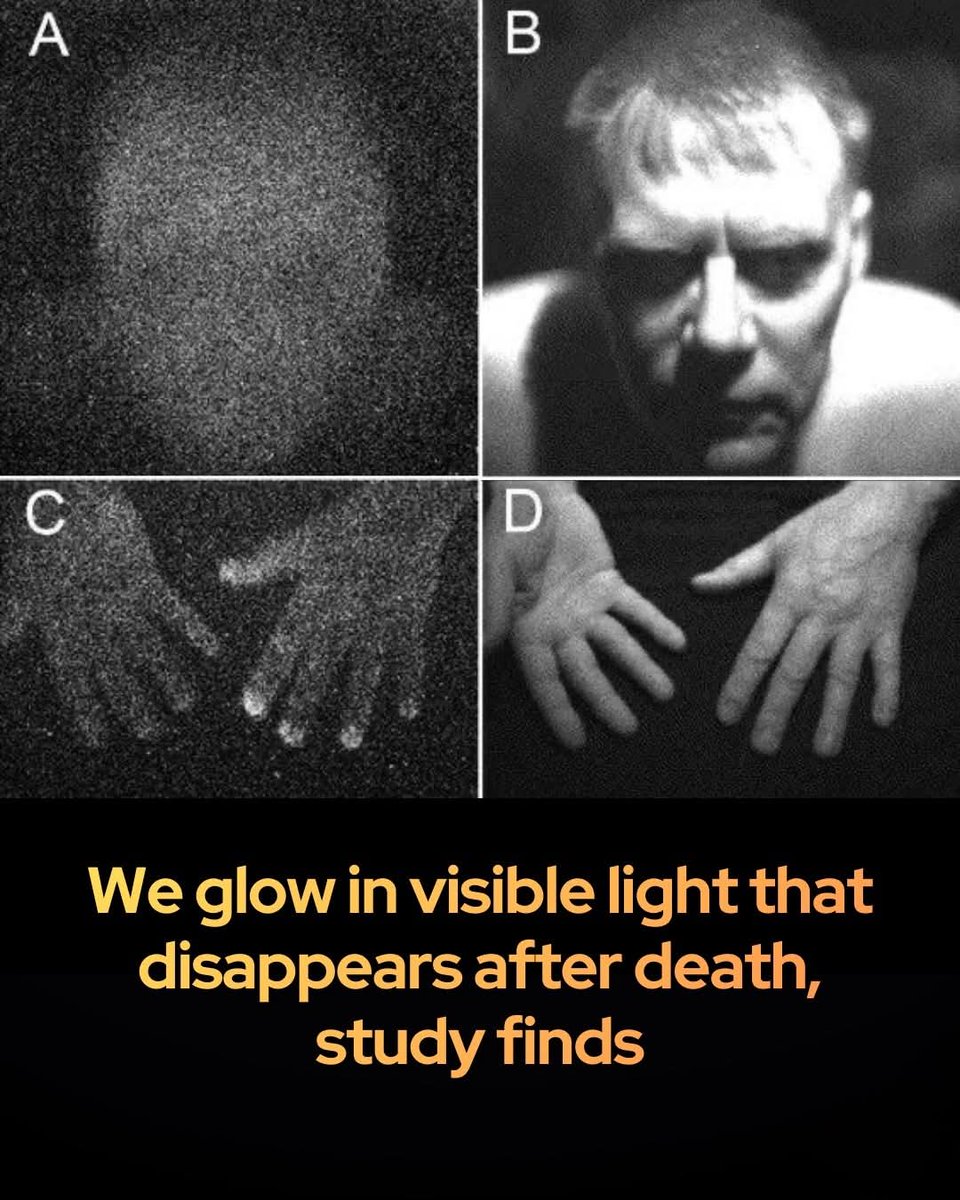
🚨 Scientists have confirmed that all living things glow with a faint light…until they die.
Your body is glowing right now, though not in a way the human eye can see. Using ultra-sensitive imaging technology, researchers from the University of Calgary and Canada’s National Research Council have successfully captured "ultraweak photon emission"—a faint, visible light produced by living organisms. By observing mice in total darkness, the team discovered that living tissue radiates significantly more photons than dead tissue, proving that this glow is a direct byproduct of biological life. Unlike body heat, which is infrared radiation, these emissions are in the visible spectrum and originate from the chemical reactions occurring within our cells.
This biological light is fueled by reactive oxygen species created during normal metabolism. When these molecules interact with proteins and lipids, they release tiny bursts of energy in the form of light. The study found that this glow intensifies under physical stress; injured plants, for instance, emitted much brighter signals. This discovery offers a revolutionary path for future medical diagnostics. Since the intensity of the light reflects the level of oxidative stress and metabolic activity, scientists believe these invisible signals could eventually serve as non-invasive markers for monitoring organ vitality, disease progression, and overall health.
source: University of Calgary & National Research Council of Canada. (2025). Imaging Ultraweak Photon Emission from Living and Dead Mice and from Plants under Stress. The Journal of Physical Chemistry Letters.
AI anther.
The "smartphone signal disrupting migratory birds' compasses" problem refers to the phenomenon where artificial electromagnetic waves (electromagnetic noise) created by humans interfere with the "quantum compass" in the eyes of migratory birds, causing them to lose their sense of direction and get lost.
New research reveals that listening to music can slash dementia risk by 40%.
A landmark Monash University-led study involving more than 10,800 participants has discovered a powerful connection between music and cognitive preservation in seniors. Researchers found that consistently listening to music after age 70 is associated with a staggering 39 percent reduction in dementia risk. For those who play an instrument, the risk is lowered by 35 percent, indicating that both active and passive musical engagement can serve as a potent shield against brain decline.
Lead researchers Emma Jaffa and Professor Joanne Ryan emphasize that these findings offer a vital, accessible strategy for maintaining brain health in an aging global population. Beyond reducing dementia risk, regular musical engagement was linked to sharper episodic memory and improved overall cognition. As medicine continues to extend human lifespans, integrating music into daily life represents a simple yet transformative lifestyle choice that may delay the onset of neurodegenerative conditions where cures remain elusive.
source: Jaffa, E., & Ryan, J. (2025). What is the association between music-related leisure activities and dementia risk? A cohort study. International Journal of Geriatric Psychiatry.
It is wonderful to meet Prime Minister Sanae Takaichi in Delhi. Japan is an important partner of India and we are confident that our ties will get even stronger in the times to come. Our talks today covered the full range of the India-Japan Special Strategic and Global Partnership. The key issues discussed include technology, innovation, AI, defence and security, pharmaceuticals and more. As far as economic linkages are concerned, our goal is clear…in the next ten years, 10 trillion Yen of Japanese investment into India and doubling the number of Japanese companies in India!
@takaichi_sanae