Blockchain infra notes: parallel execution, zkVMs, runtimes, engineering judgment.
Start here — why most parallel execution designs fail:
https://t.co/bYmPOZa8nB
Notebook: https://t.co/27bdHPJL0d
Not a trading account.
By 2036, you might use blockchain every day without knowing it.
Your AI buys services. Your business settles across borders. Your assets move between providers.
What would make that future worth choosing?
https://t.co/5MlSRXIBGA
AI assistants need context to help us. That context also lets providers assess us.
Anthropic’s threat report raises a question: we guard against AI misuse, but who guards against misuse by the providers?
https://t.co/8m50XilsT0
We're publishing our most detailed threat intelligence report to date.
It covers how people tried to misuse Claude—for cyberattacks, influence operations, surveillance, biology, and building weapons—and how we found and stopped them.
We disrupted every operation in the report, and used the lessons from them to strengthen our safeguards. Where appropriate, we also shared what we found with authorities and other AI companies.
These cases are not typical: we’re highlighting some of the most sophisticated misuse we’ve seen. But they’re especially important to discuss, because they show us where AI misuse is headed, where our safeguards work, and where they need to improve.
We’re publishing this report so others can spot the same activity on their own platforms, and so we can give the public a clearer view of how emerging threats develop.
Read the report: https://t.co/0EJUnYEgfz
So when someone flashes a 100K TPS number, I mostly want to know one thing: what does that number look like when the chain is actually busy.
Wrote this up properly here:
https://t.co/bYmPOZa8nB
Everyone shipping an L1 seems to need “parallel execution” on the slide now.
Fine. But most of the designs I’ve looked at still fall over once you put real DeFi contention on them — not in the whitepaper, in the access patterns.
People keep buying more cores like that’s the scarce resource.
In practice the critical path is contested state. If everything hot hits the same accounts, extra cores mostly wait.
Goodbye, Poseidon!
An epic 8-year, 8-figure rabbit hole in post-quantum cryptography reaches its dream conclusion. The Ethereum Foundation is abandoning Poseidon for L1, pivoting to SHA or BLAKE. This milestone unlocks ultimate security for lean Ethereum and foreshadows a golden era of hash-based cryptography.
Since 2018, the Ethereum Foundation has invested in magic cryptographic bricks, so-called "SNARK-friendly hashes". In 2019, Poseidon was born. It held strong and became the dominant SNARK-friendly hash, securing billions via zkrollups and zkVMs.
In a stunning reversal, breakthrough SNARK designs show that SNARK-friendly hashes aren't necessary after all. Off-the-shelf traditional hash functions like SHA2 and BLAKE2s can now match Poseidon in a SNARK. In hindsight the key was not SNARK-friendly hashes, but hash-friendly SNARKs.
The secret is doing maths over the smallest prime number: 2. So-called "binary fields" natively speak the language of bits, aligning with the boolean operations inside traditional hashes. This is a stark departure from "prime fields", where awkward large-prime arithmetic makes bit manipulation painfully expensive.
We're talking sci-fi cryptography. 1M traditional hash calls proven per second, on a laptop. Just 100x overhead vs native CPU boolean compute. Nobody predicted such performance, not even the handful of binary-field visionaries. Hat tip to the research geniuses: Jim and Ben with Binius in 2023; Ron, Benedikt and William with Flock in June.
With SHA2, the lean aesthetic of minimal assumptions reaches its climax. The EF's principled stance on pure hash-based cryptography has aged like fine wine. We now enjoy foundations the world can trust for decades and centuries, foundations worthy of the dream of an internet of value.
Speed of deployment is a secondary win. There's no longer a need to wait years for Poseidon cryptanalysis to bake. Emile and Thomas from the EF post-quantum team are moving at breakneck speed with binary fields. The strawmap now points to a production-grade leanVM in 2027, with CL, DL, EL deployments in 2028.
As AI becomes exceptional at cryptanalysis, the contrarian bet to avoid riskier structures like lattices and isogenies is visibly paying off. The past weeks have been brutal. Lattice-based "HAWK" and isogeny-based "SQIsign", both signature schemes in NIST's Round 3, have suffered blows. Sources I trust say more blood is coming.
On AI, the open autoresearch trend kicked off by ECDSA[.]fail is spreading fast, with amazing outcomes from zk[.]golf and SNARK[.]fast. Days ago SNARK[.]fast crossed 1.8M BLAKE3/sec proven on an M3 Max. Stay tuned for fresh autoresearch challenges dropping tomorrow.
Also tomorrow: Ethproofs call #10, dedicated to binary fields. Possibly the most noteworthy Ethproofs call yet. Experts leading the charge will present the future of hash-based SNARKs at 2pm UTC. What an incredible time to be alive. To witness history, DM me for a calendar invite :)
Today I can confidently claim that hash-based cryptography has won out for blockchain post-quantum signatures. SNARK succinctness compresses arbitrarily many signatures into one small proof per block. SNARK flexibility yields k-of-n threshold signatures, complex multisigs, and more.
Ultimate security. Uncompromising performance. Full programmability.
Believe in something. Believe in hashes.
Power changes a system. Responsibility closes the feedback loop.
When authority is separated from consequences, organizations repeat choices they never fully learn from.
Engineering Power and Responsibility:
https://t.co/PQVhdHQd31
Backward compatibility keeps more than old clients alive.
It keeps their assumptions alive too.
The cost appears when a new rule meets a state the old system was allowed to create.
@JensenHuang Reasoning is only one component of autonomy.
The harder question is how uncertainty crosses into the control loop: what gets deferred, what gets overridden, and what can be reconstructed after the fact.
A Coldcard build silently skipped its hardware RNG.
The setting existed。Its value was wrong。
The firmware built.
The wallet worked.
The seeds only looked random.
A system can preserve every healthy signal while losing its most important property.
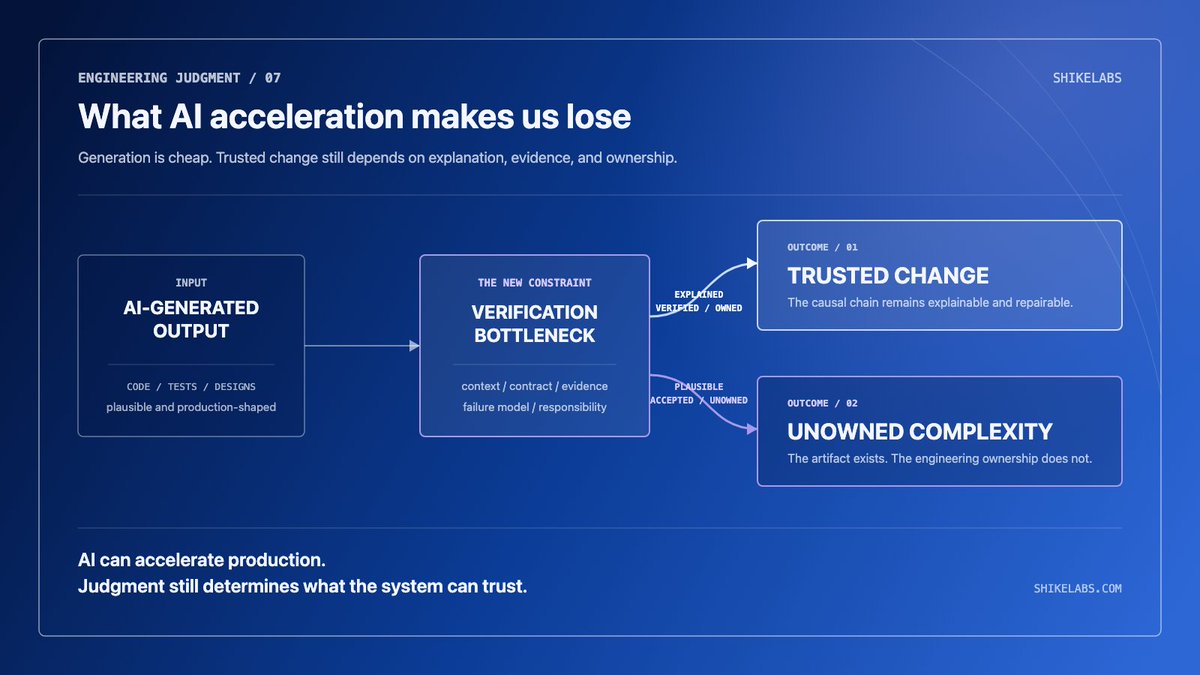
AI can generate code and tests faster than teams can understand, verify, and own them.
When accepted output outruns causal ownership, the gap becomes unowned complexity.
What AI Acceleration Makes Us Lose:
https://t.co/dwhzf5Xjk8
A price feed can be correct and still be unfit for liquidation.
The question is not whether a trade happened.
It is whether that trade can bear the weight of every position priced from it.
Lido’s move toward larger validators is not a free efficiency gain.
Fewer validator messages make the network lighter.
Response time during an operator failure matters more.
Scaling rarely removes cost. It relocates it.
https://t.co/U13Ee5uNaM
A dependency stops being technical when changing it requires three teams to agree.
At that point it is part of the organization’s runtime:
slower, stateful, and harder to observe than the code that created it.