I bought a @HyundaiIndia Exter less than a year ago.
It’s been a nightmare — the car has broken down 10+ times, same issue every time.
Each “repair” by Ramaa Hyundai fails within days or hours.Weeks in workshops. No real fix.
A manufacturing defect Hyundai refuses to own up to.
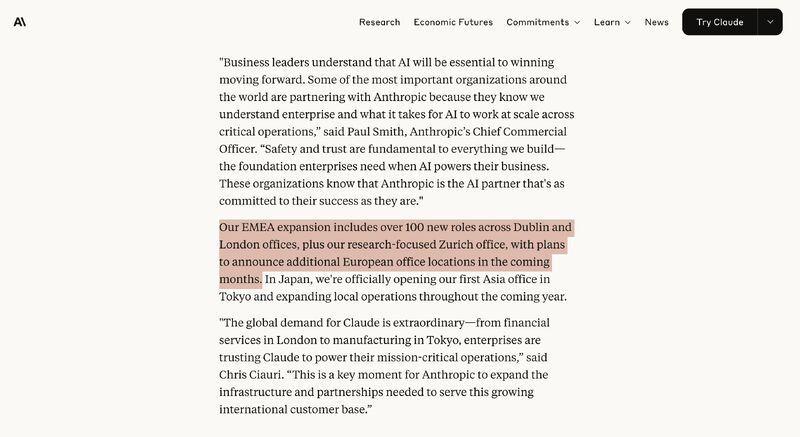
Great News: Anthropic plans to triple it's international workforce. What does this mean for PMs
𝗛𝗶𝗿𝗶𝗻𝗴 𝗣𝗹𝗮𝗻𝘀:
Anthropic plans for 100+ roles across Dublin, London, and Zurich offices
𝗚𝗿𝗼𝘄𝘁𝗵:
• Revenue grew from $1B to $5B just this year
• New initatives (Claude Code) added $500Mn
• Serving over 300,000 customers globally
• Seeing unprecedented global demand from enterprises
𝗪𝗵𝗮𝘁 𝗱𝗼𝗲𝘀 𝘁𝗵𝗶𝘀 𝗺𝗲𝗮𝗻 𝗳𝗼𝗿 𝗣𝗠𝘀
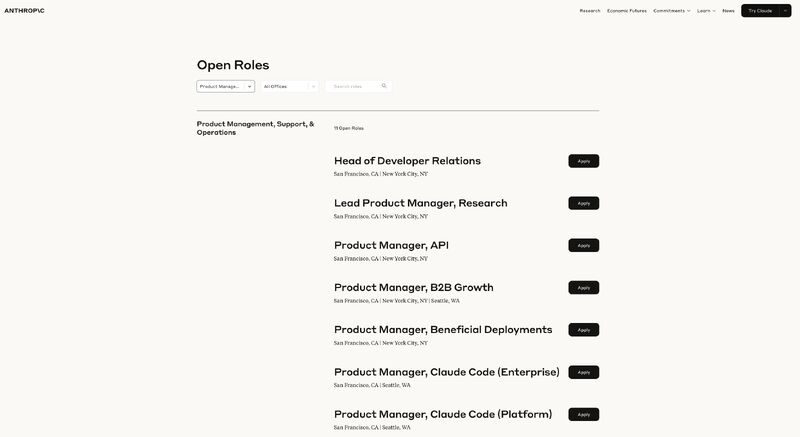
Anthropic alone has 10+ PM openings. With their international hiring plans, this number will go up.
Product management is here to stay,
Product management will not be the same, but it will not die (at least in the near future.)
If you want to be a PM in this world, you need to adapt. You need to change how you think, how you strategise, and how you execute.
In the new world, product management is not going to be about features or solutions or capabilities. It is all about data: what data can you use, what can you predict using the data, how accurate will your predictions be, what do you do if your predictions are wrong.
These are the questions PMs will be required to answer.
If you're not answering these questions already or if you don't know how to answer them. You might already be behind.
I am an AI Product Leader. I write a weekly newsletter showing you what it 𝗿𝗲𝗮𝗹𝗹𝘆 means to do AI product management. Sign up so you don't get left behind. Link in comments.
Ever felt like a fraud at work?
Like everyone else has it figured out except you?
Let me tell you something: that’s not imposter syndrome—it’s just a lack of confidence.
The good news? You can fix it.
Here’s how I overcame it as a product manager:
✅ Step 0: Acknowledgement
Acknowledge that imposter syndrome is just a lack of confidence, not a real flaw.
✅ Step 1: Identify what’s holding you back
Is it lack of knowledge, preparation, or unrealistic expectations.
✅ Step 2: Learn how you can gain confidence
read online, take a course, shadow a teammate, or even just ask questions. Remember, as a PM, your superpower is curiosity—not expertise.
✅ Step 3: Do whatever it takes
Learn, practice, ask (or beg) for help. But do whatever it takes to gain the required confidence.
✅ Step 4: Don't aim to have all the answers
There will be things you can't influence or change or know. Let go of them. Focus on asking the right questions. Not knowing all the answers.
Product Management is overhyped.
That is what I told myself after doing (and failing at) it for the first 2 years.
Turns out, I had no idea what a PM really did.
After 10 years of experience and working closely with world-class PMs, I have a much better definition of the role.
But, sadly, even today, 60-70% of aspiring and new PMs are in the same boat—confused and clueless about "what does a PM do"
Here’s the simplest way to think of a PM's role:
(before you continue to read, don't forget to bookmark for easy reference later)
A PM is responsible for (everything it takes to) finding answers to these questions.
1. Where do we want to go
2. How will we get there
3. What problems should we solve to get there
4. Are all important people on the same page
5. What solutions to build? How to deliver on time?
6. How do we know we're making progress
Let's understand in detail:
1. Where Do We Want to Go
A PM must create a clear vision so the entire team knows the destination.
Build a deep understanding of the market, customer needs, and company’s goals. Regularly communicate the vision to ensure everyone knows it, agrees with it, and remembers it.
Every successful product starts with a clear and ambitious vision
2. How Will We Get There
A PM needs to create a strategy to reach the vision.
In the strategy, a PM should define what to focus on, what to avoid, target users, market trends, and strengths/weaknesses. Then, collaborate with teams to refine this strategy and adjust based on feedback and market changes.
A well-defined strategy is crucial to success.
What Problems Should We Solve to Get There
Prioritizing the right problems is the only way to create value for the users.
Understand user's real needs and pains, and then prioritize the critical ones that align with the vision.
Do this continuously, not just once a year.
Are All Important People On The Same Page
Ensure everyone is aligned to make true progress.
Communicate proactively and transparently. Involve relevant people in decisions, and iterate based on feedback. Regularly check if they're still aligned.
Non-aligned teams move in different directions, slowing down progress
What Solutions To Build? How To Deliver On Time?
Identify and develop the right solutions, deliver them on time.
Brainstorm the best solutions and build those with the highest impact on the user. Deliver on time to maximise impact.
Users will use (and love) your product only if it solves their problems.
How Do We Know We're Making Progress
It is not progress, if it can't be measured.
Create clear metrics and success criteria. Review progress regularly to measure success / failure. When off track, adjust your roadmap or your goals or both. With every success / failure, ensure you learn and get better.
Measuring success keeps everyone focused and accountable.
--
If you’re thinking, “This is exactly what I need to master,” I’ve got something special for you.
On October 15th, I’m launching a course that goes even deeper into these essential PM strategies.
Until then, I’ll be sending you more details about what’s included in the course. And when the course goes live, you’ll be the first to know!
Want in? Join the waitlist now and be the first to get all the details: https://t.co/Rs5e9YbHOf
P.S. We’ve poured hundreds of hours into this course—late nights, countless upgrades, and a lot of passion—and we can’t wait to share it with you.
3 Mistakes that are slowing down your Product Management career!
Here are easy ways to fix them:
Mistake #1: Not having a concrete goal
Most PM's don't have a clear picture of where they want to be professionally in the next 1/5/8 years.
If you don't know where you're going, you will not reach there.
Mistake #2: Not having a plan to meet the goal
Even if you know where you want to go, you need to have a solid plan of how to get there.
AND... you need to keep updating the plan as you go along. Things change very quickly, and if you don't respond as quickly, your plan will not help.
Mistake #3: Using the wrong metrics to measure progress towards goal
Once you're on the path to success, it is important to know how to measure progress. If your methods of measurement are wrong, you will not know if you should speed, slow down, or change directions.
One way to tackle all 3 mistakes is to think of our careers like we do for our products:
- Have a concrete plan
- Have a solid roadmap
- Prioritise relentlessly
- Ensure the right people support you
- Have success metrics to guide you
This is the topic of our next Masterclass:
The Fast-Track PM Success Formula: Accelerate Your PM Career in 2024
Details
When: 1st Sep 330PM IST | 11AM London time
Where: Google Meet
Entry: FREE for first 100 | $15 after that
Sign up: in comments
Agenda:
1. Biggest mistakes PMs make
2. Tricks avoid these mistakes
3. Most imp skills to build a career as a PM
P.S. Free slots fill up in less than 30 minutes
@JustAnotherPM I think it is because of two reasons:
1. Sports is not thought of as a career option. So it's pursued as a hobby and dropped for a 'job' or 'business'
2. Good sports equipment is not affordable by everyone. Without good training and equipment, you can only get so far.
5 questions that will help you make high-quality decisions (and create a real difference):
The more decisions I make (at work and in life) the more I think of ways to improve the quality of my decisions.
Here are 5 questions that I think make my thinking better.
1. Think Big:
How can I achieve my 10-year plan in the next 6 months? (Peter Thiel)
2. Simplify Everything
How can I teach this concept to a child? (Feynman's technique)
3. Identify The Real Problems
"Why?" Ask it five times to uncover the real root cause (The Five Why's Technique)
4. Work Backward From The Customers POV
What would a mock press release announcing the finished product from the customer's perspective say? (Amazon's Working Backwards Method)
5. Simplifying The Problem
How can I break down the problem into fundamental truths, facts, or principles that apply to the situation and build my reasoning from there? (First Principles Thinking)
In the coming 10 days, I will dive deep into 10 crucial documents every product manager should master.
I will talk about what each document includes, why it is important, and what you should do to master it.
Here's what's coming up:
1. OKRs and KPIs
2. Product Roadmap
3. Product Proposal / One Pager
4. Product Requirements Document (PRD)
5. User Stories
6. Project Pages
7. Progress Updates
8. Release Notes
9. Internal training / Go-to-Market Plan
10. Results and Measurement of Goals
From OKRs and KPIs to release notes and training materials, we'll cover it all!
These aren't just any documents—they form the backbone of what product managers do every day, quarter, and year.
They inform the product strategy, keep you on track, and keep pushing you in the right direction.
Let's embark on this learning journey together! 💼💡
All you need to do:
- follow me @justanotherpm
- stay tuned
- like and share so more people can learn
In tomorrow's post, we talk about OKRs and KPIs
This is day 4 -- Documents that Product Managers should master
Product Requirements Document (PRD)
What is a PRD
A PRD is a document that includes all details about a specific feature, solution, or product. It acts as the central point of information for engineers to understand the solution, and translate it into code.
Why are PRDs important
1. Common understanding - PRDs lay the foundation of common understanding. It ensures that the engineer's understanding of "what" to build is the same as that of the PM's.
2. Agreement - PRDs also act as a contract or agreement between PMs and engineers on the specifics of the solution that will be built. It is also an agreement on the quality benchmark below which the solution will not be launched. Finally, it is also an agreement on the success criteria of the solution after launch.
3. Scope - PRDs are the central point of knowledge that defines what is in scope for a specific feature. Great PRDs also define what is OUT OF scope for that feature.
4. Clarity - PRDs provide a high level of depth into the idea, ensuring high clarity and low ambiguity.
5. Reference - PRDs act as reference points for PMs, engineers, and other stakeholders who want to know why, what, when a feature / solution was developed and launched.
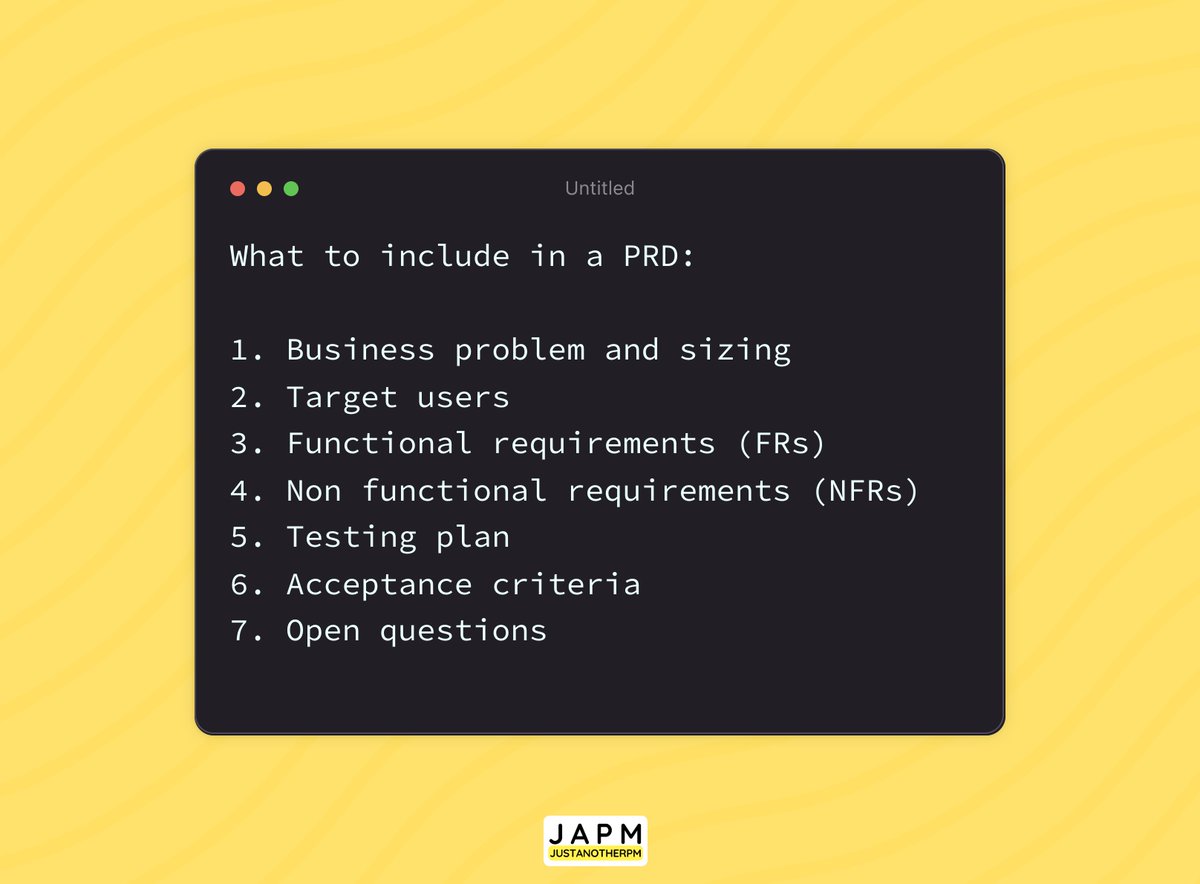
What to include in PRDs
A great PRD includes all the information that is relevant to its audience. And that ensure all of the above aspects are met. Hence it makes sense to create the format that works best for PMs, Engineers, and Designers
With that said, here are a few things that I always include:
1. Problem statement and sizing: The problem that we're solving via this solution. What is the impact of solving this problem. I usually copy paste this from my POP document (more details on POP linked below)
2. Target users: in this section mention all the users that you could be targeting, and then explain why you have chosen the persona that you have. Help others understand "what" your choice is and "why" is it your choice
3. Functional Requirements (FRs): this is the most critical and lengthy section of the PRD, which covers 70-80% of the document. It contains a very high degree of detail about every aspect of the of the product. A good way to think of this is to lay out the the entire user entire journey, and detail each step of the journey.
Be as detailed as possible. (Extra details do no harm, but less will almost always cause damage.)
4. Non Functional Requirements (NFR): NFRs are requirements that are not necessarily visible or usable for the end user, whereas FRs are visible and usable by the user. Common NFRs include performance, security, etc. Ex: "Netflix must ensure that it is available 99.99% of the time, allowing users to access content seamlessly without interruptions."
5. Testing Plan: is a list of tests that have to be passed before the solution can be launched.
6. Acceptance Criteria
Think of this as a checklist, in which every check is critical to be met before the product can be made available to users.
7. Open questions
Even if you create detailed PRDs, there will always be some open questions. Document these questions in a separate section. It is important for readers to know that you have considered these questions, even if you don't have answers at the time of writing.
Things to remember
1. One document can NOT capture everything. Leave notes, open questions, so everyone knows what still needs to be answered.
2. While thinking of FRs, don't forget to also capture unhappy flows. Example: "When users are unable to login, show them forgot password screen"
Mistakes to avoid
1. Don't treat PRDs as a static document
PRD is not a one and done document. It is an evolving document. Based on your discussions, feedback, questions, you should update it to keep it relevant and impactful.
2. Make sure there is no ambiguity
Be very sure to reduce / remove ambiguity. Anything you leave for interpretation, will always be interpreted incorrectly.
--
That is it for today. Stay tuned for Day 5, where we talk about user stories.
If you haven't already, please follow me @JustAnotherPM. I share meaningful content on product management.
Product managers and leaders -- do you have a process for learning and / or consuming new information?
Not only for work, but even for things that you like to learn as a person.
Popular opinion:
Product managers, you can build world-class products if you understand your customers well.
Unpopular opinion:
Collecting customer feedback is NOT the challenge
Consolidating, organizing, and analyzing it is.
To overcome this challenge:
😎 Good PMs build processes
⭐ Great PMs use tools and AI
As a Great PM myself, I use @CycleProduct to consolidate customer feedback from multiple sources into a single platform.
Cycle does many things, but the thing I love the most:
It's AI. And it's ability to automatically extract the most important insights
Cycle's AI has made analysing customer feedback seamless and much more impactful.
It helps me:
- analyse feedback holistically
- uncover “real” feedback; filter out the noise
- save large amounts of effort, time, and errors
That's not all. The tool is extremely useful and a delight to use.
1. Quick and seamless:
To collect data from multiple sources (Google Sheets, Notion, Slack, Hubspot, Salesforce, Zapier, etc.)
2. AI fine-tuning:
Helps bring the business context and make the insights more meaningful and actionable
3. Customer Voice dashboard:
Automatically analyses feedback and surfaces the most pressing questions
4. Integrates with Linear
Allowing me to keep product discovery and product delivery in sync
If you’re like most Great PMs and strongly believe in the power of “customer feedback” you will love @CycleProduct
This should help product managers (hopefully)
TLDR:
1. If you've got promotions, show it on your resume / linkedin. Not doing so might signal stagnation
2. Always do thorough research about the company and the specific role.
3. Perceived lack of preparation is a “massive red flag.”
4. Rehearsed answers do not work. Quality > quantity. He says -- “They say a lot of words but nothing meaningful”
5. Authenticity and meaningful engagement mean a lot
6. Interviewee contributing to interviewer's learning is a strong positive signal
7. A growth mindset and a humble approach—make you shine
8. Continuous learners are appreciated
My take: it feels like most people know most of these things already. But most don't focus on them and take it for granted. Instead, most PMs while preparing focus only on the specific question types and not so much on these softer and human aspects.
@JustAnotherPM This is really cool. There have been so many times where I need to wait weeks for design capacity to open up, in order to test a new feature
Do you use these as is for user testing? Can I use my existing app designs and add new features to it?
Are you a product manager who validates product ideas before building them?
Great product managers focus on building MEANINGFUL prototypes to validate ideas
They ensure they invest only in the highest-ROI ideas
The problem?
Prototyping needs design skill and a lot of time