Why AI Can Now Make Discoveries - my conversation with @danintheory, Lead of the Foundations of Reinforcement Learning team at @OpenAI
00:00 Intro: AI's wild week in mathematics
01:21 What OpenAI's Foundations of RL team does
03:08 Dan's journey: from black holes and quantum gravity to frontier AI
07:04 Are AI systems becoming useful for real science
08:21 The AI math moment: Erdős, OpenAI, DeepMind, and Anthropic
08:52 Why the OpenAI result was an act of exploration
10:25 OpenAI vs. DeepMind: informal reasoning vs. formal proof
12:13 RL 101: learning by doing, not just watching
15:10 Why reinforcement learning works
15:58 How RL breaks: sparse feedback and long-horizon tasks
17:03 RLHF: how human feedback shaped early language models
18:48 Move 37, self-play, and the search for novel strategies
22:16 Explore vs. exploit in scientific discovery
24:49 Why RL may now be "the cake," not the cherry on top
25:46 Why RL started working with large language models
27:29 Is RL "sucking supervision through a straw"?
28:47 Why language may be the grounding layer for intelligence
31:46 A contrarian take on the Bitter Lesson
32:41 What test-time compute actually is
34:50 How RL gives models the ability to think
35:40 Verifiable rewards, math, coding, and the messy real world
38:00 What physics can teach us about AI
42:08 Is there a thermodynamics of AI?
43:08 From Erdős problems to Einstein-level AI
45:16 Is AI already doing original science?
45:51 How far are we from AI automating AI research
47:41 Why Dan is excited about the future of science
Introducing our first set of Llama 4 models!
We’ve been hard at work doing a complete re-design of the Llama series. I’m so excited to share it with the world today and mark another major milestone for the Llama herd as we release the *first* open source models in the Llama 4 collection 🦙. Here are some highlights:
📌 The Llama series have been re-designed to use state of the art mixture-of-experts (MoE) architecture and natively trained with multimodality. We’re dropping Llama 4 Scout & Llama 4 Maverick, and previewing Llama 4 Behemoth.
📌 Llama 4 Scout is highest performing small model with 17B activated parameters with 16 experts. It’s crazy fast, natively multimodal, and very smart. It achieves an industry leading 10M+ token context window and can also run on a single GPU!
📌 Llama 4 Maverick is the best multimodal model in its class, beating GPT-4o and Gemini 2.0 Flash across a broad range of widely reported benchmarks, while achieving comparable results to the new DeepSeek v3 on reasoning and coding – at less than half the active parameters. It offers a best-in-class performance to cost ratio with an experimental chat version scoring ELO of 1417 on LMArena. It can also run on a single host!
📌 Previewing Llama 4 Behemoth, our most powerful model yet and among the world’s smartest LLMs. Llama 4 Behemoth outperforms GPT4.5, Claude Sonnet 3.7, and Gemini 2.0 Pro on several STEM benchmarks. Llama 4 Behemoth is still training, and we’re excited to share more details about it even while it’s still in flight.
A big thanks to all of our launch partners (full list in blog) for helping us bring Llama 4 to developers everywhere including @huggingface, @togethercompute, @SnowflakeDB, @ollama, @databricks and many others👏 This is just the start, we have more models coming and the team is really cooking – look out for Llama 4 Reasoning 😉
A few weeks ago, we celebrated Llama being downloaded over 1 billion times. Llama 4 demonstrates our long-term commitment to open source AI, the entire open source AI community, and our unwavering belief that open systems will produce the best small, mid-size and soon frontier models. Llama would be nothing without the global open source AI community & we are so ready to begin this next chapter with you. 🦙
Read more about the release here: https://t.co/7mbK3uggjO, and try it in our products today.
Congrats to @em_dinan, @ShoYaida, and @suchenzang on their new work https://t.co/ZT61Hg7Awl, applying the effective theory blueprint of PDLT to the transformer architecture!
From theory to practice, here's our latest attempt to bring the two sides closer together: https://t.co/xN8zKiNX2L
This was also one of the most delightful collabs I've had the chance to be a part of. Thanks @ShoYaida & @em_dinan for being such wonderful humans to work with! 😍
What is deep learning theory? Join @PhysicsToday at 1 p.m. EDT on Thursday, March 30th for the free webinar "The Principles of Deep Learning Theory" presented by @DanInTheory and @ShoYaida. Register here: https://t.co/5nMPt4hU8H
Registration is now open for our 2023 Summer Workshop! Featuring plenary talks, posters, and networking, the #Workshop will bring together researchers across #AI and #physics disciplines. August 14–18, 2023 at @Northeastern. https://t.co/Jb1stzm3gM @AIVOInfo
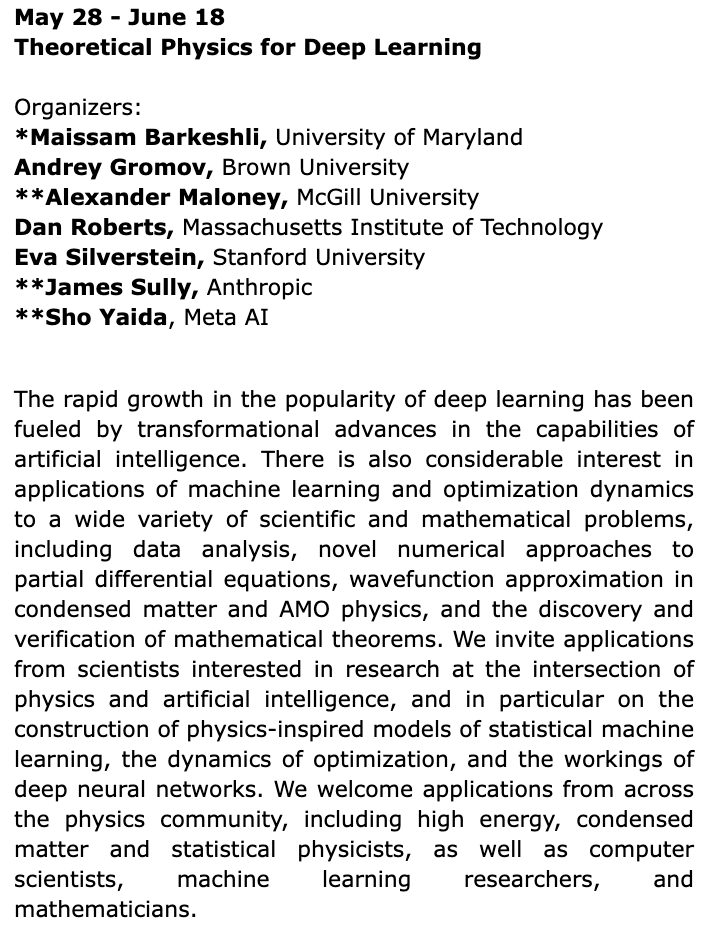
If you like both physics and AI -- and in particular if you are interested in using physics tools to study AI -- please apply to the "Theoretical Physics for Deep Learning" workshop at the Aspen Center for Physics this summer (May 28 to June 18):
https://t.co/t0tbr6I0Ui
New work on the origin of @OpenAI's neural scaling laws w/ Alex Maloney and @jamiesully2: we solve a simplified model of scaling laws to gain insight into how scaling behavior arises and to probe its behavior in regimes where scaling laws break down.
https://t.co/uzAztBKJ4p
1/
New exciting work from @ShoYaida! Using the effective theory framework of PDLT, he finds a 1-parameter family of interesting hyperparameter scaling strategies that interpolate between the NTK and maximal-update parameterizations.
https://t.co/sKqMr63BBg
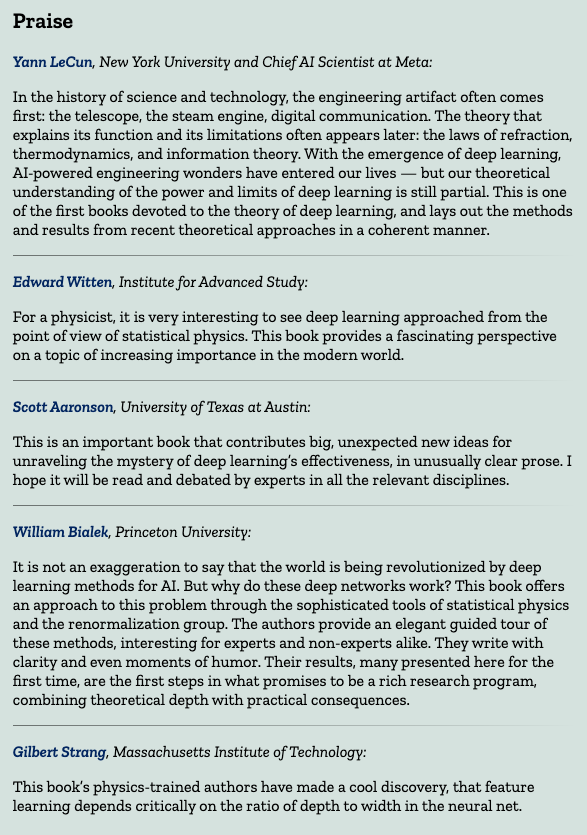
Check out this really nice post on PDLT by Jennifer Lin from FHI on LessWrong. In the post, she includes a summary of key results and then focuses on potential implications for AGI forecasting and safety in terms of interpretability.
https://t.co/ju2xKCpx75
1/2
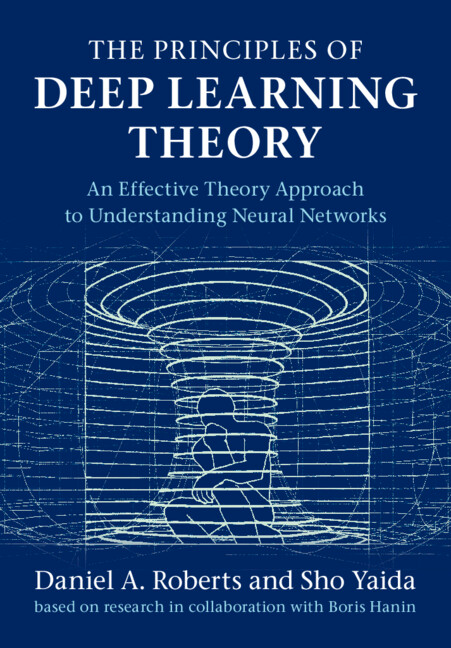
The Principles of Deep Learning Theory, by @ShoYaida, @BorisHanin, and myself, is available in print today from @CambridgeUP! You can find links to purchase (as well as a link to a free arxiv draft) here: https://t.co/SJMjqHPihz
1/4
Read about new developments in deep learning with authors and researchers Daniel A. Roberts (@danintheory), Sho Yaida (@Shoyaida) and Boris Hanin (@BorisHanin) in their book The Principles of Deep Learning Theory: An Effective Theory Approach to Understanding Neural Networks. 👇
The Principles of Deep Learning Theory by @danintheory@ShoYaida@BorisHanin
This volume develops an effective theory approach to understanding deep neural networks of practical relevance
#StatPhys#NetworkSci
https://t.co/6mYhBzdyUR
Special AI☕ break edition about exciting developments in mathematical deep learning – inspired by physics. 🔥
📺 https://t.co/GBdd1PMAOX
Make sure to check it out if you want a quick summary over parts of the https://t.co/v2QTpwDxul book by @danintheory, @ShoYaida, @BorisHanin.