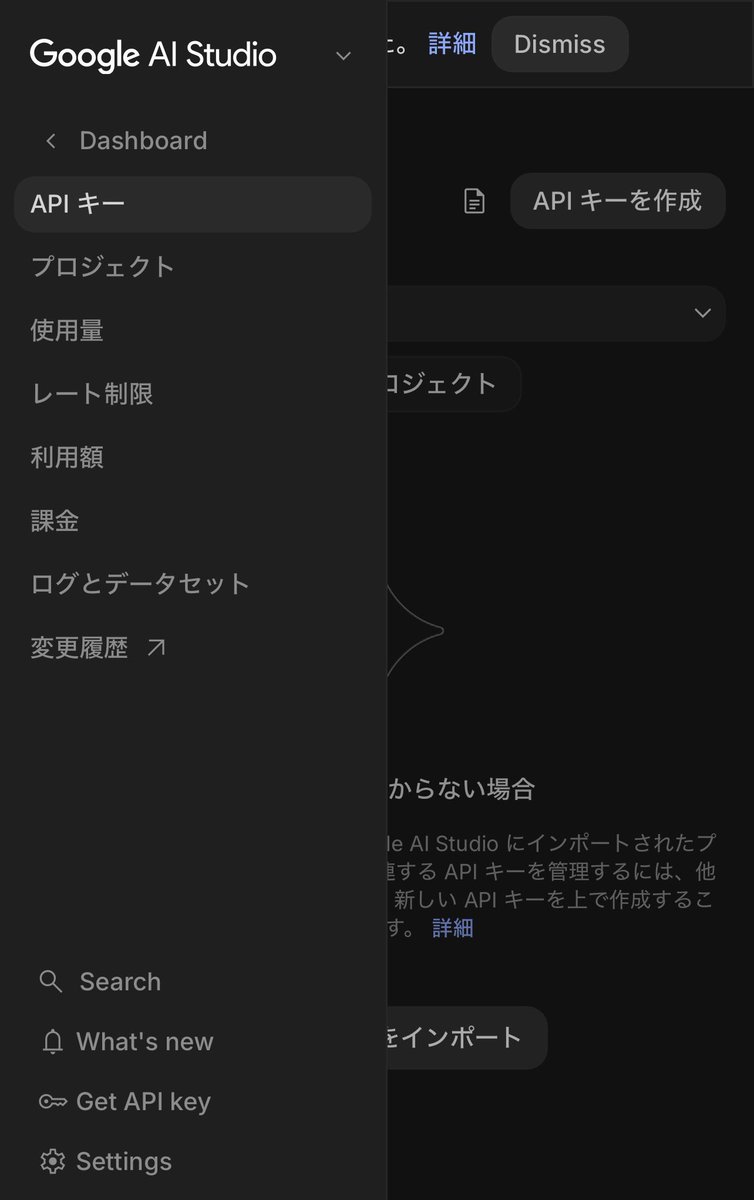
I followed the method shared in this post and added the model he recommended in OpenCode. Now it works perfectly!
This finally solved the Gemini API issue that had been bothering me for about three months. Ironically, I was still searching for a solution just last night, and today I happened to come across this post. Talk about perfect timing!
Huge thanks—this really helped me a lot.
I’d love to see them merged into one super app someday.
But if everything depends on Codex alone, my usage limit definitely won’t be enough. I’m really curious how OpenAI will combine or manage usage across its products, since so much of my planning, discussion, and thinking already happens with GPT.
@thsottiaux
Are you serious? I only asked Codex to write a roughly 1,000-word article into Obsidian, and it burned 4% of my 5-hour quota. Is that even normal? That’s terrifying.
Same here, and thanks for doing the reset.
I wasn’t on the 2x promo either, and I’m not using fast mode.
Just normal Codex work: editing a few web pages, moving content around, running a few tasks.
But the usage still feels like it drops visibly faster than before.
I get that you may not be seeing anything broken internally, but from the user side, the pressure is very real.
Especially when a lot of my content work now lives in Codex.
I have to say this about Codex usage.
It says I get 5 hours, but after editing a few web pages for about an hour, I was already down to 30%.
At this point it doesn’t feel like I’m “burning quota.”
It feels more like a SpaceX launch.
I thought I was vibe coding.
But watching the usage bar drop felt like I was lighting a rocket.
Tibo said part of this is because there used to be a x10 promo, so people now feel like the limit got smaller.
But I’ve been a Plus user the whole time.
I’m not coming from some huge temporary quota.
I’ve basically moved all my content work to Codex now.
But at this rate, I’m honestly worried I won’t be able to keep using it like this. @thsottiaux
https://t.co/y58JUMTwMm
@scottstts We had a 2X usage promotion multiplier. Not playing any tricks here but we legitimately are not finding an issue.
Still did reset the usage because we can, but we can't find anything that is broken here.
A small question I still haven’t figured out:
Should you keep taking very small paid work?
I have a tiny side thing where I help a friend write content and make PPTs.
At first, the price was low. I didn’t really treat it as “making money.” It was more like helping out.
But over time, it started to feel different.
The fee got lower.
The requirements got higher.
At some point, video editing also appeared in the work.
And the awkward part is:
my skills are improving,
but the tools I use are also getting more expensive.
Before, maybe I was only spending time.
Now there are AI subscriptions, materials, formatting, revisions, and communication costs behind it.
If I keep doing it, it still brings in a little money every month.
Not much, maybe enough for a few cups of milk tea.
If I stop, it feels a bit wasteful.
This kind of small-money work is really hard to decide.
How do you handle it?
Do you keep it as a small but stable cash flow,
or cut it off and save your time for something bigger?
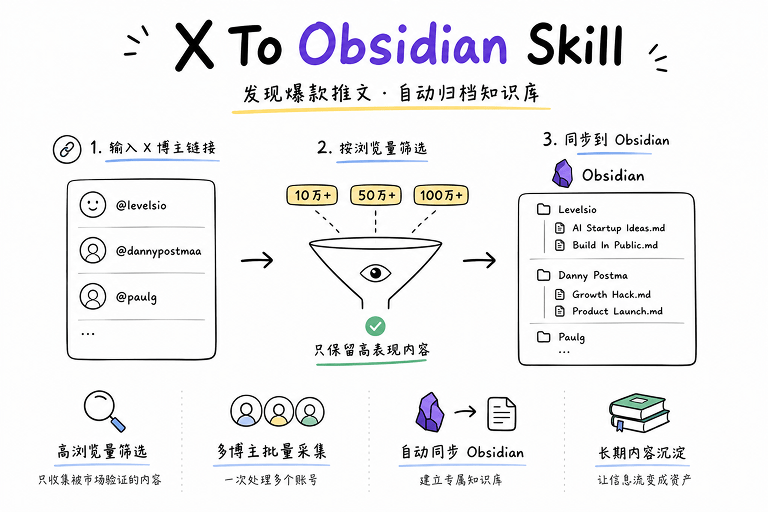
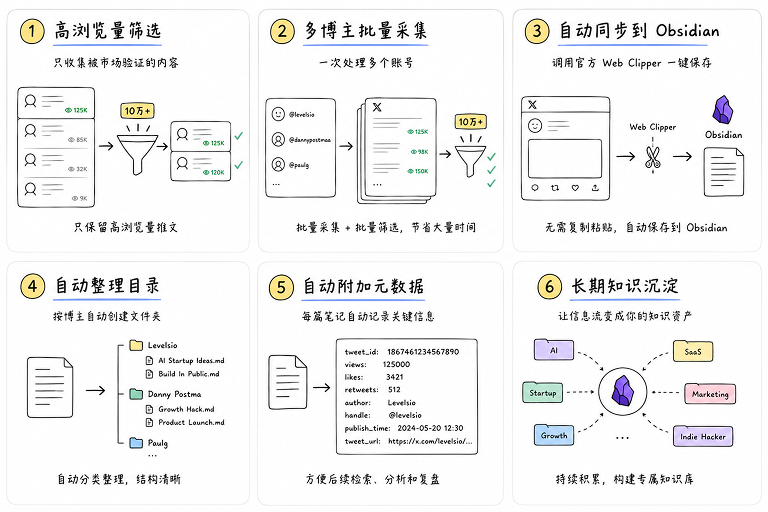
I think this tool is useful.
It solves a real problem:
good posts on X should not just sit in bookmarks and collect dust.
Sending them into Obsidian,
organizing folders automatically,
and adding metadata
all make the information easier to find again.
But I would still treat this step as better bookmarking,
not knowledge building itself.
If something is only saved, categorized, and tagged,
but I never judge it again,
rewrite it in my own words,
or connect it to a real question I’m working on,
it still has not really become mine.
It just moved from normal bookmarks
to cleaner bookmarks.
For me, the real next step is still asking:
Why did I save this?
How does it connect to what I’m doing?
Can I explain it again in my own words?
So I would treat tools like this as an entry point.
They help me keep the things worth thinking about.
But the thinking still has to happen after that.
If this fits your workflow, try the GitHub repo and leave him some feedback.
https://t.co/M2MxgTsQuN
I saw today that Codex can now connect to more models.
My first reaction was: this is great.
If I can use different models inside one client, I can switch less between Codex, OpenCode, and other tools.
But I quickly thought of another problem.
If Codex wants to become that main entry point, the client experience also has to be stable enough.
Recently, the Codex Windows client has been very laggy for me. It already affects my daily use.
Codex + GPT models is still a top-tier combo for me.
But if it is Codex + other models, and the client is still laggy, then compared with OpenCode + other models, the advantage becomes less clear.
Sometimes I might still go back to OpenCode, simply because it feels smoother to use.
I really hope Codex keeps getting better, @thsottiaux.
Reducing model-switching cost matters.
But as a daily coding base, smoothness matters too.
https://t.co/1GWGrLXYK1
@thsottiaux@OpenAIDevs Thanks for the update. Just to add: Codex has also been extremely laggy for me on Windows lately.
It’s not just the capacity errors — even typing feels very slow and almost unusable at times, which really affects the experience.
Hope the team can take a look at this too.
A few hours ago, I thought this Codex reset came at a slightly awkward time.
@thsottiaux said that because of the bug fix, the limits would be reset within 24 hours.
But my own weekly limit reset was already coming soon, only a few hours apart.
So at the time I thought:
this reset might be kind of wasted.
Then I noticed a small detail later:
reset chances seem to stack.
I now have 2 reset chances.
That feels much better.
I used to think that if two reset timings overlapped, one of them was basically wasted.
Now it doesn’t look that bad.
If I don’t have a big task right now, I can just keep them.
When I really run into a project that needs a long stretch of work, I can use them then.
https://t.co/7sMcVaRqZy
DeepSeek API was due for renewal. I put in 20 yuan before and it lasted over half a year — still have about 10 left. This time I just went straight to 100.
After using it this long, it handles pretty much everything well — not great with images though.
The key thing: I use Codex to build the foundation and framework. When the quota runs low, DeepSeek can keep working inside that same framework. That's enough for me.
Different models, different jobs. Save the heavy thinking for the top model. Once you've polished the workflow and framework with Codex, the rest goes to DeepSeek — no problem.
DeepSeek API was due for renewal. I put in 20 yuan before and it lasted over half a year — still have about 10 left. This time I just went straight to 100.
After using it this long, it handles pretty much everything well — not great with images though.
The key thing: I use Codex to build the foundation and framework. When the quota runs low, DeepSeek can keep working inside that same framework. That's enough for me.
Different models, different jobs. Save the heavy thinking for the top model. Once you've polished the workflow and framework with Codex, the rest goes to DeepSeek — no problem.
I spent most breakfasts as a kid running scenes in my head.
When I dipped fried dough sticks into my soy milk, I'd imagine a tiny figure standing on top — scrambling higher as the dough sank, until the last dry patch disappeared into the milk.
I'd also picture our cat sitting beside me watching cartoons, and I'd narrate the whole thing to him.
Not sure when it faded, but somewhere along the way that kind of imagination just stopped.
Now I use GPT image gen. Every so often it hits me — things only I could see before, now the whole world can see them. Feels like my childhood friends came back.
Does anyone else use Image Gen in their head?
I love using image generation whenever I have a weird idea or want to see something, but sometimes I don’t feel like opening the app and writing a whole prompt, so I just make the image in my own head.
Recently I found out I have the ability to use a form of Image Gen internally. I’ve generated so many images that I can almost entirely predict what it’s going to make.
For example, I was walking past a coffee shop and saw this orange cat sitting in the window with a tiny croissant next to it. I was about to open the app and ask it to make “a cinematic photo of a sleepy orange cat guarding a croissant in a cozy Parisian café,” but then I realized it wasn’t worth the effort and just generated it in my head.
It gave me something like: warm morning light, shallow depth of field, film grain, tiny paws, slightly surreal but still realistic, probably a little too glossy. Then I imagined the cat wearing a little beret because obviously the model would do that.
I just thought that was a pretty cool discovery I’ve made. Interested to see if anyone else has this ability.
—
I wonder if this is how codex feels when it uses image gen?