Our new paper titled Swarming bacteria exhibit developmental phase transitions to establish scattered colonies in new regions is out now in @ISMEJournal tweetorial to the preprint is below https://t.co/08Rndanb0O
Our new preprint on swarms of gliding Capnocytophaga - mysterious and understudied bacteria found abundantly in the human oral microbiota is live https://t.co/2QPgpvGVLa
Using Image Velocimetry, we found that they undergo phase transitions to form scattered microcolonies (1/4)
If you are at the 2026 ASM Microbe meeting in Washington DC, please check out a talk on sensory origion of zorbs by our lab's postdoc Jitendra Gosai at the 'Holding Tight: the importance of bacterial adhesion' session on June 5th. @gosciee
Distinct motors, shared mechanics: unifying principles of microbial gliding | Journal of Bacteriology https://t.co/93869AZPbd
Our minireview is out now in J Bact!
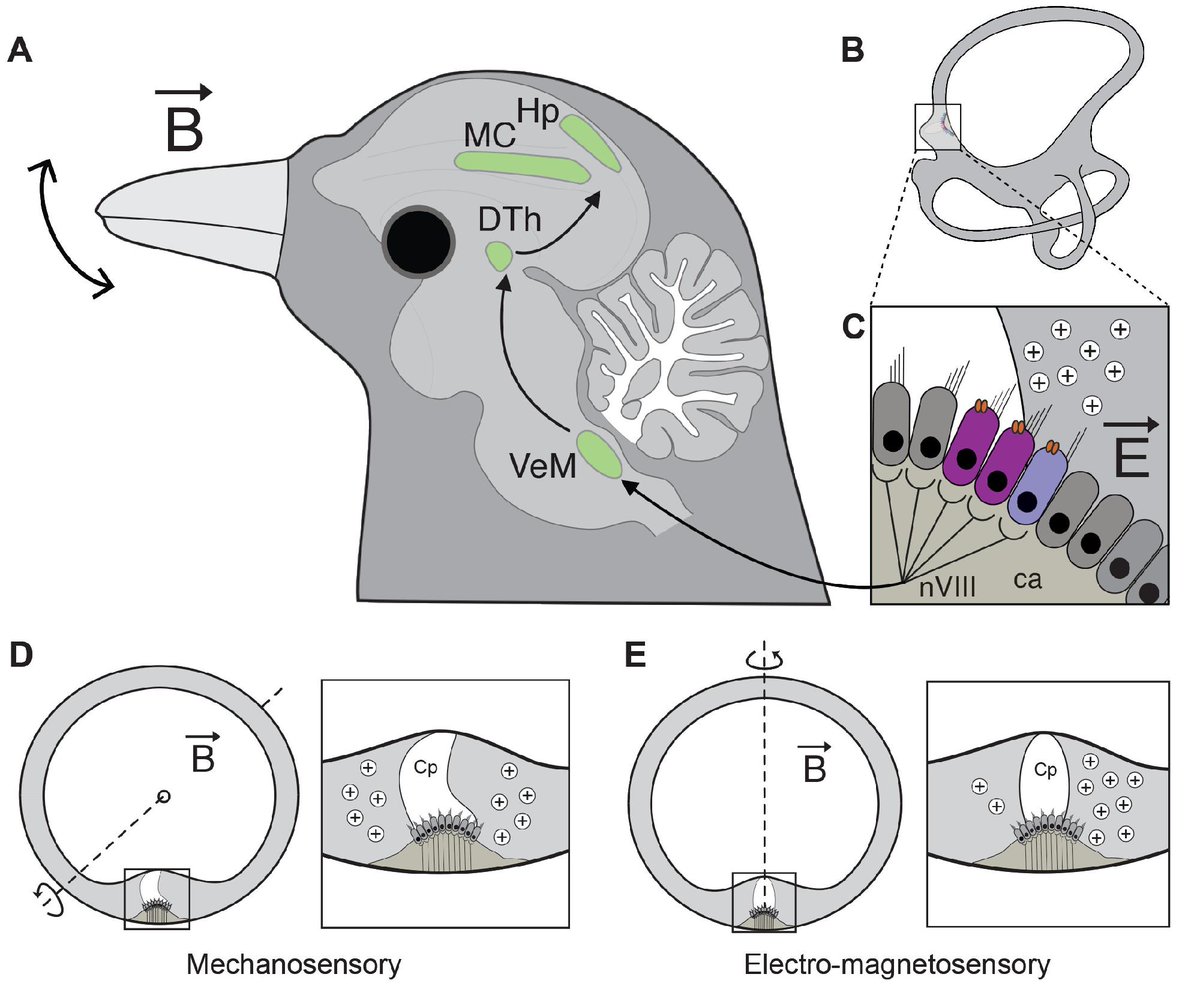
How animals detect the Earth’s magnetic field remains a mystery in sensory biology.
In a new Science study, researchers used whole brain activity mapping, tissue clearing, and light sheet microscopy to identify neuronal populations activated by magnetic stimuli in the pigeon. Learn more: https://t.co/DV1MEXigKV
We have announced 𝗙𝗮𝗰𝘂𝗹𝘁𝘆 𝗛𝗶𝗿𝗶𝗻𝗴 𝟮𝟬𝟮𝟱 at BITS Pilani across our campuses in Pilani, Goa, Hyderabad, Dubai, and off-campus centres.
This is an opportunity for passionate researchers and teachers to join a world-class ecosystem that fosters innovation, collaboration, and impactful research.
Apply by 5th October 2025 if you want to be considered for this cycle of recruitment.
#BITSPilani #facultyhiring @bitspilaniindia@bitsgoa@BITSPilaniDubai@bitshyd
In this perspective, we discuss a vision for AI-driven #enzyme discovery to unveil a world of enzymes that transcends biological evolution and perhaps offers a route to genetically encoding almost any chemistry.
https://t.co/rfGwDHHJdC
A conveyor belt-associated protein of T9SS-driven gliding bacteria acts as a molecular switch, reversing T9SS rotation to fine-tune movement - like a smart conveyor or biological snowmobile adapting to changing terrain. @ShrivastavaLab https://t.co/DOdBhpjgC1
Presenting RABiTPy - a Python package for bacterial tracking that works in a jupyter notebook format for: video/image stack import and processing, AI-based or traditional cell segmentation, cell tracking, trajectory analysis, and downstream plotting
https://t.co/MbfOtwqn2j
New paper on co-zorbs from my lab. Co-zorbs seem to be a new way for bacteria to get around. Magesh, et al. (2025). Co-zorbs: Motile, multispecies biofilms aid transport of diverse bacterial species. PNAS, 122(6), e2417327122. https://t.co/YvUWvVtcuF
Happy to share that a study led by @ShahLab_Enzymes and our joint PhD student Pavani Dadi, where multiple neuromodulatory compounds are reported to be produced by an evolved enzyme from the gut microbe Bacteroides fragilis is now online https://t.co/DDT0ubNfMM
Congratulations to our 2nd year PhD student @samyabrata_sen for winning a Poster Award for Innovation in Environmental Solutions @ASUBiodesign annual retreat 👏🥳🎊
📢Excited to share our new paper in @NaturePhysics : Cooperative hydrodynamics accompany multicellular-like colonial organization in the unicellular ciliate Stentor!
How do single-celled organisms benefit from teamwork? Let’s dive in! #Multicellularity
https://t.co/qtt3HTDjVx?
Congrats to Emma Henderson for receiving the Howard C. Berg Award for an Outstanding Talk on Motility! 🏆🎉
Emma (@ShrivastavaLab, @ASU)
📄 Read the preprint: https://t.co/M9ZCRltVXx
#blastmeeting2025#motility