One of the best things my brother ever taught me:
If someone tries to deadline you arbitrarily in a negotiation, the first thing you have to do is blow through the deadline.
The alternative, accepting the deadline, surrenders your leverage up front.
(Corollary: Don't impose arbitrary deadlines.)
NBC’s Craig Melvin: “In hindsight, were you able to be impartial [about his ability to run again]?”
JILL BIDEN: Jill Biden: “Well, you know, the doctors did assure us. I mean, he had a exam every — every year — a health exam like every president does. The doctors assured us he was, you know, he was healthy, and I saw him doing the job every single day. Every single day he got up, he went into the office, he did the job, he passed bipartisan legislation. You know, he — he worked — and I saw him work hours into the night. So, I — you know, yes, did I see him, you know, slowing down a little bit? When he got tired, did he stutter a little bit at night? Yeah, sure. But he was still doing the job, and he was doing a good job.”
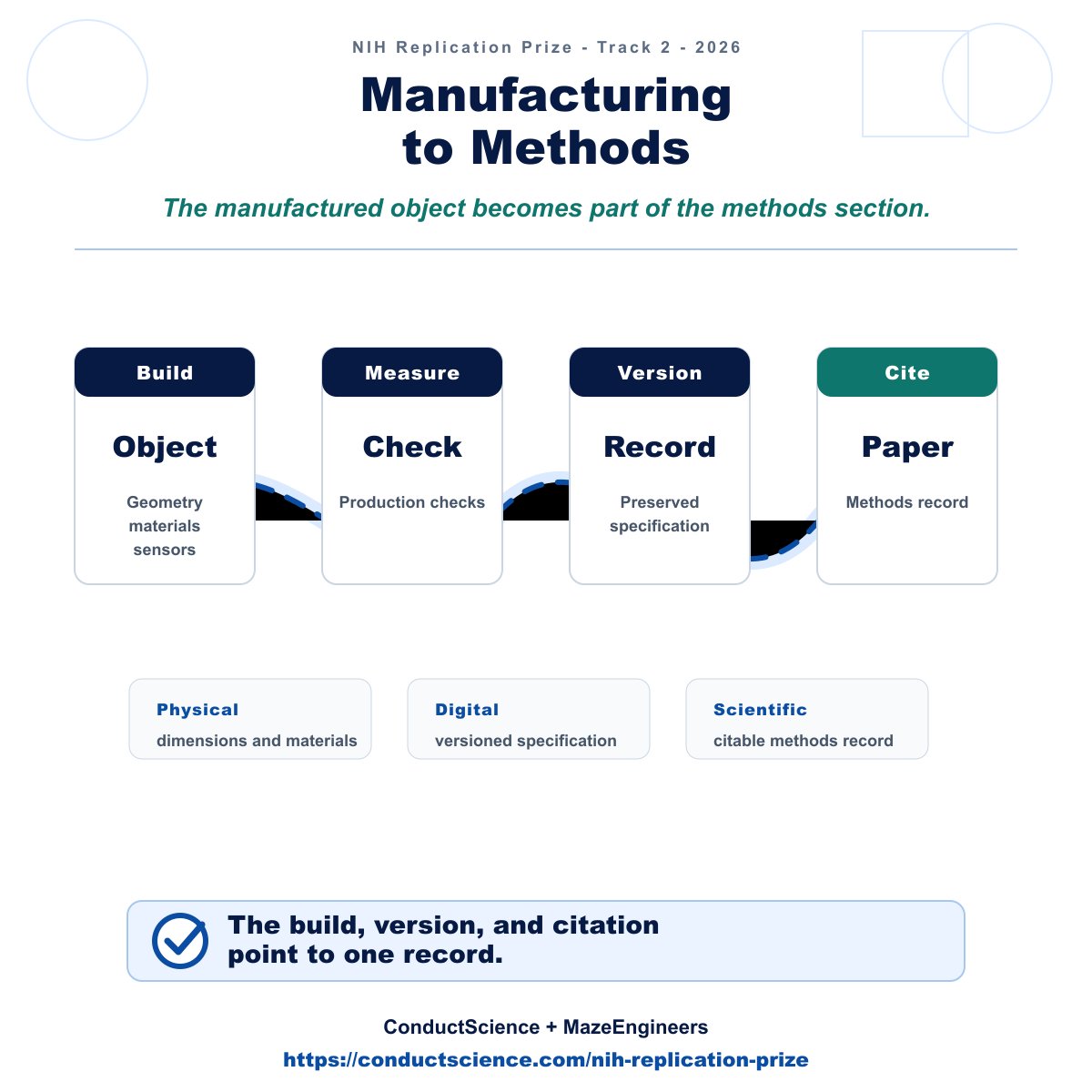
The manufactured object belongs in the methods section.
Geometry, materials, sensors, version history, and production checks all shape the experiment.
Build it. Check it. Version it. Cite it. https://t.co/CgnHPn6sny
https://t.co/8IRm0yzxTq
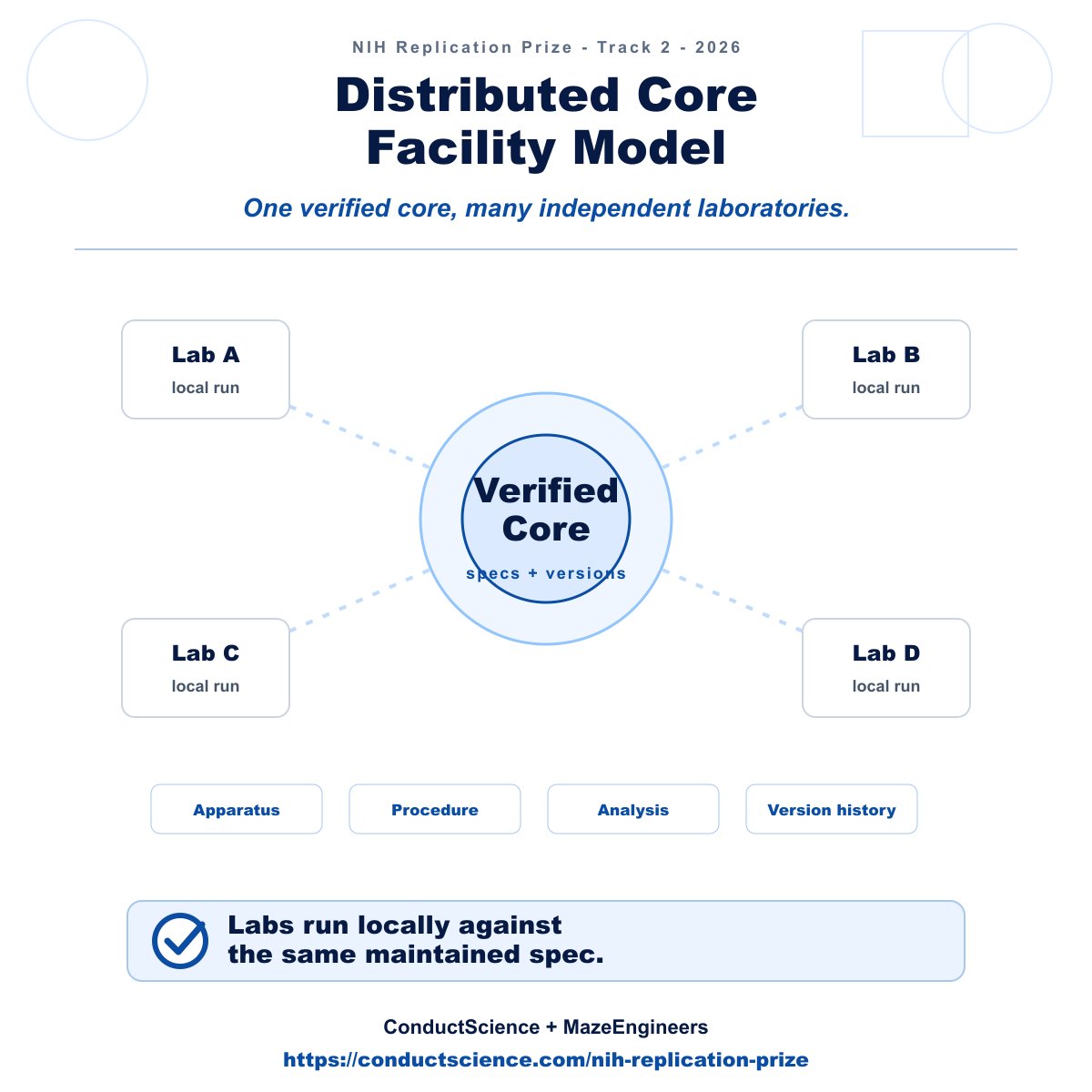
Replication can work while each lab runs in its own facility.
A distributed core keeps the specifications, versions, procedures, and analysis layer maintained while labs run locally.
One verified core. Many independent laboratories. We helped invent the distributed manufacturing core facility. Its why we win the @NIH replication prize
ConductScience was named a winner of the @NIH_CommonFund Fund Replication Prize
I keep coming back to the practical part of this.
A lab repeats a behavioral experiment with the right maze, the right dimensions, the right timing, the right camera setup, the right scoring rules, and a method record that says exactly what happened.
The product side matters. A better maze is easier to cite. Automated timing removes a person with a stopwatch. Computer vision makes scoring rules more consistent. A published method package gives the next lab something to inspect before they repeat the work.
The winning submission documented that in laboratories using our standardized apparatus, results from independent control groups varied roughly half as much as the historical multi-laboratory benchmark.
I am grateful to the team that built this across hardware, software, computer vision, manufacturing, research intelligence, technology transfer, and publishing.
The NIH result is a strong proof point for the way we think about products. Scientific tools should help the next lab repeat the work.
https://t.co/Mn7zMsz2yq
NIH results page:
https://t.co/4Wd0WzT1rL
ConductScience and MazeEngineers have been named winners of the NIH Common Fund Replication Prize, Track 2: Replication Exemplars.
For labs, this is about products that make behavioral methods easier to repeat.
https://t.co/8IRm0yzxTq
@simpsoka Sometimes I just want to go blasting and not overthink a huge detailed spec. Its incredible at executing plans but not great at planning and thinking through things before diving into the details. It makes explanations way too complex
@thsottiaux The powershell input is hard to read. I can't look at logs and clearly find my inputs. The status line could be more clear. It doesn't automatically update the tab to tell me what I'm working on. I wish it had an auto summary of what I'm working on for quick context switching
@thsottiaux easier status line configurations. when planning, less literal interpretations. when executing be literal. better formality context switching based on user text input (my 10pm instructions are much more degraded than my 9am)
I am a physician and a researcher. I also build software. And the longer I spent in all three of those worlds, the more one thing became impossible to ignore: science methodology is the most important part of research, and it is the least developed as infrastructure.
In software, we solved this problem 20 years ago. Code is versioned. Pipelines are automated. Tools compose. You can call a function from a terminal, chain it into a workflow, test it, diff it, deploy it. The entire discipline is built on the principle that process should be reproducible by design, not by memory.
Science has never had that. A protocol is a document. It lives in a methods section written in passive voice prose, in a PDF nobody can query, in a Word file on someone's desktop. More than 70% of researchers have tried and failed to reproduce another lab's experiment. That failure is not because scientists are careless. It is because the tools we use to describe methodology were never designed to be instructions. They were designed to satisfy journal reviewers.
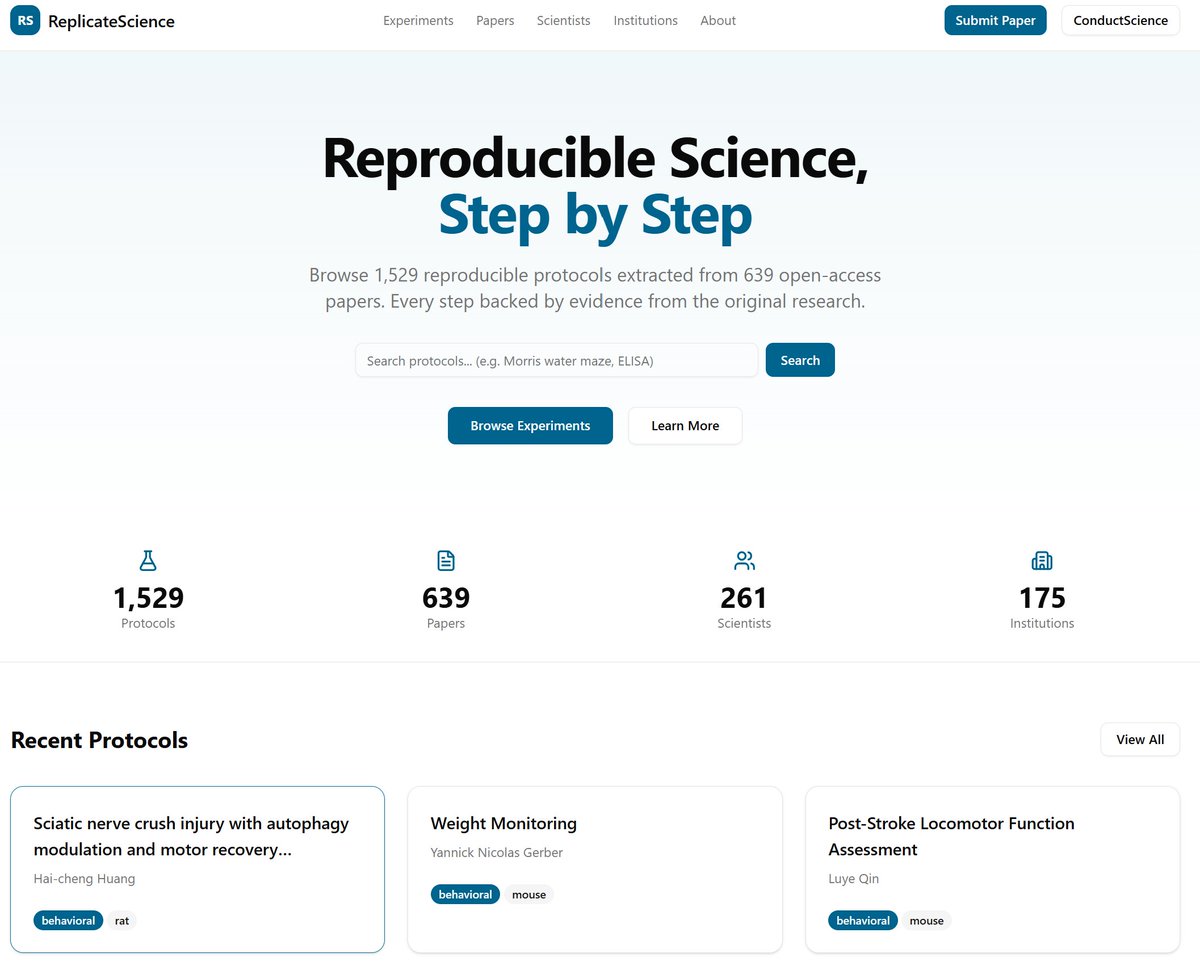
ReplicateScience started as an answer to a simpler problem: take open-access papers, pull the methods, and turn them into something a person can actually follow. Structured steps, evidence quotes from the original text, equipment mapped to real suppliers. That part exists today, across 1,529 protocols from 639 papers.
But the reason I keep building it is the bigger problem. I want science methodology to become programmable infrastructure. Not a UI you browse, but a protocol layer you can query from a terminal, integrate with ML pipelines, version like code, and trigger from automated systems. The kind of thing where a behavioral rig can advance a protocol step based on sensor output, or where a lab can diff their actual procedure against the canonical one and log the deviation automatically.
That is what software engineering already is. Science deserves the same primitives.