Have you tried using the new video editing features in Flow yet?
Here's a tutorial on how to insert an object into your clip (and a few other examples we've loved from the community).
Add a skeleton, spider, black cat or whatever haunts your imagination straight into your video with object insertion in Flow. Just click on the pencil icon on your video, type out your vision, and watch the story unfold.
Veo is getting new precision editing capabilities that let you easily add or remove elements from a scene - all while preserving the integrity of your original video. 🎥
Excited to share this has now been accepted at #NeurIPS2025 as a position paper (<6% acceptance)!🎉
We advocate for systematically studying entire model populations via weight-space learning, and argue that this requires charting them in a Model Atlas.
@NeurIPSConf#NeurIPS
🧵👇
Image generation with Gemini just got a bananas upgrade and is the new state-of-the-art image generation and editing model. 🤯
From photorealistic masterpieces to mind-bending fantasy worlds, you can now natively produce, edit and refine visuals with new levels of reasoning, control and creativity.
A quick dive into Gemini 2.5 Flash’s capabilities 🧵
We are releasing a paper I'm very excited about. We know test-time scaling is a path to greatly improved results, and achieves reasoning in the case of LLMs. We present a new and promising way to amortize it into training using HyperNetworks for image generation models.
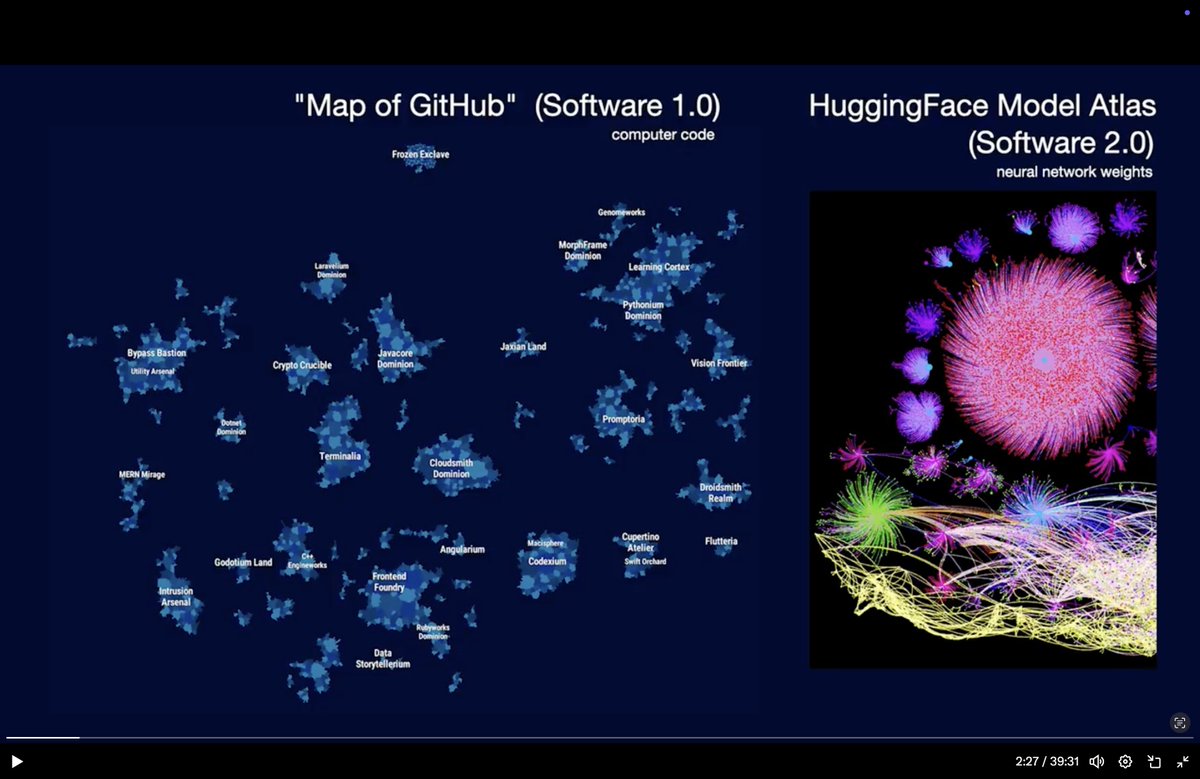
@karpathy Thanks for the inspiring talk (as always!). I'm the author of the Model Atlas. I'm delighted you liked our work, seeing the figure in your slides felt like an "achievement unlocked"🙌Would really appreciate a link to our work in your slides/tweet https://t.co/rJjBhMmRjf
Such an amazing feeling to see our generative object insertion video model, used by the incredible artists @Eliza_McNitt & @DarrenAronofsky in their film "Ancestral" at @Tribeca ✨
Check out the film and the tech behind it here: https://t.co/eDMMiIjTcz
@Google@GoogleDeepMind
Add and remove objects 🚫
insert or remove items or characters in your videos all while matching the consistency and style of your scene.
🚀 We can remove a spaceship from the backdrop.
🦆 And add a rubber duck to a panning shot.
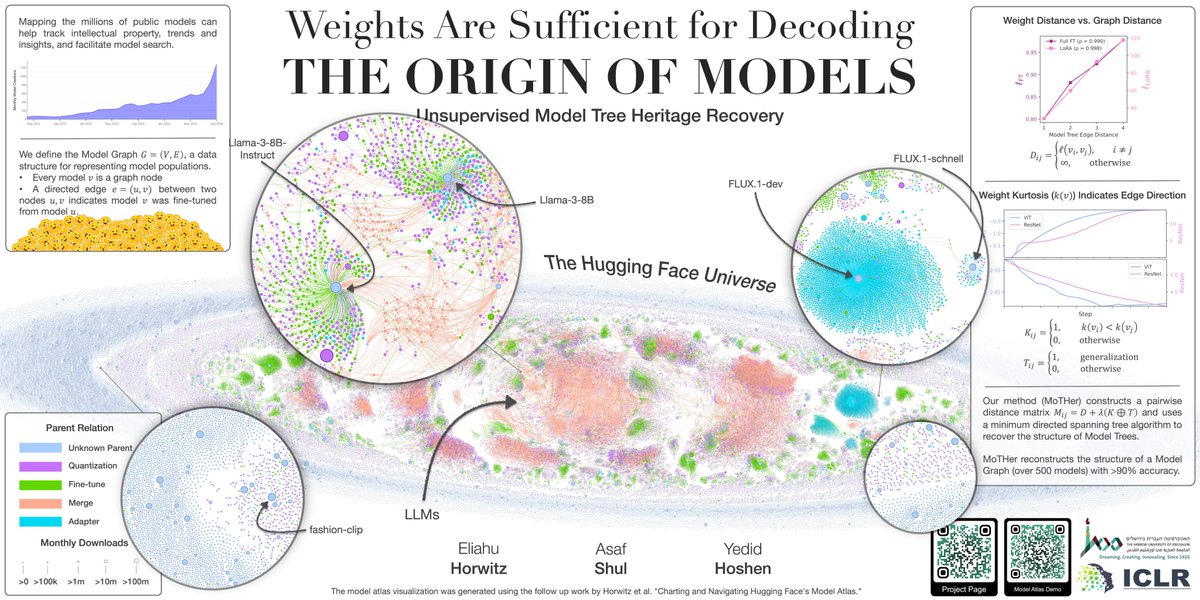
Our work maps hereditary relationships between models. We find that weights🏋️ are sufficient for decoding the Origin of Models🌳
Presenting today at @iclr_conf, 15:00–17:30, Hall 3, poster #360.
Come by to see our method, visualizations, and interactive demo atlas👀🚀 #ICLR2025
🚨 New paper alert! 🚨
Millions of neural networks now populate public repositories like Hugging Face 🤗, but most lack documentation. So, we decided to build an Atlas 🗺️
Project: https://t.co/1JpsC6dCeg
Demo: https://t.co/4Xy7yLdIZY
🧵👇🏻 Here's what we found:
Happy to introduce Veo 2, our latest video generation model, rolling out to trusted testers today.
It's not perfect, but it's a significant improvement over current state-of-the-art models, as our benchmarks demonstrate.
I'm sharing something unique we've been making at Google (w/ UNC). We are releasing our work on a new class of interactive experiences that we call generative infinite games, essentially video games where the game mechanics and graphics are fully subsumed by generative models 🧵
Google presents Diffusion Models Are Real-Time Game Engines
discuss: https://t.co/IBV70a990g
We present GameNGen, the first game engine powered entirely by a neural model that enables real-time interaction with a complex environment over long trajectories at high quality. GameNGen can interactively simulate the classic game DOOM at over 20 frames per second on a single TPU. Next frame prediction achieves a PSNR of 29.4, comparable to lossy JPEG compression. Human raters are only slightly better than random chance at distinguishing short clips of the game from clips of the simulation. GameNGen is trained in two phases: (1) an RL-agent learns to play the game and the training sessions are recorded, and (2) a diffusion model is trained to produce the next frame, conditioned on the sequence of past frames and actions. Conditioning augmentations enable stable auto-regressive generation over long trajectories.
One last poster I forgot to post.
«Recovering the Pre-Fine-Tuning Weights of Generative Models» by @EliahuHorwitz#ICML2024
Clear explanation, 8 line code, visually appealing, and QR code for additional information.