As the SIERRA team of @inria_paris, we will be presenting 11 papers at @NeurIPSConf 2021 and a Test of Time Award!
+ Very happy to mention that one of our papers received an Outstanding Paper Award!
See the thread below for details + join us at the posters if interested! 1/13
I am honored to be a 2025 Google PhD Fellow in Machine Learning & ML Foundations 🥳
Grateful to @Googleorg for their incredible support, my advisors @BachFrancis & Michael I. Jordan, and my lab at @Inria & @ENS_ULM for fostering a space to think deeply.
I am honored to be a 2025 Google PhD Fellow in Machine Learning & ML Foundations 🥳
Grateful to @Googleorg for their incredible support, my advisors @BachFrancis & Michael I. Jordan, and my lab at @Inria & @ENS_ULM for fostering a space to think deeply.
Not all scaling laws are nice power laws. This month’s blog post: Zipf’s law in next-token prediction and why Adam (ok, sign descent) scales better to large vocab sizes than gradient descent: https://t.co/uoy5GPrZek
Happy to have our recent papers on conformal prediction with e-values presented at COLT by my advisor @BachFrancis!
Full details here:
📚https://t.co/exKCl7g5Pf
📚https://t.co/YFtmxeVTtN
#COLT2025
For good probability predictions, you should use post-hoc calibration. With @Eugene_Berta, Michael Jordan, and @BachFrancis we argue that early stopping and tuning should account for this! Using the loss after post-hoc calibration often avoids premature stopping. 🧵1/
I’ll be presenting our paper at COLT in Lyon this Monday at the Predictions and Uncertainty workshop — come say hi if you're around! 👋
Check out @DHolzmueller's thread below 👇 #COLT2025
Characterizing finely the decay of eigenvalues of kernel matrices: many people need it, but explicit references are hard to find. This blog post reviews amazing asymptotic results from Harold Widom (1963!) and proposes new non-asymptotic bounds.
https://t.co/HrrAacOvCA
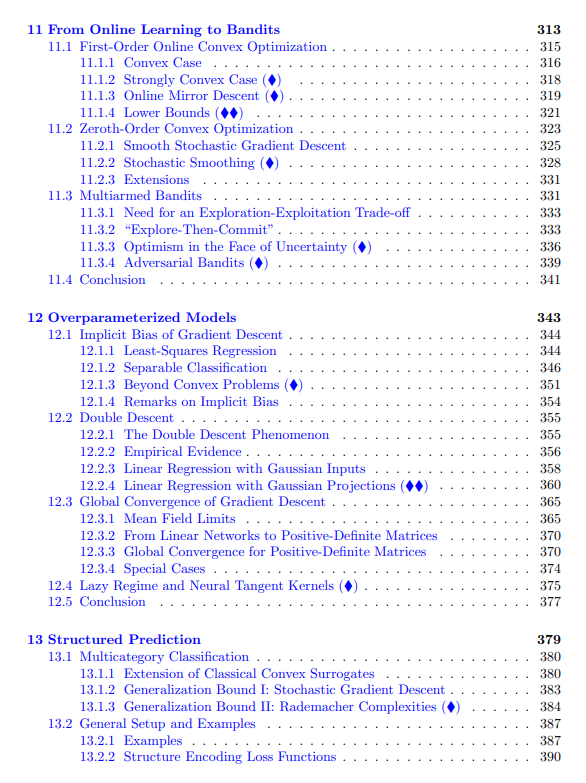
A free book: Learning Theory from First Principles by @BachFrancis
It covers a bunch of key topics from machine learning (ML) theory and practice, such as:
- Math basics
- Supervised learning
- Generalization, overfitting & adaptivity
- Tools to design learning algorithms
- Optimization in ML
- Local, Kernel and sparse methods
- Neural networks
- Ensembles
- Online learning
- Overparameterized models
and more!
The book also includes simple experiments (in MATLAB and Python), exercises, and references to more advanced material
Read it here: https://t.co/nv4sXdBGBi
Michael Jordan is indeed one of the greatest thinkers in the history of AI 🐐
Economics, incentives (mechanism design), information flow, creativity, cooperation, greed and power struggles are important topics that we crucially need to understand better for the benefit of humanity and all intelligent beings.
The worst that could happen is that kind, empathetic, empowering, cooperative, helpful AIs are never realised or don’t become ubiquitous in our lives.
Thanks @BachFrancis for sharing.
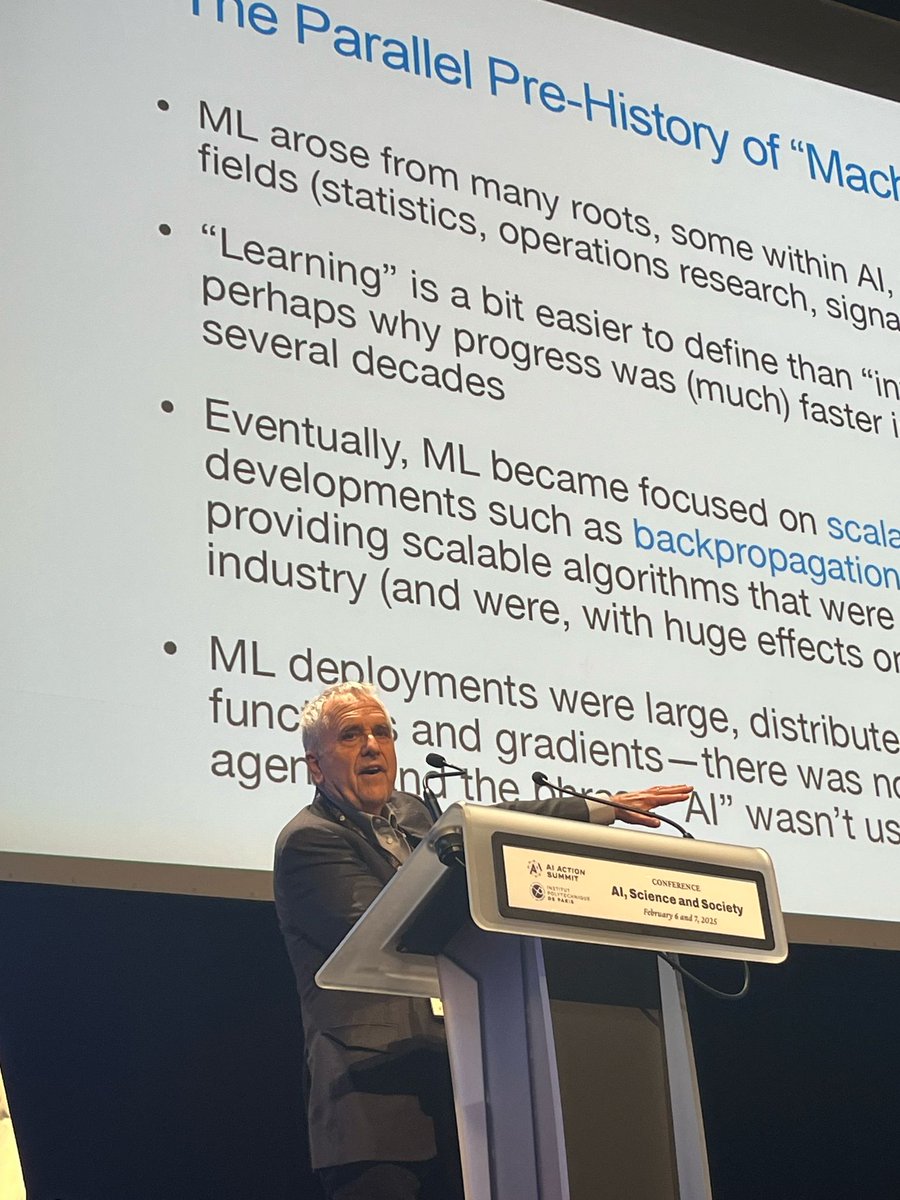
🔴 @Inria est présent à la conférence "AI,Science and society" à @IP_Paris_, prélude au #SommetActionIA et sous la direction du Pr. Michael Jordan (@UCBerkeley-@Inria) !
L'événement a été inauguré ce matin par Michael Jordan et cet après-midi par @ClaraChappaz 🗣


![Inria's tweet photo. [🔴#IAScienceSociety] @BachFrancis (@inria_paris-@ENS_ParisSaclay) participe au symposium "The Mathematics of #MachineLearning" aux côtés de @gabrielpeyre, Gilles Louppe (@UniversiteLiege), Gersende Fort (@CNRS) et Vianney Perchet (@INSAE @IP_Paris_). https://t.co/HoB2r8xTjN](https://pbs.twimg.com/media/GjHFwJ_WwAAzT-Y.jpg)






![Inria's tweet photo. [🔴#IAScienceSociety] @BachFrancis (@inria_paris-@ENS_ParisSaclay) participe au symposium "The Mathematics of #MachineLearning" aux côtés de @gabrielpeyre, Gilles Louppe (@UniversiteLiege), Gersende Fort (@CNRS) et Vianney Perchet (@INSAE @IP_Paris_). https://t.co/HoB2r8xTjN](https://pbs.twimg.com/media/GjHFwK6WgAAebig.jpg)


