Over the past week, I’ve been overwhelmed by the love and support of friends, industry colleagues, and people I've never met. Thank you to everyone who has shown kindness to my family and me. It means the world to me.
I came to the United States 53 years ago, and becoming an American citizen is one of the greatest gifts and proudest moments of my life. NVIDIA has been my life’s work. Building it into the company it is today alongside my colleagues has been a privilege and an honor. Nowhere but in America could a company like NVIDIA be possible. I love our country, and I love NVIDIA.
I did not live up to the standards expected of everyone at NVIDIA, and I have made serious mistakes in my personal life. I created problems for the Board that I deeply regret. I own my mistakes completely, and I am committed to cooperating with the Board’s independent investigation.
Since my departure, I’ve seen an outpouring of calls from NVIDIA’s employees, investors, business partners, and customers for me to return as CEO. Many continue to reach out to me directly as the company navigates complex technology, market, competitive, and geopolitical dynamics. NVIDIA is a once-in-a-generation company. If the Board of Directors decides that my return is in the best interest of our shareholders, our employees, the company, and America, I would be honored to answer these calls and return as CEO.
Thank you again to everyone who has shared their good wishes. I am profoundly humbled by your support. To my family: I love you, and I will spend the rest of my life being worthy of yours.
Jensen
The U.S. wouldn’t be leading in AI today without @JensenHuang.
His push into physical AI aims to reindustrialize America and keep it ahead for decades. Ousting him would undermine U.S. technological leadership and work against the national interest.
We introduce RoboSkills: a minimal, low-cost skillset for agentic robotics 🤖
It supports diverse robotics workflows, such as learning cat’s cradle 🧶 from a human video (Real2Sim) and transferring multi-person motion to characters and humanoids 💃 (Motion Generation).
We also support Auto Research, Agent as Policy, and Agentic Simulation. With suitable tools and workflows, we enable cheaper models to solve complex tasks.
GitHub: https://t.co/pofI0n6xoM
Website: https://t.co/qxzU18vN0R
Watch the video for more examples.
Long-horizon spatial reasoning remains a major challenge, even for the strongest frontier AI models.
Impressive results from @EnactraAI! 🚀 WorldBox boosts GPT-6 Astra from 23 to 61 gems on MazeBench, a 2.7× improvement!
Exciting to see how memory, world modeling, and simulation can help AI agents tackle much harder problems.
🚨New level unlocked! 🚨 We doubled GPT‑6 Astra’s score on MazeBench with WorldBox, our agentic sandbox for spatial reasoning.
Astra: 23 gems 💎💎
Astra+WorldBox: 61 gems 💎💎💎💎💎
MazeBench, by @patience_cave, is a tough test of long-horizon spatial reasoning: 256 interconnected rooms where even Opus 5.5 used 2.2B tokens and collected just 13 of 100 gems.
WorldBox provides agents with an agentic sandbox, for managing long-term memory, inferring complex mechanics, and simulating reasoning.
Watch the sandbox take shape and the agent tackle increasingly tricky puzzles. 🧵
What excites me about ASENA is the shift in who does the engineering: the agent isn’t just operating the robot—it helps build what the robot can do next.
So proud of @anjjei and the team! Beautiful work, and a fantastic demo. 🤖
Our G1 robot found its way to the pantry, picked up a Pringles can, and handed it over. No pre-built map. No training for this task.
Behind it is a coding agent, writing, running, and fixing the robot's programs as it goes. And it self-evolves: what works is saved as code for the next task, no retraining needed. This is ASENA.
Joint work with @Isabella__Liu, @edmund_bu, Johan Bjorck, @yin_hongxu, @zhengyiluo, @jankautz, @DrJimFan, @yukez, and @Sifei30488L. 🧵👇
Recova started with a frustration we kept coming back to: we wanted to collect more real-world robot data, but we simply didn’t have enough people to keep the robots running.
With a small team, you feel every interruption. A failed attempt can mean someone has to step in, fix the scene, and get things going again. We spent a lot of time thinking about how much of that work the robots could take on themselves.
That became Recova. A coding agent develops recovery skills in simulation. On real robots, the system monitors progress, tries to recover when things go wrong, and asks for help when it needs it. Those experiences—including human corrections—feed back into training.
We put this loop to work across four real-robot stations. On one task, observed human intervention dropped from 87.5% to 0% over four collection rounds.
That result means a lot to me because it gets at why we started: giving a small team a way to collect more experience than we could personally supervise, one attempt at a time.
A huge congrats to Isabella, An-Chieh, and our collaborators for bringing this to life!
Can we scale robot learning without scaling human labor? 📈
Demonstrations, resets, failure recovery, constant supervision—collecting robot data still takes substantial human effort.
🔑 Three keys let agents take on more of the work:
1. Real2Sim2Real: Agents explore and learn in digital twins, where trial and error is safer and cheaper.
2. Autonomous Recovery: Robots learn to recover from unexpected failures instead of waiting for human resets.
3. Human-on-Demand Learning: Multiple robots run in parallel, and humans step in only when autonomous recovery falls short.
🥑 Recova brings these together to get more robot learning out of every hour of human effort.
https://t.co/Wy7gucGq9r
Joint work with @anjjei, Johan Bjorck, @ZhidingYu, @yin_hongxu, @jankautz, @DrJimFan, @yukez, and @Sifei30488L.
👇 Here's how it works 🧵
Excited to share that Assured Robot Intelligence (ARI) has joined @Meta to help build the future of humanoid intelligence!
When we started ARI one year ago, our mission was clear: achieve physical AGI. Through deep customer engagements and real-world deployments, it became clear to us that serving the massive opportunity ahead requires training a truly general-purpose physical agent.
We believe this agent will be humanoid — and that scaling will come from learning directly from human experience, not teleoperation alone. Meta’s ecosystem brings together the key components needed to make this vision possible. We will be joining Meta Superintelligence Labs (MSL) to help bring personal superintelligence into the physical world.
We are incredibly grateful to the brilliant minds, robotics researchers, engineers, partners, and supporters who have worked with us on this journey. Thank you to our investors and angels, led by @aixventureshq , for believing in our mission.
This is just the beginning.
SR-3D aims to bridge strong 2D perception with consistent multi-view 3D reasoning. It reaches new SOTA on 3D scan and video spatial understanding benchmarks. Great work by @anjjei — check out the thread + project page and give it a try🔥🔥
SR-3D was accepted to #ICLR2026, and the code has now been released!
We also release SR-3D-Bench, a region-level spatial QA benchmark on egocentric videos.
Code: https://t.co/q5EDsgDBjb
SR-3D-Bench: https://t.co/6KML2FedRH
🚀 Excited to share the release of GSPN! 🎉 #CVPR2025#nvidia
Our release includes a custom, highly optimized CUDA kernel for the core GSPN operation.
👉 Check out the code and try it for your vision foundational models: https://t.co/8L3YSyZl8B
📑Paper: https://t.co/YjTwhZUpyK
🖥️Project: https://t.co/oYSJoSkaIP
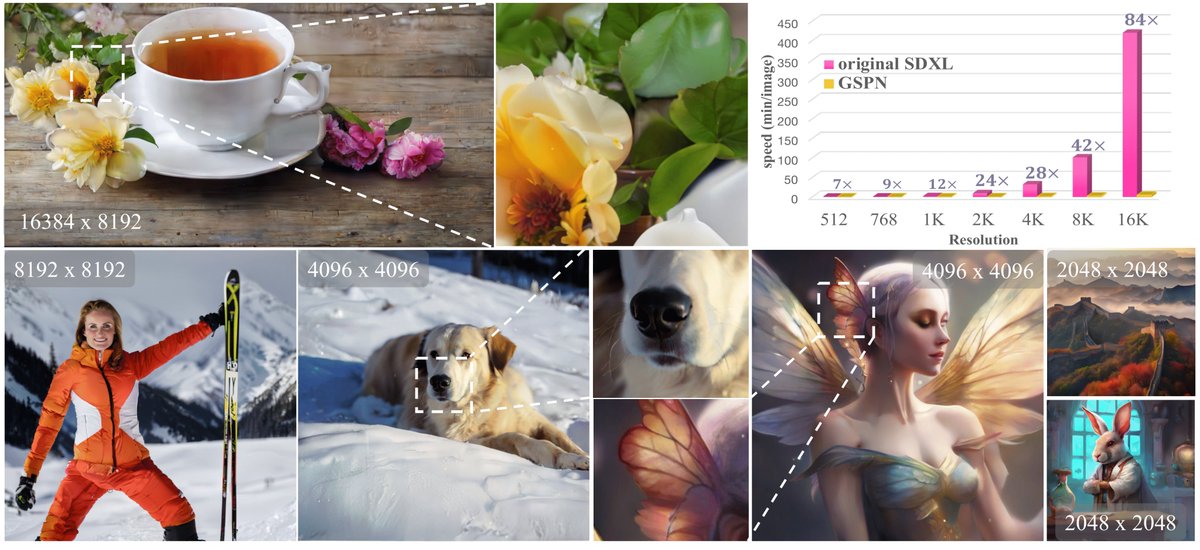
The code of GSPN #CVPR2025 is released! We proposed a new sqrt(N) complexity attention mechanism, which enables efficient high resolution image generation. We can generate 8k images with 42x speed up compared to self-attention in StableDiffusionXL!
Code: https://t.co/eGbL0dxS68
Paper: https://t.co/5jVXRx5UUf
📢 Unposed few-view 3D reconstruction has never been so easy, and SOTA pose estimation as a byproduct!
Check out our #ICLR2025 ORAL paper (top 1.8%): NoPoSplat!
Catch the amazing @Botao_Ye at:
Oral: Thu 4:18 pm
Poster: Thu 10 am (#204)
Website: https://t.co/uBhK0tvoVU
🚨Paper Alert 🚨
➡️Paper Title: Describe Anything: Detailed Localized Image and Video Captioning
🌟Few pointers from the paper
🎯Generating detailed and accurate descriptions for specific regions in images and videos remains a fundamental challenge for vision-language models.
🎯Authors of this paper introduced the “Describe Anything Model (DAM)”, a model designed for detailed localized captioning (DLC).
🎯DAM preserves both local details and global context through two key innovations:
🔱A focal prompt, which ensures high-resolution encoding of targeted regions, and
🔱A localized vision backbone, which integrates precise localization with its broader context.
🎯To tackle the scarcity of high-quality DLC data, they proposed a Semi-supervised learning (SSL)-based Data Pipeline (DLC-SDP).
🎯DLC-SDP starts with existing segmentation datasets and expands to unlabeled web images using SSL.
🎯They also introduced DLC-Bench, a benchmark designed to evaluate DLC without relying on reference captions.
🎯DAM sets new state-of-the-art on 7 benchmarks spanning keyword-level, phrase-level, and detailed multi-sentence localized image and video captioning.
🏢Organization: @nvidia , @UCBerkeley , @UCSF
🧙Paper Authors: @LongTonyLian , Yifan Ding, Yunhao Ge, @Sifei30488L , @hanna_mao , @Boyiliee , Marco Pavone, @liu_mingyu , Trevor Darrell, Adam Yala, @YinCuiCV
📝 Read the Full Paper here: https://t.co/96KFj9oY9F
🗂️ Project Page: https://t.co/SWmm8w1xJj
🧑💻 Code: https://t.co/OsOZdWllvS
🎥 Be sure to watch the attached Technical Summary Video - Sound on 🔊🔊
Find this Valuable 💎 ?
♻️QT and teach your network something new
Follow me 👣, @NaveenManwani17 , for the latest updates on Tech and AI-related news, insightful research papers, and exciting announcements.
Introducing GSPN: A Leap Forward in Vision Attention Mechanisms
Paper: https://t.co/YjTwhZUpyK
Project: https://t.co/oYSJoSkaIP
We present GSPN (Generalized Spatial Propagation Network), a novel attention mechanism developed at @nvidia. Unlike pixel-to-pixel scans like mamba, GSPN performs line-to-line scans, effectively reducing the sequence length from N to sqrt(N). This architecture enables significant computational efficiency, especially for high-resolution inputs.
Let’s think about humanoid robots outside carrying the box. How about having the humanoid come out the door, interact with humans, and even dance?
Introducing Expressive Whole-Body Control for Humanoid Robots:
https://t.co/Y4hTwHRoiz
See how our robot performs rich, diverse, and expressive motions in the real world 👇🧵
3D Gaussian Splatting is great, but can it work without the pre-computed camera poses? Introducing:
COLMAP-Free 3D Gaussian Splatting
Our recent work shows not only it can, but 3D Gaussians make camera pose estimation easy (compared to NeRF) along with reconstruction.
👇🧵