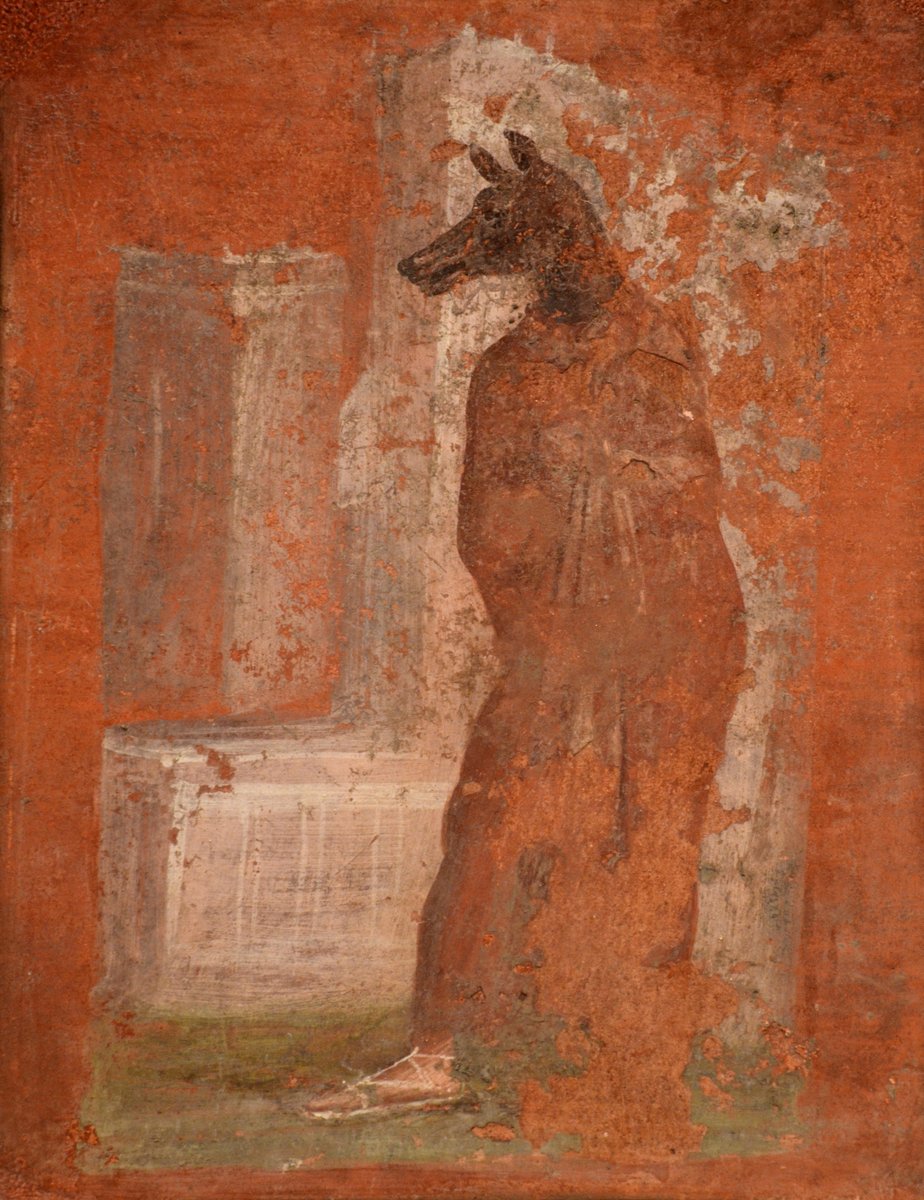
Fresco of a figure wearing an Anubis mask. Origin: The assembly hall (Ekklesiasterion) of the Temple of Isis, Pompeii, Italy. Date: 1st century AD. Medium: Fresco painting. Collection: Naples National Archaeological Museum, Naples. Photo Credit: @carolemadge **
This striking fresco, set against a vivid Pompeian red background, offers a window into the secret rituals dedicated to the Egyptian goddess Isis. Her worship was immensely popular across the Roman Empire.
The figure shown here is not the jackal headed god Anubis himself. Instead, it is a priest or a participant wearing a mask, impersonating the god during a ceremony inside the temple.
Decades before this fresco was painted, the impersonation of Anubis caused a massive scandal in Rome itself (19 AD). The events centered on Paulina, a noble, married, and highly virtuous woman who was deeply devoted to the cult of Isis.
Decius Mundus, a Roman of the equestrian order, fell madly in love with her. He offered her gifts and a massive sum of 200,000 Attic drachmae, but Paulina refused his advances.
Despairing to the point of contemplating suicide, Mundus was aided by Ide, his father's freedwoman. Ide accepted 50,000 drachmae from Mundus and used half of that sum to bribe the priests of Isis. The priests then convinced Paulina that the god Anubis had fallen in love with her and was summoning her to the temple.
Paulina went to the temple at night. Once the doors were closed and the lights extinguished, Mundus—who was hiding inside—emerged. Paulina spent the night with him, believing in the darkness that he was truly Anubis.
Three days later, Mundus revealed his identity to her. Paulina immediately reported the deception to her husband, who brought the matter before Emperor Tiberius. The Emperor intervened with fury: he ordered Ide and the complicit priests to be crucified, the temple of Isis to be destroyed, and the cult's statue thrown into the Tiber River. Mundus was sentenced to exile.
The cult was temporarily banished from the capital, yet this fresco from Pompeii shows that the rituals continued elsewhere in the Empire.
Thanks for reading!
** Photograph: https://t.co/uTYcltH9Um
This file is licensed under the Creative Commons Attribution-Share Alike 2.0 Generic license.
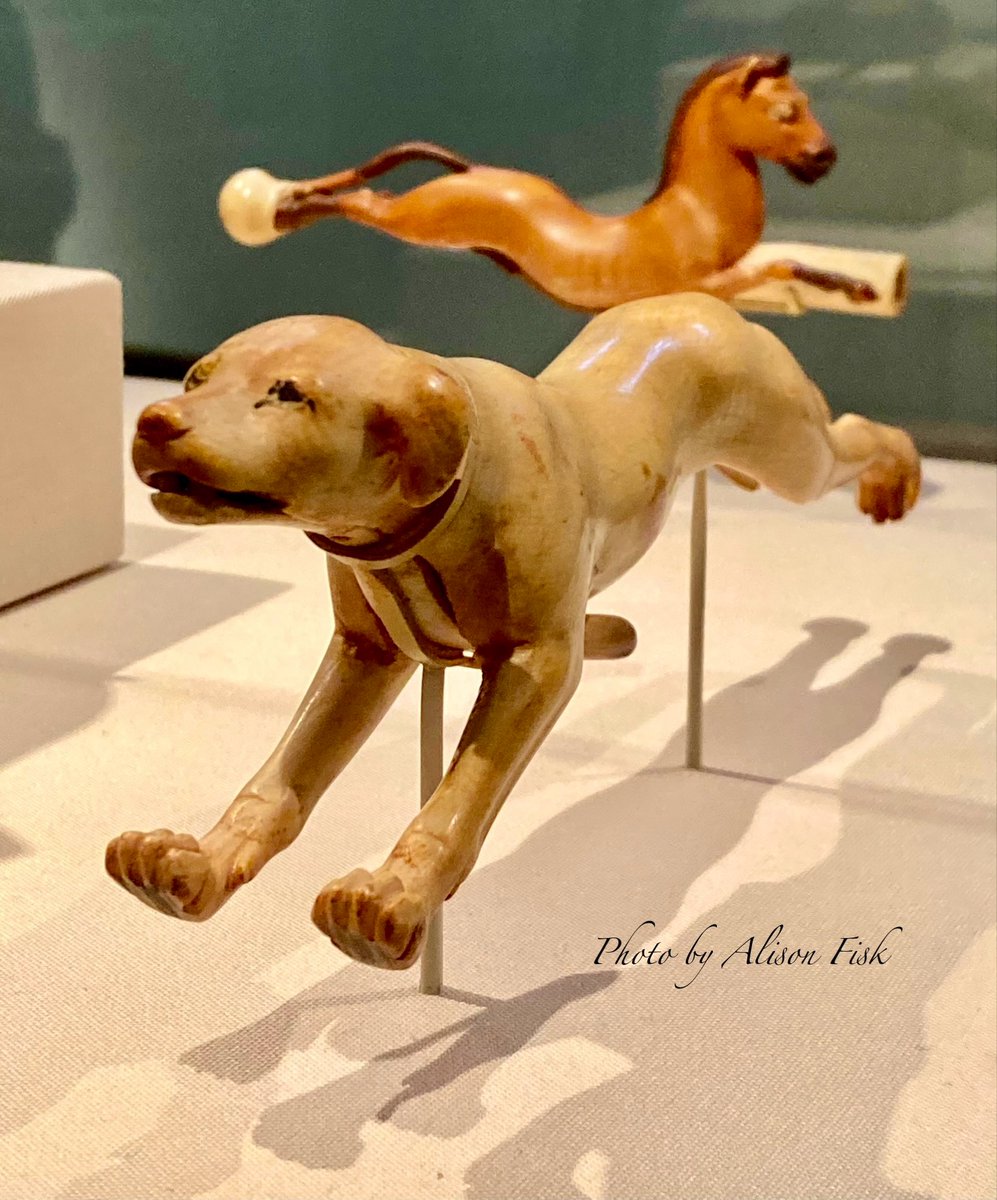
A very good boy! 🐾🐕😍
An amazing c. 3,400 year-old ancient Egyptian dog carved from ivory. This leaping dog opens and closes its mouth as if barking by using a lever below its chest.
The Met 📷 by me https://t.co/CGRjHzKRBQ
#Archaeology
Diez años después de su estreno sigo recomendado por HALLOWEEN 🎃 la sensacional miniserie OVER THE GARDEN WALL. Un emotivo y tierno viaje (con su toque siniestro) sobre la amistad, la pérdida, el perdón y los recuerdos. La tenéis en HBO 🖤
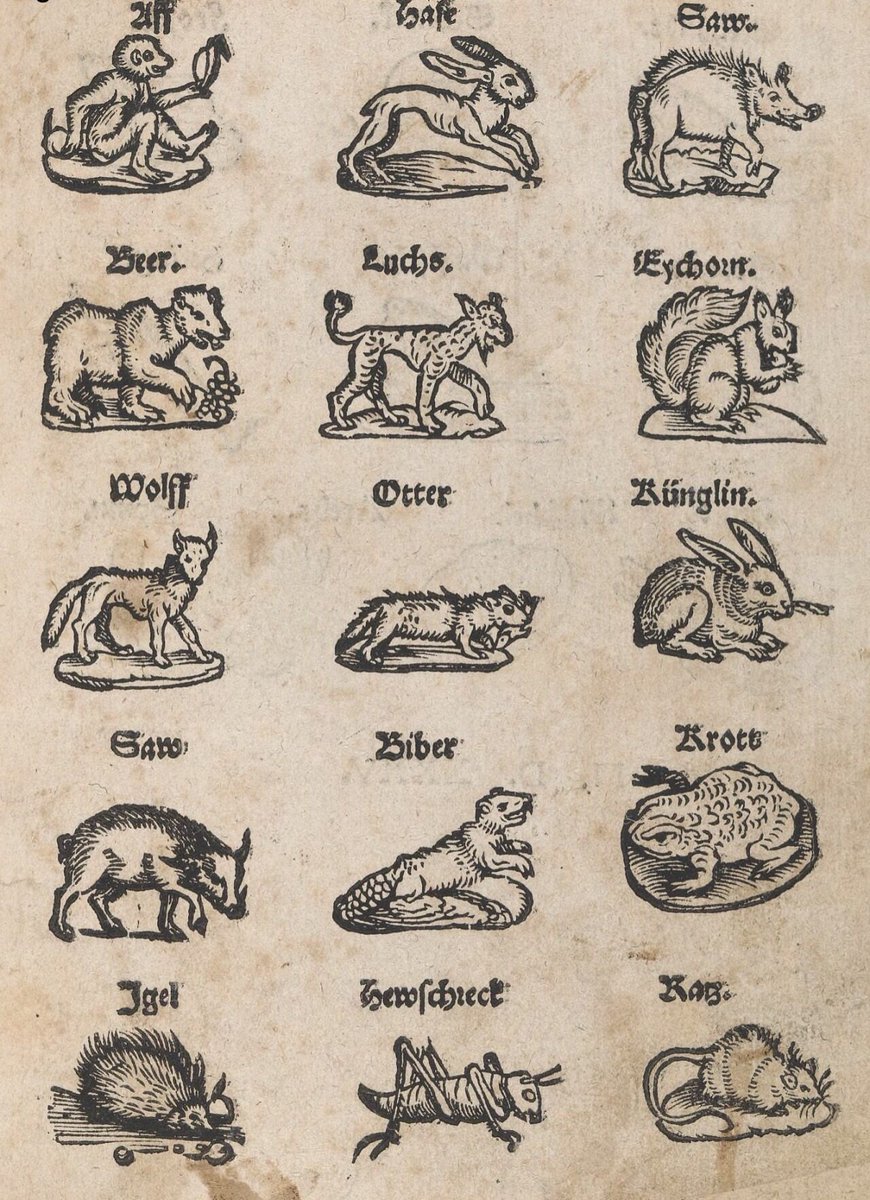
Modelbuch aller Art Nehens vn Stickens (animals page, p. 13v). Publisher: Christian Egenolff. Frankfurt am Main, 1535 AD. Medium: woodcut on paper. Dimensions: c. 18.5 × 13.5 cm. Collection: The Metropolitan Museum of Art, New York.
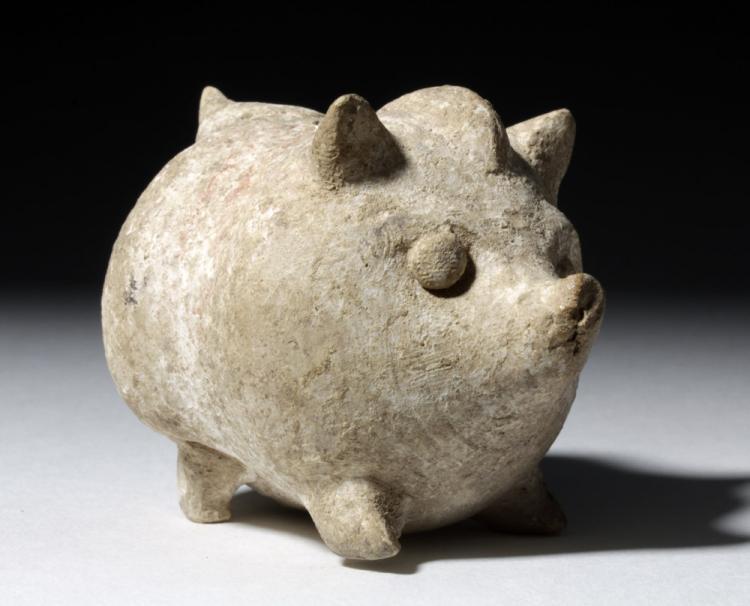
Terracotta rattle in the shape of a pig. Culture: Greek (likely Cypriot), 6th–3rd century BC. Medium: terracotta; hollow-bodied with an internal rattle; pierced vents on top and base. Possibly from Cyprus.
From ancient Egypt, more than 3,000 years ago ~ this wooden cosmetic spoon with handle in the shape of a biting, running jackal (ca 1539-1292 BC)
https://t.co/FJXlm6jQfX
Cut flowers on this and other pages within this manuscript give the illusion that their stems pierce the page to keep them in place - 15th century, Kraków, MNK 3025 I, p. 63
Y así es como estamos… tratando de hacer nuestro trabajo lo mejor posible pero con los recursos más limitados que nunca. Aquí diez datos que sitúan a Madrid como la comunidad que peor trata a su universidad pública. Es una p**a vergüenza 😡🤬 https://t.co/txKoykM5DJ