Everyone’s chasing attention
I’ve been busy building what actually works
While most were posting for likes i was helping people grow for real
I’ve worked with top creators founders and brands
The ones you see winning every day on this app
And the truth is it’s not about hacking the algorithm
It’s about understanding people because when you understand people you stop chasing engagement and start building real influence
What we do is simple
We help you grow a real active page
We put the right people behind your replies so your name shows up in the right places
And we create content that actually gets people to care
This isn’t some agency
No copy paste no quick fixes
Everything is built from scratch with one goal:
Helping you build something that actually matters
I’ve been in the trenches
I’ve seen what works and what doesn’t
I’ve helped accounts go from invisible to unavoidable
Growth isn’t magic
It’s real work done by people who care about the result
And that’s what we do here
If you’re serious we’re ready
Moonwell just got drained for over $9 MILLION, and its own token is pumping while the attack is still happening.
> Moonwell is a lending protocol on Base where users deposit crypto as collateral to borrow other assets against it.
> One of its markets accepted a token called $MAMO as collateral, priced using an oracle that reads MAMO's value straight off the open market.
> That's the flaw, an attacker didn't need to hack anything, they just needed to move MAMO's price.
> They pushed the price of $MAMO up roughly 8x, from $0.0105 to about $0.088, entirely artificially.
> That inflated the value of $MAMO sitting in the attacker's own wallet as collateral, on paper, far beyond what it was actually worth.
> Against that inflated collateral, they borrowed real assets out of Moonwell's other markets, $cbBTC, $USDC, $wstETH, and $ETH, again and again.
> According to on-chain monitoring firm ExVul SkyEye, the single largest transaction alone moved 14.34 cbBTC, worth roughly $1.15 million.
> Total drained across cbBTC alone: 71.36 cbBTC, worth approximately $5.7 million
> With the broader attack across all four assets reported at over $9 million and reportedly still ongoing.
> Every transaction is sitting in plain sight on Basescan, moving into a single wallet.
> And somehow, in the middle of all this, Moonwell's own governance token was up 25% in the past hour.
The attacker didn't break in through code. They just moved one number on the open market, and the protocol's own rules did the rest.
GameStop just launched a product that's already showing up as a real diagnosis inside addiction treatment centers and barely anyone's talking about it.
– It's called GameStop Power Packs. Users pay real money to open a digital trading card pack online.
– Whatever card comes out, they can ship it home or sell it straight back to the site for instant cash.
– The format is known industry-wide as a "digital repack." Fanatics runs its own version and calls it "the future of collecting."
– A reporter investigating the space identified 52 separate digital repack sites currently operating.
– The larger platforms actually verify a user's age.
– Many of the smaller ones advertising heavily on social media just ask users to check a box confirming they're 18, and accept payment in cryptocurrency, no bank trail required.
– Birches Health, a virtual treatment provider for gambling addiction, reported a 207% increase over the past 12 months in patients specifically bringing up "trading cards" and "digital repacks" during treatment.
– That's the exact same category of language clinics track for slot machines and sports betting apps.
– Instead of pulling back, one of the biggest names in the space leaned further in.
– Arena Club, co-founded by Yankees legend Derek Jeter, began running a new ad campaign in July built entirely around father-son bonding.
– In the ad, a dad says he's "able to recreate his childhood." His kid responds, "Now we're ripping packs together." They fist bump as the tagline lands: "That excitement, that thrill, you'll be hooked."
A treatment center is already logging real patients over this. The industry's response wasn't to slow down, it was to put a childhood hero's face on an ad that tells kids straight to their face that they'll get hooked.
An NBA player faked a foot injury on live TV and quietly told a friend he was leaving the game early. Every bet against him won. Two years later, the FBI arrested him alongside a Hall of Fame coach and four mafia families.
> Terry Rozier was a Charlotte Hornets guard on March 23, 2023, playing against the New Orleans Pelicans.
> He played briefly, logged stats well below his season averages, then exited citing "foot discomfort."
> Prosecutors allege he'd told a friend beforehand he planned to leave early, letting that friend place roughly $200,000 in prop bets against his own performance before tip-off.
> Every one of those bets won.
> At the time, the NBA investigated the unusual betting activity and said it found no rule violations.
> The scheme resurfaced years later, part of a much larger FBI investigation made public on October 23, 2025.
> Agents arrested Rozier, Portland Trail Blazers head coach Chauncey Billups, and former NBA player Damon Jones in one coordinated morning raid.
> More than 30 people were indicted across two separate schemes.
> One used insider NBA information. The other was a rigged underground poker ring financed by the Bonanno, Gambino, Genovese, and Lucchese crime families.
> Billups was allegedly used as a "Face Card," a recognizable name meant to lure wealthy victims into games he knew were rigged.
> FBI Director Kash Patel personally led the press conference, calling the scale of it "mind-boggling."
> The NBA placed both Rozier and Billups on immediate leave. Commissioner Adam Silver said he was "deeply disturbed."
> Rozier pleaded not guilty in December 2025 to conspiracy to commit wire fraud and money laundering.
> In April 2026, the Miami Heat released Rozier from the team while the case remained pending.
He faked an injury in front of a national television audience. It took federal agents two years, a mafia-financed poker ring, and a Hall of Fame coach's arrest in the same case to finally catch it.
A 20 year old bank teller stole $215,000 and vanished. On his deathbed he begged his daughter never to look him up. She looked him up that night and started a podcast to talk about it 2 years later.
> Theodore "Ted" Conrad was a vault teller at Society National Bank in Cleveland, starting in 1969.
> On July 11, 1969, he finished his shift, stuffed $215,000 in cash into a paper bag, and walked out the door.
> He was never seen as Ted Conrad again.
> $215,000 in 1969 is worth roughly $1.8 MILLION today.
> Investigators chased him for decades.
> His case ran on "America's Most Wanted" and "Unsolved Mysteries."
> He resurfaced hundreds of miles away as Thomas Randele, sold luxury cars in Massachusetts, got married, raised a daughter named Ashley.
> Ashley grew up knowing nothing about any of it.
> In March 2021, dying of lung cancer, he finally told her: he'd changed his name decades ago, and the authorities were "probably still looking" for him.
> He agreed to give her his real name. One condition, she had to promise never to look into it.
> She promised.
> She broke it the same night, searched his real name and found hundreds of articles about a bank teller wanted since 1969.
> He died two months later, at 71. 52 years on the run and never arrested.
> In late 2023, Ashley turned everything she found into a podcast "Smoke Screen: My Fugitive Dad."
He asked her to bury the secret forever. She looked him up that night and started a podcast to talk about it 2 years later.
A 23-year-old asked ChatGPT how to fix his gun, how long police take to respond, and how to buy bullets as a convicted felon. Then he robbed a bank with the exact plan it helped him build. The chat history was still open on his phone when police found him.
> Deron Lewis-Payne, 23, of Omaha, Nebraska, walked into i3Bank on February 10, 2026.
> He pointed a Llama Mini-Max .45 handgun at two tellers and told them he'd kill them if they didn't comply.
> He fled with roughly $9,175 in cash.
> Surveillance footage caught his face clearly, along with distinctive clothing he was wearing.
> He was arrested days later after a foot chase, during which he threw some of the stolen cash on the ground.
> He initially admitted to driving the getaway vehicle but denied involvement in the robbery itself.
> He consented to a search of his phone.
> Investigators found he'd used ChatGPT to ask about law enforcement response times, how to strip and repair the handgun, and how to obtain ammunition despite being a convicted felon.
> His Google Maps history also showed he'd searched directions to the bank before the robbery.
> He pleaded guilty to bank robbery and brandishing a firearm during a crime of violence.
> On August 13, 2026, a federal judge sentenced him to 121 months, over 10 years, with five years of supervised release to follow.
> The gun was never recovered. Investigators only got back $2,397 of the stolen money.
He didn't just use ChatGPT to plan the robbery. He never even deleted the conversation.
A man robbed two people at gunpoint for their crypto. He also ran a Telegram channel where he casually posted screenshots of the exact wallets that received the stolen money. It took one investigator days to trace it all back to him.
> On April 17, 2026, five attackers broke into a home in France and stole roughly 7.2 Bitcoin, worth $557,000, sending several people to the hospital in the process.
> Three days later, on April 20, a second crew tied up another victim and threatened them until they handed over another $110,000 in crypto.
> Total stolen across both robberies: $667,000.
> Independent investigator ZachXBT traced the stolen Bitcoin as it moved from wallet to wallet, bridged across blockchains, and cashed out through exchange accounts.
> The trail led to a man going by M1llionz, who also posted under the name RichMilly666 on Telegram and TikTok.
> He ran a Telegram channel called EMPIRE, openly advertising bank fraud services to followers while showing off hotels, flights, cars, and designer goods, blurring only his own face.
> On that same channel, months earlier, he'd posted screenshots and videos of his own crypto wallets, never expecting anyone to connect them to a future crime.
> ZachXBT matched those exact wallet addresses to money arriving directly from both robberies, roughly $84,000 worth, using nothing but timing and public blockchain data.
> He reported the trail to Tether and law enforcement. Tether froze $93,507.51 tied to the case.
> As of now, no arrest, charge, or conviction has been made.
> M1llionz's real identity remains alleged, not confirmed by any police agency, though ZachXBT says he's uncovered emails and aliases potentially tied to the account.
He filmed himself flexing the exact wallets that would later receive stolen money. He just didn't know someone was already watching the blockchain, waiting for him to slip.
A man won £12,500 at William Hill. Staff panicked, pressed the emergency button, and called police on him twice for trying to collect his own winnings.
> Michael placed three cash bets totalling £2,400 at a William Hill shop in Harrogate in August 2023.
> The bets were on two tennis matches and one football game.
> All three won. His total payout came to roughly £12,500.
> He first collected at the Starbeck branch. Staff only had £5,500 in the till, so that's what they paid him.
> Michael left a £110 tip for the staff anyway.
> The next day he went to the Harrogate Spa branch for the remaining £6,500+.
> About a minute after he asked for his money, a staff member hit the panic button and called police.
> Officers showed up. One told Michael on camera: "He hasn't got the cash to pay you out."
> Staff pushed him to accept a bank transfer and hand over personal details instead.
> Michael refused. He'd paid in cash, and wanted to be paid in cash.
> Police were called a second time mid-dispute. Michael filmed both visits.
> He walked away with two unpaid betting slips, each still printed with "Good luck!" from William Hill.
He won the money fair and square. The bookmaker's response was to treat him like a suspect for asking to be paid what he was owed.
A Massachusetts man bet $12,950 on a hole DraftKings accidentally created in its own system. It paid him $934,147.83. DraftKings tried to cancel most of it. Regulators said no.
– On October 15, 2025, during Game 3 of the MLB ALCS between the Toronto Blue Jays and Seattle Mariners
– A DraftKings trader misclassified Blue Jays outfielder Nathan Lukes as a "non-participant" in the company's internal trading system.
– That error disabled the safeguard meant to stop customers from stacking correlated versions of the same bet into one parlay.
– It meant a bettor could combine Lukes' hit totals, 5+, 6+, 7+, and 8+ hits in the series, all inside a single ticket, each leg priced as if it were independent.
– A Massachusetts customer found the gap and placed 27 parlays totaling $12,950, several of them padded further with unrelated college football and NFL favorites.
– Lukes finished the seven-game series with nine hits. Twenty-four of the 27 parlays hit.
– DraftKings owed him $934,147.83.
– DraftKings froze the tickets and asked the Massachusetts Gaming Commission for permission to void most of it
– Offering to pay roughly $96,000 instead and calling the bettor's actions "unethical."
– On December 18, 2025, the commission rejected that argument outright, noting the error was entirely internal to DraftKings, not caused by any outside data feed.
– One commissioner put it plainly: "It's the cost of doing business."
– The vote was unanimous, 5-0. DraftKings was ordered to pay the full $934,147.83.
He found a hole DraftKings built into its own system, bet directly into it, and won. DraftKings tried to rewrite the outcome after the fact. Regulators told them the mistake was theirs to keep.
A 79-year-old grandmother spilled coffee on her lap in a parked car. A jury awarded her nearly $3 MILLION. For decades, the world only heard half the story.
> In February 1992, Stella Liebeck, 79, went through a McDonald's drive-thru in Albuquerque with her grandson.
> She parked so she could add cream and sugar, and set the cup between her knees since the car had no cup holders.
> As she tried to remove the lid, the cup tipped and scalding coffee, served at 180-190°F, poured directly onto her lap.
> She suffered third-degree burns across her thighs, buttocks, and groin, covering about 6% of her body.
> She spent 8 days in the hospital and needed skin grafts and over two years of follow-up treatment.
> McDonald's had already received over 700 complaints about coffee burns in the prior decade and had settled some of them, but kept the temperature high for taste and shelf life anyway.
> Stella asked McDonald's for $20,000 to cover her medical bills. They offered her $800.
> She sued. At trial, evidence showed McDonald's had ignored the safety complaints for years.
> The jury found McDonald's 80% at fault, awarding $160,000 in compensatory damages and $2.7 MILLION in punitive damages.
> The judge later cut the punitive amount to roughly $480,000.
> Both sides settled privately for an undisclosed sum before any appeal was heard.
> The case became late-night comedy fodder for years, "the greedy old lady who sued over her own spilled coffee."
> The actual burn photos and McDonald's internal safety records only became widely seen in 2011, in the documentary "Hot Coffee."
She never got rich off it. She just wanted the coffee cool enough that it wouldn't happen to anyone else.
A man deposited a junk mail check for $95,000 as a joke. The bank cleared it. He gave it all back anyway.
> Patrick Combs was 29, living in San Francisco in 1995, with $200 in his account.
> Junk mail arrived with a promotional check made out in his name for $95,093.35. Printed across the front: NOT NEGOTIABLE.
> As a joke, he signed the back with a smiley face and deposited it at an ATM.
> He expected the bank to laugh it off. They never called.
> Ten days later he checked his balance. $101,217.34. The check had cleared.
> The promotional check was close enough to a real one that it legally qualified as one under banking law.
> By the time the bank noticed, it was legally too late to recall the funds.
> He tried to withdraw $95,000 in cash. Learned the big safe deposit boxes were taken, $500 bills didn't exist anymore, and $95,000 in hundreds didn't fit in a small box.
> He got a cashier's check instead and locked it away.
> A month later the bank came for the money, accused him of fraud, and threatened police.
> He refused to give anything back until they admitted in writing that the mistake was theirs.
> Six different lawyers reviewed his case. All six told him the money was legally his to keep.
> The standoff lasted five months. He did TV and newspaper interviews. The public loved him.
> He gave every dollar back anyway. All he asked for in return was a signed apology letter and lunch with the bank president.
> He got the letter buy never got the lunch.
He turned the whole thing into a one-man show, "Man 1 Bank 0," and performed it 2,000 times around the world.
A man stole $110 MILLION from a crypto platform using nothing but a bug in its code. He won in court. Then the FBI found something else on his laptop.
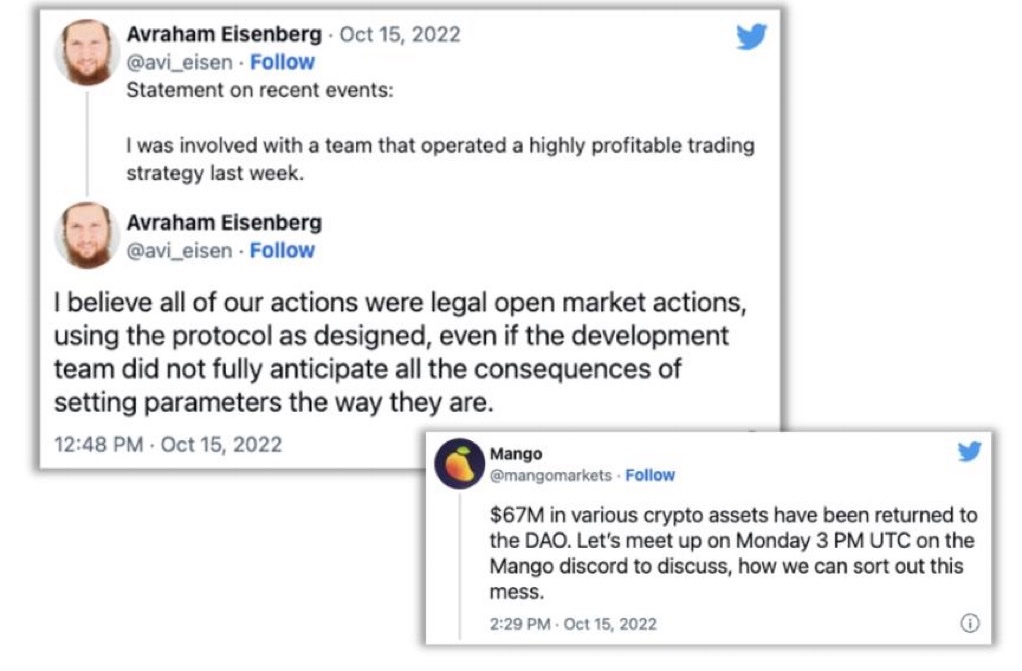
> Avraham Eisenberg deposited money into Mango Markets, a crypto trading platform, across two wallets he secretly controlled.
> He traded the same contract between his own wallets and pumped its price over 1,000% in about 20 minutes.
> The platform's code read his own fake trade as real.
> It let him borrow $110 MILLION in crypto against it, and he walked away with the money.
> Hours later he tweeted from his real account, calling it "a highly profitable trading strategy."
> He offered the platform's users a deal: he keeps $47 MILLION, gives back the rest. They voted yes. He kept the money.
> He was arrested in December 2022.
> A jury convicted him of fraud in April 2024.
> In May 2025, a federal judge threw out every conviction. The platform had no rule against what he did, so legally, he hadn't lied to anyone.
> Prosecutors are appealing.
> But when agents searched his devices at arrest, they found something with nothing to do with the $110 million.
> He pleaded guilty to possession of child sexual abuse material. He's serving 52 months.
He beat the biggest crypto theft case in history on a technicality. The FBI came for the $110 million. They stayed for what was on his laptop.
A DraftKings employee accidentally leaked his own company's secret data. That same weekend, he won $350,000 at their biggest rival. The internet called it insider trading. It triggered an FBI investigation into the entire industry.
– Ethan Haskell was a mid-level content manager at DraftKings, one of the two dominant daily fantasy sports companies alongside its direct rival, FanDuel.
– On September 27, 2015, before that day's NFL games had all kicked off, Haskell accidentally published internal DraftKings data showing which players were being picked most often across every lineup submitted to its "Millionaire Maker" contest.
– That data is only supposed to be released after lineups lock, specifically so no one can use it to gain an edge while games are still live.
– That same weekend, Haskell entered FanDuel's Sunday NFL Millions contest and placed second, winning $350,000 off a $25 entry.
– This is exactly the kind of scandal that keeps sports betting fighting off federal oversight
– The story broke in The New York Times on October 5, 2015, and exploded online, with users accusing him of using inside knowledge from one company to win big at the other.
– Both companies immediately banned all employees from playing daily fantasy sports anywhere, on any site, for money.
– DraftKings hired an outside law firm, led by a former U.S. Attorney, to investigate. It took nearly two weeks.
– The investigation found Haskell hadn't actually received the leaked data until roughly 40 minutes after his FanDuel lineup was already locked, meaning he couldn't have used it even if he'd wanted to.
– That didn't end it. New York's Attorney General opened a formal investigation, demanding both companies turn over records.
– Days later, it was confirmed the FBI and Department of Justice had also opened a separate federal investigation into the wider industry.
– Sports betting and casinos have spent a decade lobbying to keep it this way, a state-by-state patchwork instead of one federal regulator
– So each operator polices itself and each state sets its own rules on payouts, data use, and penalties.
– Reporters then found this wasn't isolated
– A FanDuel employee with access to internal data had also been playing on DraftKings, which FanDuel confirmed.
– Nevada's gaming regulators went furthest of all, banning both companies from the state entirely, ruling daily fantasy sports met the legal definition of gambling and needed a license neither company had.
He accidentally leaked his own company's secret numbers. That same weekend he won $350,000 off their biggest rival. Whether he touched that data before locking his bet became a federal case.
An elderly British man saw £285,700 appear in his William Hill account after a 10p spin. The casino confirmed the win. About 24 hours later, the money vanished, and he later suffered a heart attack.
– John Riding, 76, from Burnley, was playing William Hill’s Cherry Bonanza game on his phone, betting just 10p per spin.
– On March 16, 2026, his account suddenly showed a jackpot of approximately £285,700.
– Riding went to his local William Hill shop, where staff checked his account and reportedly confirmed that he had won.
– He celebrated with other customers and told his family he had received life-changing news.
– He planned to move closer to his grandchildren, buy his granddaughter a car and take his family on holiday.
– Around 24 hours later, the £285,700 disappeared from his account.
– William Hill said the apparent jackpot was caused by a technical glitch that had incorrectly credited money to players' accounts.
– Riding said the dispute left him devastated, and he later suffered a heart attack, spending about a week in hospital.
– William Hill ultimately left his account with just £15.40.
– Riding and other affected players challenged the company's decision, with legal action reportedly being explored over the disputed winnings.
He thought a 10p spin had just secured his family's future. Instead, £285,700 disappeared from his account, and days later he was recovering in a hospital bed. William Hill called it a glitch.