@hug_ge Nous sommes ravis d'annoncer que les résultats de cette étude ont été publiés en libre accès dans le Journal of Endometriosis and Uterine Disorders,
“Strategies for self-management of endometriosis symptoms: An observational study”
https://t.co/4jHA850bFr
Nous sommes ravis d'annoncer que les résultats de cette étude ont été publiés en libre accès dans le Journal of Endometriosis and Uterine Disorders:
“Strategies for self-management of endometriosis symptoms: An observational study”
https://t.co/4jHA850bFr
Vous êtes atteintes d’endométriose? Faites avancer la recherche clinique en participant à une étude sur les stratégies d’autogestion de l’endométriose #recherche#gynécologie#endométriose https://t.co/Mzmc7wpW6A
Vous êtes atteintes d’endométriose? Faites avancer la recherche clinique en participant à une étude sur les stratégies d’autogestion de l’endométriose #recherche#gynécologie#endométriose https://t.co/Mzmc7wpW6A
"New England Journal of Medicine reckons with its racist past and complicity in slavery." NEJM leading the way. @bmj_latest and @TheLancet must follow. https://t.co/SXO9EhxRLy via @statnews
This week is #CoProWeek 2022, and we’re talking all things #coproduction!
What is co-production? Take a look at this handy animation about the key principles that make up co-production and delve deeper in our guidance: https://t.co/KHokZ47FhO
Living in #Geneva, #francophone and suffering from #endometriosis? Take part in this survey to help #researchers at the @Hopitaux_unige learn about our "autogestion" coping strategies. Support research on our invisible disease!
Vous êtes atteintes d’endométriose? Faites avancer la recherche clinique en participant à une étude sur les stratégies d’autogestion de l’endométriose #recherche#gynécologie#endométriose https://t.co/Mzmc7wpW6A
"I have learnt more about what effective patient advocacy and leadership can achieve since then,"
Take a look at this piece from @tessajlrichards in the @bmj_latest on the support she receives from patient networks: https://t.co/nN2Ywe4L9t
@TO_dpr@CIHR_IMHA @KarimKhan_IMHA @Rosie_Twomey@HettyMulhall@srdastouri Brilliant, thank you! Sheesh. I've seen the good, bad, and the ugliest imagineable in PPI! (Including healthy person in lavishly paid job circulating a photo of a cancer survivor who dozed off for a bit in a meeting they went to, snickering about her.) Utterly void of empathy.
📢Our preprint (i.e., not peer reviewed yet) is out! We're 6 #PatientPartners in 🇨🇦 sharing experiences on #PatientEngagement that "goes wrong" - https://t.co/8UVmoewQE1. For reflection, not blame @Sabrina_Poirier @VinaMohabir @ProulxLaurie @suerobinsyvr @JefferySmithME #PPI
Participez au prochain café de la #recherche, mardi 14 mars de 12h30 à 13h30, sur le thème «les conflits d’intérêts dans la recherche», présenté par Monique Caillat, avocate spécialisée en droit de la santé et sciences de la vie #médecine#santé https://t.co/zpnbtZxfcb
A brilliant short film by @UCLHresearch BRC. Involving people of all backgrounds and ethnicities in clinical research is hugely important in identifying treatments that work for everyone. @NIHRresearch 's Be Part of Research programme aims to address this.
https://t.co/gzG3sHZnLE
So far, doctors can't help. My LoCo is treated by two brilliant specialists + supportive GP. All 3 tell me, w great honesty, that they don't know how to help me or their other LoCo patients. They listen, throw supportive measures at symptoms, but There. Is. No. Cure. Yet.
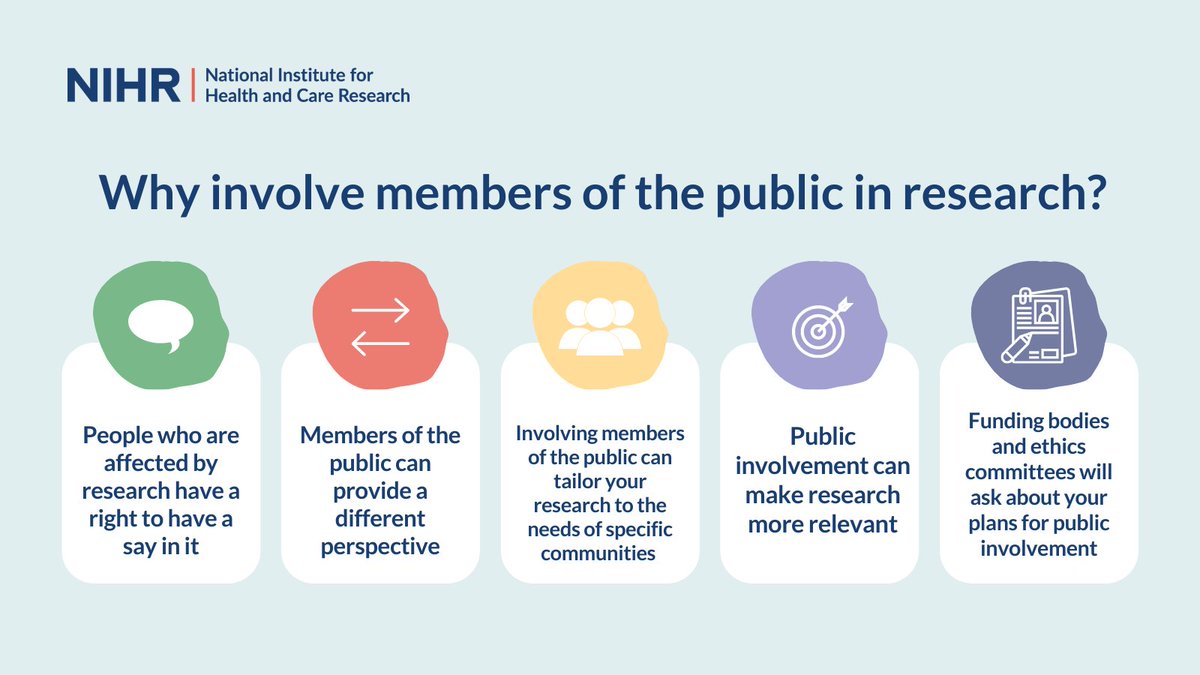
Why involve members of the public in research?
Find out more about why you should involve patients, carers and the public and how to plan, support and resource public involvement in your research in our briefing notes for researchers: https://t.co/HdcZmHeKxm