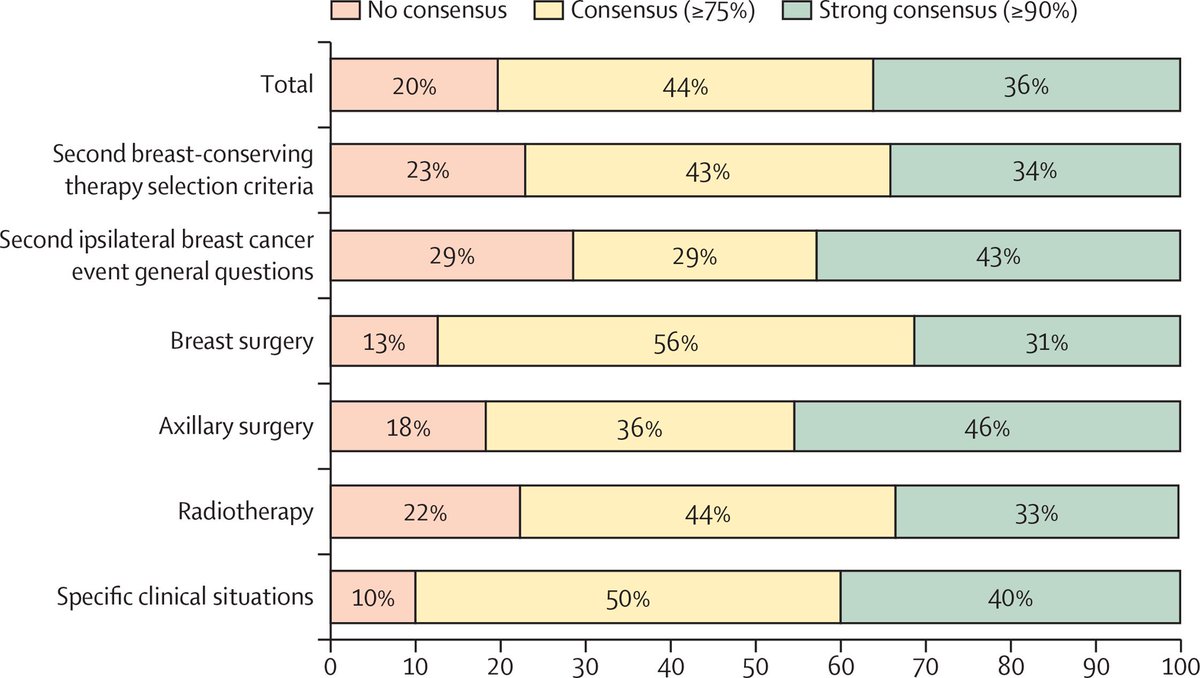
International Delphi Consensus on a Second Ipsilateral Breast Cancer Event
✅ Repeat lumpectomy + PBI re-irradiation: long interval (preferably ≥5 years), small/unifocal tumor, favorable tumor–breast ratio, clear margins feasible, acceptable cosmesis, and no grade ≥3 late RT toxicity.
➡️ Mastectomy: multicentric disease, unfavorable tumor–breast ratio, inability to achieve clear margins, severe fibrosis/poor cosmesis, or grade ≥3 prior RT toxicity.
HER2+ or TNBC alone are not absolute contraindications to repeat BCT.
https://t.co/z5AdVGt3Ec
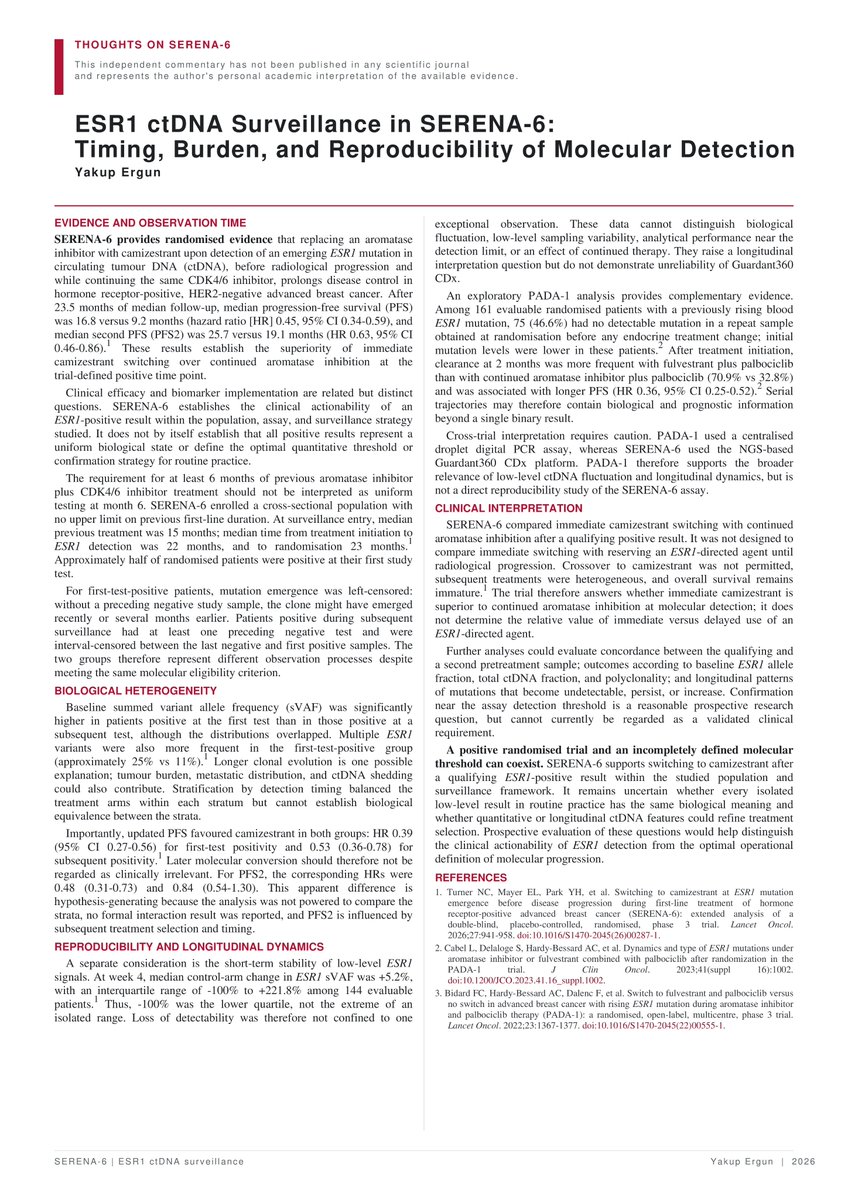
Thoughts on SERENA-6 is a personal commentary that has not been published in conventional academic journals.
From now on, I will share my personal writings in this format as a protest against a publishing system shaped by arbitrary editorial decisions, editors’ personal biases and conflicts of interest, favoritism within professional networks, excessive article processing charges, and the coercive “publish or perish” culture.
In advanced #TNBC and #Her2+ breast cancer, for many it’s not an “if”brain metastases will occur, it’s a “when.” Catching brain disease early can preserve cognitive function and decrease rates of catastrophic complications (herniation/death). We have many effective therapies for breast cancer with CNS disease now and folks can live many many years we need to change with the times and screen!! #bcsm #brainmetastases #Breastcancer
sBRCA alterations are not biologically or clinically equivalent to gBRCA mutations. In this large real-world study, shorter CDK4/6i treatment duration was observed only in gBRCA carriers, while patients with sBRCA alterations alone had outcomes similar to BRCA-wildtype patients.
https://t.co/79LZColNsI
The MONARCH Trials — The Complete Abemaciclib Story
From metastatic HR+/HER2− breast cancer to high-risk early breast cancer, HER2-positive disease, and CDK4/6 inhibitor continuation beyond progression, the MONARCH program has defined the clinical role of abemaciclib across the breast cancer continuum.
This infographic provides a one-glance visual summary of the key MONARCH trials and their major clinical take-home messages.
What trial from the MONARCH program has had the greatest impact on your clinical practice?
#BreastCancer #bcsm #Oncology #MedTwitter #Abemaciclib #CDK46 #MONARCH #MedicalEducation #MVOnco
#SABCS25 | A-BRAVE translational analysis: Baseline TIL ≥30% predicted benefit from adjuvant avelumab in high-risk early TNBC (3-year DDFS 92% vs 59%). No benefit was seen with lower TIL levels. Evidence for TILs as a predictive IO biomarker continues to grow.
https://t.co/Dtn5wWqoFH
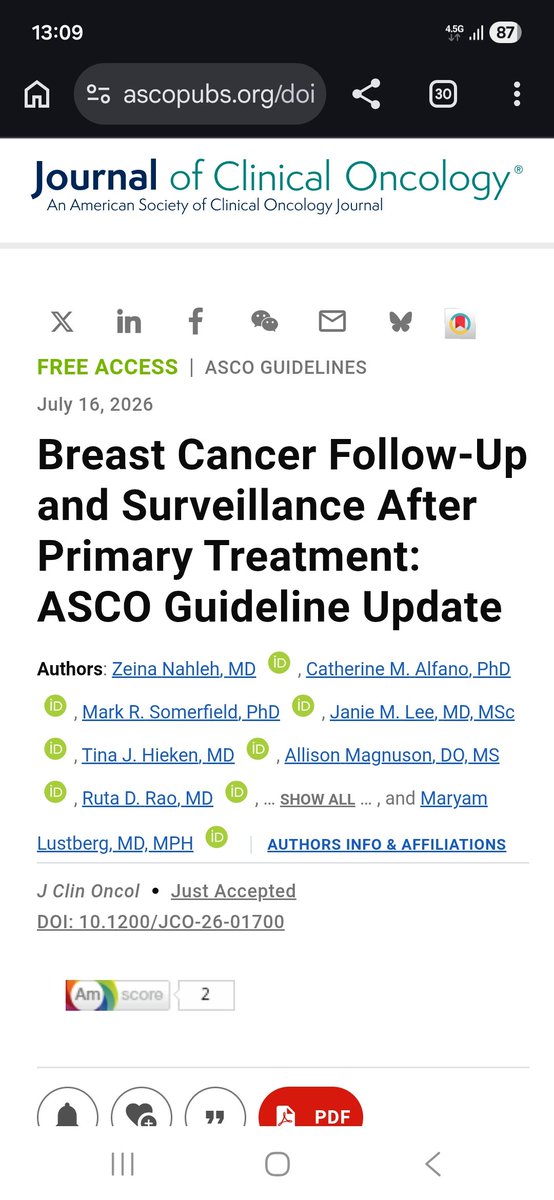
@ASCO proposes risk-adapted follow-up after BC:
Low➡️annually
Intermediate➡️every 6–12 mos for 5–10 years
High➡️every 3–6 mos after active treatment, until year 10!
At year 5, reassess risk; switch to annual follow-up only if low-risk criteria are met!
https://t.co/8t5Pd1JIBQ
🧬 Every cancer cell survives because it finds a way to repair its DNA.
Understanding DNA repair pathways explains why:
✅ BRCA-mutant tumors respond to PARP inhibitors
✅ dMMR/MSI-H cancers benefit from immunotherapy
✅ Platinum chemotherapy works better in HRD tumors
✅ ERCC1 overexpression predicts platinum resistance
✅ DNA-PK is emerging as a radiosensitization target
From BER, HRR, MMR, NER, NHEJ to the Fanconi pathway, these mechanisms form the foundation of modern precision oncology.
Master the biology—and the therapies become much easier to understand.
#Oncology #PrecisionOncology #CancerBiology #DNADamage #DNARepair #PARPInhibitors #BRCA #HRD #MSI #LynchSyndrome #Immunotherapy #PlatinumChemotherapy #MedicalOncology #HemOnc #OncoTwitter #MedEd #FOAMed #DrNB #DMOncology #CancerConceptsExplained
New study looking at the Impact of #BreastCancer Polygenic Risk Score Disclosure on Decisional Conflict Around Risk-Reducing Mastectomy in Women with Pathogenic BRCA1/2 Variants.
https://t.co/66doeBiTJj
@judygarber5
EMERALD-1 Final OS Analysis
Durvalumab ± Bevacizumab + TACE in Unresectable Embolization-Eligible HCC (eeHCC)
Key findings
• Previous EMERALD-1 showed a significant PFS benefit.
• Final analysis showed no overall survival benefit with the addition of durvalumab ± bevacizumab to TACE.
• Combination therapy was associated with higher toxicity and treatment discontinuation.
• PFS improvement did not translate into an OS benefit.
Clinical implication
• Improved disease control alone should not be assumed to improve survival in eeHCC.
• Treatment decisions should balance PFS benefit against toxicity, treatment burden, and cost.
Reference
Sangro B, et al. EMERALD-1 Final Overall Survival Analysis. ESMO GI Congress 2026.
#ESMOGI2026 #HCC #LiverCancer #Oncology #MedTwitter #MVOnco
Can we move beyond chemotherapy in first-line metastatic TNBC?
The BEGONIA Arms 7 & 8 study evaluated the chemotherapy-free combination of Dato-DXd + durvalumab, demonstrating encouraging activity with:
• ORR: 79%
• Complete response: 12.9%
• Median PFS: 14.0 months
• Median DoR: 17.6 months
• Activity observed across PD-L1 subgroups.
While these phase Ib/II results are highly promising, they are hypothesis-generating. Randomized phase III trials are essential before changing standard clinical practice.
What are your thoughts on the role of ADC–immunotherapy combinations in first-line mTNBC?
Reference: Schmid P et al. BEGONIA Arms 7 & 8. Annals of Oncology. 2026.
#BreastCancer #TNBC #mTNBC #ADCs #Immunotherapy #DatoDXd #Durvalumab #Oncology #MedTwitter #MVOnco
CARBOPLATIN MATTERS: Beyond pCR—Improving Survival in Early TNBC
Carboplatin has long been regarded as a strategy to increase pathologic complete response (pCR) in early triple-negative breast cancer. The PEARLY trial suggests its benefit extends beyond pCR, with a significant improvement in long-term event-free survival.
Key findings
• 868 patients with stage II–III TNBC
• 5-year EFS: 82.3% vs 75.1%
• Absolute EFS gain: +7.2%
• HR 0.67 (33% relative reduction in EFS events)
• Benefit observed in both neoadjuvant and primary surgery → adjuvant settings
• Higher hematologic toxicity, while quality of life and patient-reported neuropathy were preserved
These findings reinforce carboplatin as an evidence-based chemotherapy intensification strategy in early TNBC, particularly when immune checkpoint inhibitors are unavailable or unsuitable.
Reference: Kim GM, et al. PEARLY Trial. Annals of Oncology. 2026.
#BreastCancer #TNBC #MedicalOncology #Oncology #AnnalsOfOncology #MVOnco