Around 2012, I was struggling to find my place in tech.
Then Facebook posted a photo of its engineering team and I saw a Black engineer who looked like me.
I later learned he was Nigerian. His name was Ola.
That moment made the dream feel possible.
I kept that photo as my screensaver for 3+ years. Every time I felt like quitting, I reminded myself: “If he can do it, why not me?”
Today, @ola works at OpenAI.
And after 14 years, I finally get to meet him.
You never know who’s watching you… Or whose life you’re changing just by showing up.
@alat_ng@alat_ng I received a credit alert but my balance isn't showing the payment. Can you fix that? I have people waiting to receive transfers from me
I have this guy that I used to patronize for my gadgets. He had a store at computer village. He had workers too.
I liked using him because he would make things convenient. Pick up and delivery if I have issues.
Very effective.
Last election, he stood on the mandate.
I tried to reason with him but he wasn't having it.
Fast forward today, his shop has closed down and his work now is to run errands for phone repairs or purchase.
I wanted to stop using him, but the way he aged, and the fact he was good to me, and he has children to feed, I feel bad for him.
I suppose done block am but my heart no gree me. Plus I want to see who he campaigns for at the next election.
Nigeria Is Bleeding From Within
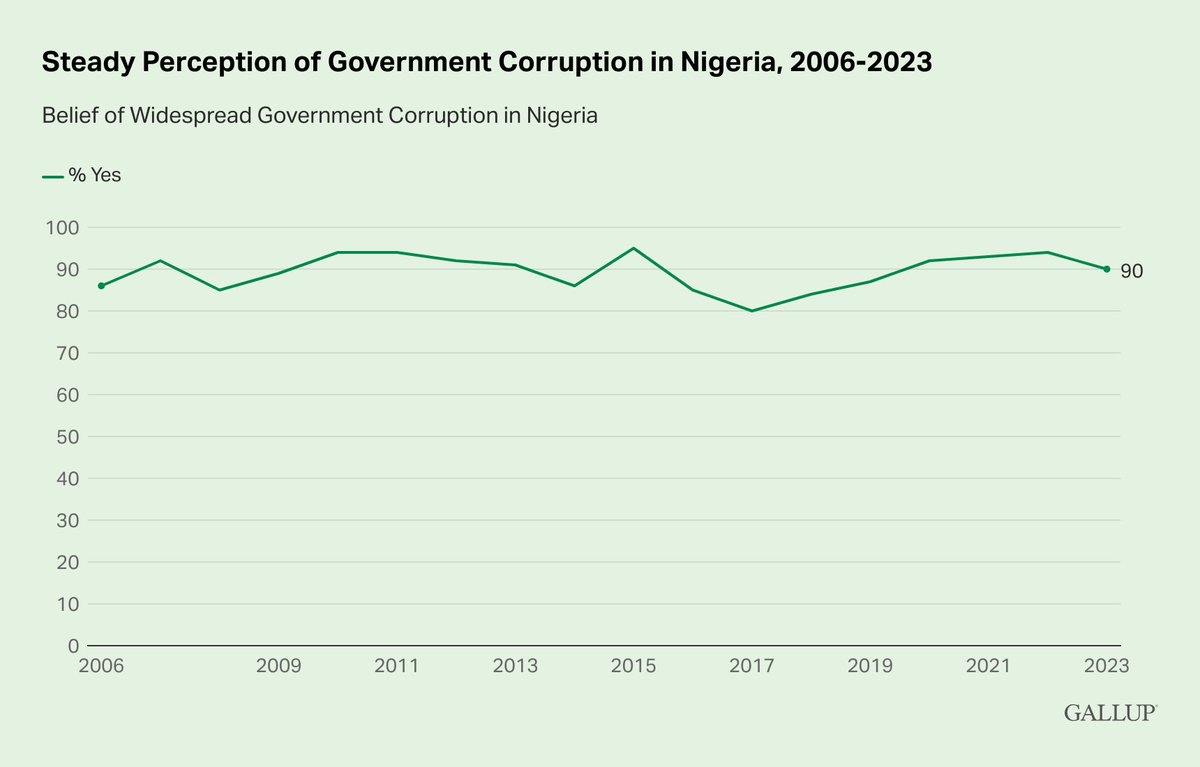
It is deeply troubling to read recent World Bank reports indicating that, while Nigeria’s Federation Revenue surged to ₦84 trillion in just three years, a staggering 41% —amounting to ₦34.44 trillion —never reached the Federation Account. This sum exceeds the combined ₦34 trillion earmarked for capital projects in the 2024 and 2025 Appropriation Bills, a comparison that underscores the gravity of the situation and signals that something is fundamentally wrong.
This is not a mere oversight; it points to institutionalised corruption on a massive scale. In 1994, when the Okigbo Panel reported about $12.4 billion from the Gulf War oil windfall as unaccounted for, Nigerians were outraged and the nation shook with indignation. Today, an even more troubling situation appears to be unfolding, yet it is met with a disquietening silence.
We are trapped in a lethal paradox: Earning more as a nation, yet having less to invest in healthcare, education, and infrastructure. From 2025, systemic “deductions” have allowed agencies to capture more resources than entire states and even critical ministries.
These leakages explain why countries with fewer resources are out-performing us across key development indices. With such a broken system, how can we fix power, strengthen our schools, build resilient healthcare, or develop critical infrastructure?
Nigeria has no business being poor. We must stop these leakages through disciplined, transparent leadership driven by character. It is time to redirect our hijacked resources back to the people and move Nigeria into the league of developed nations.
With our collective resolve to change this corruption-infested system, a New Nigeria is POssible. -PO
From Pharisee to Tax Collector: Rethinking Tinubu’s Kenyan Comparison
In a recent remark in Yenagoa, Bola Ahmed Tinubu suggested that Nigerians should find solace in being “better off than Kenya and other African countries.” While this may have been intended to soften the impact of economic hardship and rising fuel prices, the comment risks downplaying the severity of the current crisis. It echoes the biblical parable of the Pharisee and the Tax Collector in the Gospel of Luke (18:9–14). A similar warning is found in the Qur’an (53:32), which cautions against self-righteousness.
Like the Pharisee who boasted of his superiority over others to mask his own spiritual void, such downward comparisons serve more as a refuge than a remedy. This validated an earlier dismissive remark by President Ahmed Bola Tinubu during electioneering: “Na statistics we go shop?” Yet statistics remain indispensable - they are the language through which nations understand their condition and chart progress. No country can develop in isolation from measurable realities or without comparing itself with peers. Comparisons, when properly grounded, are not instruments of escapism but tools of accountability. What is objectionable is not comparison itself, but comparison stripped of credible, verifiable data—mere tax collector comparisons that soothe rather than solve.
On key development indicators such as security, the Human Development Index, life expectancy, GDP per capita, literacy levels, and electricity access, Kenya consistently outperforms Nigeria. Nigeria is the fourth most terrorised nation in the world, while Kenya is not among the ten worst. Kenya’s HDI ranking is 143 out of 180 countries, with a coefficient of about 0.630, compared to Nigeria’s ranking of 164 out of 180, with a coefficient of about 0.530. Its GDP per capita is roughly $2,200–$2,300, compared to Nigeria’s $807–$835. Kenya’s poverty rate is about 43% of the population (approximately 23 million people), while Nigeria’s is about 63% (around 150 million people), over six times that of Kenya. Kenya’s life expectancy is about 67 years, while Nigeria’s is about 54 years. The literacy rate in Kenya is approximately 81–85%, compared to Nigeria’s 62–65%.
Kenya’s electricity access is higher, while Nigeria has one of the lowest levels of electricity access in the world. Kenya has about 3.5 million out-of-school children, while Nigeria has about 20 million. Kenya’s inflation rate has been about 4.5% or lower over the past three years, while Nigeria’s has remained above 15% within the same period. Kenya’s exchange rate has been around USD 1 to KES 130 over the past three years, whereas Nigeria’s exchange rate rose from below ₦500/$1 to above ₦1,250/$1 within the same period. Even with developments in the Middle East and rising oil prices, Kenyans have not experienced the sharp increases in petroleum product prices seen in Nigeria.
Across other key indicators, Kenya also performs better. In the end, these indices clearly show that Kenya ranks higher than Nigeria on several development metrics. The standard of living of Kenyans is better than that of Nigerians. If the President considers Kenyans to be suffering despite these stronger figures, then Nigerians are in a far more difficult situation. He should therefore refrain from self-consolation and, in honest reflection, take responsibility for the situation and make a determined effort to drive improvement. This requires a posture of humility, accountability, and commitment to addressing the factors that have slowed Nigeria’s development.
A new Nigeria is POssible. -PO
One of my favourite short form stories is the one told by Leo Tostoy.
It's called "How much land does a man need."
It tells the story of a peasant named Pahom, who believes that if he only had enough land, he wouldn’t fear anything—not even the devil.
Here's how it goes:
Pahom lives a simple life but envies landowners. When he finally gets the chance to buy some land, he feels satisfied… briefly.
Soon, he wants more. And when he gets more, he still isn’t content. The more land he acquires, the more greedy and restless he becomes.
One day, he hears of a distant group of people- the Bashkirs— who are willing to sell land at a very cheap rate.
This is where it gets interesting:
Their deal is simple:
For a fixed price, you can have as much land as you can walk around in a single day.
But there’s a catch — you must return to your starting point before sunset, or you lose everything.
Excited, Pahom sets out early in the morning. As he walks, he keeps pushing further, thinking, “Just a little more land… just a bit more.”
He ignores the heat, exhaustion, and time.
By afternoon, he realizes he’s gone too far and must rush back before sunset. Panicked, he starts running. His body is failing, his breath is heavy, but greed drives him forward.
Just as the sun is setting, he reaches the starting point and collapses.
Dead.
In the end, his servant buries him in a grave.
Six feet long.
The lesson:
All the land he chased…
All he truly needed…
was enough to be buried in.
I hope that answers the question of how much money is really enough money
There are three ministries in Nigeria that, if they truly worked together, could make life easier for Nigerians while generating billions of dollars in revenue every year.
But for that to happen, we need leaders who are willing to put Nigeria first.
The three ministries are:
1. Federal Ministry of Transportation
2. Federal Ministry of Marine and Blue Economy
3. Federal Ministry of Art, Culture, Tourism, and Creative Economy
These ministries control sectors that could make Nigeria feel like heaven on earth.
Take tourism for example.
Nigeria’s tourism industry contributes roughly $4–5 billion annually.
Now compare that with the Philippines, where tourism generates close to $100 billion every year.
Yet Nigeria has more cultural diversity, more festivals, a globally influential music industry, and one of the largest film industries in the world.
Now look at the maritime sector.
The Philippines earns roughly $16–25 billion annually from maritime and ocean industries.
Nigeria earns about $6–8 billion.
Yet Nigeria has the largest port economy in West Africa, massive oil shipping activity, a long Atlantic coastline, and one of the biggest consumer markets in Africa
The opportunity is there… but corruption and poor coordination continue to slow progress.
The last time I visited the Philippines, I traveled from Manila to Cebu, then to Bohol, and back to Manila on a Ro-Pax vessel.
That journey made me imagine how transformative such a system could be in Nigeria.
Nigeria has eight coastal states that touch the Atlantic Ocean:
• Lagos State
• Ogun State
• Ondo State
• Delta State
• Bayelsa State
• Rivers State
• Akwa Ibom State
• Cross River State
In addition, several inland states are connected to the ocean through river systems flowing into the Niger Delta, including:
• Anambra State
• Edo State
• Benue State
• Niger State
• Kogi State
If Nigeria fully developed inland water transport, cargo and passengers could move by boat from inland states like Kogi, Anambra, and Benue to coastal cities.
A Ro-Pax vessel earns from two main streams:
• passenger tickets
• vehicle and cargo transport (cars, buses, trucks)
A typical medium Ro-Pax ferry carries:
• 800–1000 passengers
• 150–200 vehicles per trip
Now imagine Nigeria building 10 major Ro-Pax routes across its rivers and coastline, operating about 20 vessels.
Routes could include:
• Onitsha to Port Harcourt
• Warri to Lagos
• Lokoja to Delta State
Each vessel could generate tens of millions of dollars annually.
Across the network, that is over $600 million in direct revenue every year.
Once tourism, logistics, port activity, hotels, restaurants, and trade are factored in, the total economic value could exceed $2.4 billion annually.
And guess what? With this, we have reduced pressure on highways, lower logistics costs, reduced congestion at airports, and created thousands of jobs.
Countries like the Philippines and Norway use Ro-Pax ferry networks as national transport infrastructure.
Now imagine Nigeria expanding that vision further.
Imagine tourism and waterway agreements with other West African countries.
• Lagos to Tema in Ghana
• Benin Republic to Bonny Island
• Coastal ferry routes across the Gulf of Guinea
The opportunities are PLENTY.
We have the resources.
We have the geography.
What we need is leadership that puts the country first.
Because with the right vision and the right people in government, Nigeria can truly become heaven on earth.
The funds we spend on presidential yachts, unnecessary renovations, or buying cars for judges, etc could build infrastructure that benefits millions of Nigerians. But we have leaders who are blind to this. Selfish leaders.
Nigeria is supposed to be a 1st world country.
The attached picture is what a ro-pax vessel looks like.
It accommodates both passengers and cars/trucks, etc.
A friend who was running a government PPP establishment in Nigeria once came to Ghana with his colleagues for strategy sessions and meetings, and he reached out to me. We met at the African Regent Hotel, and I took him to our office at East Legon.
He kept repeating that he was impressed we had a real office and people working on things that regularly brought in money, without depending on government contracts.
I didn't quite understand what he meant until he explained that 99% of the people who came to him to get things done didn't have a going concern. Most companies existed only on paper, and they planned to sell the deals to foreign third parties.
They decided to work directly with those third parties and cut out all the middlemen, but some things still slipped through. He said the headache he had was that people in government were making referrals he could not easily refuse. I understood what he meant, as I once stayed a month in Abuja.
I was mainly at a relative's guest house, and they were hustling daily because they had a thriving business. There were also people around us who did almost nothing every day but partied at night, only to end up with contracts. There is an entire ecosystem of people like these who facilitate corruption.
Many of them are here with us on Twitter, and they will be the first to criticize bad governance. There was a particular guy I knew from school who did that for about a decade, from 1999 to 2009, before he decided to run for office. He lost his election and then ended up as a politician's special assistant. He became the corruption interface.
The last time I saw him at the airport in Abuja, he looked quite prosperous and asked why I hadn't come to look for projects with him. I told him I loved sleeping well at night, and he laughed so hard. I was being truthful. I can't forget the time we worked on a project for a major parastatal, and someone called us at 3 am to leave town, or we'd lose our lives.
I had to relocate my team to another hotel and left town the next day with 8 million Naira still outstanding from them. The Director of Welfare for that parastatal was assassinated that week. They had zero accounts, and everything was fabricated. We were putting systems in place and had asked the Chief Accountant for bank statements to prepare a trial balance. They didn't like that.
We escaped with our lives and decided to avoid public sector jobs from then on. My friend who came to Accra offered a partnership, but we declined. There were more stress-free ways to make money.
The @BudgITng guy who was recently attacked brought back all these memories.
My father never came to a single thing I invited him to.
Not my primary school graduation. Not my secondary school prize giving where I collected 3 awards and kept looking at the gate. Not my university matriculation. Not the ceremony when I got called to bar in 2012. I'd send him the date weeks in advance and he'd say I'll try and that was always the full sentence. I'll try. No follow up. No explanation after.
My mother would sit in his place and clap loud enough for 2 people.
I stopped inviting him after the bar call. Not from anger. Some people love you completely and still cannot show up and after a while you stop making them feel guilty about it.
He was not a bad man. I want to be clear about that.
He was a mechanic in Mushin for 35 years. Worked 6 days a week. Sent every one of us to school. Never raised his hand. Never left. The lights stayed on and the rent was paid and there was always food and he did all of it quietly without asking to be celebrated.
He just could not sit in a plastic chair and watch something.
I accepted that and moved on.
Last year I bought my first property. A flat in Ojodu. Took 9 years of saving and 2 years of paperwork and a lawyer who nearly finished me. When the keys finally came I sat in the empty flat on the floor for an hour just breathing.
I called my mother first. She screamed. My sister cried.
I didn't call my father.
3 days later he called me.
Said he heard about the flat from my mother. Said he wanted to come and see it.
I didn't know what to do with that so I just said okay. Gave him the address. Figured he'd say I'll try and we'd never speak of it again.
He showed up on Saturday at 9am.
Stood at the door in his good agbada. The one he only wears for serious things. Holding a small nylon bag.
I let him in and he walked through every room without speaking. Not quickly. Slowly. Like he was counting something. He checked the pipes under the kitchen sink. Knocked on the walls. Opened and closed the windows twice each. Looked at the ceiling in every room the way only a man who has fixed things his whole life looks at ceilings.
Then he came and stood in the sitting room and looked at me.
Said the pipework is good. Said the windows seal properly. Said whoever built this knew what they were doing.
I nodded.
Long silence.
Then he opened the nylon bag.
Inside was a small framed photo. Me at maybe 7 years old sitting on the bonnet of an old car in his workshop. Grinning. Both legs swinging. He's standing beside me with his hand on my shoulder looking at something outside the frame. I remember that day. I had gone to the workshop after school and he let me sit there while he worked and gave me a Fanta and put a Michael Jackson cassette on the small radio.
I didn't know anyone had taken a photo.
He said he kept it on his workshop table for 22 years. Said he wanted me to have something for the new place.
I held that frame and stood very still.
He said he knew he missed things. Said he was not good at the sitting and watching. That crowds made something in him go wrong in a way he never knew how to explain.
Then he said the flat was good and he was proud and he asked if there was anything in the kitchen because he hadn't eaten.
I laughed.
Made him eggs and bread while he sat at my kitchen table in his good agbada like he owned the place.
We ate and he told me about a car he was working on. I told him about a case that was giving me trouble. Normal conversation. The kind we should have been having for years.
He left at 1pm. At the door he gripped my shoulder the same way he did in that photo.
Didn't say anything.
Didn't need to.
The photo is on my sitting room wall now. First thing I hung in the whole flat.
Some fathers cannot sit in the plastic chair.
But mine drove to Ojodu in his good agbada on a Saturday morning with a 22 year old photograph in a nylon bag.
That was his standing ovation.
I just didn't know to look for it in that shape.
Let us reflect, sincerely and without sentiment.
In the past few days, the President has reportedly approved ₦3.3 trillion as a “full and final” payment for debts in the power sector. Yet, this is not the first time such approvals have been made.
On May 17, 2024, ₦3.3 trillion was approved for the same purpose. On July 25, 2024, another ₦4 trillion bond was approved to settle similar debts. There have also been other approvals in between, all targeted at addressing the same power sector liabilities.
This raises a fundamental question: were the previous approvals mere announcements without execution?
₦3.3 Trillion Again? Nigeria’s Power Crisis Without End
During the 2023 campaign, President Bola Ahmed Tinubu made a clear promise: that if he failed to deliver stable electricity, Nigerians should not re-elect him. Today, the reality is that power supply has worsened, to the extent that there are even discussions about disconnecting the Presidential Villa from the national grid.
Each time legitimate concerns are raised, what we see appears more like policy pronouncements than measurable progress.
Now, again, we are confronted with another ₦3.3 trillion approval to settle power sector debts.
These debts were largely accumulated under successive administrations of the All Progressives Congress between 2015 and 2025. This raises serious concerns about accountability, transparency, and effectiveness in public financial management.
It is important to note that government institutions and agencies, including the Presidential Villa owe a significant portion of these debts. Year after year, budgets were made and funds appropriated. Why then were these obligations not settled when due? And from what source will this new payment be made? Are we resorting once more to borrowing to service inefficiencies?
Key questions remain unanswered: How did the debt accrue? What is the actual total debt in the power sector? Which components of the debts are due to operators’ inefficiency and should be borne by them? Why have previous approvals not translated into tangible improvements? Who are the real beneficiaries of these repeated payments?
Is the ₦3.3 trillion approved on April 6, 2026, the same as the ₦3.3 trillion approved in May 2024, and how does it relate to the ₦4 trillion bond approved in July 2024?
Nigeria must move beyond recycled announcements and confront the power sector crisis with sincerity, transparency, and decisive reforms.
Until we do so, we will remain trapped in a cycle of debt and darkness.
But with discipline, accountability, and the right leadership, a new Nigeria is still possible. -PO
This is one thing we have to unlearn. When the market is very large, and potential competitors are not capitalizing on their advantage, you NEVER play the "start-lean" game.
People keep talking about Opay but forget the other elephant in the room: PalmPay. Opay had to raise a lot and fight like mad, not only against well-funded Nigerian financial institutions but also against a well-funded Chinese-owned competitor.
The skills and resources required to fight at this level, sadly, are very limited within our local startup ecosystem, as people have not learned to build very fast and sell very fast to learn, earn, and grow. We keep waiting for incremental investments.
If we have seen how this works with Opay and others for Fintech, why can't it be repeated in Healthtech or even Education, for instance?
The energy sector is another good example. What Dangote did is the equivalent of Opay for the energy sector. Distribution is still wide open, and renewable energy also needs to be done at a sufficient scale as China did.
The thing I still admire Opay for is that the banks didn't see them coming, as they were too afraid of the telcos and were trying to frustrate telco mobile payments without realizing that their flank was exposed by online banking.
While startups were talking about building neobanks to compete with existing banks, Opay and others just built and scaled without trying to fight anyone. Their agents even initially created more transaction volume for the banks.
Their apps sell more airtime and data plans for telcos than the existing dealer network does. Everything moved online much more rapidly because Nigerians got cheaper smartphones. The telco curse is regulation and reliance on ancient vendors to build their tech.
This is a masterpiece in timing and execution backed by the right amount of capital and less wishful thinkingul thinking. We should learn well from it and replicate it in other sectors.
Yesterday defenders of democracy, today's destroyers, What a shame.
What an irony of history, that the acclaimed defenders of democracy and human rights who claimed to have fought for democracy during the era of General Sani Abacha now find themselves worse than the man they opposed.
Today, General Sani Abacha, once presumed face of oppression, will be remembered as seemingly more democratic and more respectful of human rights than the so-called champions of activism from the NADECO days. Power indeed reveals character.
A New Nigeria is POssible. -PO
“Tell Daddy to come back, Daddy where are you?’”😢💔
-A heart-wrénching video shows a young girl identified as Kushim weeping inconsolably during the burial of her father who was k!ll£d in a recent Plateau att@ck.