Deeply saddened by the passing of @HelenBranswell, a journalist of integrity and professionalism. Throughout her career, Helen demonstrated an unwavering commitment to evidence, science and truth, helping the public understand some of the most complex and consequential health challenges of our time. At a moment when misinformation competes with facts, her reporting was a trusted source of clarity, honesty and insight.
We at @WHO were privileged to work with Helen over many years, whether through one-on-one interviews or the hundreds of press conferences she attended during COVID-19 and beyond. Her questions were always informed, thoughtful and fair, reflecting a deep commitment to helping the public understand the facts and their implications for health.
On behalf of WHO, I extend my sincere condolences to Helen’s family, friends and colleagues. She will be greatly missed.
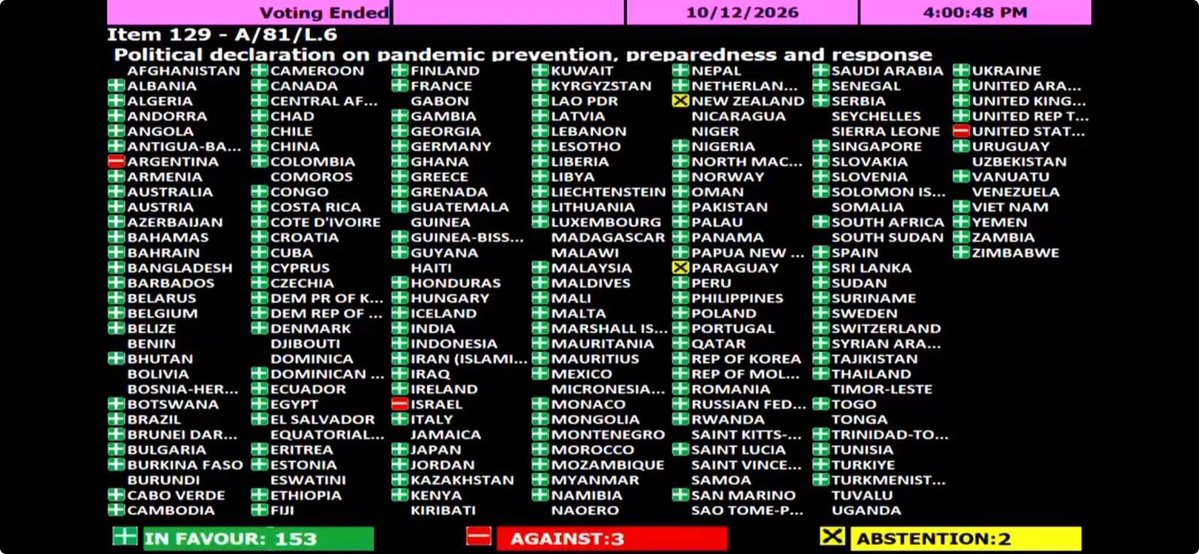
Overwhelming support at #UNGA for the political declaration on pandemic prevention, prepardness and response: 153 for, 3 against and 2 absentions. National sovereignty and international cooperation are not mutually exclusive, they're mutually reinforcing.
‘Australia without migrant workers’
Who made this? 👏
Mandatory viewing for any fool who still doesn’t understand the implications of slamming the gates shut.
For decades, dependence on fossil fuels meant dependence on volatility. In past oil shocks, countries had little choice but to absorb the pain.
Now they have an exit ramp: Homegrown renewable energy has never been cheaper, more accessible, or more scalable.
The resources of the clean energy era cannot be blockaded or weaponized. There are no price spikes for sunlight & no embargoes on the wind.
The fastest path to energy security, economic & national security is clear:
Speed up a just transition away from fossil fuels & toward renewable energy.
🩸 Did you know: 1 blood donation can save up to three lives?
Blood transfusion saves lives and improves health, but many patients requiring transfusion do not have timely access to safe blood.
@DrJBhattacharya@DrJBhattacharya, she says the opposite of what you're saying: "we haven't recommended the use of so-called lockdowns," and then, "we do recognize that some countries and some areas have had to use so-called lockdown measures because they needed to buy themselves some time".
Did you know that stopping infections today can prevent cancer tomorrow?
1 in 10 cancer cases are caused by infections. But many of these cancers are totally preventable through vaccines, antibiotics and early treatment.
Watch the daily dose to learn more.
2/ Some still say @WHO was “too slow” to declare a PHEIC. Much of this rhetoric reflects hindsight bias and politicization.
Decisions were made with the information available at the time as events unfolded — Context is important.
https://t.co/etxv7IMlY8
🧵#COVID19: six years on
1/ Six years ago today, @WHO declared the novel coronavirus outbreak a Public Health Emergency of International Concern (PHEIC)- the highest level of alarm under international health law at the time
This pandemic has changed global health forever.
@DrJBhattacharya@WHO No, we said we didn’t recommend lockdowns. You won’t find lockdowns recommended as a policy option in any WHO guidance. Surely you know the difference between an active recommendation and not opposing a country making a choice between lockdowns or more death?
The @WHO tweet doesn’t recommend or push anything. It acknowledges that some countries use these measures when health systems are overwhelmed and notes they’re not sustainable. It’s descriptive, not prescriptive.
The WHO doesn’t have the power to “push the world into” anything anyway. Countries made their own decisions.
We’re six years out and still endlessly relitigating 2020 while measles continues to spread uncontrollably and vaccine confidence is cratering. Can we please focus on the actual crises in front of us?
@DrJBhattacharya I will give this 1 try. I am looking at your inciting tweets with astonishment. You probably group me in the box of lock down pushers. I wonder if you ever have been in a public health crisis advisory role, hospital outbreak management team, employer health
@sebastian_paul@jakescottMD@MarionKoopmans@DrTedros@WHO No, we didn’t. But if you can’t understand the difference between actively recommending something and not opposing a choice that is the lesser of two evils, I can’t help you.
@sebastian_paul@jakescottMD@MarionKoopmans@DrTedros@WHO If you are trying to protect your house from a forest fire, there sometimes comes a point where you have to give up protecting your house to protect yourself. It’s a terrible choice to have to make, but in that situation, it’s a necessary choice. Same in this case.
@sebastian_paul@jakescottMD@MarionKoopmans@DrTedros@WHO But you will not find in any WHO guidelines a recommendation that countries use lockdowns to stop COVID-19. It’s not a policy option that we recommended. We simply acknowledged that some countries had no options left, and supported them to do as they saw best.