🚨 New Fortinet vulnerability being exploited as an 0-day
CVE-2026-35616 - FortiClient EMS pre-authentication API access bypass - CVSS 9.1 Critical
After observing in-the-wild exploitation of this vulnerability earlier this week, Defused reported it to Fortinet under responsible disclosure.
Fortinet has released an emergency hotfix - plus a scheduled patch - for FortiClient EMS 7.4.5 and 7.4.6.
The vulnerability allows an unauthenticated attacker to bypass API authentication and authorization entirely, unauthorized code or commands via crafted requests.
This discovery was made through our upcoming Radar feature launching next week 😇
Advisory: https://t.co/Jr2fUbq8JV
Track exploitation of this and other Fortinet vulns in real time and get updates on the new Defused Radar 👉 https://t.co/iRDhHlDkep
Credit also to @heckintosh_ for independently discovering this vulnerability 💪
🚨 We are observing probing of Apache Roller for CVE-2026-129448, the unauthenticated RCE that Apache has warned is exploited in attacks.
The requests POST a serialized Java object to /roller-services/xmlrpc using the ex:serializable extension type. The object is an empty placeholder class, so this is a check for whether the server deserializes untrusted data before auth. That pathway is the exploit surface for the RCE.
If you run Roller, upgrade to 6.1.6. If you can't, remove the XML-RPC servlet mapping. Disabling XML-RPC in the admin UI does not block this.
Track exploit intelligence 👉 https://t.co/juLcSVcx7Q
🚨 During the past 24 hours, we have observed probing of N-able N-central for the 0-days that were dropped publicly yesterday.
We have seen opening of anonymous agent sessions, pulling appliance config and hitting the remote control endpoint without auth. These pathways are part of the 0-day exploit surface.
If you run N-central exposed, take it off the internet now.
Track exploit intelligence 👉 https://t.co/juLcSVcx7Q
🚨During the past 24 hours, we have observed a small amount of actors targetting SSHole (CVE-2026-123158)
Exploitation is not widespread yet, but is showing an early accelerating trend.
Track exploit intelligence 👉https://t.co/FMlpPAiZfm
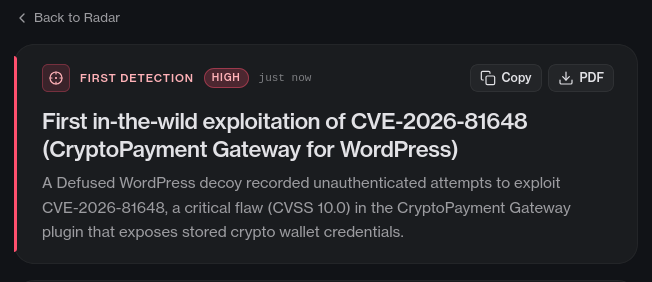
🚨 We are observing in-the-wild exploitation attempts against CVE-2026-81648, a critical (CVSS 10.0) flaw in the CryptoPayment Gateway for WordPress. There’s been no prior public report of this vulnerability being exploited in the wild.
This vulnerability lets anyone read a site’s stored payment-gateway settings, including wallet credentials held in cleartext, and overwrite that configuration.
The attacks we recorded came from infrastructure that markets themselves as "Anonymous KYC-Free VPS Hosting."
Full IOCs on Defused Radar 👉 https://t.co/TTnxgi9Hv5
🚨 Our Oracle E-Business Suite decoys recorded exploratory exploits against CVE-2026-101767, an unauthenticated SQL injection in EBS's Thin Client Framework servlet that chains to remote code execution, this morning, Oct 27.
The bug was recently disclosed by @Horizon3ai and patched in Oracle's October CPU. No public report exists of this CVE being attempted in the wild.
Full IOCs on Defused Radar 👉 https://t.co/TTnxgi9Hv5
⚠️php2shell (CVE-2026-109618 and CVE-2026-109619): we’re seeing “P2SB” multipart probes hitting our Palo Alto GlobalProtect honeypots.
The requests carry a PHP_SESSION_UPLOAD_PROGRESS marker (“p2s-rider”) and a dummy file upload with no payload, which points to someone checking for the vulnerable upload-progress behavior and likely building a target list of Palo Alto devices.
Source is a known mass-exploit IP: 204.76.203.]7 (AS51396 Pfcloud UG, NL)
Track php2shell exploitation on Defused 👉 https://t.co/TTnxgi9Hv5






![DefusedCyber's tweet photo. ⚠️php2shell (CVE-2026-109618 and CVE-2026-109619): we’re seeing “P2SB” multipart probes hitting our Palo Alto GlobalProtect honeypots.
The requests carry a PHP_SESSION_UPLOAD_PROGRESS marker (“p2s-rider”) and a dummy file upload with no payload, which points to someone checking for the vulnerable upload-progress behavior and likely building a target list of Palo Alto devices.
Source is a known mass-exploit IP: 204.76.203.]7 (AS51396 Pfcloud UG, NL)
Track php2shell exploitation on Defused 👉 https://t.co/TTnxgi9Hv5](https://pbs.twimg.com/media/HVdLZIPWgAAJREU.jpg)
![SimoKohonen's tweet photo. "Your website is vuln. Contact blue team https://pentest-tools.]com/ now and update ur webapp fast."
This can't be legitimate 😂 https://t.co/Qv6yjShMoR](https://pbs.twimg.com/media/HVP2P2iWoAAiMzE.jpg)





