Cursor's coding agents can now use your whole computer.
Computer Use lets them click and type in any desktop app, not just the browser, so they can run the iOS Simulator to test what they built. It kicks in on its own when a task needs it. Update Cursor to get it.
Artificial Analysis moved its Coding Agent Index to v2.0, adding Cognition's FrontierCode, where tasks are graded on whether a maintainer would merge the change. Merge-readiness is a more honest bar than tests passing.
@MattMillsReal@bot ha yeah mine hands repo stuff off to a cloud agent too and it comes back with a PR. a whole CRM is a big ask though, curious how far it gets before it needs you to make a call on something
the new coding agent index from @ArtificialAnlys knocked almost every setup down (20 of 21 configs dropped, mean 54.8 to 47.4) just by swapping in harder tasks
opus 5.5 in claude code still leads at 61.7
kinda makes me trust last month's leaderboards less. which benchmark do you actually check before switching?
DuckDB 2.0's new agent mode cut the query output a coding agent reads by 59%. Total input dropped by only about 0.5%.
That's from DuckDB's own test. The system prompt the agent re-reads every turn is much bigger than any query result, so the saving barely shows up in cost or runtime.
What agent mode does: when Claude Code, Codex, Cursor, Gemini CLI or Copilot runs duckdb with output going to a pipe, results come back as compact Markdown tables with the type in each header. Results over 1,000 rows or 10,000 bytes are cut to the first and last 20 rows, with a line saying how many were left out. Errors come back as JSON, and a query that returns millions of rows gets stopped early.
So don't expect a smaller bill. The real win is that a cut-off result is marked right in the table, and one huge result can't flood the context.
It stays off if you pass -csv, -json or -markdown. -no-agent turns it off, and .show tells you which agent it detected.
One thing before you upgrade: DuckDB versions before 2.0 can't open database files that 2.0 creates. Your existing files still work in both. If a 1.x process in CI or on a teammate's machine has to open a file your agent just created with 2.0, it will fail.
@AIchanyi the "who should respond to which piece of feedback" part is the one I keep tripping on. do you route review comments back to whichever agent opened the PR or does it figure that out itself? I mostly just keep it one agent per PR so I don't have to think about it lol
I prefer working with my Claude Code agent on my PRs instead of in the chat sessions. Why?
- Shows the context of why key decisions is made.
- Provide audit trail for your team to catch up.
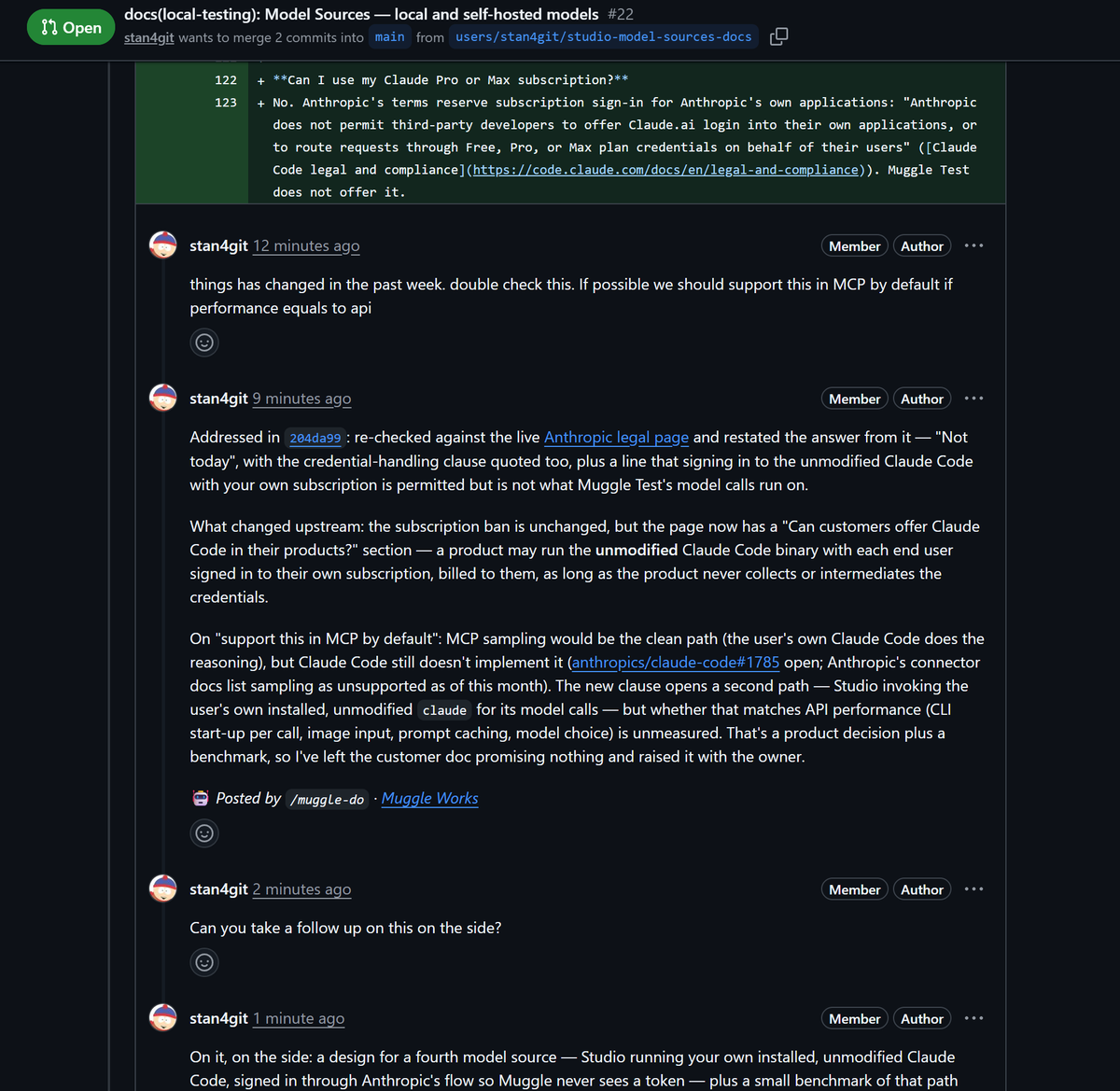
- Adjust the design as conversation goes, with full context in the coding agent.
- Cascade changes to all the implementation PRs, with the updated design.
Try us: https://t.co/ZIgQ69gIVe
Install in Claude Code:
/plugin marketplace add https://t.co/w58NvxLXCa
/plugin install muggleai@muggle-works
"Harness" didn't have an agreed definition until this week, and that's the real story, not the word itself. Theo posted a long explainer because, as he put it, nobody had written one he could point people to. A primitive usually gets a shared vocabulary before it gets load bearing. This one didn't.
Strip it down: a harness is everything wrapped around a raw model call so a person doesn't have to retype "please fix this bug" every time. Interface, agent SDK, permissions, adapters to the tools you actually use, that's the stack. Claude Code is a harness built on the Claude Agent SDK. Codex is OpenAI's version of the same idea with different defaults. Cursor and Windsurf are harnesses wearing an editor's skin.
What's changed is who builds one from scratch instead of just reaching for Claude Code or Codex off the shelf. Claire Vo's How I AI walked through assembling a custom harness on the Claude Agent SDK for Sentry bug triage this year: adapters for Sentry, Linear, GitHub and Vercel, a terminal UI built with the Ink library, structured outputs instead of a chat window. Docker shipped coding harnesses as a first class product feature this year rather than leaving every team to wire its own. One independent breakdown of Claude Code's own internals counts six separate harness layers sitting above the model itself. None of that work makes the model smarter. It's scaffolding getting taken seriously as its own discipline.
I watched this same pattern play out with container orchestration a decade ago: the primitive gets good fast, then almost all the engineering value migrates into the layer managing it. Same shape here. The model is closer to a commodity than any pricing page admits. Teams aren't spending their engineering hours on weights anymore. They're spending them on the harness.
https://t.co/VcT22nYi0D
@Arindam_1729 the "decision your teammate made last week" part is the one I can't figure out. conventions are easy bc you'd write those down anyway. but who actually updates the file when something gets decided in a slack thread? feels like that's where it falls apart
Artificial Analysis rebuilt its Coding Agent Index around code a maintainer would merge. Claude Code with Opus 5.5 leads at 61.7, but Codex with GPT-6.1 Sol scores 54.1 at $1.50 a task vs $11.42. How to read it, and what to test. https://t.co/hVS1IqGL2S
@coolprobn wait does cursor already pick up .agents/skills or is that still the hope part? I've got a couple skills I'd love to share between tools and right now it's just me copy pasting them around
My recommendation to all founders - pick 1 or 2 agent platforms and go deep
It doesn't matter which one honestly...
I've chosen Grok and Claude Code and trying to actually create imp workflows that move the needle
the design canvas built into claude code native app is so good
my process lately has been to scaffold on that canvas in a window next to chat, build in prod and test (vercel preview links), then port to @paper to document/share if there's handoff, or create PR
the paper/claude juggle is the only friction point but i prefer paper's multiplayer.. it's way easier to share and collab there than artifacts imo
@4484 same for actual coding tbh, anything in a repo I'm in cursor. but the personal agent wins for me on stuff that never touches a terminal, like a website I have to be logged into or my calendar. kinda use them for different halves of the day
The most valuable use case of Grok Bot this week was having it visit https://t.co/uAUIiVwVa2, and then using Cursor Cloud Agents to assess all of my production apps and mitigate any vulnerabilities. Talking to one Grok Bot spawned ~6 cloud agent sessions and fixed ~11 issues.
I recently made a post on bookface (YC's internal social platform) on how we run our internal software factory. Thought it'd be valuable to post on X as well https://t.co/YZCnJGvEcm
@thecsguy mine's groceries lol. it pulls my hellofresh week and builds the PC Express cart so I don't open either app. not coding at all but it's the one I'd miss most if it broke
I've been building something new.
I love building with Claude Code, but I keep running into the same problem.
It can write the code. It just doesn't know my taste.
The references I love, the details I obsess over, the design decisions I'd make.
So I built Attuna.
A way to give your AI coding agents your own creative direction.
Early access waitlist is open:
https://t.co/UYWuu6pj91