Theoretical computer scientist. Algorithms, complexity, mechanism design & computational social choice. Interested in old problems and surprising mathematics.
@DominikPeters@harisazizk@mashbat6 I understand, though I also think if one cares about a result and the techniques used to get it then that should not be a decisive factor.
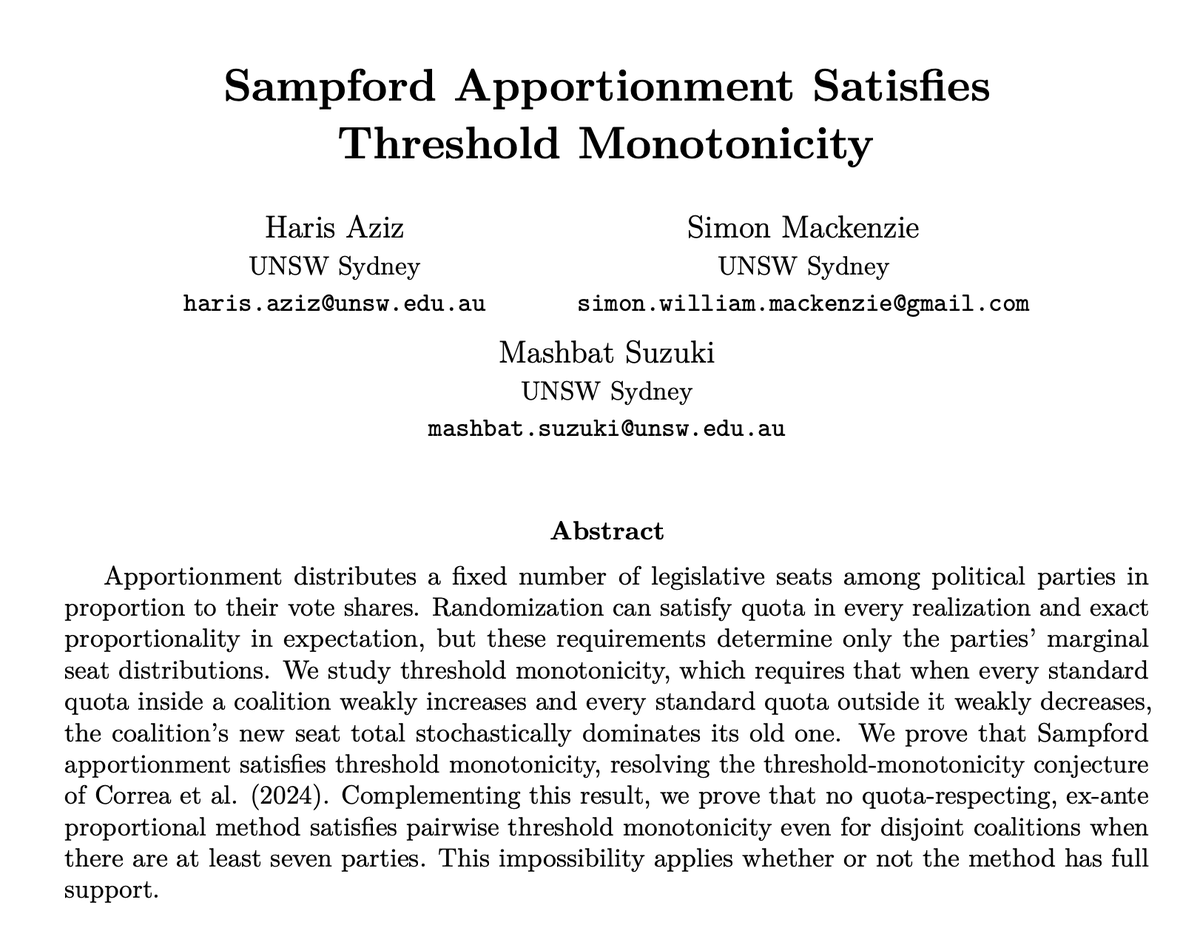
New paper with @SimonWMackenzie & @mashbat6:
Sampford’s apportionment is the 1st known rule to satisfy threshold monotonicity, quota, and exact expected proportionality.
https://t.co/fyuvPhgAbp
#apportionment#socialchoice
@DmitryRybin1@mahdi_tcs_ Not every preprint needs conceptual progress. The preprint nonetheless makes progress on the relevant optimisation problem beyond what Sol can achieve, and explains what is going on. I'm not sure how your chat convinces you that this is worthless.
@DmitryRybin1@mahdi_tcs_ Their preprint involves the SOTA researchers and actually explains the improvement. They also shave off something orders of magnitude greater than Sol alone, although you could argue that is not particularly important.
@prerak_011@Quasilocal What goalposts? We learn what these systems are capable of and adapt, there are no goalposts. Wanting a simple statement like "AI is good at mathematics" seems like the wrong way to approach this.
@DmitryRybin1@mahdi_tcs_ I think his point is that there is little value to incrementally improving \omega in this way aside from demonstrating that Sol 5.6 can do it with no guidance.
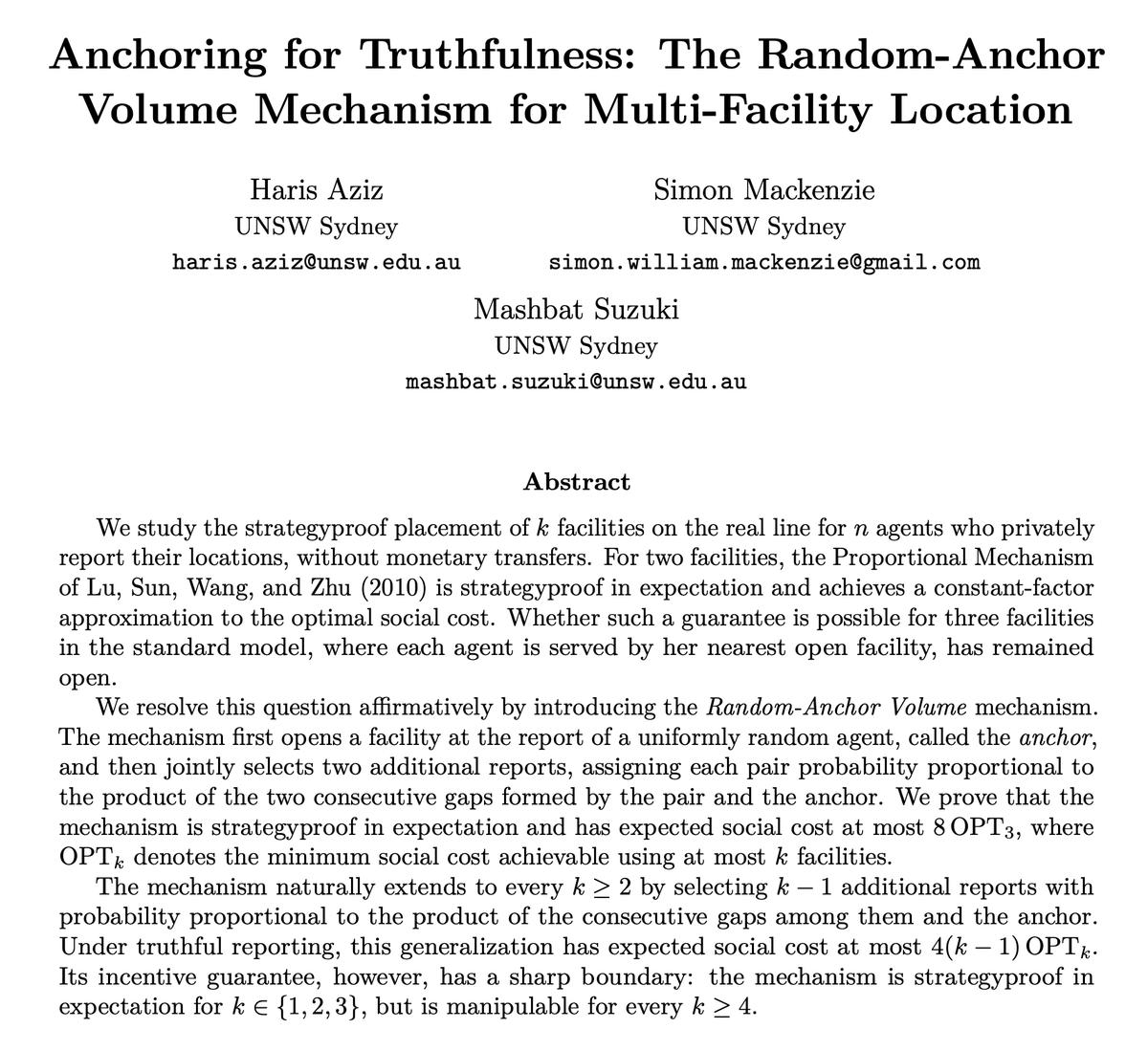
📜New paper with @SimonWMackenzie & @mashbat6: first randomized strategyproof mechanism for 3-facility location with constant-factor approx of social cost.
https://t.co/lMkesT8YjJ
@ConnorTalksAI@HowToPrompt__ But it shows that the way it solved those open problems is maybe more brittle than it seems at first. This may make it harder for it to progress beyond the low-hanging fruit.
@rpominov@bullposting@Jesseeckel it's obvious Mythos class models can't do that, and it should've been since day 1 at Anthropic. In hindsight such claims are obviously ridiculous, same as saying gpt-2 was too dangerous or that we needed a moratorium after gpt-4.
@workemail270519@Noahpinion No, those are traits of intelligence. I think you are focusing on a restricted subset. As I implied, your definition of AGI does not seem useful to me. Intellectual work requires reliable autonomy and agency, beyond what fable has.
@AlvanArulandu@nsrg_shah Yes, I'd be curious to see if the details are the same and what constants you get. I couldn't get it to go below 2^(2nlogn+o(n)) unless you're allowed to use randomness, in which case it seemed to be able to shave the factor of 2 in the exponent.
@workemail270519@Noahpinion Ok, call that AGI if you want. Great, what value does that add? I think you are impressed by a subset of intelligence which fails to capture the whole thing.
@willdepue Asking what eval will go up is like asking how learning category theory will increase my IQ test score. The eval is still unclear. People see many things are missing, are trying to articulate what they are, but like most difficult concepts it takes time to crystalise.
@nasqret@rperezmarco I would also be quite surprised if it cracked problems requiring genuine new insight rather than superhuman association and computation.