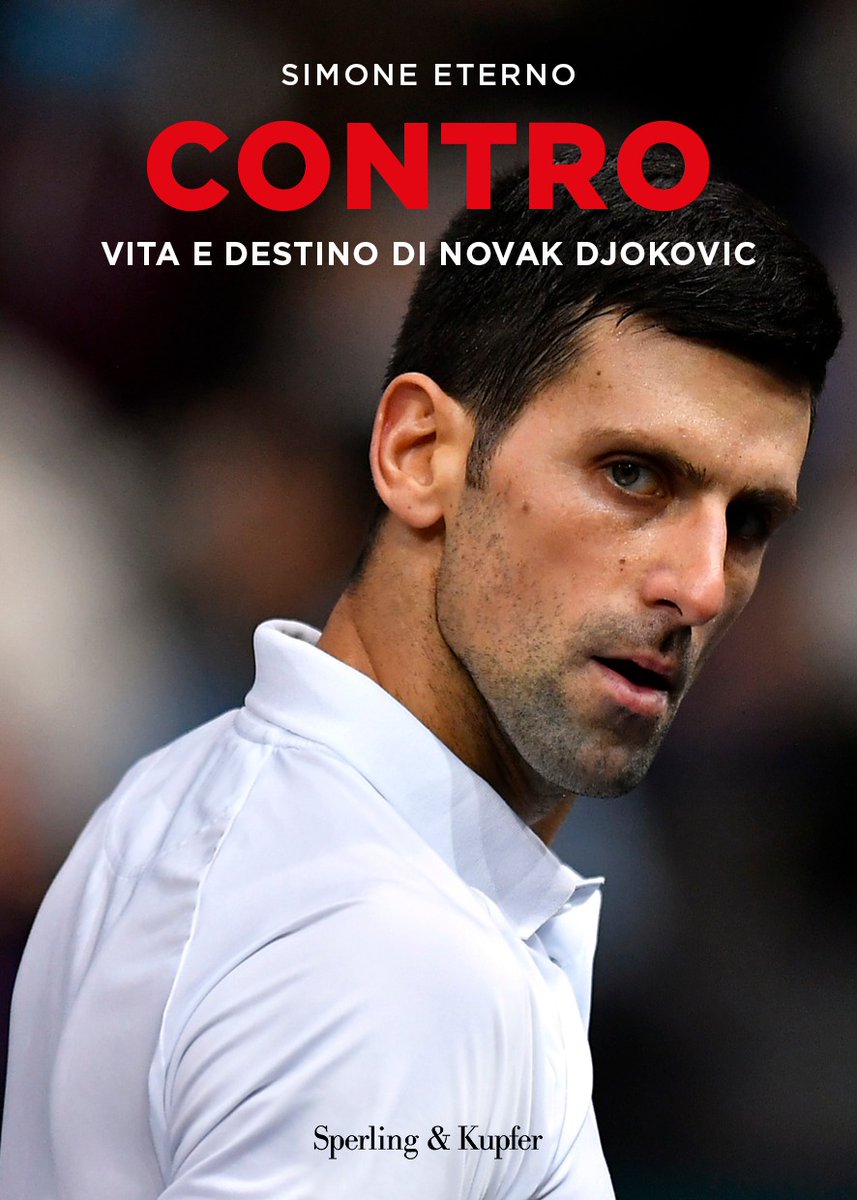
CONTRO. E' quel che ho pensato quando mi hanno chiesto di raccontare Novak Djokovic.
Contro il destino.
Contro i più forti.
Controcorrente.
Dal 22 marzo lo trovate in libreria❤️, ma potete già preordinarlo dal signor Bezos, se vi va https://t.co/jbDpXkylWz
Poi, ci vedremo in giro
@stefaniareale5 non la denuncio perché mi fa pena. Occhio però perché a dare dello "sciacallo" alla gente, potrebbe trovare qualcuno meno magnanimo.
ah, mi occupo di tennis da ben prima di Sinner. Lo farò anche dopo Sinner. Impazzire
JANNIK SINNER UPDATE:
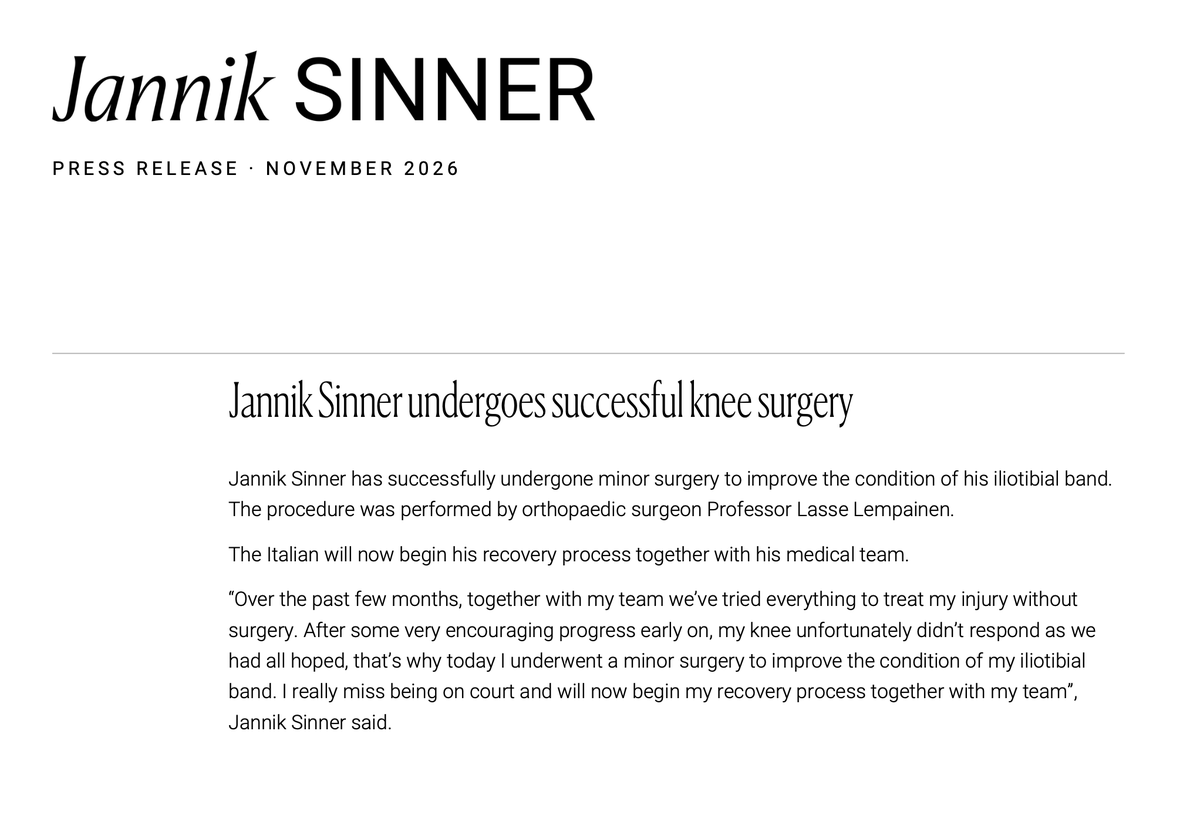
Jannik Sinner had successful knee surgery, according to reports. The procedure he had was a lengthening of the ITB (iliotibial band). That is a relatively minor procedure, done through a small incision.
Because of his chronic ITB friction syndrome, the tight ITB tendon was rubbing on the outer edge of his femur, causing inflammation and bursitis under it. The surgery typically not only lengthens the tight ITB (so as to take pressure off the outer edge of the femur where it has been rubbing) but also, the surgeon will remove any irritated tissue or bursa under the ITB that has been related to chronic irritation/inflammation.
The surgery is done through a small incision and healing is pretty quick. The limiting factor is that the ITB tendon (which was cut so that it could be lengthened/elongated- and then repaired/sewn back together) needs to heal.
Tendons do not have a great blood supply, so healing is slower than other tissues, and that is why they are mentioning 2-3 months. To push harder sooner would risk rupturing the repaired tendon, a risk that no one would take. He could start lighter rehabilitation almost immediately, but in my experience, I would not allow any higher loading on that tendon for 8 weeks. At that point, he could gradually start increasing the loads with running and cutting. If they are being super cautious, hey may actually wait until 12 weeks before higher-level activities. So his return to competitive tennis may actually be longer than the "3 months" mentioned.
I do hope that when they did the ITB lengthening surgery, that they also took the opportunity, with him under anesthesia, to put an arthroscope into the knee itself (thru tiny buttonhole incisions) to rule out other issues that could be a source of lateral knee pain (i.e. meniscus, lateral patella, chondral damage- something I mentioned in detail in my prior post). The ITB tendon lengthening surgery is all performed outside the knee and gives no direct look into the knee for other potential issues. It would have been very easy to also check the knee interior via arthroscopy and be sure. Having said that, ITB lengthening surgery is relatively minor, it should heal fully, and the success rates are pretty high (80%+) even for high-level athletes and their ability to return to full activity and high performance.
Once again, wishing Jannik a speedy and full recovery!
Here are my thoughts on Jannik Sinner and his upcoming surgery. I state these as an orthopedic surgeon specializing in knee surgery/injuries who has cared for numerous high-level athletes, including pros, over the years.
First, regarding the presumed diagnosis (that we are being told) of iliotibial band friction syndrome (ITB friction syndrome). ITB friction syndrome is a common overuse ailment, especially in distance runners and cyclists. Not too common in tennis players. It is usually due to overuse, and not from a specific single injury. Sometimes it can be related to certain training methods resulting in overuse. If indeed it is ITB friction syndrome, then it was correct for him to wait for months because this condition is almost always treated conservatively without surgery. It typically responds to rest, rehabilitation, and change in any training/program that may be causing it. Certain individuals are more prone to it especially based on their knee and leg alignment, having one leg longer or shorter than the other, and having a tight lateral thigh/ITB.
Secondly, ITB friction syndrome causes pain on the lateral/outer side of the knee. for anyone with chronic lateral knee pain, other conditions (that can mimic ITB-related pain) must be ruled out. These include a occult lateral meniscus tear (something not seen on MRI, and that sometimes happens), lateral patellar pain syndrome (not unusual in lanky individuals like Sinner especially with his playing style where he crouches a good bit to move and hit), and also any type of damage to the lateral or outer side of his knee cushion (articular cartilage damage - again, sometimes not seen well on MRI).
If it has come to the point where he needs surgery for presumed ITB friction syndrome, I believe it is also essential at the time of surgery to look inside the knee with an arthroscope to rule out issues noted above. Typically, the surgery for chronic ITB syndrome involves a small opening on the outer side of the knee over the ITB area. It does not look into the knee itself. In Sinner's case, I would take the opportunity of him being under anesthesia and having surgery, to put an arthroscope in through tiny buttonhole incisions and look around the knee itself for other issues that could be masquerading and giving chronic lateral knee pain. You need to be certain of this! Especially in high level athletes where you don’t want to have to do another surgery down the line.
One last thing. If indeed he had chronic ITB friction syndrome, and that diagnosis is correct, that is something that causes pain, but there is typically no harm in playing through that particular type of injury, so I am surprised he was sidelined for so very long. Also, that fall he took at Wimbledon on the grass, where he sustained a valgus-type twist and loading of both knees, usually is not the source of ITB friction syndrome. If that fall was significant, it would be more likely to cause an MCL (ligament on inner side of knee) sprain, and also potentially meniscus tear or articular cartilage damage. I've even seen it cause compression and some damage to the outer/lateral side of the patella and joint surface across from the patella (trochlea). All of this can be checked at the time of ITB surgery, with a simple knee arthroscopic evaluation.
Either way, Jannik should be able to recover fully. He appears to be in excellent/experienced hands with Dr. Lasse Lempainen. Wishing Jannik a full & speedy recovery!
@janniksin@bgtennisnation@christophclarey@TennisChannel
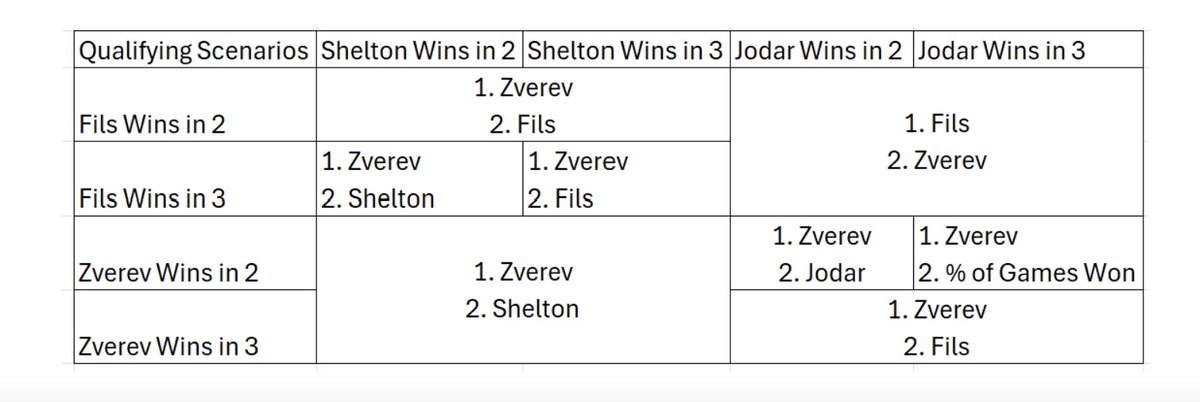
@AntoOliv_98 sbagli che ciò che conta è la % di set, non il numero secco dei set.
Dunque:
Zverev andrebbe 4 set vinti e 2 persi: 66,67%
Fils andrebbe 5 set vinti e 3 persi: 62,5%
Shelton è 4 set vinti e 3 persi: 57,14%
By Elo rating, Tiafoe ranks 16th, Cobolli 26th.
Tiafoe's 1925 Elo is the lowest rating of a favorite in a Tour Finals match ... ever.
Their average rating is 4th worst, ahead of three matches from the 2005 Masters Cup -- Puerta vs Gaudio, Davydenko, and Gonzalez.