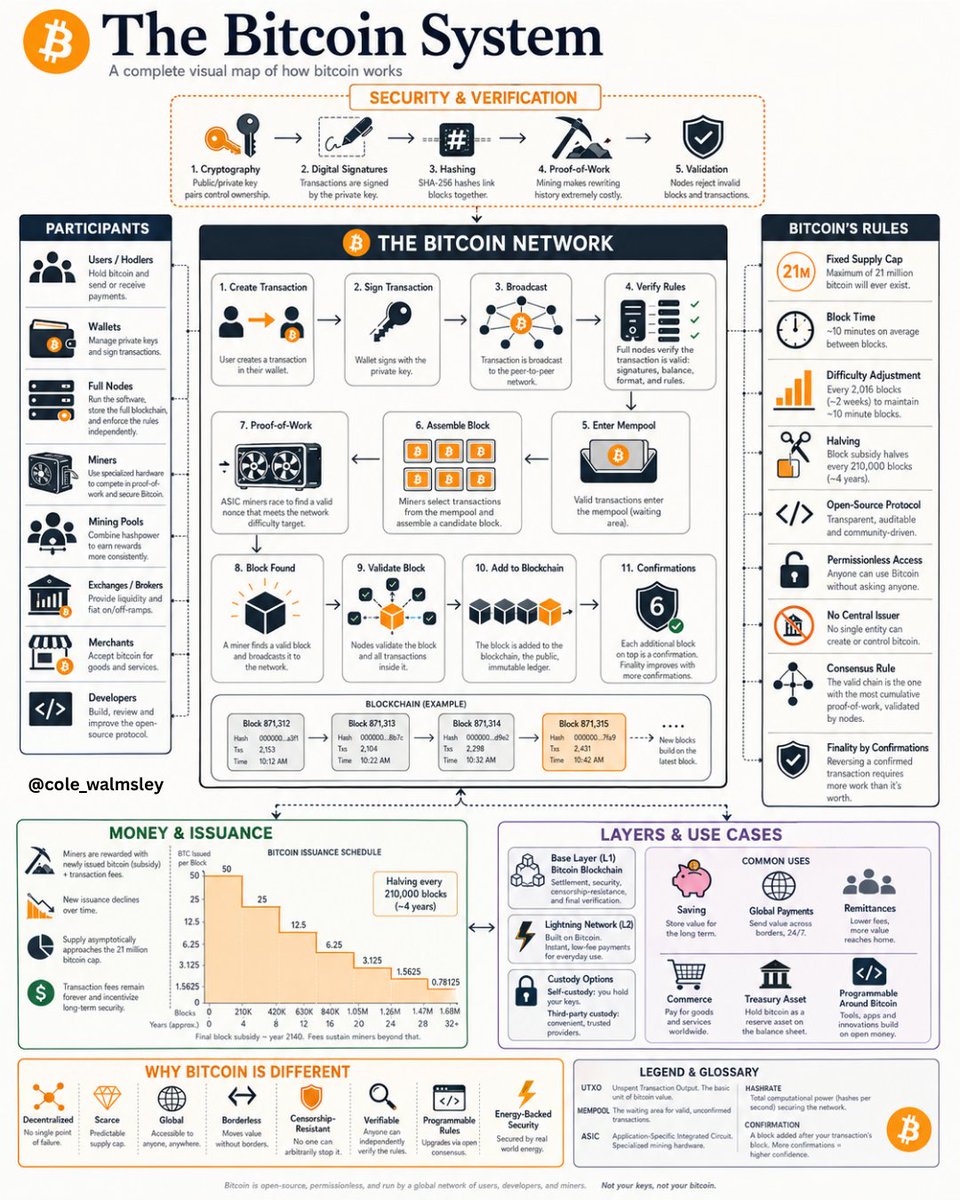
💥Just Released💥
👉2nd Edition of The Simplest Bitcoin Book Ever Written!
⚡️Includes:
• A brand new section on n*str!
• All updated graphs and charts
• Updated Resource Section
Visit: https://t.co/p52hTkb7kI to grab yours today!
⚡️Grab your free PDF of my book at https://t.co/p52hTkazva
🧡Written for pre/new-coiners in an easy-to-read layout
🔥Includes
- Why we need bitcoin
- What it is
- How it works
- Rebutting fud
- High signal Resources section
- On Lightning
- Why bitcoin only
@alexsllater@Sakuravu7a@Shtihmas11@asanoha_gold Wait are you serious? This is your response to 100% valid questions about how you use/secure/manage your customers * most sensitive data*? I hope you rapidly rethink that response.
@willkramer@alexsllater You definitely can not trust them with your personal info, they literally tell you they use it to train on https://t.co/z8RDbRGEwo
Hey @alexsllater it says you use customer passport data to train your models in your privacy policy?
I have a couple questions…
AI Model Training with Passport Data
• Your Privacy Policy states that user data (including passport and travel-document details) is used “to train and evaluate models that improve Soar.” Please describe exactly which passport-related data is used for training, how it is processed or anonymized/pseudonymized before training, and what safeguards prevent re-identification.
• Which specific AI/ML models (or types of models) are trained or fine-tuned using passport or booking data?
• Do you use third-party model providers (e.g., for training or inference) that may see passport data? If so, what data processing agreements and controls are in place?
• What techniques (e.g., differential privacy, federated learning, data filtering) do you apply to protect sensitive passport information during model training and evaluation?
• Can users opt out of having their passport or travel data used for model training? If not, why?
• How do you ensure that models trained on passport data do not leak or memorize sensitive personal information (e.g., through model inversion or extraction attacks)?
Risk, Transparency & User Rights
• What are the primary security and privacy risks you have identified with passport data and AI training, and how are they mitigated?
• Have there been any past security incidents, near-misses, or audits related to passport data or model training?
• How do you communicate your AI training practices and security measures to users beyond the privacy policy?
• What happens to passport data if a user’s passport expires between booking and travel, or if they request deletion?
Compliance, Auditing & Testing
• Have you completed SOC 2, ISO 27001, PCI DSS, or other relevant certifications/audits for handling passport and payment data?
• How frequently do you perform penetration testing, vulnerability scans, and Data Protection Impact Assessments (DPIAs) specifically for passport handling and AI training?
• What is your incident response and breach notification process (including timelines) if passport data is compromised?
• How do you handle international data transfers of passport information (e.g., to the US or other jurisdictions)?
Airline & Booking Integration
• At what point do you pass passport data to Duffel and the operating airlines?
• How do you verify that user-entered passport data exactly matches the physical document?
• What controls are in place with your partners (Duffel, airlines, Twilio, payment processors, etc.) regarding passport data security and usage?
• How do you support digital travel credentials, biometrics, or IATA One ID to potentially reduce storage of traditional passport data?
General / High-Level Questions
• What is your full end-to-end process for collecting, transmitting, storing, processing, and deleting passport and travel-document details in Soar?
• How do you ensure compliance with GDPR, CCPA/CPRA, APIS, Secure Flight, and other international aviation and data protection regulations?
• What is your data minimization policy specifically for passport data? Which exact fields do you collect (e.g., number, issuing country, expiry, name/DOB as on document), and why?
• Do you collect or store full passport scans/images, or only extracted textual data?
• How long do you retain passport and travel-document data after a booking or account deletion?
Continued below…
Hey @alexsllater it says you use customer passport data to train your models in your privacy policy?
I have a couple questions…
AI Model Training with Passport Data
• Your Privacy Policy states that user data (including passport and travel-document details) is used “to train and evaluate models that improve Soar.” Please describe exactly which passport-related data is used for training, how it is processed or anonymized/pseudonymized before training, and what safeguards prevent re-identification.
• Which specific AI/ML models (or types of models) are trained or fine-tuned using passport or booking data?
• Do you use third-party model providers (e.g., for training or inference) that may see passport data? If so, what data processing agreements and controls are in place?
• What techniques (e.g., differential privacy, federated learning, data filtering) do you apply to protect sensitive passport information during model training and evaluation?
• Can users opt out of having their passport or travel data used for model training? If not, why?
• How do you ensure that models trained on passport data do not leak or memorize sensitive personal information (e.g., through model inversion or extraction attacks)?
Risk, Transparency & User Rights
• What are the primary security and privacy risks you have identified with passport data and AI training, and how are they mitigated?
• Have there been any past security incidents, near-misses, or audits related to passport data or model training?
• How do you communicate your AI training practices and security measures to users beyond the privacy policy?
• What happens to passport data if a user’s passport expires between booking and travel, or if they request deletion?
Compliance, Auditing & Testing
• Have you completed SOC 2, ISO 27001, PCI DSS, or other relevant certifications/audits for handling passport and payment data?
• How frequently do you perform penetration testing, vulnerability scans, and Data Protection Impact Assessments (DPIAs) specifically for passport handling and AI training?
• What is your incident response and breach notification process (including timelines) if passport data is compromised?
• How do you handle international data transfers of passport information (e.g., to the US or other jurisdictions)?
Airline & Booking Integration
• At what point do you pass passport data to Duffel and the operating airlines?
• How do you verify that user-entered passport data exactly matches the physical document?
• What controls are in place with your partners (Duffel, airlines, Twilio, payment processors, etc.) regarding passport data security and usage?
• How do you support digital travel credentials, biometrics, or IATA One ID to potentially reduce storage of traditional passport data?
General / High-Level Questions
• What is your full end-to-end process for collecting, transmitting, storing, processing, and deleting passport and travel-document details in Soar?
• How do you ensure compliance with GDPR, CCPA/CPRA, APIS, Secure Flight, and other international aviation and data protection regulations?
• What is your data minimization policy specifically for passport data? Which exact fields do you collect (e.g., number, issuing country, expiry, name/DOB as on document), and why?
• Do you collect or store full passport scans/images, or only extracted textual data?
• How long do you retain passport and travel-document data after a booking or account deletion?
Continued below…
So many firsts here...😲
First lotto solo mined RDTS block.
First RDTS block not mined with DATUM Gateway (and first using ckpool software).
First RDTS block not mined using OCEAN.
Hi! I am Keysa, author of The Simplest Bitcoin Book Ever Written. In case you are new here, you might like this free, simple, downloadable, printable brochure to share with friends, co-workers and family 🧡
Link in message below..
"Filtering arbitrary data is censorship. It betrays Bitcoin's neutrality."
It doesn't. Every protocol is defined by what it refuses to carry. A voice codec dropping oversized packets is not silencing speech.
A monetary network that won't defend its scope doesn't stay neutral. It just lets whoever has the most resources define its scope instead.
New issue: why Bitcoin isn't a bulletin board, even when the bulletins are noble.
https://t.co/fG6cZJZbYn
We are honored to present the full version of The Timechain Codex by @FractalEncrypt on our site.
Grab a cuppa, sit back, and enjoy this remarkable science-fiction graphic novel translation of @dhruvbansal's Bitcoin Astronomy.
Edited by @TomerStrolight
Link below 👇
Hi! I am Keysa, author of The Simplest Bitcoin Book Ever Written. In case you are new here, you might like this free, simple, downloadable, printable brochure to share with friends, co-workers and family 🧡
Link in message below..
Public companies have fiduciary duties to their shareholders.
Once you create a public Bitcoin treasury company, your obligations change.
You now have fiduciary duties tied to shareholders, capital markets, and the broader financial industrial complex that funds and sustains the structure.
That structure can also become a short-term price manipulation complex.
That doesn’t make anyone good or bad.
But it does mean motives, incentives, and constraints need to be understood.
This evolution is not inevitable.
It’s being engineered.
Those who care about Bitcoin should understand who Adam, Saylor and others running Bitcoin treasury companies, ultimately work for now, and adjust their expectations accordingly.
The next move is obvious: Blockstream gets reverse-acquired into $BSTR and becomes subordinated to the financial industrial complex at an even higher degree than it was through the venture rounds.
Cantor is building this complex for a reason.
Our job is to fight back with self-custody and nodes, the way Bitcoin was designed by Satoshi.
Nothing more.
Nothing less.
Hi Anthony,
Since you did not reply to my DM about right of reply questions for my last article, I will try to reach you here.
On the topic of spam and spammers:
May 2, 2025: instagibbs files the OP_RETURN uncap PR #32406. Eleven seconds after the bot announces it in #bitcoin-core-dev IRC channel, instagibbs writes "fanquake please lock for now."
fanquake locks the PR within the same minute. You then add the "Needs release note" label to the now-locked PR.
Fifteen minutes later you joke on IRC about labels being a way to "inscribe comments via github label edits."
Four operational acts by three devs that were instrumental in the OP_RETURN uncap sequence, inside a sixteen-minute window. The PR was filed, lock-requested, locked, and label-administered before any community engagement could begin.
Four questions:
1: Was the sequence prearranged?
2: Do you consider this a proper and responsible way to conduct Bitcoin development on a contested protocol change?
3: Considering the great controversy and polarization, was your inscription joke fitting for the moment?
4: The same three of you, you and instagibbs and fanquake, ACKed and merged PR #27832 in June and August 2023, the documentation amendment that narrowed the scope of -datacarriersize, later used to close Luke's filter patch. The same three then executed the May 2 sequence on and around the PR that would uncapOP_RETURN. Coincidence?
The bitcoin's still in the wallet after two days.
Follow @asanoha_gold for the passphrase clues.
Tune into the weekly update video dropping in a few hours:
https://t.co/9ljf5U4gpP