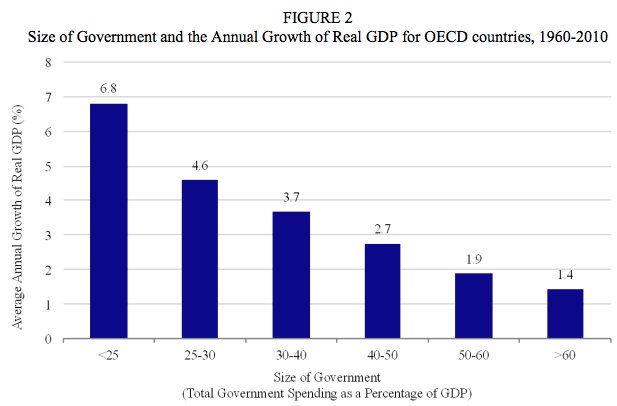
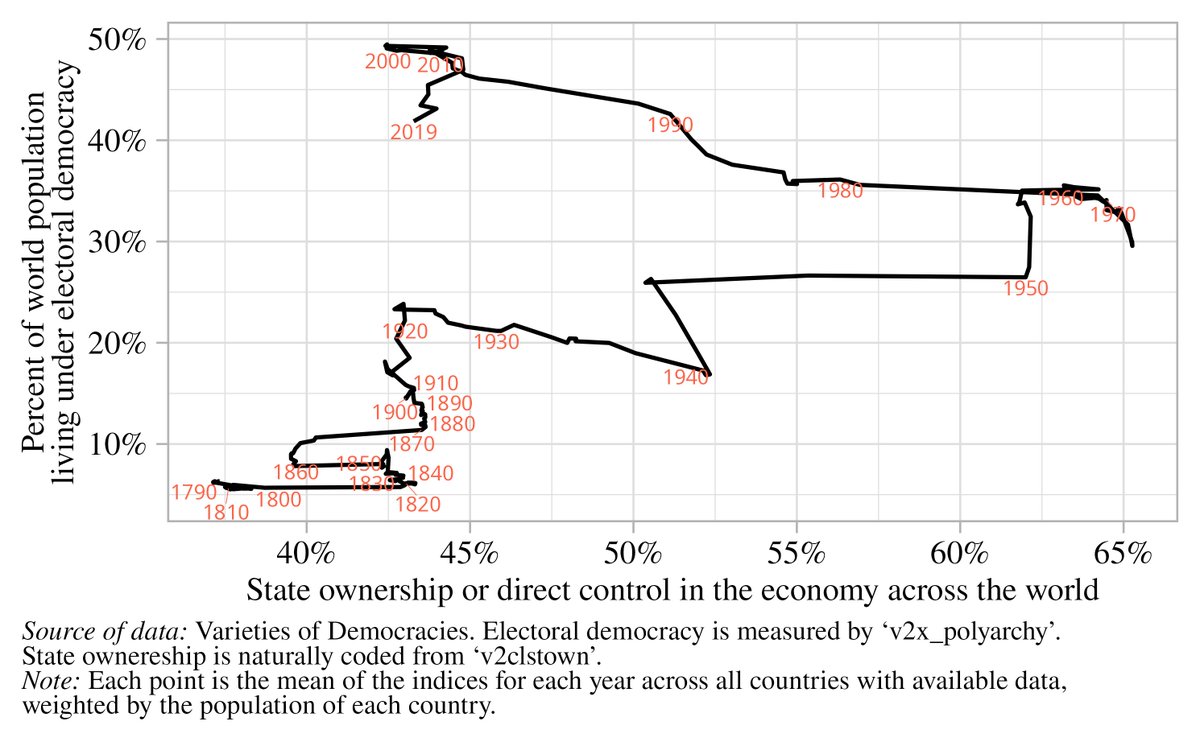
Vapaus on kaiken onnellisuuden perusta. Ilman vapautta ei ole onnellisuutta.
Freedom is the basis of all happiness. Without freedom, there is no happiness
@JukkaLepikko Matalaotsat ja treidaajat tarvitsevat myös kurssilaskua toisinaan.
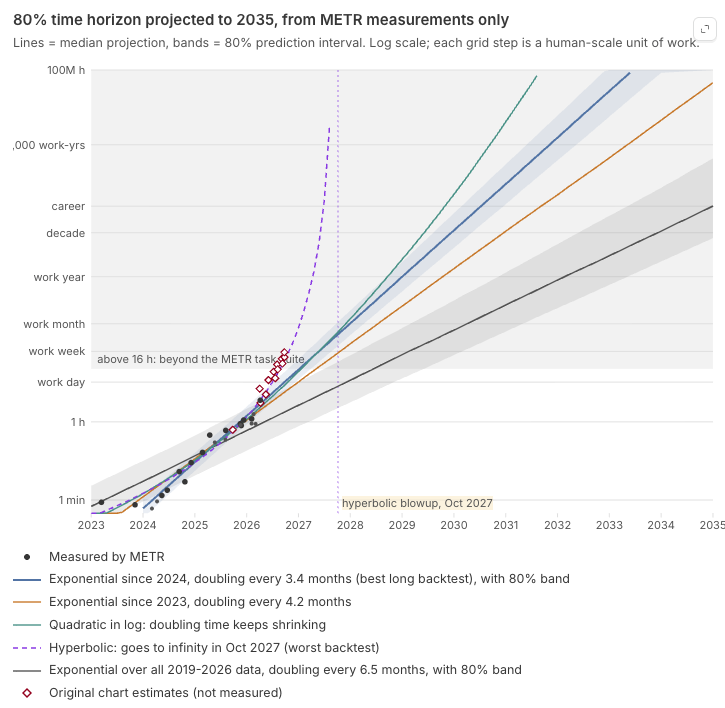
Suuri kuva on selvä: AI mullistaa maailman ja paljon nopeammin kuin mikään aiempi murros.
The West is a commitment to institutions: the rule of law, democratic elections, independent courts, free speech, and open markets – all of which allow for diversity of views, cultures, and systems within those bounds.
These same institutions pose an existential threat to the self-appointed elites of Russia and China, who exploit their populations – not just in the present, but across generations. It is an intergenerational crime.
@OttoBruun Jos muutokset ovat yhteiskunnallisesti Pareto-optimaalisia (kaikkien tilanne paranee tekemättä kenenkään tilannetta huonommaksi), en näe mitään ongelmia tuloeroissa.
@HalmeJus Tosikommunisteilla tavoite on lopputuloksen tasa-arvo millä tahansa hinnalla.
Jos kaikki ovat absoluuttisen köyhiä ja tuloeroja ei ole, se on hyvä tila.
@klaus_koo Voisin ottaa periaatteessa eläkeprojektin jossain tällaisessa organisaatiossa.
Pääongelma on, että pidän itseeni kohdistuvaa julkisuutta syöpään verrattavissa olevan riesana.
Joten olisin mielelläni mukana rahoittamassa ja vaikuttamassa, mutta lähtökohtaisesti taustajoukoissa.
Earlier today I wrote that school destroys critical thinking. Many of you asked for proof.
The proof is Marx.
Marxism is probably the most tested theory in human history. Tested on paper by the best economists in the world. Tested at full scale on hundreds of millions of people, across several continents, for more than a century. And it failed every single test.
A free mind, one that checks its ideas against reality, cannot remain Marxist. If so many people still are, it's not a problem of intelligence. It's a problem of method. They were never taught to verify.
Let's start from the beginning.
In 1867, Marx publishes Das Kapital. Everything rests on one idea: the value of a good comes from the amount of labor it contains. The boss's profit is therefore labor stolen from the worker.
Four years later, in 1871, Menger and Jevons independently show that this is wrong. Value doesn't come from labor. It comes from the usefulness the buyer sees in the good. An hour spent digging a useless hole creates zero value. That's the marginal revolution, and all of modern economics is built on it.
In 1896, Böhm-Bawerk shows that Marx's system contradicts itself: real prices don't match labor values, and Marx knew it. The foundation collapses.
In 1920, Mises asks the question that kills it: without private property, there are no market prices. Without prices, how does a central planner know what to produce, how much, and with which resources? Answer: he can't. Hayek finishes the job in 1945: economic knowledge is scattered across millions of minds, and no central bureau can ever gather it.
That's the theory. Now the predictions.
Marx predicted the revolution would break out in the most industrialized countries, England and Germany. It happened in Russia, an agrarian country. Wrong.
He predicted workers would grow poorer and poorer under capitalism. They grew richer than at any point in history. Wrong.
He predicted the State would wither away. Everywhere his ideas were applied, the State became total. Wrong.
Now the experiments.
USSR: forced collectivization, famine in Ukraine, millions dead, the Gulag.
China: Mao's Great Leap Forward. Between 15 and 45 million dead depending on the historian. The largest famine in human history, produced by a plan.
Cambodia: the Khmer Rouge killed roughly a quarter of their own population in four years.
Then there are the natural experiments. The most brutal ones, because they eliminate every excuse.
Korea. Same people, same language, same culture, same history. In 1945, the North was richer than the South. Today, income per person in the South is about 29 times higher than in the North. Only one variable changed: the system.
Germany. One people cut in two. One side had to build a wall. Not to keep people out. To keep them in.
Venezuela. The largest proven oil reserves on the planet. Nearly 8 million people fled the country. 21st-century socialism ended with Maduro captured last January.
Meanwhile, the other system, the one you were taught to hate, did this: in 1820, about three quarters of humanity lived in extreme poverty. Today, around 10%. And the biggest escape from poverty in history, China after 1978, happened at the exact moment the Communist Party brought markets back.
From Marx to Maduro, 150 years of data. All pointing the same way.
So how does anyone stay Marxist?
With the magic sentence: "that wasn't real communism."
Think about what that sentence means. A theory that fails every time it's tried, whose believers then declare that none of the attempts counted, is no longer a theory. It's a faith. Karl Popper saw it as early as 1945: Marxism survived its refutations by making itself irrefutable.
A mind trained to think for itself asks one question: how many failures does it take before you question the hypothesis? One, two, ten, forty?
That's exactly the question school never teaches you to ask.
Marx isn't taught as a hypothesis to test against the data. He's taught as a morality tale: there are oppressors and oppressed, and the right side is obvious. You learn the conclusion, never the method.
A four-year-old would ask: "Okay, but where did it work?" Fifteen years of schooling later, they've stopped asking.
A system that teaches you to obey has no interest in teaching you to verify. Because the day you start verifying is the day you start being free.
And that day, you stop being a Marxist.
This is the strongest argument I know against AI taking over the world: the smarter AI gets, the more it costs to make it even smarter. There's a law of diminishing returns here. So even though AI is a game changer, that speaks against a sudden singularity.
@Sukkola Mahdollisuuksien ja riskien spektri kasvoi helposti ennustettavasta kapeasta putkesta viuhkaksi, jonka toisessa reunassa on maailmanloppu ja toisessa täydellinen avaruushomokommunismiutopia.
Mahtavaa aikaa olla elossa!
One of the things the data analysts on our side obsessed over was "composition"—whether the electorate looked close enough to 2024 for Republicans to win. And despite polls that showed a Democrat blowout, the data kept on telling us the same story: in some states turnout was merely OK, in other states it was downright amazing, and in no state was it catastrophic. There was a genuine sense of optimism on our team: our people were showing up.
So, I asked the smartest data guy I know, does that mean we're going to shock the world? "No," he told me. "We might do better than the polls suggest. But the data is telling us that a lot of Trump/Vance 2024 voters are pissed and planning to vote for the other guys. Our voters are turning out, but they may not vote for us."
Well, that looks prophetic now. Our voters did show up. In Florida, for example, the electorate was 9 points more Republican than Democrat, just a couple points worse than 2024. Undoubtedly there were places we could have done better on turnout. But the main problem is not turnout. The main problem is that many people who voted for Trump/Vance in 2024 voted for Democrats in 2026.
There will be a lot of infighting and arguing over what happened and why that is. One of the pollsters I really respect told me that our economic messaging wasn’t sharp enough down the stretch. I’m sure that’s true.
But the real reason we lost is obvious to almost everyone.
Another pollster—one of the smartest people I know in politics, told me yesterday we’d lose the generic ballot by 13 points. I felt negative going into Tuesday, but even I was shocked by this. In his polling, he saw that a lot of Trump 2024 voters were angry and planning to vote for Democrats. He asked those voters who had abandoned us what would cause them to come back on our team. The top four answers, accounting for nearly all of the responses were:
1) End the war
2) Focus on cost of living/inflation
3) Put America First
4) Change our relationship to Israel
Our voters showed up. And the above four reasons are why many of them voted for Democrats. This is according to a pollster who nailed the results. While many spent Monday attacking Rachel Campos Duffy for calling for a diplomatic resolution to the conflict, it turns out her political advice was sound. (She’s also a great person.)
In the next few months, there's going to be a lot of gaslighting. Expect to hear any number of establishment politicians say the solution to our woes is amnesty. I'm open to the idea that we should change enforcement—by focusing more on businesses that hire illegal labor, for instance. But anyone pushing amnesty is lying to you.
The reason we lost is the war. The president himself said so last night.
If you'd like to argue it was worth it, that losing the Senate for the next 6 years was worth it, then do so. Argue it was a worthwhile cost to pay. Agree or disagree, that's at least honest.
But everyone knows why we lost. And any honest conversation about where we go from here must start there.
I remain hopeful about our country. To the people who are pissed off and want to say, “I told you so”: you’re right, you did tell us so. Take that energy into electing Republicans who share your worldview. To the people who are just pissed at the results, you should be. Let’s take that anger and get back to the work of saving our country.