My new report for the @QuincyInst is out today 👇
The central argument is simple: Washington is making a serious mistake if it assumes it is still dealing with the Iran of the prewar period.
The wars of 2025 and 2026 have accelerated a profound shift in Iranian strategic thinking.
For years, influential elements of Iran’s leadership favored calibrated restraint: absorb pressure, preserve diplomatic offramps, avoid an uncontrolled escalation spiral, and gradually accumulate leverage.
The lesson many Iranian security elites now believe they learned is almost exactly the opposite: restraint without a credible willingness to impose painful costs was interpreted as weakness and ultimately invited war.
That is giving rise to what I call “persistent counter-escalation.”
The idea is not to match overwhelming US firepower. It is to deny Washington control of the escalation ladder by ensuring that pressure on Iran generates escalating costs elsewhere: against US bases, regional infrastructure, maritime commerce, energy flows, and through Iran’s regional partners.
Iranian strategists increasingly speak openly in these terms. One described a “pain index”: if the adversary imposes one unit of pain, Iran should impose two or three. Parliamentary speaker Mohammad Bagher Ghalibaf recently put it even more bluntly: “the era of proportionate responses is over.”
The Strait of Hormuz is central to this emerging doctrine. So are Iran’s missiles and drones, its regional alliance network, economic coercion, and increasingly, a debate over whether these capabilities are sufficient without a nuclear deterrent.
This is ultimately about more than how Iran fights. Tehran is trying to convert wartime leverage into a different regional order, one in which Iran cannot be attacked or economically isolated while US bases, neighboring states, energy infrastructure, and maritime commerce remain insulated from the consequences.
There is a dangerous paradox here. This strategy may strengthen Iran’s ability to impose costs, but it also creates far more pathways for every confrontation to become a regional conflagration.
That leaves Washington with a question military superiority alone cannot answer: Does imposing still greater damage on Iran restore deterrence, or reinforce Tehran’s conclusion that only greater capacity to impose costs on everyone else can keep it secure?
Breaking that cycle is essential if Washington wants to escape this strategic quagmire rather than deepen it through more rounds of escalation
Read the full report here:
https://t.co/O79XvFR9Tj
Noteworthy that every argument for why Israel isn’t committing genocide in Gaza, once all half assed sophistry is exhausted, boils down to “if this is true it makes me uncomfortable”. Well, yes the truth is often uncomfortable, part of being an adult is facing objective reality.
Iran's Pezeshkian gifted Swiss President a book titled "American Aid to the Iranian People" — a booklet containing images of US attacks on civilian targets in Iran.
We have entirely too many people living in this country who believe the purpose of the United States is to send Americas sons and daughters to die on behalf of their ethnic homelands
The US 10Y Note Yield is now moving in a literal straight-line higher, up to 5.13%.
This is no longer an issue that we have months or years to address.
This is unsustainable.
You, @citrinowicz , are correct that Iran–Israel relations under Mohammad Reza Shah were complex but close. There were, of course, tensions. These intensified after Nasser’s death, as Egypt under Sadat developed closer relations with the Shah. With Iran’s oil revenues soaring in the 1970s, the Shah became increasingly critical of Israel’s positions on the issue of the Shi’as in Lebanon and Palestinian question, including the PLO and the status of Jerusalem. Indeed, there are credible reports that he provided financial support to Yasser Arafat. These tensions came to a head when the Shah ended his support for the Iraqi Kurds following the 1975 Algiers Agreement with Saddam Hussein. His decision brought down the Tehran–Tel Aviv–Washington collaboration that had sustained the Kurdish insurgency. This served Iranian national interests. But Israel was deeply unhappy: it wanted to keep Iraq preoccupied with fighting the Kurds.
I discuss these and other relevant issues in Chapter 8 of my book, Iran’s Rise & Rivalry with the US in the Middle East.
Iran doesn’t necessarily care to maximize pain on Trump ahead of the midterms IF it can get a favorable deal before. They have strong leverage now & would prefer to cash it for the most benefits, since post midterm world is unclear either way. Yet they’d want a lot upfront.
New: 8 Navy personnel assigned to USS Abraham Lincoln strike group attempted suicide during a period when ships were engaged in combat ops against Iran & the carrier set a modern record for its time at sea, per letter from service’s acting secretary, obtained by CNN.
https://t.co/HPK4l5V51A
BREAKING: According to Politico, the Trump Administration is planning to implement a 90-day diesel export “ban”.
This comes immediately following President Trump stating yesterday that he was “in favor” of the rumored diesel ban.
While it is still murky as to whether or not this will proceed, as it facing almost UNANIMOUS opposition from every industry expert, the likely “logic” from the White House is that it (in theory) could bring the price at the pump down on diesel in the lead up to the midterms.
Just yesterday, the United States reached NEW all time highs on diesel at $6.5276/gallon, up 76.84% from this day last year ($3.6933/gallon).
While the exact terms of the proposed ban/restriction is unclear, Energy Secretary Chris Wright seemingly 180’d from yesterday where he outright opposed the ban, to now stating today that the United States would be looking to impose “restrictions” compared to an outright ban of diesel exports.
With less than 6 weeks to go until the U.S. midterms, it is wildly unlikely that the proposed “restrictions” could have a significant impact on U.S. diesel prices, but it WOULD be spinning yet again the roulette wheel of economic theory that is already extremely strained under the pressure of the converging U.S./Iran War and Yemen/Saudi War.
According to Politico:
“It very well may come down to the last person in the room with Trump before he makes the decision.”
I spoke to @AJEnglish's @MotamediMaziar about the diplomacy unfolding at UNGA and the central obstacle to ending the Iran war: credibility.
Tehran believes the June MOU showed the danger of giving up leverage first, only to depend on U.S. commitments that can be reversed or go unimplemented.
That helps explain Iran’s strategy now: negotiate, but maintain coercive leverage—especially over Hormuz—until a reciprocal deal with upfront concessions is actually secured.
https://t.co/TU24zDxxqj
Significant comments today amid UNGA U.S.-Iran diplomacy from Mohsen Rezaei, secretary of Iran’s top national security body, the Supreme National Security Council.
He says Pezeshkian & Araghchi went to New York to convey Iran’s internally agreed terms, not negotiate new ones: “There has been no discussion of changing the conditions.” Araghchi was tasked with transmitting them through mediators.
Rezaei says Iran won’t return to the diplomacy of the Islamabad ceasefire. He says Washington must first accept Iran’s conditions and has “4–5 days” to act.
The short deadline amounts to an implicit threat of further escalation if it doesn’t.
He also warned neighboring states aiding US pressure on Iranian aviation: block Iranian flights and “your airports will have no flights.”
His message overall is that Tehran is open to diplomacy, but its terms are fixed and US action must come first.
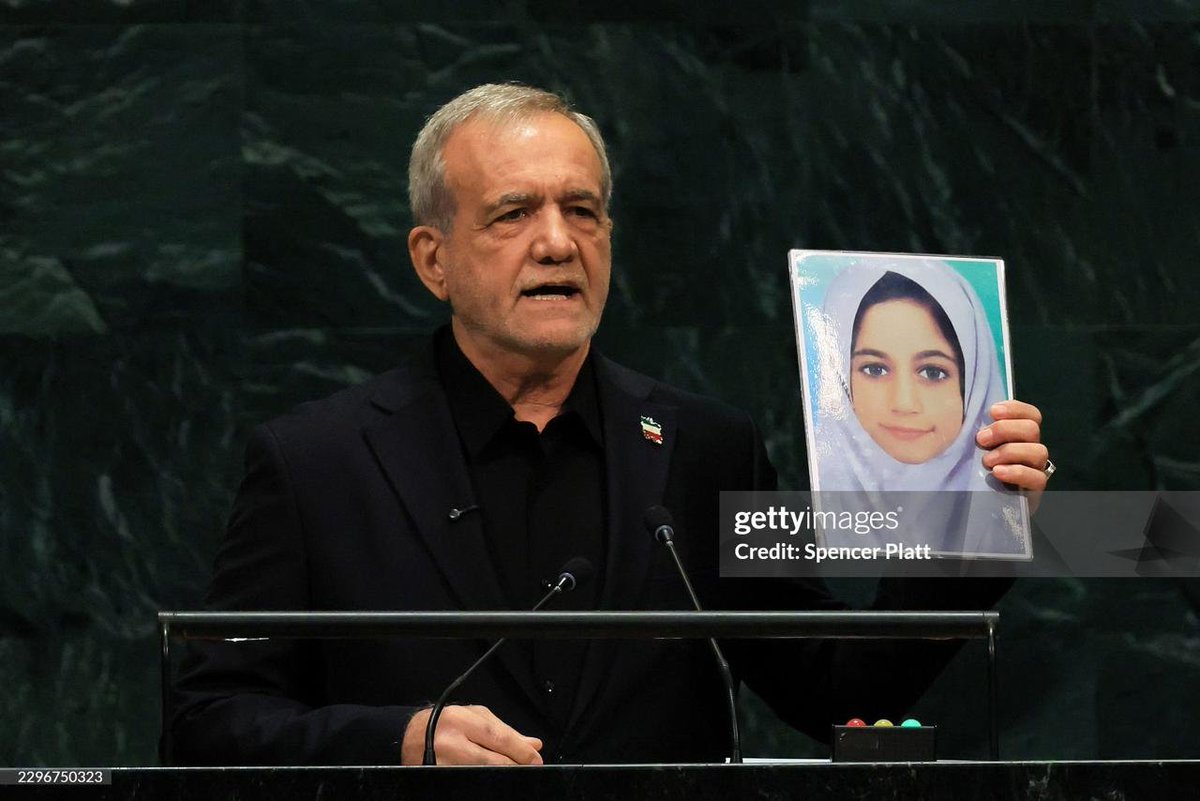
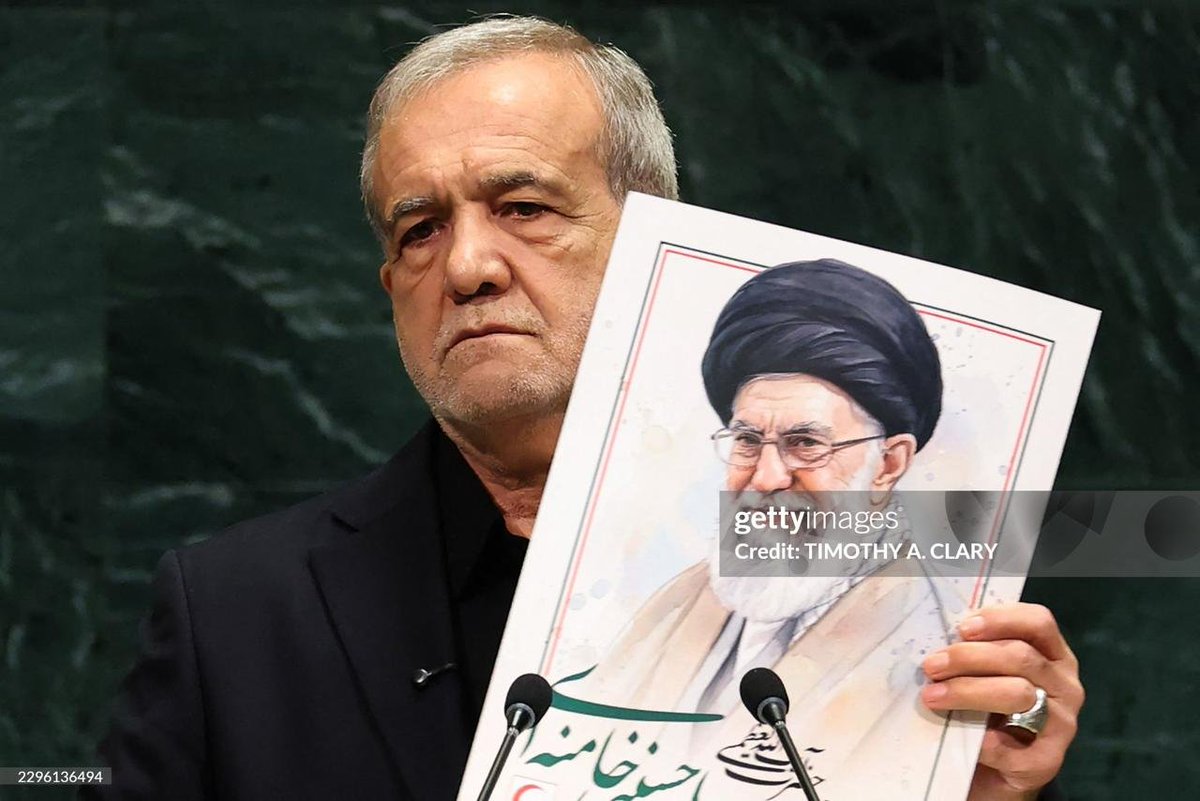
Pezeshkian’s UNGA message: Iran concluded from the war that “we need power” to deter attack, but remains open to diplomacy. On nuclear policy: “neither nuclear weapons, nor deprivation of nuclear knowledge.” On Hormuz: others can’t enjoy free passage while sanctions deny Iran the same. “We are ready for dialogue,” but not “the language of force."
"In Iran today, one can witness the birth of a strong dislike for the US, alongside a growing desire to build Iran back better. There is a wider sense that this war is clarifying something.
An image that was once assumed widespread – that Iran is a nation kidnapped by our political establishment – is beginning to erode.
In its place is another idea: that we are a nation at war with a hostile regional foe and its imperial backer."
https://t.co/StoufceSAY
Meanwhile, opposition leader Maria Corina Machado's senior advisor says that during the last 24 hours, MCM has been denied entry into Venezuela three times. "She has attempted to enter the country by air and sea but has been turned away each time." - David Smolansky
Senior Advisor to María Corina Machado
Congratulations to @AkbarSAhmed, whose book, CROSSING THE RED LINE, is out today.
Especially as Biden administration officials try to whitewash their reputations, Akbar's detailed reporting provides a vital resource for those who want to hold them accountable.
@BrettErickson28 Here’s a link that covers some of these comments including on Bab Al Mandeb and Hormuz: «نهتنها تنگه هرمز به حالت قبل برنمیگردد بلکه بابالمندب هم به قبل برنمیگردد.»
https://t.co/X5GTE71rpL
Amid today’s diplomacy, IRGC Gen. Safavi backed giving Pezeshkian room to negotiate, but said Iran’s terms must be met, including that Hormuz AND Bab al-Mandeb won’t return to prewar status quo & a new regional security order must emerge without the US, led by Iran & Gulf states.
Trump says the US and Iran had a 3-hour meeting today, offered Iran a choice between “greatness” and “obliteration,” and said there is “momentum” for a deal.
The talks come as Iran’s leverage is peaking ahead of the midterms: Hormuz disrupted, Bab al-Mandeb disrupted, Saudi energy infrastructure and the East-West pipeline hit, and oil above $100 before news of diplomacy.
All this comes with the global inventory cushion significantly depleted, US munitions stocks under immense strain, and Chinese oil demand recovering.
Iran enters these talks with substantial leverage. The question is what it can extract from it.
Breaking News: Iran's foreign minister Araghchi met with Witkoff and Kushner on the sideline of the UN General Assembly today. This is the first direct meeting between U.S. and Iran since the peace deal fell apart. They discussed finding a path to a diplomatic deal, officials said.
https://t.co/iJGuuGnPXg
If the Iran War ends in a strategic settlement, its terms will ultimately define the strategic outcome of the entire post-Oct. 7 period. That is the larger lens through which these years should be judged: whether the resulting regional order leaves Iran or Israel strategically stronger. For them, the outcome is fundamentally zero-sum, even if it isn’t necessarily so for the US.