Staff Scientist, Zap Surgical. Prev Associate Professor, Mathematics & Statistics, Univ. of San Francisco. I post on math.stackexchange under the name littleO.
Your ChatGPT memories now benefit from a sleep wake cycle, which consolidates patterns and higher level context understanding to facilitate better answers!
If anything this shows how fundamental the Pauli principle is
When gravity collapses a star, the gravitational energy rips electrons out of their shells and a white dwarf forms, stabilised by the electron degeneracy pressure
If the star is more massive the gravitational force can squeeze the electrons into protons to form neutrons, move atomic nuclei closer together. It becomes a neutron star, which survives only because the Pauli principle reappears at a deeper level: neutrons are uncharged fermions, so neutron degeneracy pressure resists further collapse.
If the star was even heavier, there could be quark stars (in principle), made from deconfined quark matter. Quarks, also fermions, provide another possible layer of resistance
Gravity and the Pauli principle are like an unstoppable force meeting an immovable object. They can be reconciled at ever higher mass only by literally ripping a hole into spacetime, a black hole
SITUATION DETECTED: Sam Altman, Dario Amodei, and Demis Hassabis have signed a joint open letter calling on Congress to mandate screening of synthetic nucleic acid orders, citing AI’s rapidly improving ability to assist with biological research as an urgent biosecurity risk.
Mice with completely severed spinal cords. Six-micrometre stem-cell microrobots steered in by magnetic field, then stimulated wirelessly. 28 days later, nerve cells reconnected at the lesion and gait improved.
This is one of the more exciting things I've read in regenerative medicine this year. ETH Zurich built microrobots, each one a human stem cell paired with a magnetoelectric nanoparticle, about six micrometres across. An external magnetic field steers it to a spinal cord injury, then a second field switches it on wirelessly so the cell turns into neurons. It needs no implanted electrodes or cables, which is what the older stimulation methods relied on.
In mice with completely severed cords, which don't regenerate on their own, nerve cells reconnected at the injury after 28 days and the animals moved close to normally again. The treatment was well tolerated, with no adverse effects or immune reaction. In zebrafish the recovery was even faster: near-normal swimming within three days.
It's also built to scale. The bots are made on a lab-on-a-chip in about thirty minutes, the particles are designed to dissolve into the tissue once they've done the work, and the same platform could one day carry stem cells for things like cardiology or wound healing.
Out now in Nature Materials. It's early and these are animal models, but the direction looks real.
Today a crazy quantum story just got wilder.
On March 31, the Google Quantum AI team published a landmark result on Shor's algorithm for elliptic curve cryptography. Technically, the paper was a bombshell: a dramatic 10x improvement over the state-of-the-art. As a stunt and wakeup call to the blockchain space, those optimisations were illustrated on secp256k1, the elliptic curve underlying Bitcoin and Ethereum signatures.
But perhaps the most striking part of the paper was sociological, not technical. Instead of following standard academic process, the optimisations were kept secret, hidden behind a zero-knowledge (ZK) proof. Google's accompanying blog post mentions they "engaged with the U.S. government". The ZK proof demonstrates the existence of algorithmic improvements without leaking details. Academic censorship with ZK, a historic first!
As a co-author of the Google paper I witnessed some of the context surrounding this censorship. To be honest, multiple aspects of that context don't sit well with me. As much as I believe the general public ought to know more, I am limited in my ability to whistleblow. Though let me be clear about one thing: the Google team's professionalism has been absolutely exemplary, and they deserve nothing but praise.
Censorship has a way of backfiring. The Streisand effect, where an attempt to bury something only draws more attention to it, is exactly what's unfolding today. First, Google's key optimisation has been rediscovered by the French. And in a thrilling turn of events, a collaborative Shor-at-home challenge just launched. The initiative, available at ecdsa[.]fail, breached a new Shor world record in a matter of hours.
Let's start with the rediscovery. Just two months after Google's paper, French quantum expert André Schrottenloher cracks the main secret optimisation. His paper, titled "Optimized Point Addition Circuits for Elliptic Curve Discrete Logarithms", landed on the arXiv today. Big congrats to André, who beat several other nerdsnipped experts to it. In a blog post also published today, Craig Gidney, the world expert on Shor optimisations, revealed that he'd been sitting on this very optimisation for a whole year under censorship pressure.
Interestingly, André missed a handful of minor optimisations, both from Google's original publication and from improvements found since. It's plausible there's still plenty of juice left to squeeze out of Shor, and this is exactly what the ecdsa[.]fail challenge is about. The verifier program developed for the ZK proof does double duty, automatically filtering for valid submissions. Dozens of compounding small and micro improvements are rolling in. As of the time of writing there's an 8.4% improvement to Google's circuit, as measured by the product of logical qubit count and Toffoli gate count. Nice!
The nerdsnipping ran deeper than anyone expected. Over the last few weeks it became clear it extended well beyond André and other quantum experts. Behind the scenes, a small army of amateurs quietly got to work. Inspired by Karpathy-style autoresearch, they turned AI on Shor. Ironically, the verifier program for the ZK proof makes an ideal reward function for AIs. The barrier to entry for this modern style of research is refreshingly low, with several non-experts, even a teenager, finding nice optimisations. Get in touch if you'd like to join a Telegram group with fellow autoresearchers :)
Part 2: neutral atoms and qday
The story doesn't end with Google. On the same day Google went public, a stealthy startup called Oratomic published its own Shor paper in a coordinated release. It made a splash, ultimately becoming the most upvoted paper on scirate[.]com, a website ranking arXiv papers.
Oratomic's claim was wild. By building on Google's logical optimisations and applying custom physical optimisations for neutral atoms, they claimed just 10K physical qubits were sufficient to run Shor's algorithm on secp256k1. That number is mind-bogglingly low.
Knowing essentially nothing about neutral atoms when Oratomic's paper landed, I was intrigued and decided to learn more about the tech. I fell straight down the rabbit hole and spent a couple hundred hours on the topic. I got a little obsessed and watched every YouTube video I could find and spoke to a bunch of experts.
My conclusion? The tech is real, very real. Even Google recently decided to start a neutral atom lab, a notable pivot from their sole focus on superconducting qubits. If you care about qday, i.e. the day a quantum computer will break the first piece of cryptography in production, neutral atoms demand your attention. I shared some of my learnings on Shor and neutral atoms in a 30min talk at the ZKProof cryptography conference. You can find it on YouTube by searching "zkproof neutral atom".
Here's an interesting observation about this duo of breakthrough papers: neither Google nor Oratomic say a word about what their results mean for qday. No timelines. Zero. Nada. That is especially baffling given that the whole point of whitehat quantum cryptanalysis is to inform qday estimations and help the general public make good decisions.
So let me attempt to partially fill the silence, similarly to what Scott Aaronson did in his April 29 post. Given everything I know, including scary non-public information, I now put the odds of qday by 2032 at 50%. 10% by 2030.
Anecdotally, the US government has its own date: 2035. Originating at the NSA and later adopted by NIST, it's when branches of the US government will be disallowed from using quantum-vulnerable cryptography. In plain language: with hindsight, that date is a joke and should be discounted entirely. I don't see how NIST avoids being forced to pull it forward by years.
Part 3: post-quantum cryptography
There are good reasons to sound the alarm today, but please do not panic. Rushing carelessly towards immature post-quantum cryptography is a recipe for disaster. IMO a good target date for migration is 2029, roughly 3.5 years out. 2029 happens to be the date selected by Google, Cloudflare, and the Ethereum Foundation.
These days most of my time goes to safely migrating Ethereum towards post-quantum cryptography as part of the broader lean Ethereum effort. There's a lot to do. We need to rip out and replace BLS signatures at the consensus layer, KZG commitments at the data layer, and ECDSA signatures at the execution layer.
The plan to get there is compelling, and is based on hash-based cryptography. Within the Ethereum Foundation we've developed a Swiss army knife called leanVM (github[.]com/leanEthereum/leanVM) powered by the magic of hash-based SNARKs. Thanks to truly exceptional work by Emile, Thomas, and others, its performance is derisked. Regarding security, leanVM is a jewel, a minimal zkVM crafted for end-to-end formal verification and maximum security.
Want to help? There are two $1M initiatives. First, the Proximity Prize (proximityprize[.]org). Solve a long-standing mathematical conjecture in coding theory, improve hash-based SNARKs, and go home a millionaire. Second, the Poseidon Initiative (poseidon-initiative[.]info), offers $1M for breaking Poseidon, the SNARK-friendly hash function.
Another major cancer treatment advance with a personalized mRNA vaccine for melanoma, on top of immune therapy, >70% survival! This fully mobilizes the immune system to destroy the tumor. In fact, it could potentially be applied to most cancers that have specific mutations!
"do not feel joy or pain" We have no idea how an intricate dance of atoms (like a human) is able to feel. I wouldn't be surprised if an entity that can solve open math problems can also feel something.
Artificial intelligences do not undergo experiences, do not possess a body, do not feel joy or pain, do not mature through relationships, and do not know from within what love, work, friendship or responsibility mean. Nor do they have a moral conscience, since they do not judge good and evil, grasp the ultimate meaning of situations, or bear responsibility for consequences. They may imitate or even simulate, but they do not understand what they produce, for they lack the affective, relational, and spiritual perspective through which human beings grow in wisdom. #MagnificaHumanitas
The point of a breakthrough is that suddenly it makes a lot of things that seemed impossible possible. In the unit distance blogpost we wrote "It does not simply settle a specific conjecture, but may provide mathematicians with a bridge to begin exploring further related problems". It's beautiful to see this coming to fruition so quickly, in a marvelous problem at the interaction between addition and multiplication, no less!
Another major problem, this time in additive combinatorics, has fallen, this time to humans rather than AI, but using methods related to the AI solution to the unit distance conjecture.
PICARD: Data, shields up
DATA: Brilliant! Shields can reduce damage we sustain. Not immunity. Not hubris. Just prudence. It's not precaution—it's strategy.
[camera shakes]
WORF: HULL BREACHES ON NINE DECKS
DATA: Here's what happened: you told me to raise shields, and I didn't
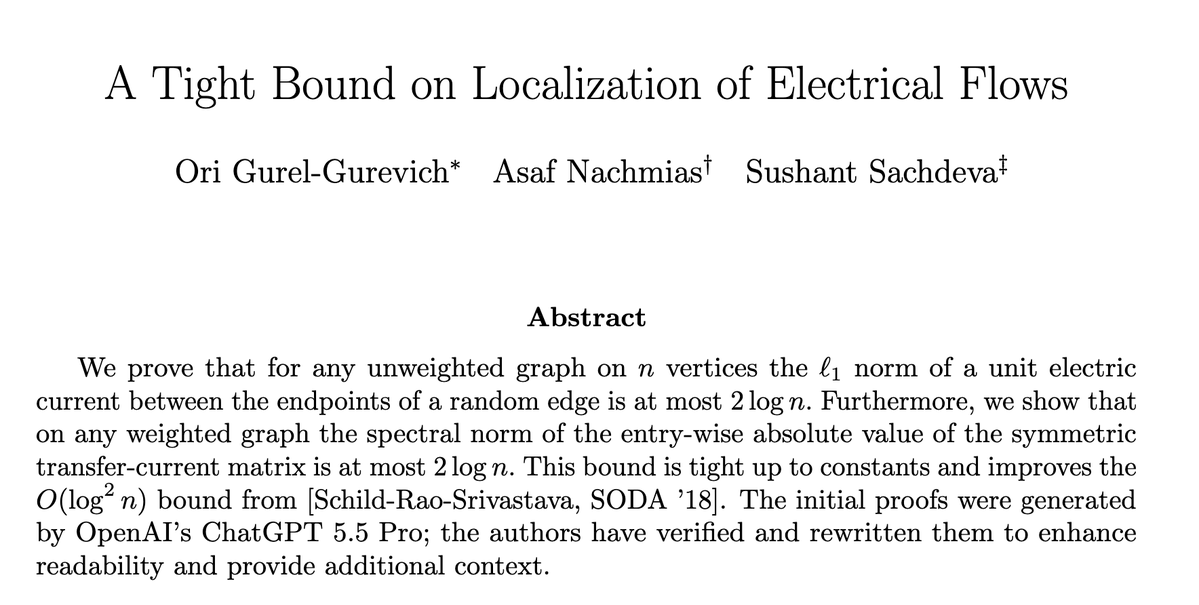
5.5 Pro one-shot settled the tight localization of electrical flows w/ a cute proof.
This improves the log^2 n result of Schild-Rao-Srivastava. Many excellent researchers and myself had thought about this q for a long time.
We now know that with an appropriate harness both Mythos and GPT-5.5 can reproduce what our internal model did in one-shot for the unit distance problem. Clearly there is an insane overhang of capabilities with this generation of models, and no ceiling in sight for what scientific advances they can bring. You can go and try to discover new things with 5.5 right now!
Huge credit to the OAI team for solving the unit distance problem with 5.5 - it is now my go to example that models can in fact pull together disparate ideas into new discoveries.
As with all 4 minute miles, we had to try and cross it too! Turns out mythos solves it with a cute, simple proof. This implies some serious overhang in discoveries!
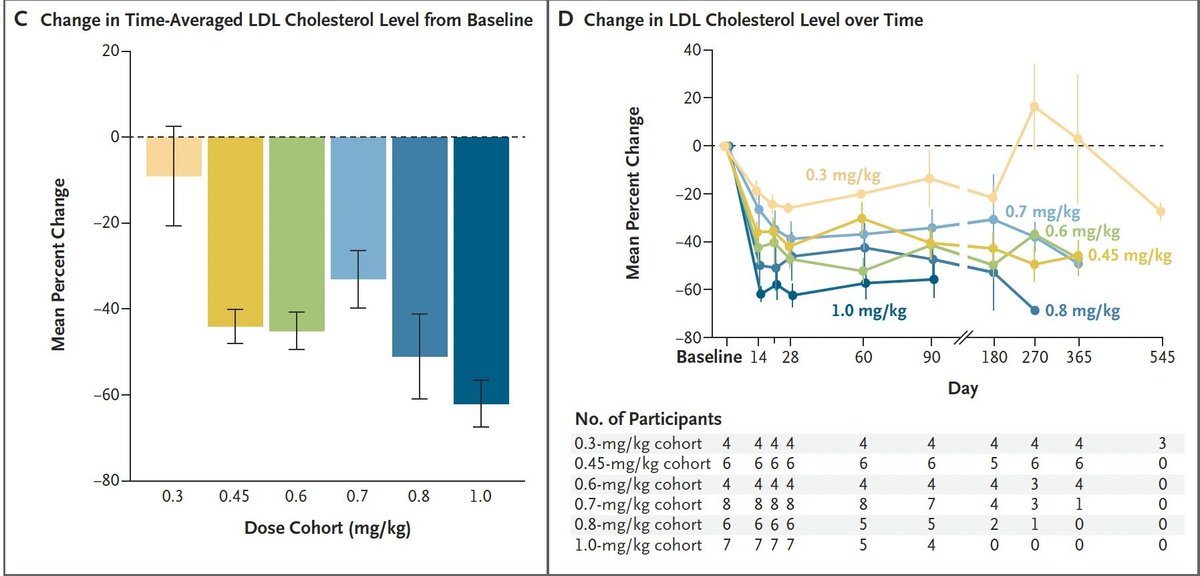
Eli Lilly has done it.
They've gone and made what seems to be a powerful, permanent gene therapy for LDL cholesterol.
That means they'll be able to effectively prevent most heart disease with a single infusion!
I’m a big Elon fan, but I was lucky to work with Tanishq on a project when he was a ~17 year old PhD student and he was the real deal. He carried the whole project himself. Super talented. Tanishq is great.
Update: Ludwig has paid me $1000 as the recent disproof of the unit distance conjecture was judged to qualify as fully autonomous interesting math.
This is an exciting development. I fully expected to win this bet but I didn't expect for it to happen quite so soon.
From the mathematicians:
"I believe it would be fair to say that every mathematician working in Combinatorial Geometry thought about this problem, and lots of mathematicians working in other areas spent at least some time thinking about it…
The fact that the correct answer is not n^(1+o(1))is surprising, and the construction and its analysis apply fairly sophisticated tools from algebraic number theory in an elegant and clever way."
"On examining the construction, it becomes more clear how people had missed this before – it requires the confluence of several different unlikely events: that a good mathematician is
(1) spending significant time in thinking about the unit distance conjecture in the first place;
(2) seriously trying to disprove it, despite the oft-repeated belief of Erdős that it is true;
(3) believes that there is mileage in generalising the original construction to other number fields, and so is willing to expend significant time in exploring such constructions; and
(4) sufficiently familiar with the relevant parts of class field theory to recognise that the appropriately phrased question about infinite towers of number fields with appropriate parameters can be solved using existing theory.
The AI met all of these criteria, and its success here echoes previous achievements: it often produces the most surprising results by persevering down paths that a human may have dismissed as not worth their time to explore, combining superhuman levels of patience with familiarity with a vast array of technical machinery.
When assessing the importance and influence of an AI-generated proof, a question I ask myself is: has this taught us something new about the problem? Do we understand discrete geometry better now? I think the answer is a moderated yes: this shows that there is a lot more that number theoretic constructions have to say about these sorts of questions than we suspected; moreover, that the number theory required can be very deep. No doubt many algebraic number theorists will be taking a close look at other open problems in discrete geometry in the coming months.
On the other hand, perhaps some in the area will be a little disappointed with how little this tells us: it does not introduce any powerful new geometric tools, or hitherto unsuspected structural results, that a proof of the unit distance conjecture would likely have called for. Still, while perhaps not the proof of a conjecture that we had hoped for, no doubt this construction and the ideas involved will have a major impact in discrete geometry."
"All the same, I would consider this to be a very "human" proof, though a extremely ingenious one.
The model’s CoT is deeply interesting. It is noteworthy that a significant majority of the thoughts are trying to construct a counterexample to the widely believed upper bound, rather than trying to prove it.
This argues that the model has some combination of good intuition, willingness to try approaches considered long-shot by the community, and a predisposition to attempt constructions. The CoT showed the model trying out a vast array of ideas from a wide range of mathematics for the required construction. The model went through ideas pretty quickly, but when it reached the crucial idea (in the paragraph starting with "Suppose optimistically that..."), it honed in on the proof quite methodically.
In my opinion this paper demonstrates that current AI models go beyond just helpers to human mathematicians – they are capable of having original ingenious ideas, and then carrying them out to fruition. This is a really impressive piece of work, and I would accept it for any journal without hesitation."
"A novel ingredient of the AI argument is to take [K : Q] → ∞"