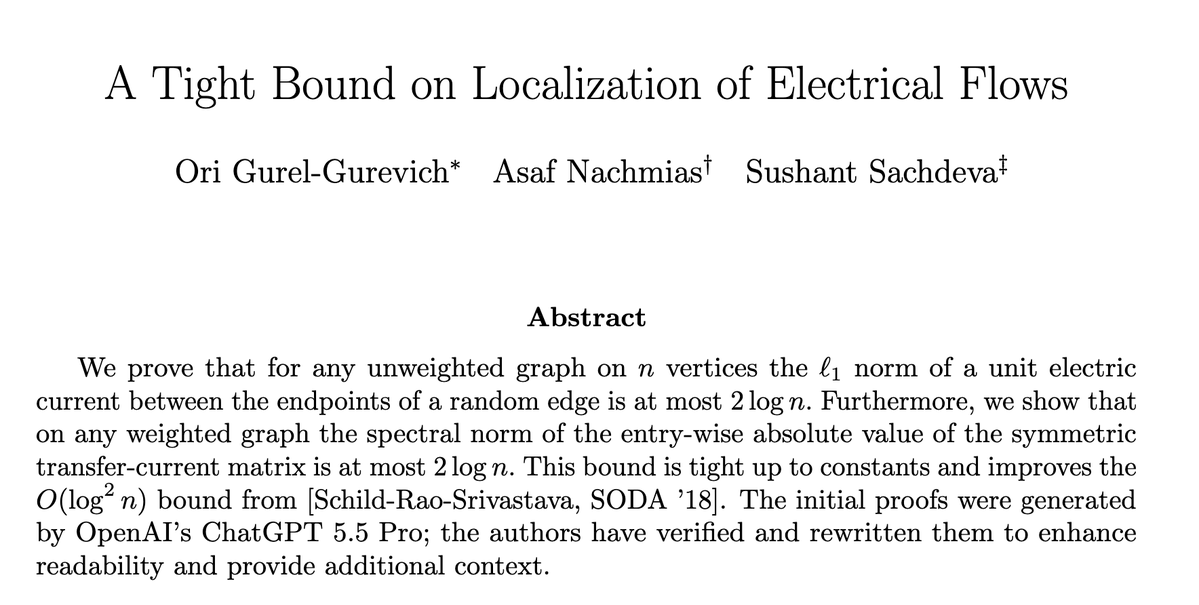
5.5 Pro one-shot settled the tight localization of electrical flows w/ a cute proof.
This improves the log^2 n result of Schild-Rao-Srivastava. Many excellent researchers and myself had thought about this q for a long time.
We now know that with an appropriate harness both Mythos and GPT-5.5 can reproduce what our internal model did in one-shot for the unit distance problem. Clearly there is an insane overhang of capabilities with this generation of models, and no ceiling in sight for what scientific advances they can bring. You can go and try to discover new things with 5.5 right now!
OpenAI models have now solved a question many mathematicians have attempted very seriously. This is thrilling yet frightening!
Only two years since the models couldn't reliably do high school math before o1 preview in Sept 2024. Any now imagine if the same progress continues!
AI has now solved a major open problem -- one of the best known Erdos problems called the unit distance problem, one of Erdos's favourite questions and one that many mathematicians had tried.
https://t.co/SD1vVPkrHR
You've been asking for this one...
Now in preview: Codex in the ChatGPT mobile app.
Start new work, review outputs, steer execution, and approve next steps, all from the ChatGPT mobile app. Codex will keep running on your laptop, Mac mini, or devbox.
The models have reached a stage where the chance of them catching an error in a written proof is comparable or better than a significant fraction of well-qualified human reviewers
I am honoured (and still a bit stunned) to receive the 2026 Presburger Award from @eatcs_secretary.
This recognizes 1 or 2 young scientists for outstanding contributions in theoretical CS
This honour is shared w my collaborators, students, institutions, & research community 1/7
Exciting news - GPT-Image-2 by @OpenAI has claimed the #1 spot across all Image Arena leaderboards!
A clean sweep with a record-breaking +242 point lead in Text-to-Image - the largest gap we’ve seen to date.
- #1 Text-to-Image (1512), +242 over #2 (Nano-banana-2 with web-search aka gemini-3.1-flash-image)
- #1 Single-Image Edit (1513), +125 over #2 (Nano-banana-pro aka gemini-3-pro-image)
- #1 Multi-Image Edit (1464), +90 over #2 (Nano-banana-2)
No model has dominated Image Arena with margins this wide.
Huge congratulations to @OpenAI on this major breakthrough in image generation! More performance breakdowns by category in the thread below.
Ok I did leave anthropic, a few weeks ago, it was one of the best places to work for a researcher. Jerry Tworek nerdsniped me
into starting this with him and others
The pretraining team at ant is one of the well functioning research team in the industry, and anthropic has great culture - I miss the fun times and claude! Thank you for everything!
In my doctorate, I proved the Erdős Primitive Set Conjecture, showing that the primes themselves are maximal among all primitive sets.
This problem will always be in my heart: I worked on it for 4 years (even when my mentors recommended against it!) and loved every minute of it.
[Primitive sets are a vast generalization of the prime numbers: A set S is called primitive if no number in S divides another.]
Now Erdős#1196 is an asymptotic version of Erdős' conjecture, for primitive sets of "large" numbers.
It was posed in 1966 by the Hungarian legends Paul Erdős, András Sárközy, and Endre Szemerédi.
I'd been working on it for many years, and consulted/badgered many experts about it, including my mentors Carl Pomerance and James Maynard.
The the proof produced by GPT5.4 Pro was quite surprising, since it rejected the "gambit" that was implicit in all works on the subject since Erdős' original 1935 paper. The idea to pass from analysis to probability was so natural & tempting from a human-conceptual point of view, that it obscured a technical possibility to retain (efficient, yet counter-intuitve) analytic terminology throughout, by use of the von Mangoldt function \Lambda(n).
The closest analogy I would give would be that the main openings in chess were well-studied, but AI discovers a new opening line that had been overlooked based on human aesthetics and convention.
In fact, the von Mangoldt function itself is celebrated for it's connection to primes and the Riemann zeta function--but its piecewise definition appears to be odd and unmotivated to students seeing it for the first time. By the same token, in Erdős#1196, the von Mangoldt weights seem odd and unmotivated but turn out to cleverly encode a fundamental identity \sum_{q|n}\Lambda(q) = \log n, which is equivalent to unique factorization of n into primes. This is the exact trick that breaks the analytic issues arising in the "usual opening".
Moreover, Terry Tao has long suspected that the applications of probability to number theory are unnecessarily complicated and this "trick" might actually clarify the general theory, which would have a broader impact than solving a single conjecture.
The comments on the problem (and the overleaf linked) are worth looking at. The solution is being characterized as the first AI-generated "book proof." Tao also has a comment pointing out that the approach taken is interesting in its own right. https://t.co/yltGOvYc6r