“Revisiting the J-Shape: Human Development & Fertility”--New findings from this @27Henrik, C Dudel, M Kolobova & M Myrskyla study “support the Myrskyla et al. reversal hypothesis for the U.S. at the subnational level when applied to historical periods.”
https://t.co/NHVWmdPYEA
“Why Are So Many U.S. Mothers Becoming Their Family’s Primary Economic Support?” Using SIPP data, Joanna Pepin et al. explore multiple pathways by which mothers become primary earners, finding that ↑ income—not relationship instability—is the main driver.
https://t.co/bbZuCVOY4U
In “Ideal Family Size & Reproductive Orientations,” Using GSS data, J Behrman finds “remarkable stability in ideal family sizes of roughly 2.5 children btw the mid-1980s and 2018,” while IDing 3 latent classes of distinct ideological dispositions. @IPRatNU https://t.co/iqsU1FH99u
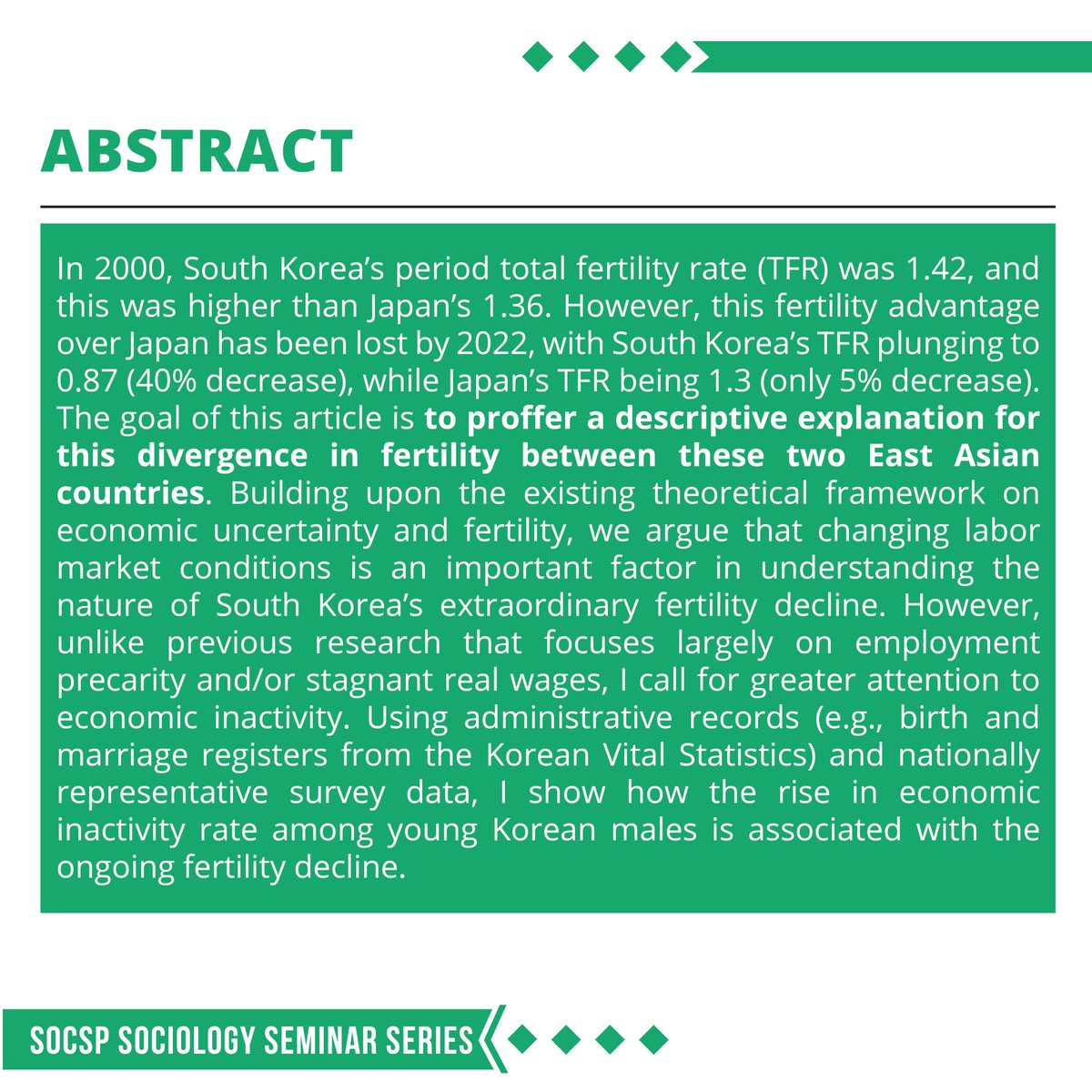
The data are in! The total fertility rate in Canada reached a new low in 2023 at 1.26 births per woman. We now have "lowest low" fertility here, defined as being below 1.3 births per woman, as we see in Japan, S Korea, Italy and Spain. StatsCan report: https://t.co/bZTy9XFwiW
Check out our new open access article! We explore the journey of sociology's most successful export to common speech, "charisma." It includes an investigation into the meaning of "rizz" and a dicussion of Peter Parker's transformation into @SpiderMan
Hi friends who study fertility!
Excited to share that our team received NSF funding to create a US Human Fertility Database. We'll be generating state-specific (since 1959) & county-specific (since 1982) period & cohort fertility indicators that will be easy to access.
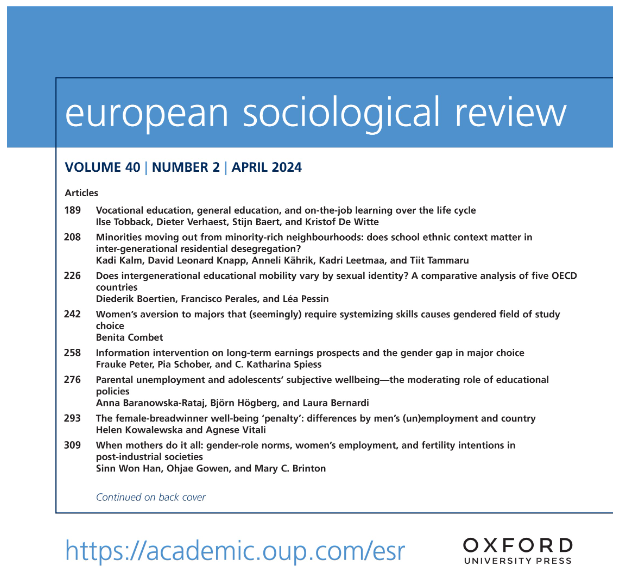
What is behind negative view of having children? Based on data from 27 #OECD countries, @SinnWon@HKUSociology finds that societal expectation of women to be both devoted mothers and wage earners leads to negative perception of motherhood amongst women. https://t.co/WDZy722lNU
New paper w/@danielasilver12! We analyze the relationship between theory figures and causal claims in sociology. Several interesting findings, most notably that visualization appears to promote clearer thinking and writing about causal relationships!
https://t.co/cfMfR9q6F3
C. Wright Mills’s Appendix in 𝘛𝘩𝘦 𝘚𝘰𝘤𝘪𝘰𝘭𝘰𝘨𝘪𝘤𝘢𝘭 𝘐𝘮𝘢𝘨𝘪𝘯𝘢𝘵𝘪𝘰𝘯 is worth reading and absorbing.
Here is a selection of some key point Mills makes in his discussion of intellectual craftsmanship (repost).
Long 🧵
The Economist's take on pronatal policy is:
1) It won't work! (uncited)
2) But if it does work, it would only help the poors
3) And we wouldn't want to do that!
https://t.co/xxVZG8JbsN
One of my dissertation chapters has been published in Population and Development Review (by @Pop_Council). Analyzing @ISSP_survey, I provide a novel explanation for why having/raising children is more negatively viewed in some countries than others.
https://t.co/RjtaYEde7o