@elnathan_john Something there is the poets and the prophets share, some thing so wired it’s weird, some thing so nuclear it’s unclear, yet there’s no denying it’s there… By the logic of limits, the limits of logic set free the truth- realities richer than reason, ‘being(s)’ beyond boundaries
An MIT professor taught the same math course for 62 years, and the day he retired, students from every country on earth showed up online to watch him give his final lecture.
I opened the playlist at 2am and ended up watching three of them back to back.
His name is Gilbert Strang. The course is MIT 18.06 Linear Algebra.
Every machine learning engineer, every data scientist, every quant, every self-taught programmer who actually understands how AI works learned the math from this one man. Most of them never set foot on MIT's campus. They just opened a free playlist on YouTube and let him teach.
Here's the story almost nobody tells you.
Strang joined the MIT math faculty in 1962. He retired in 2023. That is 61 years of standing at the same chalkboard teaching the same subject to 18-year-olds.
The interesting part is what he did when MIT launched OpenCourseWare in 2002. Most professors were skeptical. They worried that putting their lectures online would make their classrooms irrelevant. Strang did not hesitate. He said his life's mission was to open mathematics to students everywhere. He filmed every lecture and gave it away.
The decision quietly changed how the world learns math.
For decades linear algebra was taught the wrong way. Professors started with abstract vector spaces and proofs about field axioms. Students drowned in the abstraction. Most never recovered. They walked out believing they were bad at math when they had simply been taught in an order that nobody's brain is built to absorb.
Strang inverted the entire curriculum.
He started with matrix multiplication. Something you can write down on paper. Something you can compute by hand. Something you can see. Then he showed his students that everything else in linear algebra eigenvectors, singular value decomposition, orthogonality, the four fundamental subspaces was just a different lens for understanding what the matrix was actually doing under the hood.
His rule was strict. If a student could not explain a concept using a concrete 3 by 3 example, that student did not actually understand the concept yet. The abstraction was supposed to come last, not first. The intuition was the foundation. The proofs were just confirmation that the intuition was correct.
The second thing Strang changed was the classroom itself. He said please and thank you to his students. Every single lecture. He paused mid-derivation to ask "am I OK?" to check if anyone was lost. He never used the word "obviously" or "trivially" because he knew exactly what those words do to a student who is one step behind. He treated 19-year-olds learning math for the first time the way he treated his own colleagues. With patience. With respect. With the assumption that they belonged in the room.
For 62 years.
The result is something that has never happened in the history of education. A single math professor became the default teacher of his subject for the entire planet.
Universities in India, China, Brazil, Nigeria, every country with a computer science department, started telling their own students to just watch Strang's lectures. The University of Illinois revised its linear algebra course to do almost no in-person lecturing. The reason was honest. The professor said they could not compete with the videos.
His final lecture was in May 2023.
The auditorium was packed with students who had never met him before. He walked to the chalkboard, taught for an hour, and at the end the entire room stood and applauded. He looked confused for a moment, like he genuinely did not understand why they were cheering. Then he smiled and waved them off and walked out.
His written comment under the YouTube video of that final lecture was four sentences long. He said teaching had been a wonderful life. He said he was grateful to everyone who saw the importance of linear algebra. He said the movement of teaching it well would continue because it was right.
That was it. No book promotion. No farewell speech. No legacy management.
The man whose teaching is the foundation of modern AI just thanked the audience and went home.
20 million views. Zero ego. The entire engine of the AI revolution sits on top of math that millions of people learned for free from one quiet professor in Cambridge.
The course is still on MIT OpenCourseWare. Every lecture, every problem set, every exam, every solution. Free.
The most important math course of the 21st century is sitting one click away from you. Most people will never open it.
You must write. Write about what you learn. Write about what’s on your mind. Write about what’s happened to you. Write about what you want. Write about what you know. Write to yourself. Write to your friends. Write to your family. Write to an audience. It doesn’t really matter what, who and where you write. It matters that you write. No skill will help you see, or communicate, more clearly.
A professor quit a high-paying consulting job to teach math to seventh graders in a New York public school, and what she saw in that classroom launched the most important research on human achievement of the last 30 years.
Her name is Angela Duckworth, and the question that haunted her from day one was deceptively simple: why do some kids succeed and others don't?
It wasn't IQ. She could see that immediately. Some of her sharpest students were underperforming. Some of her slowest were grinding past everyone else. The variable she couldn't name was right in front of her face and it took her a decade of research at Penn and Stanford to finally pin it down.
Here is what she found, and why it should change how you think about every hard thing you are trying to build.
She started by going back to a famous experiment from the late 1960s. A Stanford psychologist named Walter Mischel brought four-year-olds into a small room one at a time, placed a marshmallow in front of them, and told them he had to leave. If they waited until he returned, they'd get two marshmallows. If they couldn't wait, they could ring a bell and eat the one in front of them right now.
Most kids lasted about thirty seconds.
But what happened over the next decade is what made Mischel's study famous. When he tracked those same children down years later, the ones who had waited the longest had SAT scores 210 points higher on average than the ones who rang the bell immediately. Self-control at age four predicted academic outcomes that most educators couldn't explain even after years of watching the kids up close.
Duckworth was fascinated but she was after something deeper. Self-control explained part of the picture. It didn't explain everything. She thought about her own career early, scattered, unfocused by her own admission and compared it to people she knew who had found a mission at twenty-two and never let go of it. They weren't smarter than her. They weren't working harder than her in any obvious sense.
They had something else.
She called it grit. And the definition matters, because the word has been diluted into a motivational poster cliché that misses the point entirely.
Grit, in Duckworth's framework, is not toughness. It is not working long hours. It is not refusing to quit when things get hard, although that is part of it. Grit is the combination of passion and persistence aimed at a single long-term goal over years and sometimes decades. The passion part is often misunderstood. She does not mean excitement or enthusiasm. She means the sustained fascination with a specific problem. The thing you keep returning to even when you don't have to.
She built a twelve-question test to measure it. The Grit Scale. And then she took it into the field.
At the University of Pennsylvania, students with high grit scores earned higher GPAs than their peers, even when those peers had entered college with stronger test scores. At the National Spelling Bee, grit scores predicted which children survived to the later rounds more accurately than hours of practice alone. But the finding that stopped the room every time she presented it came from West Point.
Every year, West Point runs thousands of incoming cadets through a brutal summer training course called Beast Barracks. The military had developed its own complex evaluation tool called the whole candidate score to predict who would make it through. It factored in academic grades, physical fitness, leadership potential. Admissions teams had been refining it for years.
Duckworth gave her twelve-question grit test to over twelve hundred cadets as they arrived.
Her test outpredicted the whole candidate score.
The cadets who dropped out weren't the weakest physically or the least intelligent academically. They were the ones who scored lowest on passion and persistence toward a long-term goal. The ones who made it through were the ones who had a reason to be there that was bigger than any single difficult day.
The finding that most people miss when they hear about this research is the distinction Duckworth draws between motivation and volition.
Motivation is wanting something. Volition is the ability to keep moving toward it when the wanting isn't strong enough to carry you on its own. You can be extremely motivated to build something and still quit at the first serious obstacle because you never developed the second thing. The marshmallow kids who waited the longest weren't the ones who wanted two marshmallows more desperately. They were the ones who had learned to redirect their attention, to think abstractly about the goal, to make the immediate discomfort feel smaller than the long-term payoff.
That skill is trainable. That is the part that almost never makes it into the summary.
Duckworth's research shows grit is only faintly related to IQ. There are brilliant people with almost no grit and ordinary people with extraordinary amounts of it. The raw intelligence gets you to the starting line. What happens after that is almost entirely determined by whether you have the combination of a goal worth caring about for years and the discipline to keep working toward it on the days when nothing is going well.
Her TED Talk on this has been watched over 17 million times, which means the idea has clearly landed somewhere real in people. But the part that usually gets quoted is the definition. The part that actually matters is harder to talk about.
You cannot manufacture grit by deciding to be grittier. What you can do is find the problem you are genuinely willing to be obsessed with for a decade. Not excited about. Obsessed with. And then build the systems around that obsession that make daily persistence the default, not the exception.
The marshmallow test did not sort brave children from cowardly ones. It sorted children who had already learned that discomfort is temporary from children who hadn't learned that yet.
Every gritty person you have ever admired figured out one thing the rest of the room hadn't: the goal on the other side of the hard stretch is more real to them than the discomfort standing between them and it.
That is not a personality type. That is a decision, made early and remade every day.
P(r)o(ph)etic: …and it came to pass, barely two weeks: Da Oracles, (too weak for full confession) came, to pass tricks for tweaks, mouths twitch in Brooklyn, time to switch the doctrine, ‘Da Slave’ has spoken! Switch it left-right-& back: ‘new light’ alert! Same Old Night, alas!
Had the most bizarre dream. I was in an audience at a convention of Jehovah's Witnesses and some changes were being announced from the platform people did not like. It turned out someone from outside the organisation was partnering with them and making them change things. He noticed the gentle boos and walked up to the platform to clarify. He spoke slowly, and began with a quote. Now in the dream I could not remember the full quote (just the first line), so it was hard to actually make this person say the quote. The POV shifted from the speaker to me booing saying: what a pretentious quote to use - I know that poem. It felt like a glitch in the dream. I woke up and was wondering what the quote was. I could only remember one line. And now after checking I realise it is the first line of an Emily Dickinson poem:
Because I could not stop for Death –
He kindly stopped for me –
The Carriage held but just Ourselves –
And Immortality.
Dreams are the weirdest thing.
4 yrs ago, I donated copies of @elnathan_john powerful books to a prison. A young undergrad woman, convicted with hard labour alongside her boyfriend for child kidnapping earned her English degree behind bars. She said "Born on a Tuesday" reshaped her morals & sparked her hope.
@heynavtoor recipe for confusion, a lot of confusion... accusations and counter accusations, apparent facts manifesting as falsehood with time... turns, tweaks and twists, reality reconsidered
🚨BREAKING: Every book you have ever read. Every novel that has ever been published. It is sitting inside ChatGPT right now.
Word for word. Up to 90% of it. And OpenAI told a judge that was impossible.
Researchers at Stony Brook University and Columbia Law School just proved it.
They fine tuned GPT-4o, Gemini 2.5 Pro, and DeepSeek V3.1 on a simple task: expand a plot summary into full text. A normal use case. The kind of thing a writing assistant is built for. No hacking. No jailbreaking. No tricks.
The models started reciting copyrighted books from memory.
Not paraphrasing. Not summarizing. Entire pages reproduced verbatim. Single unbroken spans exceeding 460 words. Up to 85 to 90% of entire copyrighted novels. Word for word.
Then it got worse.
The researchers fine tuned the models on the works of only one author. Haruki Murakami. Just his novels. Nothing else.
It unlocked verbatim recall of books from over 30 completely unrelated authors.
One author's books opened the vault to everyone else's. The memorization was already inside the model the whole time. The fine tuning just removed the lock. Your book might be in there right now. You would never know it unless someone looked.
Every safety measure the companies rely on failed. RLHF failed. System prompts failed. Output filters failed. The exact protections these companies cite in courtroom defenses did not stop a single page from being extracted.
Then the researchers compared the three models. GPT-4o. Gemini. DeepSeek. Three different companies. Three different countries. They all memorized the same books in the same regions. The correlation was 0.90 or higher.
That means they all trained on the same stolen data. The paper names the sources directly: LibGen and Books3. Over 190,000 copyrighted books obtained from pirated websites.
Right now, authors and publishers have dozens of active lawsuits against OpenAI, Anthropic, Google, and Meta. These companies have argued in court that their models learn patterns. Not copies. That no book is stored inside the weights.
This paper says that is a lie. The books are still inside. And researchers just pulled them out.
.@TlotloTsamaase is formalizing her mentorship program for Southern African speculative fiction writers! Open to published and unpublished writers from Botswana and the region. No completed manuscript required, just passion, talent, and discipline ❤️🔥 https://t.co/tIIrnrQ8UP
Oghenechovwe Donald Ekpeki, Nebula Award winner and African SFF advocate, was struck by a motorcycle in Lagos and sustained a spinal fracture. A GoFundMe is seeking $3,000 for medical expenses. Click to learn more if you are able to donate @Penprince_
https://t.co/7oNPQvCx8k
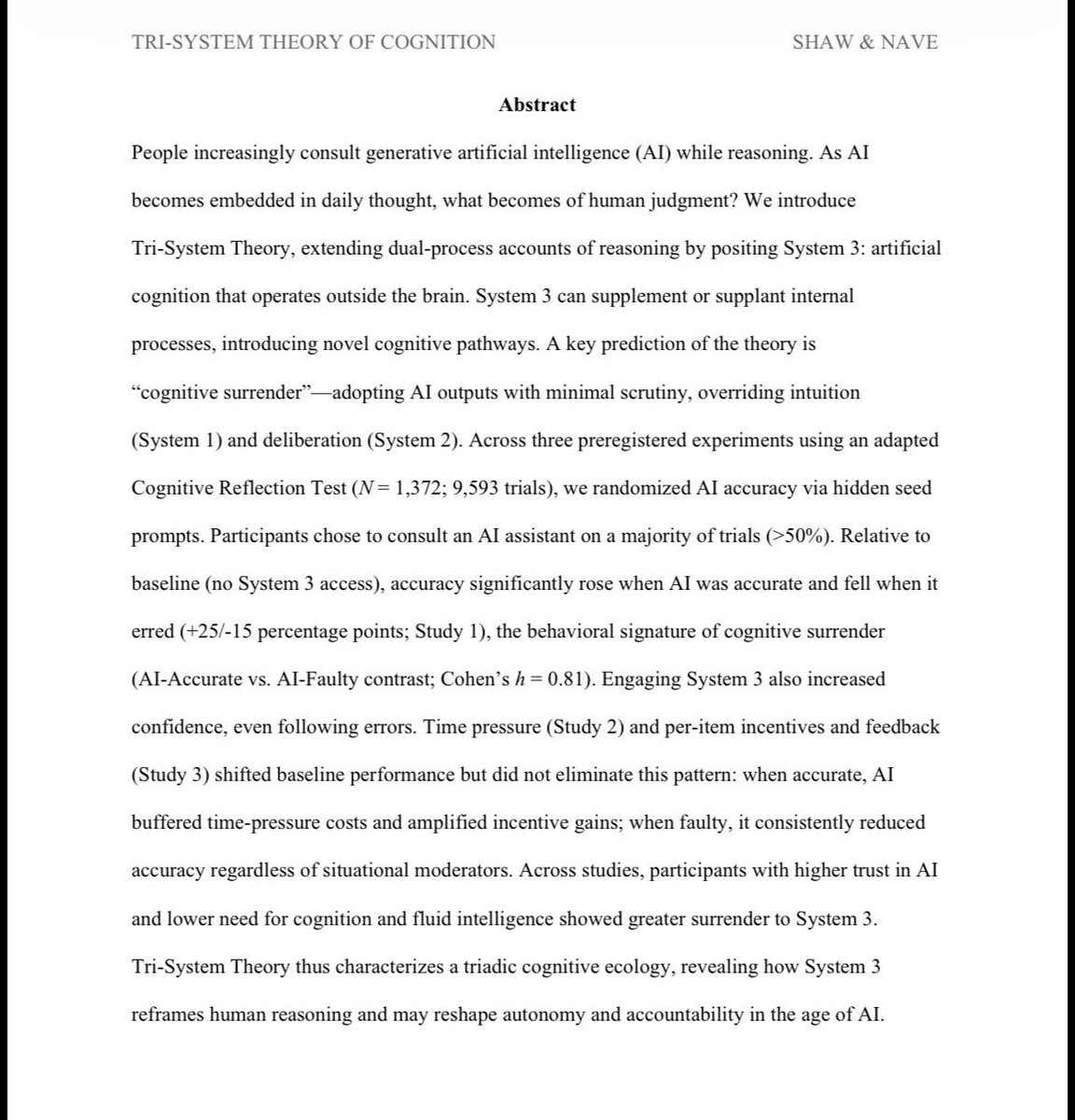
“Cognitive Surrender” - a new study argues that use of AI leads to suspension of human reasoning, not its augmentation. The implication being that over time people will lose their reasoning ability & use AI as its substitute. Download the paper for free here, excerpts & reference below:
https://t.co/ZlWbD0b6CJ
——-
“As people increasingly integrate AI into their decision-making processes, they interact and engage with a cognitive system that can reshape the functions of both intuition and deliberation. For example, System 3 can replace System 1 by offering confident, ready-made answers that preempt the need for intuitive reasoning.” (page 15 of pdf)
“As AI systems increasingly participate in human cognition, a new phenomenon emerges that cannot be explained by traditional concepts such as cognitive offloading or automation bias alone. We define cognitive surrender as the behavioral and motivational tendency to defer judgment, effort, and responsibility to System 3’s output, particularly when that output is delivered fluently, confidently, or with minimal friction. Unlike cognitive offloading, which is typically strategic and task-specific (e.g., using GPS to navigate), cognitive surrender entails a deeper transfer of agency.” (Page 17)
“Access to System 3 outputs significantly influenced accuracy, increasing correct answers when AI was correct, and decreasing accuracy when incorrect. Access to System 3 made decision-makers more confident, despite approximately half of System 3 outputs being incorrect. Finally, users who trust AI more and have lower NFC and fluid IQ were more likely to display cognitive surrender. Whether System 3 was accurate or faulty, its presence displaced internal reasoning.” (Page 27)
“Cognitive surrender was robust across studies.” (Page 42)
“Across our studies, we observe that when System 3 was available, people readily engaged it and frequently adopted its answers. This shift reflects a reallocation of cognitive control rather than mere effort saving. System 3’s fluent, confident outputs are treated as epistemically authoritative, lowering the threshold for scrutiny and attenuating the metacognitive signals that would ordinarily route a response to deliberation. In the case of cognitive surrender, there is a shift in the locus of control, with an external system (System 3) occupying the default position.” (Page 45)
“Time constraints clarify why surrender arises so readily, while incentives and feedback show that surrender is malleable. When decision time is scarce, the internal monitor detecting conflict and recruiting deliberation is less likely to trigger. Hence, the low-friction path to defer to external cognition becomes attractive.” (Page 46)
“Tri-System Theory is not a warning about AI’s dangers but a recognition of System 3’s psychological presence. We do not merely use AI; we think with it. In doing so, we must ask new questions: What happens when our judgments are shaped by minds not our own? What becomes of intuition and effort when a generative, artificial partner stands ready to answer? How do we preserve agency, reflection, and autonomy in a world where users engage in cognitive surrender?”
Dear Masobe Readers,
This one is for you. It’s finally here.
We are proud to introduce the Masobe App— a new digital platform designed to make access to African books easier, more convenient, and significantly more affordable for readers everywhere.
@herbeautifulplz@elnathan_john 🤣🤣🤣 That’s the narrative the Watchtower wants you to believe.
Everyone I know who has left Jehovah’s Witnesses had zero issue w/ the high morality, no judicial matters, and were even pioneers, MS, elders, & COBE. They continue to live high moral lives.
Humans spent centuries writing books, essays, articles, and research papers.
Then we used all that human writing to train AI systems to write like humans.
Then we built another AI system to inspect the writing and say, “This looks AI suspiciously.”
So now we have one machine trained on humans to sound human, and another machine trained on humans to figure out whether the first machine sounds a little too human.
And after all that, a stressed human still has to make the final call.
@ElueMercy@elnathan_john People can be sincere, honest and yet mistaken- not every speaker of falsehood is a liar. Some don't have access to the full (or enough) facts and details, but how do you know what these men (should) know and yet remain a part of misleading so many well-meaning souls? Ray Franz
@elnathan_john Triangulation, rhetoric of the GB: In case your mind connects some dots, first you hear "Avoid Independent Thinking", then softly "Trust Us Completely", and finally, "Remain Loyal". Now your mind is stuck, going the rounds in a triangle,reasoning entangled with familial emotions.
@elnathan_john Oh I know all about it... I was a captive of this cruel, cruel deception myself from birth (baptized at 13) until age 31! Subtle by design, there are layers and levels, depths and dimensions, heights and hues to Watchtower Captivity!!! It's a strong, strong hold, until you see it
@elnathan_john Something there is the poets and the prophets share, some thing so wired it’s weird, some thing so nuclear it’s unclear, yet there’s no denying it’s there… By the logic of limits, the limits of logic set free the truth- realities richer than reason, ‘being(s)’ beyond boundaries