@CritterOfHabit Ever since I found out she gets killed off so quickly after she shows up in it I've refused to watch it. I was so excited for her potential in the MCU.
Because you harass women out of the trades and when that doesn’t work, you kill us.
On November 11, 2025, 20-year-old welder Amber Mary Czech was murdered with a sledgehammer at her workplace, Advanced Process Technologies, by her co-worker, 40-year-old David Bruce Delong.
Delong said he did not like Czech, claimed she had once given him a "bad look," and said he had been thinking about killing her for some time.
@wazukyandkaim@PlayWarframe You aren't alone in this. While I do love the design I'll admit I would prefer to not have every female Warframe's heirloom skin to have their ass out in the open.
@PlayWarframe I think it would be badass if she had a wild west styled trench coat. They could make it have the same custom options as Vauban with his heirloom jacket. All in all I do love the design.
Ryan Al Najjar was bound with tape and drowned in a ditch by her own father and brothers.
Why? Because she said she didn’t want to wear a hijab anymore.
Now tell me again that the hijab is a choice. Tell me that Muslim women have a “choice”.
Tell me that Ryan had a choice.
Iranian taekwondo athlete Hanieh Shariati was arrested for posting videos training without hijab.
Her Instagram shut down and no one knows where she’s being held.
In the Islamic Republic, a woman’s hair and body are treated as threats to national security.
She was 17, and the law said she had to marry her rapist—or be dishonored forever.
She said no.
In 1965, Franca Viola was a teenager living in Alcamo, Sicily, when she made a decision that would change Italian history. But first, she had to survive.
Franca had ended a relationship with Filippo Melodia, a man with mafia connections who didn't accept rejection. On December 26, 1965, Melodia and a group of armed men stormed her family's home. They beat her mother. They abducted Franca and her eight-year-old brother Mariano, who tried desperately to protect his sister.
Mariano was released. Franca was not.
For eight days, she was held captive. Raped. Terrorized. And constantly pressured to agree to marry her attacker.
Because in 1965 Italy, that was the solution. That was the law.
Article 544 of the Italian Penal Code allowed a rapist to escape all punishment if he married his victim. It was called "matrimonio riparatore"—rehabilitating marriage. The idea was that marriage would "restore" the woman's honor, which had been destroyed by the rape.
Her honor. Not his crime.
This wasn't ancient history. This was 1965—the year the Beatles released "Yesterday," the year America sent troops to Vietnam. In modern Italy, rape victims were expected to marry their rapists or live as damaged, unmarriageable outcasts.
When Franca was finally released after eight days, everyone—her community, society, even some in her own family—expected her to do what women always did: accept the marriage and move on with her ruined life.
Franca Viola said no.
With her father's support, she refused to marry Filippo Melodia. Instead, she did something unprecedented: she pressed charges. She took him to court.
The backlash was immediate and brutal. Her family was shunned. Their fields were set on fire. Their name became synonymous with dishonor. In Sicily, where honor codes ran deep and mafia influence was strong, defying this tradition was dangerous.
But Franca didn't back down.
The trial became a national sensation. For the first time, Italians across the country had to confront the horror of a law that protected rapists and punished victims. Newspapers covered every detail. The country divided between those who supported Franca's courage and those who condemned her for "shaming" herself and her family.
In 1966, Filippo Melodia was convicted and sentenced to eleven years in prison.
Franca Viola became the first woman in Italian history to publicly refuse "rehabilitating marriage" and successfully prosecute her rapist.
The cultural shift was seismic. Italy's President Giuseppe Saragat received her. Pope Paul VI—the Pope himself—met with her, a quiet acknowledgment that the Church recognized something fundamental was changing.
In 1968, Franca married Giuseppe Ruisi, her childhood friend who loved her without prejudice, who saw her as a whole person rather than a "dishonored" woman. Their marriage was a statement: victims of violence deserved love, respect, and normal lives.
But the law didn't change immediately. Article 544 remained on the books.
It took fifteen more years. Fifteen years of activism, of cultural shifts, of other women finding courage in Franca's example. Finally, in 1981, the Italian Parliament abolished the "rehabilitating marriage" law.
Rapists could no longer escape justice by marrying their victims.
Franca Viola, a 17-year-old girl from Sicily who simply said "no," had helped change the law of an entire nation.
She never sought fame. She lives quietly with Giuseppe, their children and grandchildren. She rarely gives interviews. She was never interested in being a symbol—she just wanted justice for what happened to her.
But history made her a symbol anyway.
Because sometimes one person's refusal to accept injustice can crack open an entire system. Sometimes a teenage girl's courage can force a modern nation to confront laws built on ancient shame and patriarchal control.
Franca Viola proved that a woman's honor isn't defined by what's done to her—it's defined by how she responds.
She was 17 years old. The law, her community, tradition, and fear all told her to submit.
She said no.
And Italy changed forever.
@SheraFamily@historyinmemes@CPSUK@BBCWomansHour@FeministHistory@UN_Women@womensaid@RefugeCharity @DrCharlotteProudman @MelanieBridgeon @EverydaySexis @MsMagazine@UNHumanRights@GlobalJusticeUK@womensaid@RightsOfWomen@UN_Women@amnesty@EqualityNow@EndVAWNow
"Can you not at least put a sane woman among us?"
The words came from a terrified patient inside the Women's Lunatic Asylum on Blackwell's Island. She was begging the doctors, the nurses, anyone who would listen.
She was talking about the new patient. The one who seemed too calm. Too aware. Too sane.
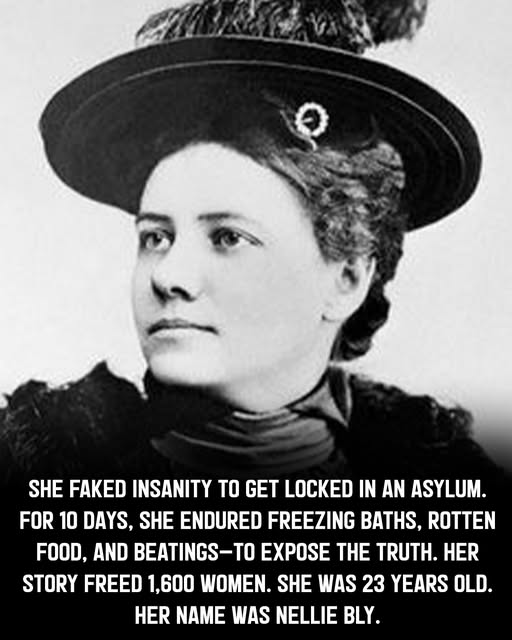
That patient was Nellie Bly. And she was exactly where she wanted to be.
In 1887, New York City's asylums were shrouded in mystery. Rumors swirled about horrific conditions, abuse, and women disappearing behind locked doors, never to be seen again.
But they were just rumors. No proof. No witnesses willing to speak. No way to know the truth.
Nellie Bly, a 23-year-old journalist for the New York World, decided to find out for herself.
Her editor, Joseph Pulitzer, supported her plan: get yourself committed to the asylum, document everything, and expose the truth.
It was dangerous. It was unprecedented. If something went wrong, Nellie could be trapped there indefinitely—declared insane with no way out.
She did it anyway.
Nellie checked into a women's boarding house and began acting erratically. She stayed up all night, spoke incoherently, stared at nothing, and claimed not to know who she was.
The landlady called the police. A judge declared her insane. And on September 25, 1887, Nellie Bly was committed to the Women's Lunatic Asylum on Blackwell's Island.
The moment she arrived, Nellie dropped the act. She behaved completely normally. She spoke clearly. She answered questions rationally.
It didn't matter.
Once you were inside, you were insane. No amount of sanity would set you free.
What Nellie discovered inside was worse than anyone imagined.
The asylum held over 1,600 women. Many of them weren't mentally ill at all.
They were poor. They were immigrants who didn't speak English. They were women whose husbands wanted to be rid of them. They were girls who'd been raped and were considered "damaged." They were inconvenient, unwanted, and discarded.
And once inside, they were tortured.
The "treatment" was barbaric. Patients were forced to sit in freezing cold baths for hours—punishment disguised as therapy. The food was rotten, inedible. Rats roamed freely. The halls were filthy.
Nurses beat patients with sticks. They tied women to chairs and left them for days. They mocked them, starved them, and ignored their pleas for help.
Nellie watched women scream for help and be silenced with violence. She saw patients beg for warm clothing and be denied. She witnessed daily cruelty designed not to heal, but to break.
And she wrote it all down. In her mind. Memorizing every detail.
For ten days, Nellie endured the same treatment as everyone else. She froze in the baths. She choked down spoiled food. She slept on a hard bench in a freezing room with no blankets.
She didn't complain. She didn't fight back. She documented.
On October 4, 1887, after ten days inside, an attorney hired by her newspaper secured her release.
She walked out of Blackwell's Island and immediately began writing.
On October 9, 1887, the New York World published "Ten Days in a Mad-House"—Nellie Bly's firsthand account of life inside the asylum.
The article was explosive.
Nellie described everything in vivid, horrifying detail. The cold baths. The rotten food. The rats. The beatings. The women who didn't belong there.
She wrote about a woman who spoke only German and was declared insane because doctors couldn't understand her. She wrote about girls as young as sixteen locked away for being "difficult." She wrote about women who begged to be released and were told they'd never leave.
The public was horrified. Outraged. Demanding answers.
A grand jury was convened to investigate. They toured Blackwell's Island. They interviewed patients and staff.
They confirmed everything Nellie had written.
The city of New York immediately allocated an additional $1 million to the Department of Public Charities and Corrections to reform asylum conditions. Staff were retrained. Oversight increased. Patients gained new rights and protections.
Some of the women Nellie had met were released. Others received proper care for the first time.
"Ten Days in a Mad-House" became a sensation. It was published as a book. It was read across the country. It sparked a national conversation about mental health, women's rights, and institutional abuse.
Nellie Bly became famous overnight.
But she didn't stop.
In 1889, at 25 years old, Nellie set out to break the fictional record set in Jules Verne's Around the World in Eighty Days. She traveled around the globe in 72 days, 6 hours, and 11 minutes—by steamship, train, and sheer determination.
She became an international celebrity.
But it was "Ten Days in a Mad-House" that cemented her legacy as the mother of investigative journalism.
Nellie Bly proved that journalism wasn't just about reporting what happened. It was about uncovering what was hidden. It was about giving voice to the voiceless. It was about risking everything to tell the truth.
Before Nellie, undercover journalism didn't exist. She invented it.
After Nellie, investigative reporters followed her lead—going undercover in factories, prisons, sweatshops, and more to expose injustice.
Nellie Bly died in 1922 at the age of 57. By then, she had revolutionized journalism, traveled the world, and advocated for women's rights and workers' protections.
But her asylum exposé remains her most enduring achievement.
Because of Nellie, over 1,600 women were seen. Their suffering was acknowledged. The system that imprisoned them was forced to change.
Because of Nellie, mental health reform began in America.
Because of Nellie, journalists learned that sometimes the most important stories require more than a notebook—they require courage.
Nellie Bly didn't just write about injustice. She lived it. She endured it. And then she made damn sure the world knew.
She was 23 years old.
She faked insanity to get locked in an asylum.
For 10 days, she endured freezing baths, rotten food, and beatings.
She did it to expose the truth about 1,600 women who'd been abandoned by society.
Her story changed mental health care in America.
Her courage invented investigative journalism.
Her name was Nellie Bly.
And she proved that one person, willing to risk everything, can change the world.
Have you seen Faith, 14, who is missing from Brighton?
Faith was last seen in Brighton at around 3.30pm on Wednesday (22 October) and concern is growing for her welfare.
She is of slim build, with long blonde hair and was last seen wearing a yellow hoodie with a cross and the words ‘God is within us’ on the back and black tracksuit bottoms.
Faith is known to have links in Brighton and London.
If you see her or know where she is please call 101 quoting serial 1097 of 10/2025
"I feel sick"!
16yr old Meya Åberg, who was raped by Muslim invader, Yazied Mohamed, in Sweden, bravely speaks out after a court ruled he could not be deported because the rape did not last long enough!
Women who hate men want nothing to do with them.
Men who hate women rape us, beat us, torture us, murder us and celebrate their ability to trample our faces in the dirt. They keep us poor and ignorant and dependent on them because a woman without an education is easier to convince that she deserves the abuse.
We are not the same.