The obvious question is why did $MGY let this get built around them the last 3 years for lower values and then feel the need to pay a massive windfall to Wildfire
ShaleBros going to ShaleBro
Goldman - "As of July 13, a total of over 1.2 million leveraged retail accounts across the Korean market triggered margin calls. Approximately 320,000–360,000 accounts were fully liquidated by brokers. South Korea has an adult population (aged 15–64) of 35.7 million people… i.e. 1 in 30 (3.4%) adults got margin called."
BREAKING: US total crude inventories fell last week ~17.8 million barrels (that's commercial and SPR stocks combined). On that basis, it's the largest weekly fall since data is available starting in 1982.
Super-Spiked Videopods (EP76): Are Underlying Oil Balances Less Bearish Than Feared? https://t.co/K4w2tL3fAB
Crude oil prices have been far more resilient than most expected in the face of unexpected OPEC quota increases and a seemingly lackluster economic backdrop. Our punchline is that while we agree there is risk of oil price softness in the back-half of this year and early 2026, underlying crude oil S/D balances are not anywhere near as oversupplied as consensus fears. We believe fears of a crash and potential extended bear market are way overdone. We are also gaining confidence that by the time we get to 2H2026 and 2027, oil price risk shifts more meaningfully to the upside.
The main points of difference in our more constructive outlook are:
(1) to disaggregate black crude oil from the more widely reported and followed overall liquids figures; and
(2) to give greater consideration to OPEC Research’s Monthly Oil Market Report versus the more broadly used equivalent report (Oil Market Report) from the IEA.
Over the past month, we have published several posts that have examined the long-term outlook from various macro forecasting agencies, consultants, and oil companies. We conclude OPEC Research leads the pack on being most realistic and pragmatic and was least impacted by “net zero / energy transition” madness of the prior 4-5 years. That doesn’t mean they are necessarily better at short-term S/D balances, but we don’t think they should be entirely dismissed either.
As a reminder, @SuperSpiked and Veriten, our focus is on the long-term outlook for energy markets and companies. We have zero interest in joining the S-T oil price guessing game that the Street and others tend to focus on. But in this case, the prevailing bearish narrative around crude oil is so pronounced and at odds with what we are seeing, we thought it worth commenting.
@NiceQuarterGuys Dual benefit of expressing gratitude and supporting the energy industry by using 2-3 tokens for the simple "thank you" / "you're welcome" exchange
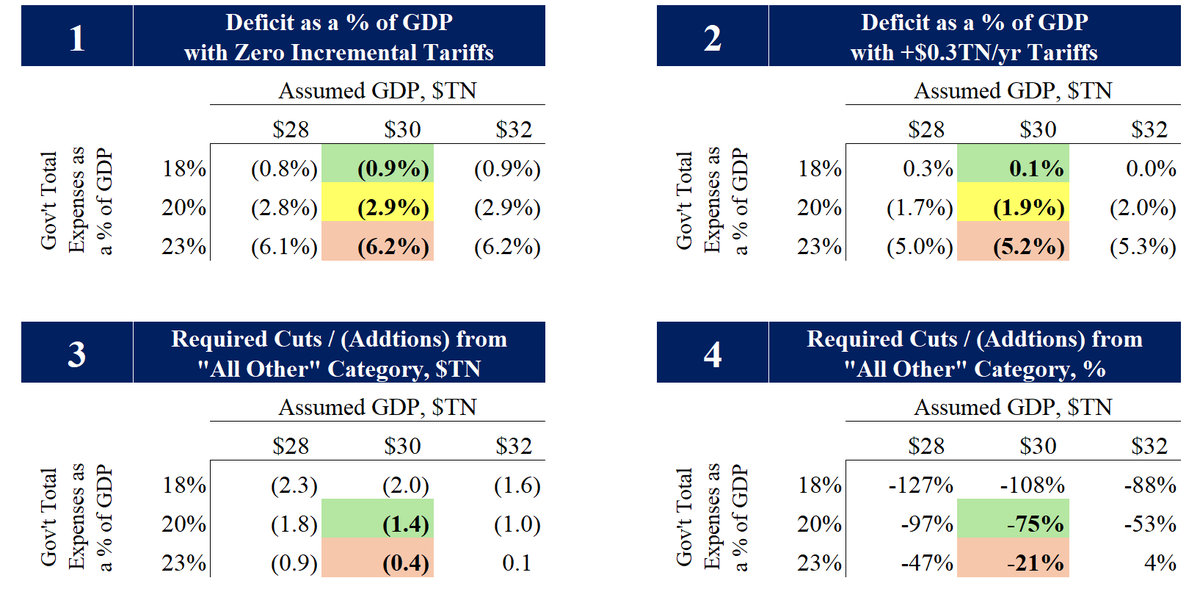
1. We’re running a 6% deficit currently. Bessent hopes to get that to 3%, which would require reducing spending to 20% of GDP, absent revenue offsets. He cites in the podcast an 18% spending ideal (Singapore).
Treasury Secretary @SecScottBessent lays out Trump's economic plan to the Besties:
-- De-lever the government via cutting spending
-- Shed excess labor from the government
-- Re-lever the private sector by de-regulating the financial system
-- Allow an unshackled private sector to absorb laid off government workers
-- Re-order global trade through tariffs
-- Bring manufacturing jobs back to the US
-- Re-invigorate the middle class
-- Unleash American energy, dropping prices
-- Prices down, real wages up
Thanks to our partners for making the DC trip happen:
@wearehims: https://t.co/AMh4ngrEHo | https://t.co/LNav2Y8k8u
@Gemini: https://t.co/4U7NUkFzaU
@iTrustCapital (use code allin): https://t.co/TyBmNQbZ9Z
3. The DOGE cuts are mostly focused on “All Other” categories which is about 20% of total expenses. But because entitlements and interest on debt are rising so rapidly, we might need $400BN of cuts just to stay even at a $30TN GDP and 23% spending level, even with $300BN of incremental tariffs. And TBD what amount of GDP deflates from govt cuts and/or is offset by the private sector.
Exclusive | Sunnova Prepares Restructuring Talks That Could Include Bankruptcy | The recourse debt is not the real problem here. It’s the solar leases themselves, which reside in the ABS. They don’t generate enough cash to satisfy the tax equity. $NOVA https://t.co/oWSYrw1DHp