KRG Breaks Government-Formation Record With No Sitting Parliament and No Caretaker Cabinet
The Kurdistan Region’s parliamentary election was held more than 650 days ago. The resulting government-formation crisis has now surpassed the recent deadlock in the Brussels-Capital Region, which lasted more than 600 days, making it one of the longest such impasses in recent history.
What makes the Kurdistan Region exceptional, however, is not simply the duration of the deadlock. The outgoing KRG has continued to exercise virtually full executive authority while avoiding any meaningful recognition that it is a caretaker cabinet. This is despite a firm precedent established by Iraq’s Federal Supreme Court, which has held that the federal government enters caretaker status once parliamentary elections are held and the previous electoral mandate expires.
The executive vacuum is accompanied by an almost complete paralysis of legislative power. The newly elected Kurdistan Parliament has held only one brief session in January 2025, during which MPs took their oaths. It has not subsequently elected its leadership, formed committees, scrutinised the government or exercised any meaningful legislative authority. The session technically remains open, but Parliament has not functioned in practice.
This combination is what makes the situation so unusual: an outgoing executive continues to govern with full powers, refuses the practical limitations associated with caretaker status and faces no operational legislature capable of scrutinising or restraining it.
The explanation lies in what the Region's institutions actually do. Parliament, the presidency and the council of ministers form a formal layer above an administrative order run by two parties along territorial lines. Decisions of consequence are taken inside the KDP and the PUK, and the institutions register the outcome afterwards.
The precedent is recent enough to be instructive. In 2015, when an opposition-led parliament moved to address the expiry of Masoud Barzani's presidential term, the KDP barred the speaker from entering Erbil and the chamber did not convene for nearly three years. The obstruction had no precedent and it held, because the party controlled the ground on which the institution sat and the institution had no independent means of asserting itself. The same mechanism is now operating with the roles partly reversed.
The present crisis reflects the same structural reality, although the balance between the two ruling parties has changed. The PUK has become more centralised and more influential, while the growing importance of gas production in its zone has strengthened its economic position against the KDP’s traditional dominance of the oil sector. Gas is now arguably as strategically important as oil, turning the PUK into a major energy power as well as a political and territorial one.
Each party maintains its own intelligence, security and counter-terrorism services, with distinct chains of command and no unifying structure between them. Fuel supply follows the same division. Each side operates its own refining and distribution arrangements under its own pricing rules, the PUK covering Sulaymaniyah along with the portions of Erbil and Kirkuk provinces it holds, and the KDP covering Erbil and the parts of Nineveh under its control.
Revenue collection has followed the same logic. Rather than channel customs receipts and internal revenue through KRG institutions where the other side could audit them or claim a share, each party has built parallel structures of private companies to collect them. The practice reaches down to routine regulatory functions. Mandatory lift inspections in commercial buildings, to take one example, are carried out by a different private company in each zone, with the fees accruing to that company.
The absence of external pressure completes the picture, and it follows from a change in American priorities. The National Security Strategy issued in November 2025 removed governance quality, human rights conditionality and nation building from the list of US interests in the region, and committed Washington to accepting the region and its leaders as they are. What remains at the centre of American policy is energy cooperation, economic corridors and partnership with local counter-terrorism actors.
In each of those three areas, the KDP and the PUK have functioned as separate counterparties for years. Energy production and export run through arrangements each side controls on its own ground. Counter-terrorism cooperation runs through two intelligence services with independent chains of command, both holding long-standing relationships with US agencies that predate the current deadlock. Commercial and industrial capacity is organised inside each zone. A unified regional cabinet is therefore not a precondition for anything Washington now wants from the Kurdistan Region, and its continued absence imposes no cost on the American agenda. Where external actors once treated a functioning KRG as a shared interest and pressed for one, they now transact directly with whichever party controls the relevant asset.
There is little reason to believe the current deadlock will end anytime soon. The most likely scenario is that it will continue until the next election, or even longer.
The full analysis, including an interactive map of the two zones’ energy and industrial infrastructure: https://t.co/Ql1bGWWyXs
Important!
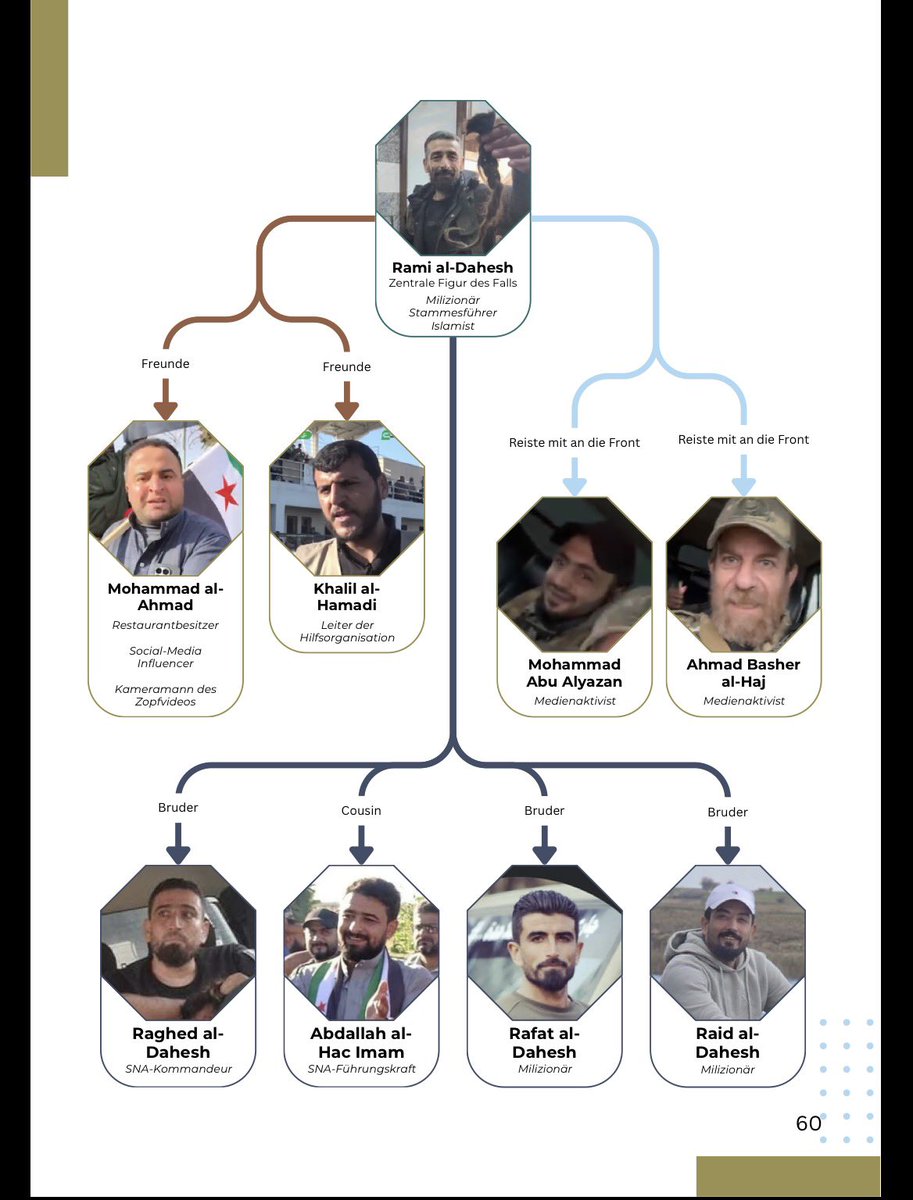
Remember Rami Al Dahesh - the soldier of the Syrian Government who glorified his act of killing a Kurdish woman and keeping her hair as a trophy - an article on Der-Spiegel has *debunked* the story as „joke“ claiming it is „fake hair“ and that Rami is not a soldier.
An 80 page in depth research paper is now revealing that Rami is indeed a soldier, the story is true - and the story which *debunked* it, is fabricated.
Happy to have been part of this research and be part of the IAKR 🫡
https://t.co/E5lkQhXl52
Yes this was obvious but from the Kurdish perspective, across the political spectrum the Israelis cannot be trusted in such an endeavor, nor can the Americans.
The Israelis were more than willing to give rhetorical support for Kurdish independence in the past but did not lift a finger to do anything else.
Trump 1 unilaterally withdrew from parts of Syria, leading to a Turkish invasion.
Trump 2 was really not that interested in the integration process between the SDF and STG, where American pressure may (highly arguable) have prevented its breakdown.
Trump had in 2025 already abruptly halted the war against Iran, much to Israel’s displeasure.
So what’s the appeal? Kurdish revolutionaries launch an uprising and seize some cities? Then get crushed over the course of months to a year after air support stops and the Iranian regime buries the revolt under artillery and tank fire? Not to mention the widespread crackdowns that would follow.
The Americans are already very quiet and limiting regarding defenses, let alone a military response, to hundreds of drone and missile attacks across the border into Kurdish areas.
No political guarantees, no security guarantees. At least publicly, which would be necessary. There’s zero appeal.
I can't stress enough how much this tweet gets wrong.
First, Prime Minister al-Zaidi is hardly the person who initiated this campaign. At most, he is overseeing its implementation in his capacity as Commander-in-Chief. The more likely driving force lies within Iraq's judicial establishment. Anyone familiar with how the Iraqi judiciary operates knows that arrest warrants targeting figures of this political stature are highly unlikely to be issued without approval from the highest judicial authority.
Second, this is hardly a "coup." Most of those arrested occupy second- or third-tier positions in Iraq's political hierarchy. Even the most prominent among them, Muthana al-Samarrai, is far from politically indispensable. He heads a relatively small parliamentary bloc and has generally functioned more as a political broker than as a top-level decision-maker.
Third, the Iran angle is probably the weakest claim in the tweet. Most of those arrested are Sunni politicians or state officials and functionaries. The Shi'a figures involved are hardly hardline pro-Iran actors, let alone individuals closely associated with the IRGC.
What we are most likely witnessing is another episode of elite power struggles and factional politics. Among the major political players, the biggest apparent loser seems to be former Prime Minister Mohammed Shia al-Sudani, although it is still too early to draw firm conclusions.
It is not unusual for new Iraqi governments to launch anti-corruption campaigns at the beginning of their tenure, only for these efforts to lose momentum over time. What makes this episode different, however, is that it appears to have strong backing from the upper echelons of the judiciary and is unfolding in the context of mounting external pressure and growing economic challenges.
Given the enduring popularity of anti-corruption rhetoric in Iraq and the public's deep frustration with impunity for the "big fish," this could prove to be a politically astute strategy for enhancing the legitimacy of the new government—and, more broadly, the political settlement on which it rests.
Havoc’s right of course — but it’s also worth pointing out that this is substantially more embarrassing than a helo losing a game of catch with an FPV.
The non-jet/rocket powered Shahed variants are slow as hell, and have the maneuverability of the Titanic in the Arctic.
To put this in terms the youth might understand, this is like a professional COD player losing a match to an elderly dude with arthritis.
Assad believed HTS could be corralled in Idlib and that Idlib would be a “dumping ground” for Syrian rebels who had been bussed there; the goal was to deport opposition Syrians to Idlib with hopes they would stay there or go to Turkey or Europe.
The Assad regime’s goal was always to divide and conquer the country, playing off groups against eachother and then selling them out one by one or massacring them.
For the regime, all the other groups were useful to a point; this included HTS and the YPG but also it felt the rebels were convenient as long as they were divided; it also thought ISIS was fine and had even released extremists ;before the war began in 2012 it had even funneled extremists down the Euphrates River valley into Iraq.
The regime was evil. It also sought to exploit the Christian, Alawite and Druze minority. It should be recalled that it likely allowed the ISIS attack on Suwayda in 2018 to send a message to the Druze as the regime was returning to southern Syria.
The regime had no ideology except being cynical. Look how it would flirt with Israel at times. It exploited the Kurds also. It let the Captagon trade grow, let the Iranians run wild, sold out to everyone, let Wagner mercenaries massacre people; until the regime collapsed and it ran away like a thief in the night as if it had never existed.