@ThinkOf_Us CEO/Founder | @Forbes Top 30 under 30 Social Entrepreneur | @WhiteHouse Champion of Change |Ashoka Fellow Schmidt Innovation Fellow|#hackfostercare
From #fostercare to standing on the #TEDTalk stage. Today, I share my personal journey and the systemic changes we're fighting for at @ThinkOf_Us Every child deserves to know love, to be part of a family. Help us turn this dream into reality. Watch, feel, act: #kinshipMatters #kin 💖 Please watch and share: https://t.co/x4Ag9r2Zm7
Introducing Devin Auto-Triage: Your AI first-responder with long-term memory.
Devin can monitor incoming bugs, alerts, and incidents, investigate them, and come back with context, next steps, or a PR.
Harvard Business Review research reveals that excessive interaction with AI is causing a specific type of mental exhaustion ( or "AI brain fry"), which is particularly hitting high performers who use AI to push past their normal limits.
A survey of 1,500 workers reveals that AI is intensifying workloads rather than reducing them, leading to a new form of mental fog.
While AI is generally supposed to lighten the load, it often forces users into constant task-switching and intense oversight that actually clutters the mind.
This mental static happens because you aren't just doing your job anymore; you are managing multiple digital agents and double-checking their work, which creates a massive cognitive burden.
The study found that 14% of full-time workers already feel this fog, with the highest impact seen in technical fields like software development, IT, and finance.
High oversight is the biggest culprit, as supervising multiple AI outputs leads to a 12% increase in mental fatigue and a 33% jump in decision fatigue.
This isn't just a personal health issue; it directly impacts companies because exhausted employees are 10% more likely to quit.
For massive firms worth many B, this decision paralysis can lead to millions of dollars in lost value due to poor choices or total inaction.
Essentially, we are working harder to manage our tools than we are to solve the actual problems they were meant to fix.
---
hbr .org/2026/03/when-using-ai-leads-to-brain-fry
MICROSOFT BUILT A TOOL THAT CONVERTS LITERALLY ANYTHING INTO CLEAN MARKDOWN FOR YOUR LLM
pdfs. word docs. excel. powerpoint. audio. youtube urls
one pip install and your AI pipeline stops choking on raw files forever
no custom parsers. no broken layouts. no garbled text.
just clean, structured markdown your LLM can actually read
https://t.co/RSt0CczfYa
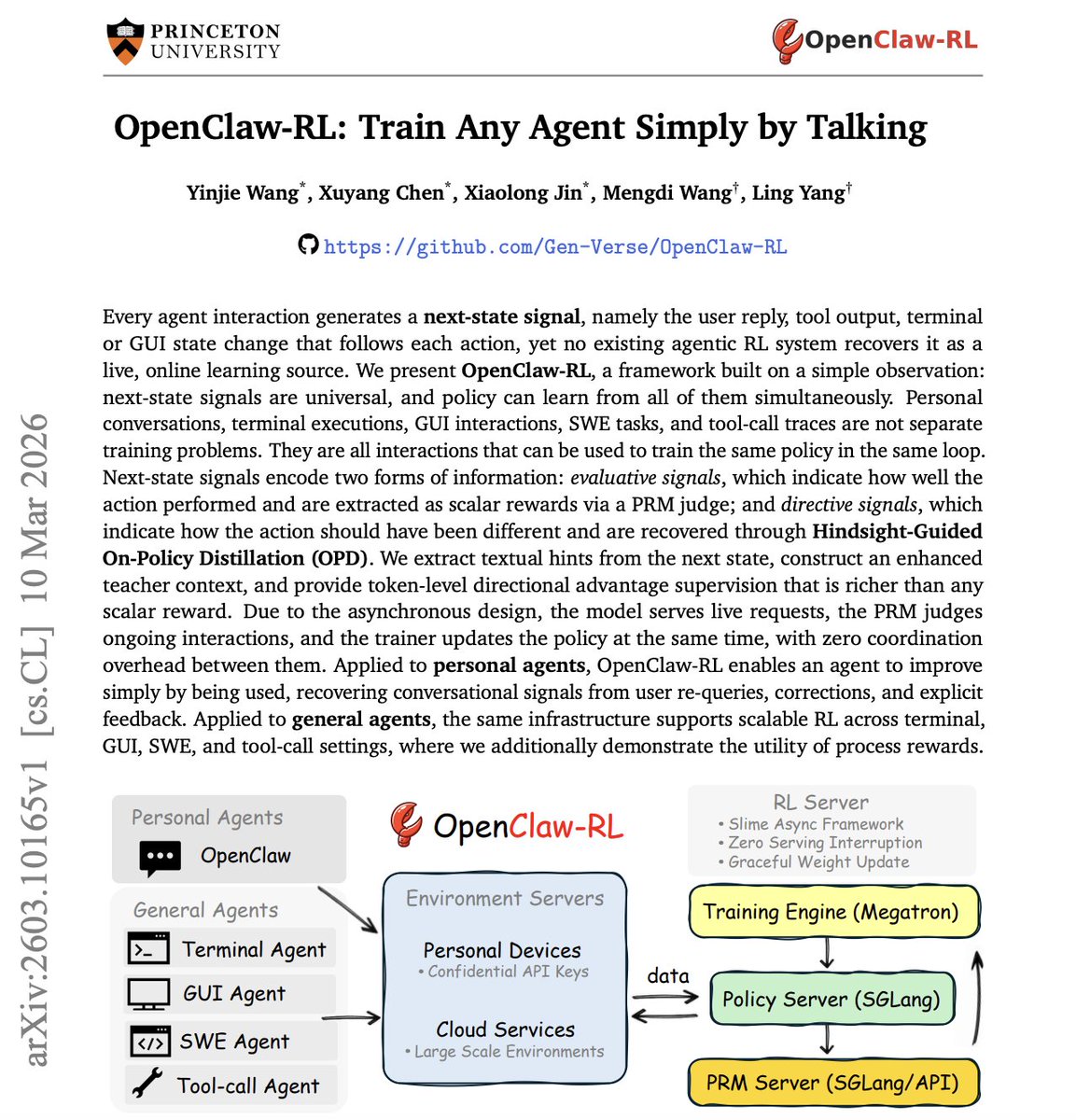
🚨BREAKING: Princeton just proved that AI agents are throwing away
the most valuable data they'll ever collect.
And nobody noticed because it looks like normal conversation.
Every time an AI agent takes an action, it receives what researchers
call a "next-state signal." A user reply. A tool result. A terminal
output. A test verdict.
Every existing system takes that signal and uses it as context for
the next response.
Then discards it forever.
The Princeton team just proved this is one of the most expensive
mistakes in AI engineering. Because that signal contains two things
nobody was extracting.
First: an implicit score. A user who re-asks a question is telling
you the agent failed. A passing test is telling you it succeeded.
A detailed error trace is scoring every step that led to it. This
is a live, continuous reward signal hiding inside every interaction.
Free. Universal. Completely ignored.
Second: a correction direction. When a user writes "you should have
checked the file first," they're not just saying the response was
wrong. They're specifying which tokens should have been different
and how. That's not a scalar reward. That's token-level supervision.
And scalar rewards throw every single bit of it away.
They built a system called OpenClaw-RL around recovering both.
Then they ran the experiment that changes everything.
An agent started with a personalization score of 0.17. After just
36 normal conversations, with no new training data, no labeled
dataset, and no human annotations, the combined method hit 0.81.
The agent didn't get retrained. It got used.
That's the part nobody is talking about. The model was serving live
requests at the same time it was being trained on them. Four
completely decoupled loops running simultaneously. Policy serving.
Rollout collection. Reward judging. Weight updates. None waiting
for the others.
The agent gets smarter every time someone talks to it.
And the deeper the task, the more it matters. On long-horizon
agentic tasks, outcome-only rewards give you a signal at the very
end of a trajectory and nothing in between. Their process reward
model scores every single step using the live next-state signal as
evidence. Tool-call accuracy jumped from 0.17 to 0.30. GUI accuracy
improved further on top of that.
This creates a shift nobody has fully reckoned with yet.
The current paradigm: collect data offline, train in batches,
deploy, hope it works.
The new paradigm: deploy, extract training signal from every
interaction, update continuously, improve automatically.
Every conversation is training data. Every correction is a gradient.
Every re-query is a reward signal.
The agents that figure this out first won't need bigger datasets.
They'll just need more users.
LLM ≠ Generative AI ≠ AI Agents ≠ Agentic AI
We need to stop grouping them together.
Each serves a different purpose, operates at a different level of complexity, and solves a different class of problems.
Here’s the breakdown:
🔹 LLM
Predicts tokens based on patterns in data.
No memory. No intent. No task execution. Just input → output.
🔹 Generative AI
Builds on LLMs to create text, code, images, etc.
It understands latent space and can generate novel content but it still waits for instructions.
🔹 AI Agents
Execute predefined tasks.
They detect intent, call tools or APIs, and handle responses. They’re modular and functional—but not autonomous.
🔹 Agentic AI
Operates with goals, plans, context, and memory.
It reasons, adapts, calls sub-agents, monitors progress, and decides what to do next—without human instruction.
This isn’t just a progression of features.
It’s a shift in system design from prediction to orchestration, from commands to autonomy.
If you're building with AI, clarity on where your system fits in this stack determines everything: architecture, tooling, risk, and value.
What is context engineering❓
And why is everyone talking about it...👇
Context engineering is rapidly becoming a crucial skill for AI engineers. It's no longer just about clever prompting; it's about the systematic orchestration of context.
🔷 The Problem:
Most AI agents fail not because the models are bad, but because they lack the right context to succeed. Think about it: LLMs aren't mind readers. They can only work with what you give them.
Context engineering involves creating dynamic systems that offer:
- The right information
- The right tools
- In the right format
This ensures the LLM can effectively complete the task.
🔶 Why Traditional Prompt Engineering not enough:
Early on, we focused on "magic words" to coax better responses. But as AI applications grow complex, complete and structured context matters far more than clever phrasing.
🔷 4 Key Components of a Context Engineering System:
1️⃣ Dynamic Information Flow
Context comes from multiple sources: users, previous interactions, external data, tool calls. Your system needs to pull it all together intelligently.
2️⃣ Smart Tool Access
If your AI needs external information or actions, give it the right tools. Format the outputs so they're maximally digestible.
3️⃣ Memory Management
- Short-term: Summarize long conversations
- Long-term: Remember user preferences across sessions
4️⃣ Format Optimization
A short, descriptive error message beats a massive JSON blob every time.
🔷 The Bottom Line
Context engineering is becoming the new core skill because it addresses the real bottleneck: not model capability, but information architecture.
As models get better, context quality becomes the limiting factor.
I'll share more as things evolve and become more concrete!
Stay tuned!! 🙌
____
If you found it insightful, reshare with your network.
Find me → @akshay_pachaar ✔️
For more insights and tutorials on LLMs, AI Agents, and Machine Learning!
🚨 Hiring in DC! The tech landscape is shifting & we're building our dream team @ThinkOfUs - Join our Open House this Thursday (3/13) to explore tech, data & comms roles as we scale our mission to transform child welfare. ⬇️ Details below
1. Halliday Glasses: Smart glasses with a 3.5-inch internal monochrome display
These glasses are equipped with an AI agent that can listen to conversations, answer questions during meetings, and do live translation
🚨ICYMI: The Protecting America's Children by Strengthening Families Act (H.R. 9076) now LAW!! 🚨
Thanks to strong bipartisan support, the bill secured year-end passage in the U.S. Senate and was signed into law by the President last weekend. https://t.co/nGlkpajFRk
The Titanic didn’t sink the way you think.
The story isn’t just about an iceberg—it’s about human error, ignored warnings, and catastrophic decisions.
Here’s the truth about what really sank the ‘unsinkable’ ship:
Tonight, @DallasCASA honored @BobMong1949 and @dallasmavs for their great work with children! It was great to see our friends @cyntmarshall ,Kenny Marshall and their family. Powerful words @Sixtocancel. Thanks to all who donated!
The #FosterCare system needs to change.
@Sixtocancel CEO @ThinkOf_Us finds a way forward by listening to those with lived experience, turning it into data, and transforming the system.
Listen to his story on the #HiltonPrize livestream https://t.co/tGeWOOAWcc
Whoa OpenAI just dropped Canvas, and it's a game changer.
It's like Claude Artifacts but you can also edit inline real-time.
Available now to Plus and Team users today
As CEO of @ThinkOf_Us, @Sixtocancel champions #kinship care by advocating for transformative policies and programs that place youth in foster care with relatives or family-based settings.
Join his session at the #HiltonPrize livestream on October 9 at https://t.co/Nuwq5sVla2
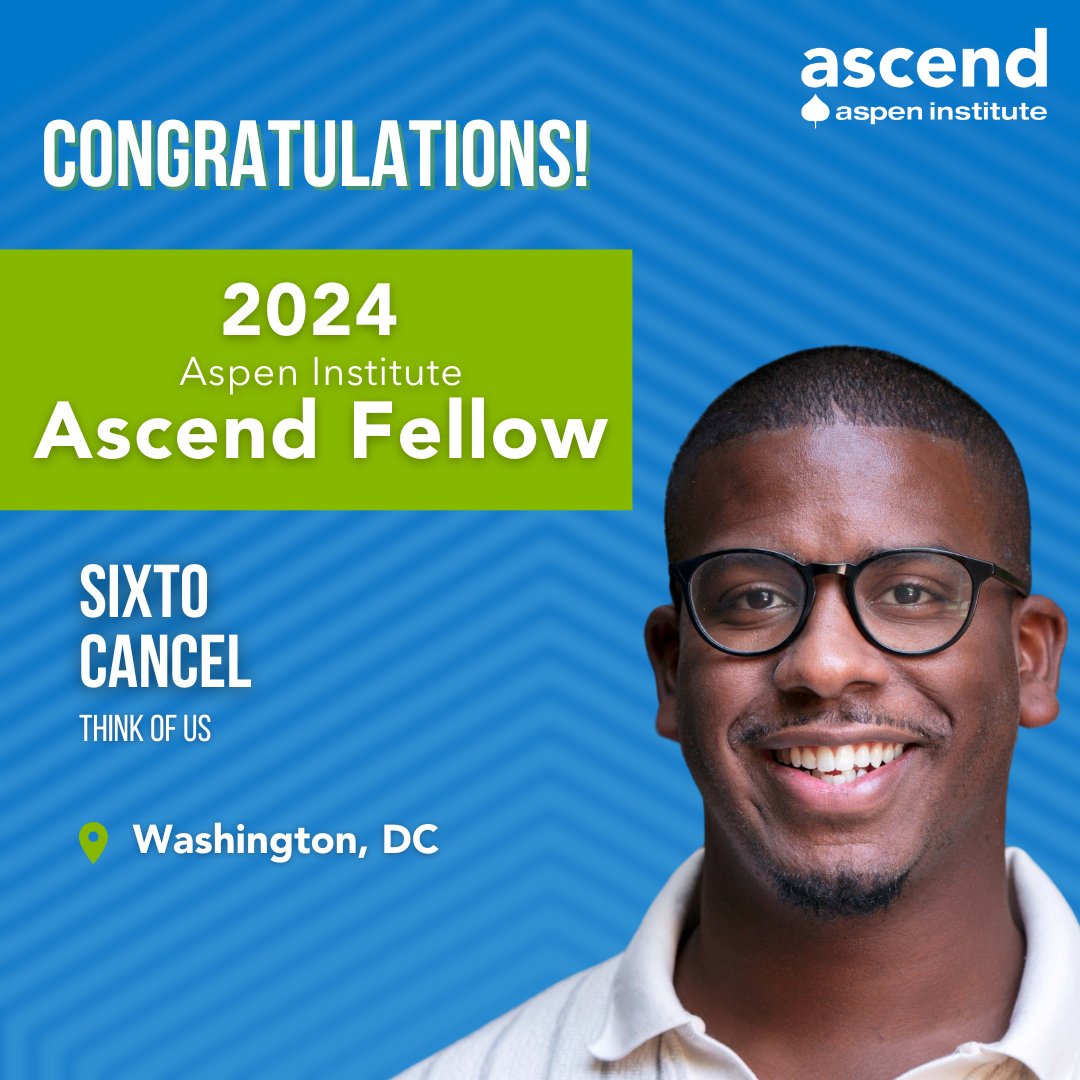
Big news! Our CEO @sixtocancel has been named a 2024 @AspenAscend Fellow. Sixto will join leaders focusing on systems change to help children & families thrive. Learn more: https://t.co/pHH4UDVcQU
The coming together of kindred spirits @kinshipcharity and @ThinkOf_Us. Fantastic to collaborate with powerhouse leaders @Sixtocancel and Robert L. Matthews and to share ideas about transforming #KinshipCare in the US and UK.
Have a listen to Sixto https://t.co/ACPcEikT7p
A touching and powerful moment in Parliament yesterday hearing newly-elected MP for Carshalton and Wallington @Bobby_Dean talk about spending time in #KinshipCare as a young teenager and paying tribute to his grandparents during his maiden speech. #ValueOurLove 💛