Head Intl High School Science Teacher; Science-in-Society Critical Thinker; Evidence-based Educator; ex-Galaxy Astronomer; Reasoned World Optimist;👨🔬RTs=CT🤔
Our World Frame:
Pattern's understood by Science &
The Margin contains today's Great Unknowns:
1) Origin of the Big Bang
2) Nature of Quantum Foam
3) Emergence of Life from dead matter
4) Hard Problem of Consciousness
Surrounding our highest values: Truth, Goodness & Beauty
🇪🇺 Europe is shifting to the right politicians — GeoUniverse
Opposition to globalization, centralized European authority & progressive social changes are currently leading in polls
Riksdagen har röstat igenom flera reformer av skolan. Ser gärna att nuvarande departement får förnyat mandat.
•Trygghet och studiero
•Förbättrat stöd i skolan
•Nya läroplaner
•Nytt betygssystem
•Tid för undervisningsuppdraget
https://t.co/4mTkqdhEXu
De ämnesspecifika instruktionerna beställdes med kort varsel och skulle skrivas på drygt fyra månader – mitt i semestertid. I fem av grundskolans ämnen var inte en enda forskare intresserad av uppdragen. https://t.co/jV2dokknit
@MisterMag1ster Djupt oroad vad AI ställer till med i skolan för både lärare och elever. Att omfamna tekniken i skolan är på sikt bekymmersamt på många olika plan. https://t.co/oOgsSA34Kb
🇪🇺 Most European countries are losing more native-born citizens than returning...
🇱🇺 Luzembourg, for example, was the anti-leader in 2024...
🇧🇬 Bulgaria and 🇱🇹 Lithuania, on the contrary, showed much better results! What are the secrets?
🇨🇳 China launched the Shenzhou-23 spacecraft with three astronauts to its Tiangong orbital station.
One of the crew members of Shenzhou-23 will conduct an experiment on a one-year stay on the station. Currently, the standard mission lasts about six months.
"Hittills har Skolverkets läroplansavdelning främst förmått producera oändligt många postmoderna dokument, till stor förvirring för både lärare och elever. Även det skolexperimentet bör stoppas."
https://t.co/gIXByqluz2
"I’ve been quite swept up by the autism spectrum idea, and it’s only in the past 10 years or so that I have felt things have gone too far, and very slowly I have come to say, 'No, this is not right'"
Autism expert professor Uta Frith talks to @Helen_Amass
https://t.co/jqdubV5zJT
Den del av kognitionsvetenskapen som nu i enlighet med bland annat Lärarutbildningsutredningen och Läroplansutredningen förväntas få större genomslag i det svenska skolväsendet benämns ofta science of learning. Det är ett internationellt erkänt, empiriskt drivet och uttalat mångvetenskapligt kunskapsfält om hur lärande sker och hur undervisning kan utformas för att påverka lärandet.
Detta vet debattörerna Pernilla Nilsson och Håkan Löfgren inget om (?) utan påstår att det som föreslås få utrymme är "studier av hur hjärnan processar information”, något som "kan integreras i utbildningsvetenskapen".
Sammantaget framstår Nilssons och Löfgrens inlägg som ett försvar av utbildningsvetenskapen utan någon tydlig ansats att fråga sig varför olika aktörer upplever att utbildningsvetenskaplig forskning är otillräcklig i vissa frågor. Den fråga som borde ställas är varför lärare, skolledare, huvudmän och policyaktörer söker svar på en rad frågor inom science of learning i stället för inom svensk utbildningsvetenskap.
https://t.co/cMI0foWyUq
Äntligen lyfts frågan. Center för skolutveckling i Göteborg har marknadsfört translanguaging som en framgångsmetod. I själva verket är det en ideologisk konstruktion utan vetenskapligt stöd.
https://t.co/ejpf4i9jU2
21. Enligt Skolverket etablerar sig elever som gått kommunal gymnasieskola snabbare på arbetsmarknaden än elever som gått på fristående skola. Samma mönster syns för högskoleförberedande program: högre andel kommunala elever söker till högskolan. https://t.co/YtJZsW5D8k
@FMannerheim har rätt i @axesspublishing: Lärarledd undervisning har ersatts med elevcentrerade metoder som inte fungerar. Resultat: sjunkande kunskaper o mer stök.
Skolan måste återgå till tydlig undervisning där läraren är kunskapsledare, inte handledare
https://t.co/c2aeFssOa3
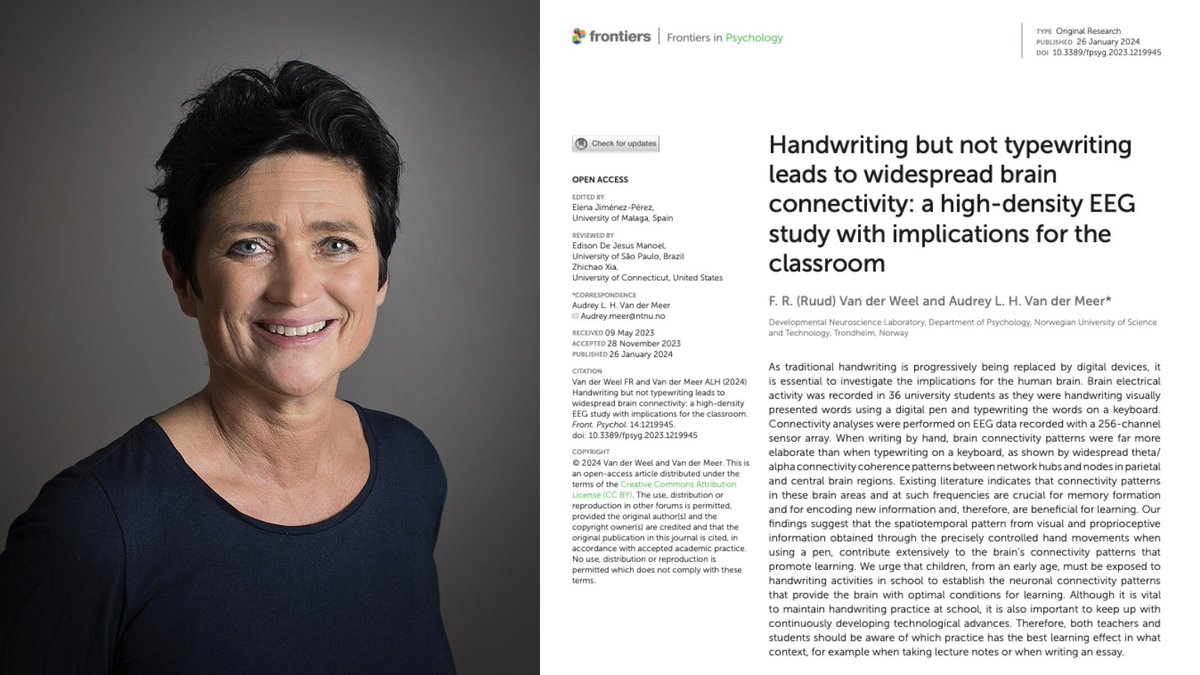
A Norwegian neuroscientist spent 20 years proving that the act of writing by hand changes the human brain in ways typing physically cannot, and almost nobody outside her field has read the paper.
Her name is Audrey van der Meer.
She runs a brain research lab in Trondheim, and the paper that closed the argument was published in 2024 in a journal called Frontiers in Psychology. The finding is brutal enough that it should have changed every classroom on Earth.
The experiment was simple. She recruited 36 university students and put each one in a cap with 256 sensors pressed against their scalp to record brain activity. Words flashed on a screen one at a time.
Sometimes the students wrote the word by hand on a touchscreen using a digital pen, and sometimes they typed the same word on a keyboard. Every neural response was recorded for the full five seconds the word stayed on screen.
Then her team looked at the part of the data most researchers had ignored for years, which is how different parts of the brain were communicating with each other during the task.
When the students wrote by hand, the brain lit up everywhere at once.
The regions responsible for memory, sensory integration, and the encoding of new information were all firing together in a coordinated pattern that spread across the entire cortex. The whole network was awake and connected.
When the same students typed the same word, that pattern collapsed almost completely.
Most of the brain went quiet, and the connections between regions that had been alive seconds earlier were nowhere to be found on the EEG.
Same word, same brain, same person, and two completely different neurological events.
The reason turned out to be something nobody had really paid attention to before her work. Writing by hand is not one motion but a sequence of thousands of tiny micro-movements coordinated with your eyes in real time, where each letter is a different shape that requires the brain to solve a slightly different spatial problem.
Your fingers, wrist, vision, and the parts of your brain that track position in space are all working together to produce one letter, then the next, then the next.
Typing throws all of that away. Every key on a keyboard requires the exact same finger motion regardless of which letter you are pressing, which means the brain has almost nothing to integrate and almost no problem to solve.
Van der Meer said it plainly in her interviews.
Pressing the same key with the same finger over and over does not stimulate the brain in any meaningful way, and she pointed out something that should scare every parent who handed their kid an iPad.
Children who learn to read and write on tablets often cannot tell letters like b and d apart, because they have never physically felt with their bodies what it takes to actually produce those letters on a page.
A decade before her, two researchers at Princeton ran the same fight using a completely different method and ended up at the same answer. Pam Mueller and Daniel Oppenheimer tested 327 students across three experiments, where half took notes on laptops with the internet disabled and half took notes by hand, before testing everyone on what they actually understood from the lectures they had watched.
The handwriting group won by a wide margin on every question that required real understanding rather than surface recall.
The reason was hiding in the transcripts of what the two groups had actually written down.
The laptop students typed almost word for word, capturing more total content but processing almost none of it as they went, while the handwriting students physically could not write fast enough to transcribe a lecture in real time, which forced them to listen carefully, decide what actually mattered, and put it in their own words on the page.
That single act of choosing what to keep was the learning itself, and the keyboard had quietly skipped the choosing and skipped the learning along with it.
Two studies. Two countries. Same answer.
Handwriting makes the brain work. Typing lets it coast.
Every note you have ever typed instead of written went into your brain through a thinner pipe. Every meeting, every book highlight, every idea you captured on your phone instead of on paper was processed at half depth.
You did not forget those things because your memory is bad. You forgot them because typing never woke the part of the brain that would have made them stick.
The fix is the thing your grandmother already knew.
Pick up a pen. Write the thing down. The slower road is the faster one.
Ett fantastiskt temanummer om SVA publicerat i Vi Lärare idag. T.ex. intervjun med Tomas Riad:
"Elever som inte har svenska som modersmål måste lära sig svenskans ljudsystem och befästa fonemen som separerade enheter. Därefter krävs explicit och metodisk färdighetsträning så att läsavkodningen automatiseras. Det gäller även för äldre nyanlända elever
Hur lärare ska bedriva den här undervisningen måste preciseras och tydliggöras, både på lärarutbildningar och i styrdokument.
För att klara sig på ett nationellt gymnasieprogram behöver en elev kunna 10 000–15 000 ord. Ska elever med utländsk bakgrund nå dit krävs både systematisk ordinlärning och en effektivare läsundervisning.
– Läsning är det realistiska sättet för dem att få ett tillräckligt stort ordförråd, givet deras utgångsläge."
https://t.co/6AN9PpLmlH
När jag skrev på X om förstelärarreformen blev responsen enorm. Lärare från hela landet hörde av sig. Många beskrev att reformen skapat misstänksamhet, hierarkier och splittring på skolan snarare än professionell utveckling. Det bekräftas i forskningen.
https://t.co/m6kc0fv6ff
https://t.co/G3wyC5sy2v Skriver om att god läsförmåga riskerar att bli en spetskompetens: ”Lärarnas kamp för att få studenterna att ens öppna en bok är ingen slump, utan en direkt konsekvens av den svenska skolans många problem”.