What's up in your sky tonight (normally few hours after sunset). USA/Mid-northern latitudes/Northern Hemisphere. Best for beginners! Learn about #stargazing!
Are you seeing something in the night sky and curious to know what it is? Tweet to us and we will let you know what it is (unless if it is a UFO! 🛸then we don't know what it is😉)!
Up before dawn Wed Nov 18? Venus is the brilliant light low in the southeast, rising near 4 am CST and about 20 degrees up by 6 am.
At magnitude minus 4.9 it outshines everything but the Sun and Moon, easy even from the city.
Sunrise 6:43.
First quarter Moon tonight, Tue Nov 17. Half lit and in the south at dusk, it is a great night for craters along the shadow line. Binoculars are enough.
Saturn shines well to its upper left, about 44 degrees up at 7 pm CST. A small scope shows the rings.
Moon sets 11:49.
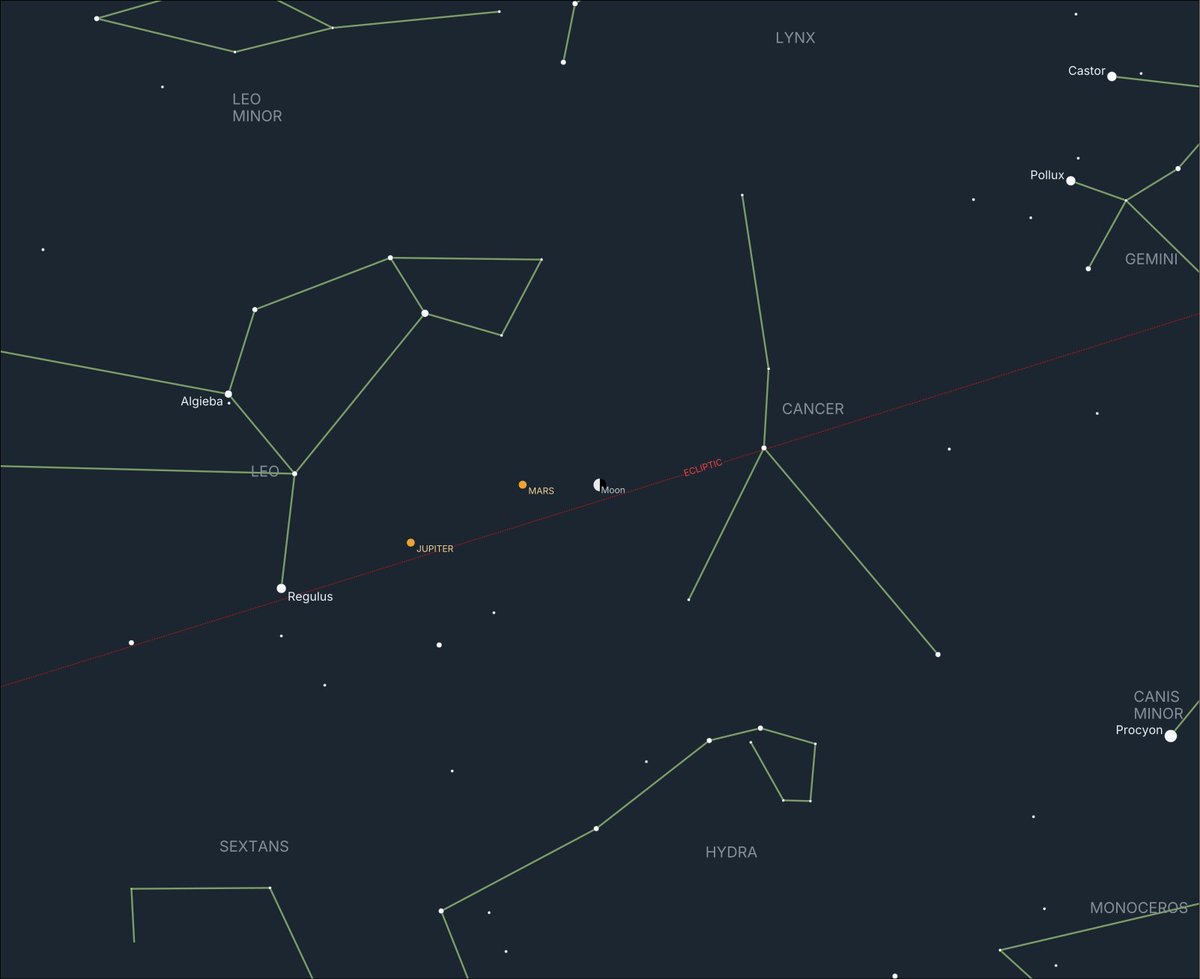
Leonids are near peak tonight into Tue morning. Expect up to 10 fast meteors an hour from a dark site.
The Moon sets at 10:45 pm CST. Watch 3 to 5 am, when the radiant in Leo is high in the east. Jupiter and Mars sit just below it.
Tomorrow night is worth a try too.
Early riser? Before dawn Sat Nov 14, Jupiter blazes high in the south in Leo, about 60 degrees up at 5:30 am CST.
Mars sits just 1.3 degrees above it, a fainter orange dot. They close to about 1.2 degrees by Sunday morning.
Jupiter rises near 11:15 pm. Sunrise 6:39.
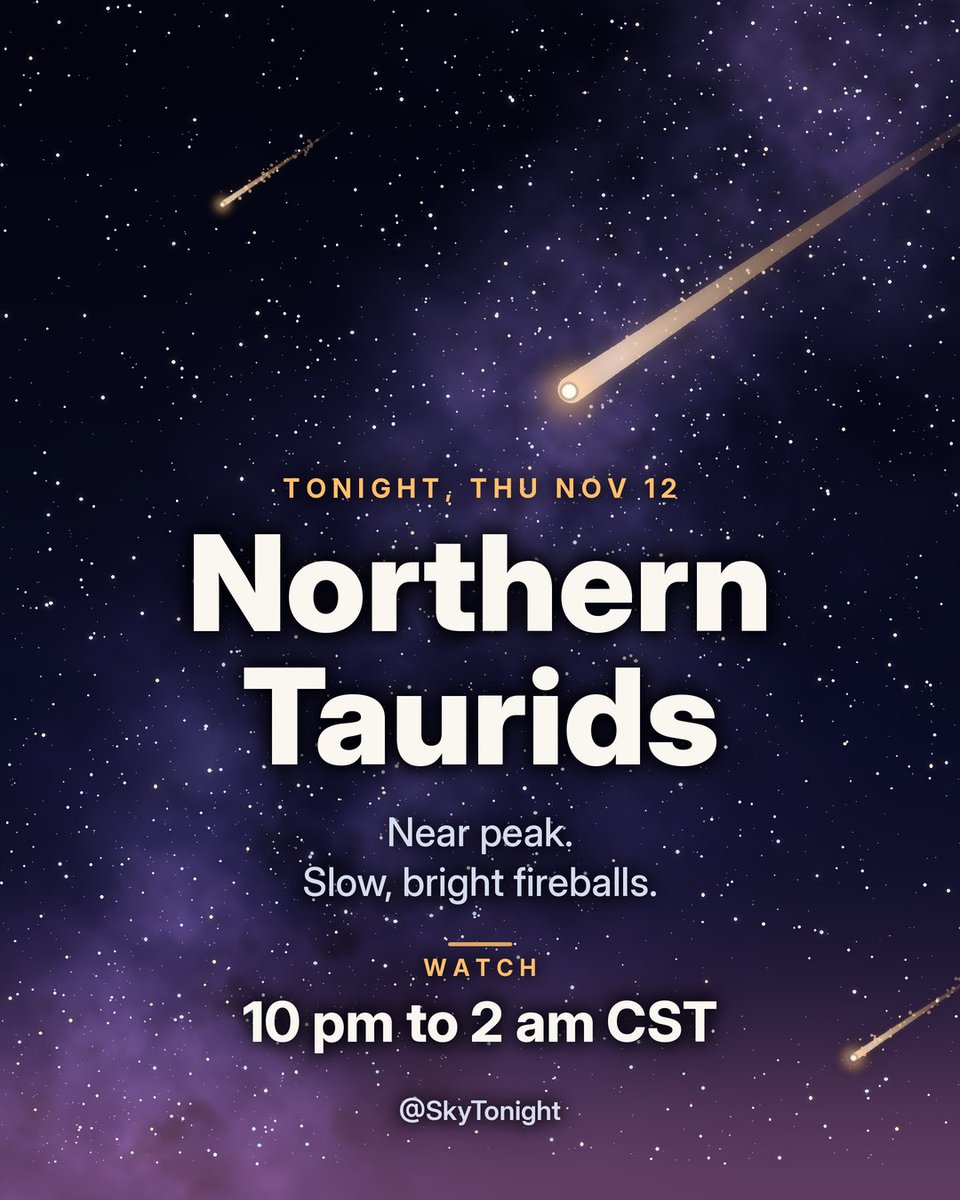
Northern Taurids are near peak tonight, Thu Nov 12. Maybe 5 meteors an hour from a dark site, but this shower is known for slow, bright fireballs.
Watch 10 pm to 2 am CST. The radiant in Taurus is high in the south near 12:15 am. The Moon sets at 6:38.
Debris from Comet Encke.
Leonid meteor shower peaks next week, around Nov 17 to 18. Expect up to about 10 to 15 fast meteors per hour from dark sites. The Moon sets near midnight, so the hours after are dark. Dust from Comet Tempel-Tuttle. Start watching after midnight, no telescope needed.
Thin crescent Moon after sunset Wed Nov 11. Only about 7% lit, low in the southwest, roughly 6 degrees up at 4:50 pm CST. Antares sits about 9 degrees from it. Find a clear southwest horizon. Binoculars may show faint earthshine on the dark part. Skyfield, Chicago.
Saturn is high in the south this evening, about 49 degrees up near 9 pm CST. It shines as a steady golden point that barely twinkles. A small telescope shows the rings and its moon Titan. Best from 7 to 11 pm.
New Moon tonight. The night sky is at its darkest for deep-sky observing. Exact new moon is 1:02 am CST Monday. The Moon stays near the Sun, rising about 7:10 am and setting about 4:25 pm, so nights stay dark from dusk to dawn.
Jupiter owns the predawn sky. Before sunrise Sunday, look high in the south around 5:30 am CST. Jupiter is the brilliant steady point in Leo, about 60° up. Mars sits just 3° to its upper right, and the pair closes in every morning, about 1.2° apart by Nov 15. Sunrise is 6:31.
Early Saturday, Nov 7, the thin crescent Moon pairs with Venus in the southeast before sunrise. They sit about 1.4 degrees apart, the closest morning this week. Best from about 5:30 am CST until sunrise near 6:30. Venus is the bright Morning Star, easy even from city skies.
Early Friday, Nov 6, the thin crescent Moon pairs with Venus in the southeast before sunrise. They sit about 12 degrees apart, and even closer Saturday morning. Best from about 5 am CST until sunrise near 6:29. Venus is the bright Morning Star, easy even from city skies.
Southern Taurids peak tonight, Wed Nov 4. Maybe 5 meteors an hour from a dark site, but this shower is known for slow, bright fireballs.
Watch 11 pm to 2:30 am CST. The radiant in Taurus is high in the south near 12:30 am, and the Moon rises at 2:40.
Debris from Comet Encke.
Venus is back in the morning sky. It passed between Earth and the Sun Oct 25 and now rises ESE about 5:05 am CST.
By 6 am Wednesday it's about 9 degrees up, so find a low, clear horizon. At 27 million miles, a small telescope shows a thin crescent. Stop before sunrise, 6:28.
Early Tuesday, Nov 3, the crescent Moon sits 2 degrees below Regulus, Leo's brightest star. Look high in the southeast from 5 am CST until sunrise near 6:25. Jupiter shines about 8 degrees to their upper right. Regulus sits on the ecliptic, so the Moon passes it every month.
Early Monday, look high in the southeast before dawn. The Moon, just under half lit, sits about 1.5 degrees from rusty Mars, with Mars at its upper left. Bright Jupiter shines about 6 degrees farther left. Best from 5 am CST until sunrise at 6:24.
Saturn is well placed in the evening sky tonight. Look east southeast after sunset for a steady golden star at magnitude 0.5, about 18 degrees up at twilight. It climbs highest in the south near 10:45 pm CDT, just before the Moon rises. Binoculars or a small telescope reveal the