@TPCarney Definitely. People calibrate what feels normal by what they grew up around. I know I did.
I didn’t grow up around many families with more than 2 kids, so I never really considered a larger family as a possibility.
Exactly. A lot of families are trying to do something very hard without the support system that used to make it more normal.
Without nearby family, parents with flexibility to be home, neighbors, community, or people who can help before everything becomes an emergency, 4 or more kids feels impossible for most people.
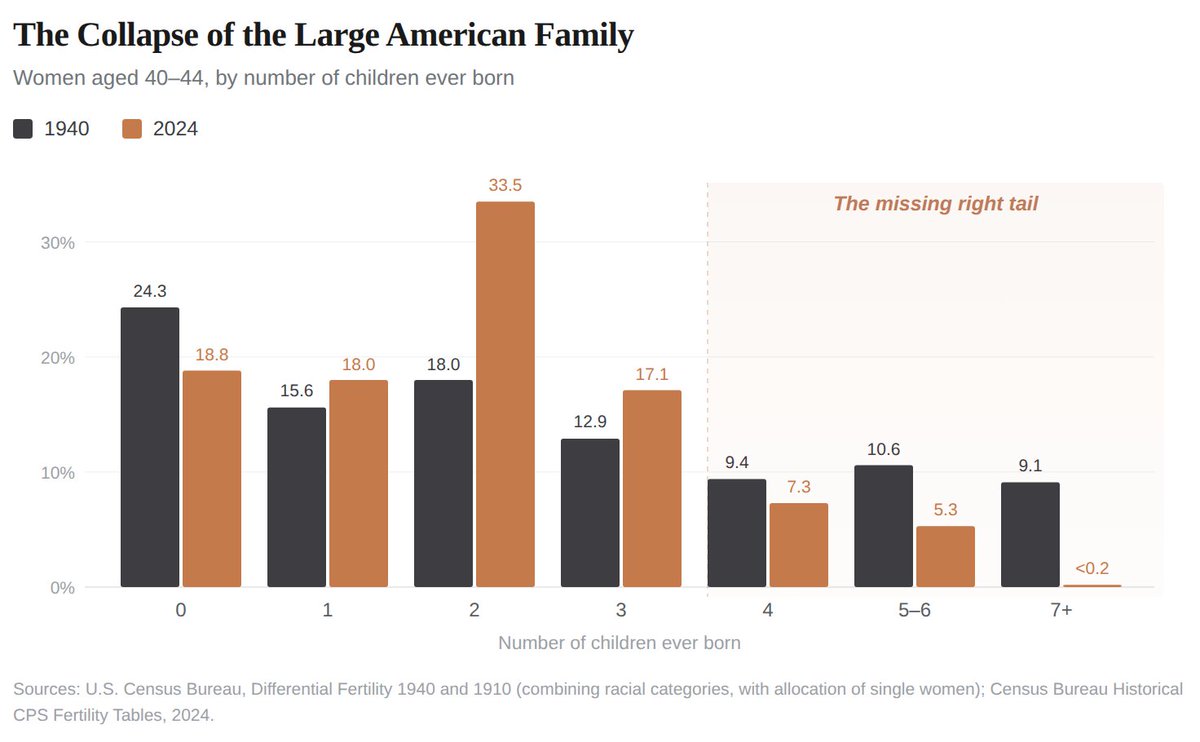
The fertility crisis isn’t only about people not having kids.
It’s also about the disappearance of the large family.
Even in 1980, roughly 1 in 3 American women had four or more children. Today, it is less than 1 in 8.
My argument: modern parenting does not scale. The way we raise children now has made large families feel unrealistic for many parents who might otherwise have welcomed them.
@1947Farmall Yeah this is definitely a real factor too. If parenting means endless negotiation with one child you feel like you can’t really discipline, it’s hard to imagine adding more.
This is actually amongst all women. You're definitely right that childlessness has gone up and this is part of the story. But as I looked into it's definitely not the whole story. Actually in 1940 after the Great Depression childlessness was actually higher on net (see this graph) but the fertility rate overall was higher than today and above replacement. Almost the entire reason for this difference was the presence of larger families that balanced it out (4+ kids).
Also overall, my thoughts are it's not going to be easy to shift the tides on childlessness, but we could probably make an impact on family size with families who want more. Roughly speaking, if 30% of women who currently end at 2 had a 3rd, and 30% of women who end at 3 had a 4th, all things else staying equal that alone would move completed fertility over replacement. So family size makes a huge difference.
I basically agree. Four kids aren’t inherently twice as hard as two.
But if every kid needs their own room, their own activities, constant driving, constant supervision, and a full college plan, then yeah, it gets overwhelming fast.
A lot of the answer is letting go of some of that.
@BackmanDevorah@CREID2852 Yes, bedrooms are a huge one. Once every child is expected to have their own room, the 3rd or 4th kid can suddenly mean needing a much bigger house.
Shared rooms used to be normal. Now, in a lot of places, a larger family means a house that just isn’t realistic for most people.
@AntiCommieBecca Yes, this is real. And even if the kids are basically fine, from my experience it seems there’s this sense that everyone is bracing for them to be a problem. That definitely makes larger family life feel less welcome.
@PrinceRilian123 Great example, that’s exactly the kind of thing I mean.
The third child doesn’t just add “one more.” Suddenly the hotel room, the car/rental car, the house, etc. all start becoming a whole next level tier of expense
@KathrynPinewood That’s amazing. One of the underrated gifts of larger families is that siblings get to have their own relationships apart from the parents. Sometimes those are the moments you remember most.
@Keego1013 Exactly. Seeing a real family with 6 or 7 kids doing well changes how you think about it.
A 3rd or 4th child feels a lot more possible when you’ve seen other families actually make it work.
I think that's fair, though I’m not sure economics and culture separate cleanly here.
Two incomes, expensive housing, formal childcare, car-dependent life, and intensive parenting norms all reinforce each other and push families toward staying small. That’s what makes the 3rd or 4th child feel so hard.
@CFBWhatNot2Wear I think this is a good example.
Shared rooms, SAHM, homeschool, no travel ball, kids more on their own for college is a very different setup than the standard intensive-parenting model, and it makes a big family much more workable.
@jayphoward Yes, agreed. A lot of this is recovering older/common-sense patterns: shared rooms, hand-me-downs, sibling responsibility, and living near family.
The challenge is that modern housing, work, and family mobility often make those simple things harder than they should be.
Interesting, that makes sense. There are definitely pockets where 3–4 kid families still feel normal.
My neighborhood is almost the opposite: urban outskirts, 7–8 families on the block, and I don’t think any have more than 2 kids.
And I do think that matters. When you see other families doing it, it feels much more possible.
@bobbyfijan Yes. Young men need to see that ambition and fatherhood are not opposites.
It takes sacrifice, but the idea that serious work and serious family life can’t coexist has done real damage.
@bobbyfijan Yes, exactly. This is a huge part of it.
People don’t make these decisions in a vacuum. If you never see serious, capable people with 4, 5, or 6 kids, stopping at 2 or 3 starts to feel almost automatic.
I agree the income problem is huge. I don’t think culture alone solves this.
My point is more that large families need real household availability, and right now that usually collides with the need for two full incomes. That’s exactly why this is both economic and cultural/structural.
The answer to the fertility crisis cannot just be another tax credit, though money matters.
Families need housing that can actually hold them. Work that still leaves room for children. Childcare beyond institutions. Communities close enough to help before everything becomes an emergency.
And a culture that honors the work of the home.