Brainwashed disciple of the 1 true Economic Guru Ross Gittins. Assisting the socially awkward w matters of the heart by providing economic conversation starters
It looks as if the release of the 2022-23 Final Budget Outcome is imminent.
Yippee!! Anything budgetary-related has me dancing on sunshine ...
So here’s some thoughts about where the budget is now, and where it’s headed.
I’ve also attached a more detailed analysis.
In summary, the improvement versus earlier forecasts is huge.
How huge?
o Net debt to GDP is already back to pre-COVID levels, and
o Last month’s IGR does project net debt to pass a trillion dollars, but not until 2046 (yes, 2046! And even then, at 14% of GDP, it will be well below today’s 21.6% of GDP)
So it’s been a great escape.
How did that happen?
The overall improvement in deficits totalling $157 bn over the four years to 2025-26 is more than explained by Treasury underestimates of WAR AND INFLATION’ impacts on the tax take (weighing in at a remarkable $273 bn).
Those same ‘war and inflation’ impacts also raise costs, but the most notable shift in costs has been for the NDIS.
Total cost increases from ‘war and inflation’ and from changed program costs (such as NDIS costs) total $82 bn over the four years to 2025-26.
Note NONE of the huge shifts noted above were due to any decision by the government. The budget came good despite our politicians, not because of them.
So what have the government’s decisions cost?
o Since the last federal election decisions have raised spending by $61 bn across the four years to 2025-26.
o But they also raised taxes by $27 bn.
o That leaves an overall worsening in the budget bottom line due to government decisions of $34 bn (that is, $61 bn less $27 bn).
Hence the simple summary is that the budget got better mostly because it was never as bad as Treasury projected it to be.
Yet there are question marks over the longer term. Treasury’s forecasts for the decades ahead (seen in the IGR) aren’t scary, but they are courageous.
They assume:
o Despite submarine costs, the defence budget only increases to 2.3% of GDP from today’s 2%.
o There’s a plan to have a plan to cut NDIS costs. However, given that this will be the largest ever cut to any government program in Australia – ever – the relative lack of detail to date may not inspire much confidence among either the nation’s disabled or its taxpayers.
o Finally, the IGR assumed productivity growth will accelerate a lot relative to what we’ve seen in the last decade. But in many ways that’s a bet that bipartisanship will recover, allowing the nation to achieve much-needed-but-difficult-to-enact reforms.
Meantime, the government has adopted very weak rules for the budget – essentially promising not to spend all of the windfalls it receives.
But China’s slowdown says the next decade will see budget tailwinds turn into headwinds, meaning the great ‘age of budgetary windfalls’ is fast coming to an end.
To date, Australia doesn’t have a plan – or rules in place – to handle that.
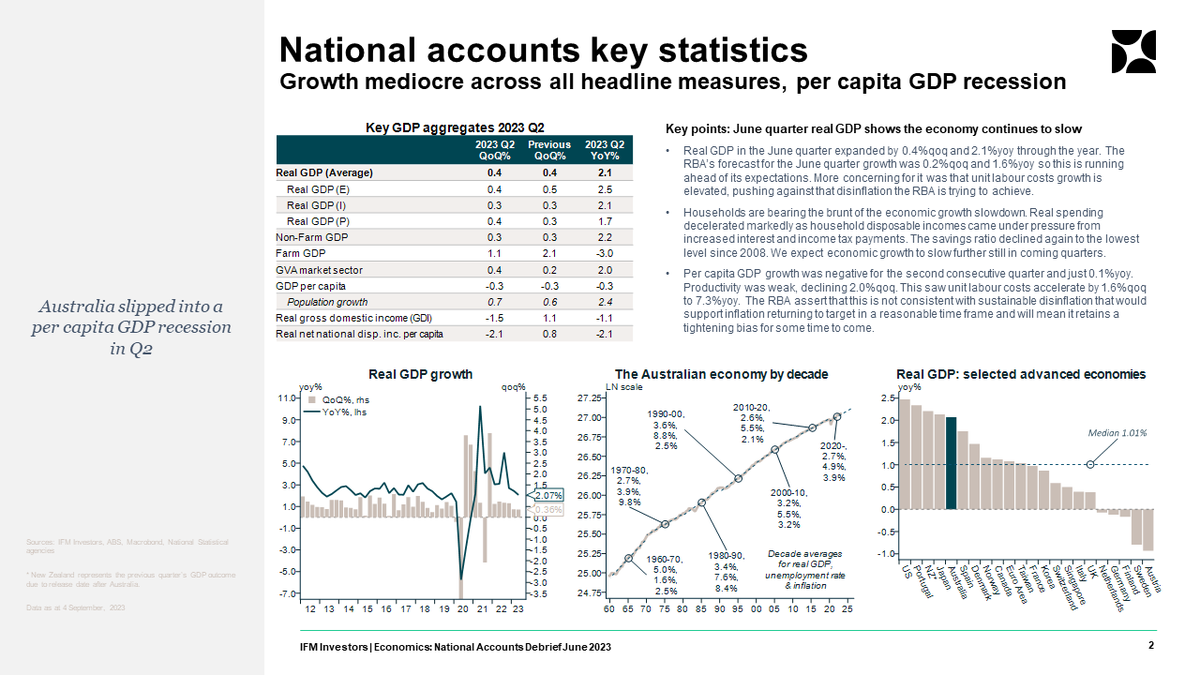
Australian GDP growth makes for a good headline number all things considered but it is a per capita GDP recession and the likelihood is the the economy slows further from here.
The following thread is some charts and tables from the release.
Never regret a day in your life. Good days give happiness, bad days give experiences, worst days give lessons, and best days give memories.
—Professor Richard Feynman
Me waiting for the focus to he placed upon the destruction of 14 years worth of real wages growth which impacts everyone, rather than the emphasis on mortgage rates which only heavily impacts a small minority...
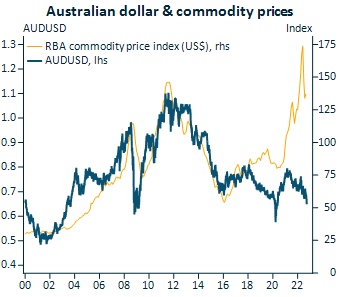
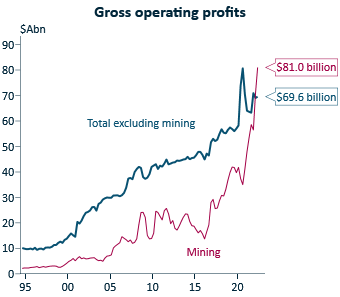
@RobinBrooksIIF While Australia does not have the same size current account surplus, it is also a net energy exporter and does have a similar decoupling of the AUD from its fundamental historic commodities relationship. And has been a huge windfall for resource producers.
But despite the smaller deficit and $10b less in gross debt (record $895.3b), the interest bill actually was $100m higher than had been forecast. That is going to ratchet up very quickly in coming months...
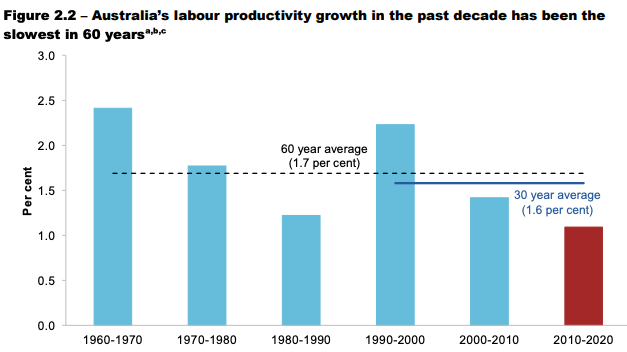
As per the latest Productivity Commission report, here's how we're tracking - and why the 1.5% growth rate used in the final Morrison-Frydenberg budget was more than optimistic...