I have made the following paid articles free.
I believe basic knowledge of optics, especially CPO, is something everyone should understand, so I decided to make all of my previously paid articles on this topic available for free.
I can confidently say that if you read all of these articles, you will be able to build your own conviction on CPO.
Please stop by my Substack, subscribe, and enjoy the articles below.
The War of Light Has Begun: https://t.co/AApOwRrrE2
The War of Light, Part2 - Who's at the Table, Who's Not, and Who's Hiding: https://t.co/NYIiSW9EDg
Why CPO Is Becoming inevitable? [CPO Special Part1]: https://t.co/dTuQLNYrjL
CPO, Fully Dissected [CPO Special Part2]: https://t.co/4pe27hwVbh
The Illusion of CPO [CPO Special Final]: https://t.co/D3dTDXOJ58
Morgan Stanley research forecasts a “more severe shortage” of hard disk drives (HDDs) that will persist at least through 2028, with suppliers pricing significantly above current levels.
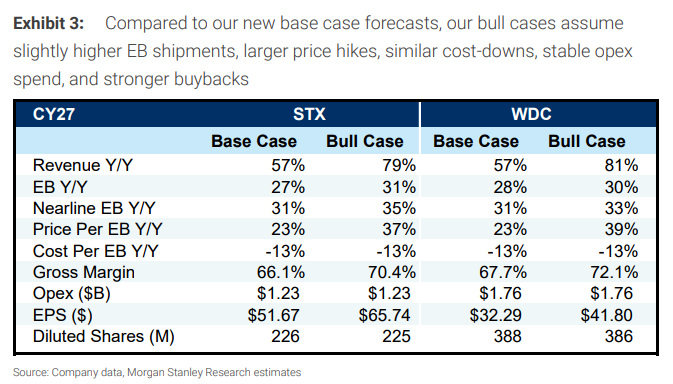
Accordingly, the firm substantially raised its target prices for major storage companies: Seagate Technology’s $STX target price was increased from $767 to $1,035, and Western Digital’s $WDC from $488 to $650. Under an extremely optimistic pricing scenario, both companies could see their EPS grow by approximately tenfold between CY25 and CY28.
The supply gap is larger than imagined—and continues to widen.
Research indicates that nearline HDD supply in 2026 will fall short of demand by approximately 300 exabytes (EB), equivalent to a 10%–15% shortfall. The gap is projected to widen further to around 400 EB in both 2027 and 2028.
Hyperscalers are currently deploying HDDs at a rate close to 100%, compared to a historical average of roughly 70%—indicating they are holding virtually no inventory and purchasing on a just-in-time basis. HDD inventory levels at ODMs have also dwindled to just one to two weeks, placing extreme strain on the supply chain.
Supply is being tightly controlled. HDD manufacturers are deliberately refraining from building new capacity (i.e., no greenfield expansions). Over the next two to three years, the annual EB growth of nearline HDDs will be entirely supply-constrained, with an estimated compound annual growth rate (CAGR) of 30%–35%. Meanwhile, demand is growing at 40%–50% annually.
Pricing: Suppliers’ target price of USD 25–30 is double the current level.
Currently, the blended average price of nearline HDDs from Seagate Technology and Western Digital stands at approximately $14.30–14.90 per terabyte (TB).
In April this year, the market was already aware that suppliers aimed to push prices to $20 per TB by 2027/2028. However, this latest research trip to Taiwan has revealed a more aggressive signal: suppliers’ internal target pricing now stands at $25–30 per TB.
A more direct signal is coming from the spot market—some distributors are already selling HDDs to customers without long-term agreements (LTAs) at $30–35 per TB, roughly 30% higher than previously reported figures.
For hyperscale cloud providers, pricing changes are typically communicated in advance and implemented gradually through quarterly price escalation clauses in contracts, offering greater control and predictability.
Cloud providers would prefer long-term agreements extending to 2032, but Seagate Technology and Western Digital are reluctant to lock in commercial terms beyond 12 months. The reason is straightforward—the application scope of HDDs is expanding, supply shortages are intensifying, the total cost of ownership (TCO) advantage over NAND flash memory is growing, and no alternative technology currently poses a threat to HDD dominance. Suppliers are willing to provide customers with five years of visibility into capacity and technology roadmaps but are unwilling to surrender pricing power prematurely, as doing so would be disadvantageous to them.
EPS Upside: Virtually all additional price increases will flow directly to profit.
Incremental pricing for HDDs translates almost 100% into after-tax profit.
This is because suppliers have been extremely disciplined in capacity expansion—there are no greenfield capacity plans, and EB shipment growth over the next two to three years is entirely supply-constrained, implying an annual compound growth rate of approximately 30–35%. Within this framework, every incremental dollar of price increase requires no additional cost and flows directly to the bottom line.
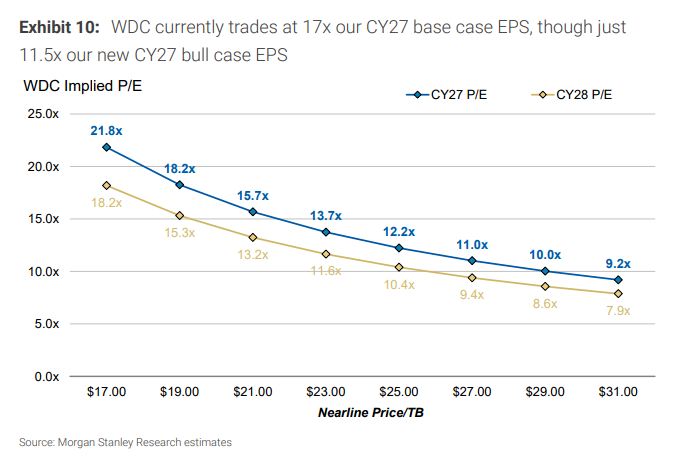
In an optimistic scenario: if nearline average selling prices reach $25/TB in CY27 and $30/TB in CY28 (consistent with channel checks in Taiwan), then:
> Seagate Technology’s CY27 EPS could exceed $70, and CY28 EPS could exceed $100.
> Western Digital’s CY27 EPS could exceed $40, and CY28 EPS could exceed $70.
By comparison, Seagate and Western Digital reported actual CY25 EPS of $10.24 and $6.95, respectively.
In the base-case forecast, the assumed nearline ASP in CY27 is approximately $19/TB, implying:
> Seagate Technology's FY27 EPS is $35.38, and FY28 EPS is $70.64.
> Western Digital's FY27 EPS is $22.40, and FY28 EPS is $43.47.
Even under this relatively conservative baseline scenario, the FY28 EPS forecasts are already approximately 70% above market consensus—Seagate Technology’s FY28 consensus EPS is around $40.60, while Morgan Stanley’s forecast is $70.64; Western Digital’s FY28 consensus is $26.20, versus Morgan Stanley’s forecast of $43.47.
How significant is the threat of new entrants?
The HDD industry is currently a highly concentrated oligopolistic market. The most frequently asked question from outsiders is whether new players could enter and disrupt this structure.
Western Digital CEO Irving Tan provided a direct answer. He explained that the barriers to becoming a competitive new entrant do not lie in capital availability, but rather in three key areas:
1. The technology certification cycle is extremely long. Certification for HAMR (Heat-Assisted Magnetic Recording) technology alone took more than 10 years.
2. It requires cross-disciplinary vertical integration capabilities. Internal integration across domains such as magnetics, materials science, photonics, and nanofabrication cannot be acquired simply by spending money.
3. The supply chain is highly concentrated with virtually no idle capacity. The HDD supply chain is extremely consolidated and currently operating at high utilization rates, making it difficult for new entrants to secure external resources they could leverage.
=>
Optical Networking: The Next Mega Trend in AI Infrastructure, May 21, 2026 (31 pp) https://t.co/ghY8iVZs31
OCS, OCP Edu Webinar, Feb 26 https://t.co/wIyZAxa9P7
Si-Photonics Switching, OCP EMEA Summit, Apr 30 https://t.co/AwPQK8UGpJ
CPO, Mar 26 https://t.co/Te6znj0kud
69 pp
Hej Sven synd att du inte fårr svar. Skall försöka summera några saker som jag ser som helt nytt.
1. Sivers is being integrated directly into GF's SCALE platform. GF only introduced SCALE publicly about a month ago. Until now, GF had announced the platform itself, but not a laser partner embedded into that ecosystem. The release states that Sivers' laser arrays will be available in GF's SCALE™ (Silicon Photonics Co-packaged Advanced Light Engine) platform and reference designs. Being picked as GF reference design vs Lumentum/SmartPhontics is strong statement and validation of Sivers as Laser supplier into the AI ecosystem. That means Sivers is no longer just supplying components into the market generally; it is becoming part of GF's preferred silicon photonics architecture.
2. Expansion beyond CPO into LPO and broader optical connectivity like Pluggables with a large TAM that is closer to ramp (1.6T. Pluggables). Earlier Sivers announcements focused heavily on External Light Sources (ELS) for CPO deployments. This release explicitly says the collaboration supports: a) Co-Packaged Optics (CPO) b) Linear Pluggable Optics (LPO), c) Other emerging datacenter interconnect architectures. This broadens the addressable market materially beyond the ELS/CPO discussed previously.
3. The first full foundry-level endorsement of Sivers' laser technology. All other communications with GF had been in group of companies or partnerships with Ayar Labs, or Wireless. Now adding foundry-level endorsement to previous announcements, with system and module partners such as O-Net, Enablence and Jabil. This is different because GF is one of the world's leading silicon photonics foundries. Having GF publicly state that it is pairing Sivers laser arrays with its silicon photonics and SCALE platforms is a stronger ecosystem validation than a group of partners on list or module-level partnership.
4. A big signal that Sivers is positioning for hyperscaler qualification for Pluggables via GF like they done for Jabil. If GF succeeds in becoming one of the major SiPh platforms for 1.6T or 3.2T Pluggables, then Sivers potentially gains visibility to: NVIDIA ecosystem suppliers, Broadcom ecosystem suppliers, AMD ecosystem suppliers, hyperscaler custom-AI programs.