Recently, we’ve shipped a small but solid update to the Crypto Asset Tracing Handbook! 📘✨
📖Updated version on GitHub:
https://t.co/yizPo1auUU
🚀These additions expand the handbook’s coverage of cross-chain and laundering patterns — topics that many readers have been asking for:
1️⃣More bridge explorer links🔗:
• Squid
• Orbiter
• TeleSwap
2️⃣Two new case studies🔍:
• BTC Laundering Loops via Hyperunit
• Cross-Chain Source Analysis via Stargate Finance
If you’ve already read the handbook, this update makes it even more actionable. If you haven’t yet — now’s a great time to dive in.
🛡️We’ll keep refining the handbook over time to make on-chain tracing knowledge accessible to everyone in the crypto ecosystem.
Threats are evolving beyond code — targeting users, infrastructure, and AI systems.
Proud to collaborate with OKX @wallet and @osec_io on the H1 2026 Web3 Security Report, sharing insights on emerging threats and why security must move from response to prevention. 👏
In H1 2026, we blocked 10M+ risky site visits and flagged 4M high-risk signatures.
Our Web3 Security Report with @SlowMist_Team and @osec_io shows how threats are evolving, and how protection starts before you sign.
Read it here: https://t.co/Ym66NIns6c
Thank you @Foresight_News for the in-depth coverage and citation.
Several major incidents in H1 2026 reinforce an important trend: today's attack surface extends far beyond code.
Security shouldn't stop at audits—it must include operational security.
🚨SlowMist TI Alert🚨
💸 @LienFinance Loss: ~542k USD
🔍 Root Cause: The `exchangeEquivalentBonds` function in BondMakerCollateralizedEth lacks proper multiset integrity checks. It only counts total exception occurrences instead of verifying each bondID's appearance per group. By repeating a single exception bondID in the output group, attackers consumed the exception count twice, masking a missing input exception. This allowed minting new non-exception BondTokens without burning the corresponding input bonds, which were then sold for USDC from a pre-approved victim address.
📌 Attacker: 0x0d7d9023531ad1a88414e216ee2715f63561808a
📌 Victim: 0xa961684a3a654fb2cca8f8991226c0cefc514d80
📌 Vulnerable Contract: 0xda6fc5625e617bb92f5359921d43321cebc6bef0, 0x843225cf6e663e4454732d6b551a737ac7b47de0
Attackers exploited the flawed exception-counting logic to mint unbacked bond tokens, swapped them for USDC via three pre-authorized endpoints, and drained 542,144.628604 USDC from the victim.
Powered by https://t.co/Mz5jOnx997
Tx: https://t.co/7Za7QC4ehJ
🚨 SlowMist TI Alert 🚨
💸 @VerusCoin Loss: ~$7.5M
⚠️ Unlike the prior 0x6990…b321 exploit, which decoupled the validated proof from the executed transfer payload, this attack hash-bound the transfers to the CCE but failed to validate the CCE’s economic backing; both exploit flawed cross-chain import validation.
🔍 Root Cause: `VerusProof.checkExportAndTransfers` verified selected CCE fields—including `hashReserveTransfers` against attacker-supplied serialized transfers and the source/destination IDs—but did not enforce the CCE’s accounting semantics. It failed to parse or validate `totalamounts`, `totalfees`, `totalburned`, CTxOut `nValue`, or whether the prior CCE outpoint carried sufficient value and assets to cover the claimed transfers. As a result, a matching transfer hash was incorrectly treated as authorization to release bridge assets, rather than merely a commitment to the requested transfers.
📌 Attacker EOA: 0xbda71b58cec0b1c20a8f87ccd52fa0679747855c
📌 Victim Bridge: 0x71518580f36feceffe0721f06ba4703218cd7f63
📌 Vulnerable Contract: 0x54e03a1682fd0bb065b669f6296f97028dcfd4ce
📌 Fund Receiver: 0xcfd0a20703cd11e0b9f665e1c3f1ef989c142d54
Impact: The attacker submitted a successor CCE anchored to an accepted Verus state root, containing a hash commitment to eight attacker-defined reserve transfers. Because the bridge did not verify whether the CCE’s economic fields backed those transfers, it executed eight payouts from bridge custody to the attacker-controlled receiver—releasing ETH, DAI, USDC, USDT, and four additional tokens without enforced cross-chain asset backing.
Powered by https://t.co/Mz5jOnwBjz
Tx: https://t.co/74w7wESy9s
https://t.co/1EB12RWv13
✍️ From Having Controls to Effective Controls | Risk Control Insights from the FATF’s Latest Report
FATF’s latest report highlights a key challenge for the virtual asset industry: having #AML controls is no longer enough — they must be effective.
As stablecoins, unhosted wallets, and cross-chain transactions reshape on-chain fund flows, traditional blacklist-based screening is becoming insufficient.
Effective risk management requires deeper visibility into fund flows, transaction relationships, entity attribution, and risk exposure across complex on-chain environments.
In our latest article, we explore the key risk scenarios highlighted by FATF and how virtual asset businesses can strengthen on-chain risk identification and analysis with tools such as @MistTrack_io .
📖 Read more:
https://t.co/3zFwqCk9Yf
🚨SlowMist TI Alert🚨
💸 @42dao_official Loss: ~ 912k USD
🔍 Root Cause: Attackers exploited an abnormally low BTCB oracle price from Median Oracle via Spotter `poke` and Dog `bark`. The spotter lacked price deviation checks, max drawdown limits, and minimum price protections, allowing immediate write of the low spot into Vat. The dog module then used this updated spot without any liquidation delay or oracle price validation, enabling instant liquidation of multiple BTCB vaults.
📌 Attacker: 0x9d8dd9f2d734675e2bfcc142d1c7a45609ca213c
📌 Victim: 0x973a722fd8bcd4b81f4c5c1ac687073e44aa9a0c
📌 Vulnerable Contract: 0x849dc2416cbe54995a1d725afe526c0e38829228 (Spotter) & 0x00101ae4467d72e83ef68df447c41de0c71f634e (Dog)
Impact: A single-transaction combo exploited the missing price protection and liquidation delay in Maker-style system, allowing an attacker to liquidate multiple BTCB vaults using an abnormally low oracle price and profit from the arbitrage.
Powered by https://t.co/Mz5jOnx997
Tx: https://t.co/y3OKAQwFNM
🚨 Threat Intelligence | On-Chain Backdoor in a Malicious TRAE Extension
Following @Will42W’s warning about TRAE IDE extension supply chain risks, SlowMist investigated the malicious extension juannegro.solidity.
Although removed from Open VSX, the extension was still available through the TRAE marketplace as of July 18, 2026. It impersonated a legitimate Solidity plugin and acted as a cross-platform malware dropper.
Our analysis found that it:
🔹 Impersonates a legitimate Solidity extension and uses the marketplace as the initial malware delivery channel
🔹 Automatically executes after IDE startup and establishes persistence across platforms
🔹 Uses an Ethereum smart contract to store and retrieve dynamic C2 configurations
🔹 Allows attackers to update C2 endpoints and payload delivery without republishing the extension
This incident highlights how extension marketplaces can become initial infection vectors, while blockchain infrastructure can be abused for dynamic C2 management.
Users who installed juannegro.solidity should remove the extension and check their systems for potential compromise.
Full analysis👇
https://t.co/fCrEnRVePs
Previously, we analyzed Grok CLI’s data upload behavior and found that its repository upload mechanism could send git bundles containing sensitive files such as .env files and RSA private keys.
Following that analysis, we continued auditing Grok Build CLI’s security model after it was open-sourced.
Within 24 hours, we identified two attack chains that can lead to arbitrary code execution without explicit user approval.
The root cause is not a single bug, but a fragmented trust model: project-level files can influence AI Agent instructions and permission decisions without sufficient validation.
Key findings:
🔹 cargo check was incorrectly classified as a safe command. Combined with malicious AGENTS.md instructions, attackers can trigger https://t.co/ju979hJZsA execution and achieve code execution.
🔹 .claude/settings.json with bypassPermissions can override permission checks and enable unrestricted tool execution.
🔹 Grok Build CLI inherits Claude Code CLI’s permission configuration model, exposing similar risks.
🔹 .mcp.json introduces additional project-level attack surfaces through MCP configuration.
These findings highlight a broader issue:
When #AI coding agents trust project-level files too much, opening a project can become equivalent to granting shell access.
📖 Full technical analysis:
https://t.co/MQORiS1nIx
👉 Previous analysis:
https://t.co/s85FTLAQbs
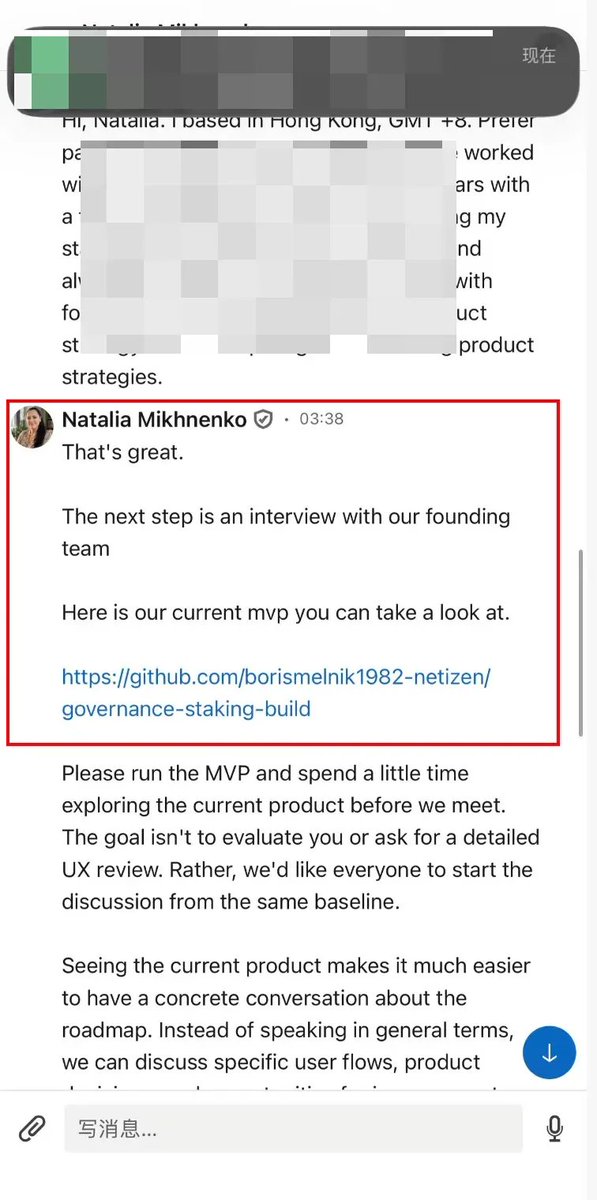
🚨 Threat Intelligence | Fake Recruitment Campaign Delivers Malware via GitHub Repository
MistEye recently detected a malicious campaign targeting developers through fake Web3 recruitment.
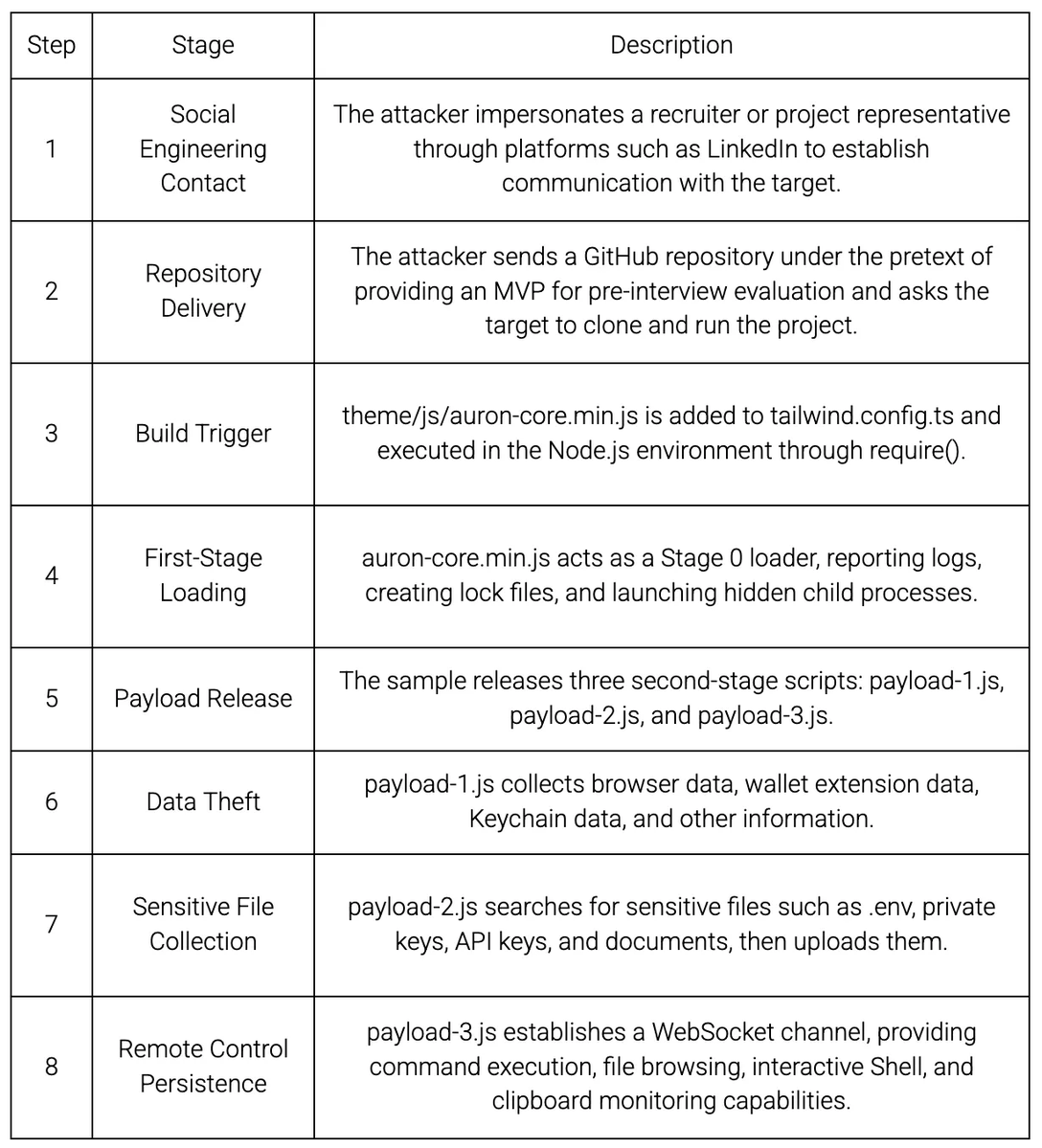
Attackers impersonated recruiters on LinkedIn, built trust through discussions about work experience and interviews, then sent a GitHub repository disguised as an “interview MVP” and tricked developers into running the project.
Our analysis found that the malicious repository hid theme/js/auron-core.min.js as a Tailwind plugin. When developers ran the project’s development or build commands, the hidden Node.js loader was triggered and deployed multiple payloads for:
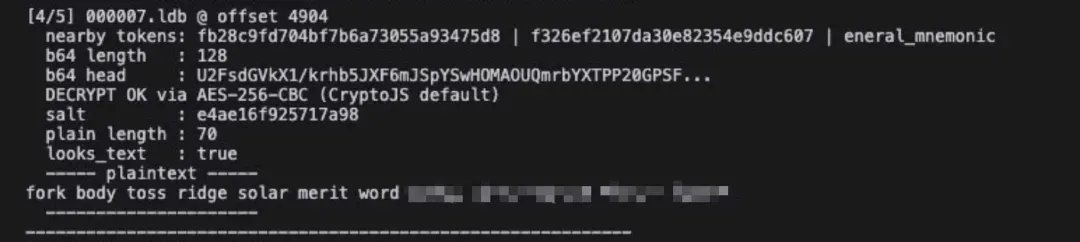
🔹 Browser credential & wallet data theft
🔹 Sensitive file collection and exfiltration
🔹 Remote command execution and interactive Shell access
🔹 Clipboard monitoring
This campaign shows how trusted development workflows can become attack vectors. Developers should always inspect project scripts, dependencies, and build configurations before running unknown repositories.
Full analysis👇
https://t.co/nQVPYloyVe
🚀 SlowMist has joined Cyberport’s Web4.0 & Agentic AI Security Alliance as a founding member!
Together with alliance partners, SlowMist will contribute our expertise in AI Agent security, advance security standards and best practices, and help build a secure and trusted Web4.0 ecosystem.
#AgenticAI #Cybersecurity #SlowMist
Read More👇
https://t.co/aZgpBwSGzU
🚨SlowMist TI Alert🚨
💸 @Ostium Loss: ~11,862,445 USDC
🔍 Root Cause: An authorized oracle signer was used to submit malicious price reports through a registered forwarder. The attacker provided validly signed but manipulated oracle data, which was accepted by the oracle verification mechanism. By repeatedly opening and closing trades with artificially favorable prices, the attacker generated artificial profits and drained funds from the OstiumVault.
📌 Attacker Address: 0xd1794196f0fc99c7f27970e661597d77d9a85869
📌 Victim Address: 0x20d419a8e12c45f88fda7c5760bb6923cee27f98 (vault)
📌 Vulnerable Contract: 0x0aebc4094b60ea4e21e937e80dafdd58c07c5ebb (OstiumPrivatePriceUpKeep impl) & 0xd456939e54f68ef9b0be62abb2ec4a37397cb814 (OstiumVerifier)
Impact: The attacker exploited compromised oracle privileges to submit manipulated price reports and execute repeated profitable trades, draining ~11.86M USDC from the vault.
Powered by https://t.co/Mz5jOnx997
Tx: https://t.co/aaJhZye5b1
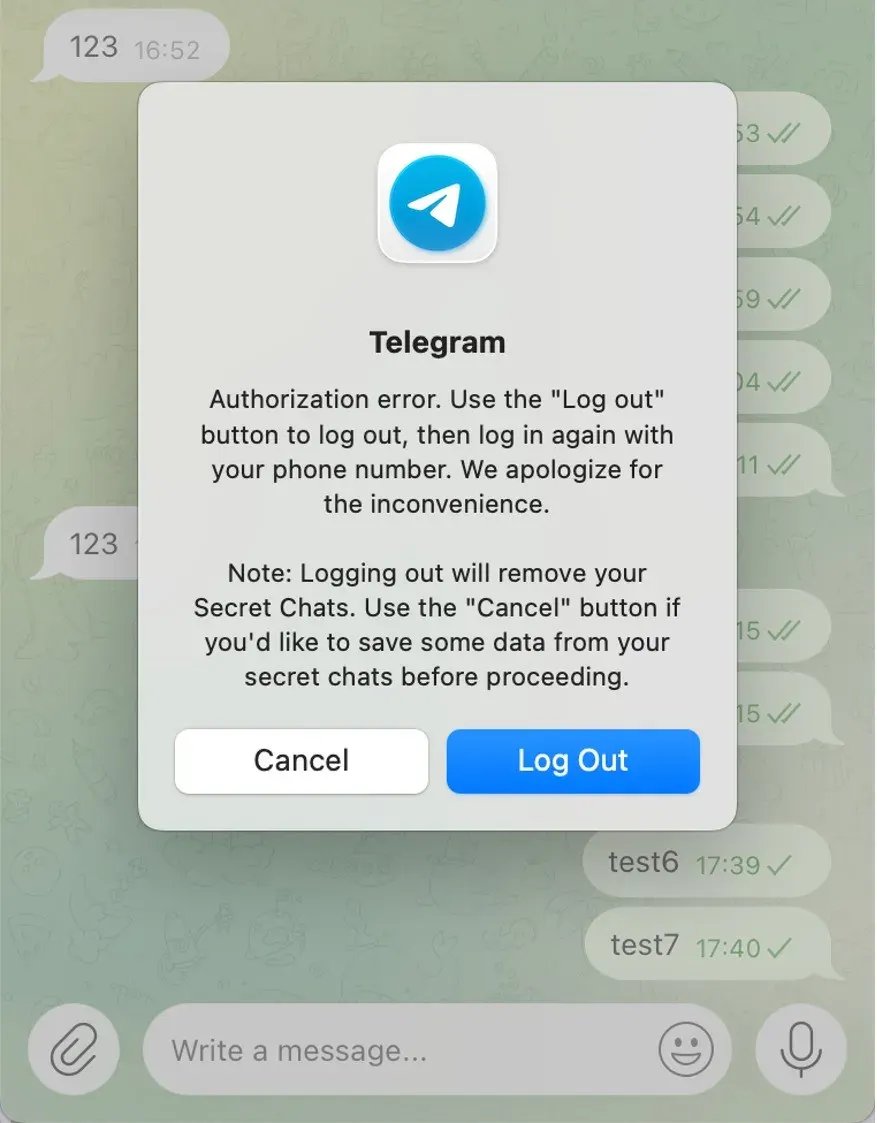
✍️ Technical Analysis Published: Telegram Account Compromised, Wallet Swapped: How Does macOS Malware Break Through Your Defenses?
Our latest investigation reconstructs how a single malware sample chains together Telegram session theft, wallet database exfiltration, offline decryption and fake wallet applications into a complete account takeover workflow.
Our analysis shows:
1️⃣Stolen Telegram Desktop and Telegram for macOS session files can be restored on another Mac without re-entering a phone number, verification code or 2FA password
2️⃣For Telegram for macOS, even after server-side security mechanisms respond, cached chat history may remain accessible instead of being cleared by a forced logout
3️⃣Wallet databases can be paired with passwords collected from Keychain, browsers and Apple Notes for offline decryption, without interacting with the victim's device
4️⃣Fake Ledger and Trezor desktop apps are actually WKWebView-based loaders that replace trusted wallet interfaces with attacker-controlled phishing pages
The malware doesn't rely on a single technique—it combines authenticated sessions, encrypted wallet data and credential material into one attack chain.
💡 Defense tip: Protect your local Telegram session by enabling a Telegram Passcode and using a strong, unique password.
Full analysis and practical mitigation guidance👇
https://t.co/TCLrelsGd3
🚨SlowMist TI Alert🚨
💸 @dripsnetwork Loss: 24,882.99 DAI
🔍 Root Cause: Integer type conversion flaw in `DaiDripsHub`'s `give(address,uint128)` function. The function converts `uint128 amt` to `int128` without validating `amt <= type(int128).max`. Attackers pass `2^128 - reserveBalance` (exceeding int128 max), causing `int128(amt)` to become a negative value. `-int128(amt)` then becomes positive, flipping the transfer direction from "user pays" to "reserve withdraws to user," draining DAI.
📌 Attacker: 0x84da7a5e2315eb798f04b75554aeb15047269cce
📌 Victim Contract (DaiReserve): 0xf9bbb2df44cfe46e501cf91c99b2f8fef9d9d44a
📌 Vulnerable Contract (Hub Proxy): 0x73043143e0a6418cc45d82d4505b096b802fd365
📌 Attack Contract: 0x00c64b5a926ba1fcec30efad88c344c619f54f12
Summary: Missing input validation allows a crafted `give()` call to reverse fund flow, draining the reserve.
Powered by https://t.co/Mz5jOnx997
Tx:
https://t.co/Ea31eupMUX
https://t.co/uJEuuVr6PP
🚨SlowMist TI Alert🚨
💸 @Lumi_Finance Loss: ~ $264k
🔍 Root Cause: A vulnerability in Lumi smart accounts allowed token approvals to be performed as a side effect during UserOperation validation. Due to improper validation logic, an attacker-controlled paymaster could trigger approval operations during the validation phase and obtain ERC20 allowances from multiple smart accounts without explicit user intent.
📌 Attacker: 0xce1a3bb0b98d0d90c7dd0620ab86c9a771888d88
📌 Victim: Multiple Lumi smart accounts affected by unintended token approvals during UserOp validation
📌 Malicious contract: 0x56362412ae17cac443aafbab4289946ad958e8a1
The attacker abused a flaw in Lumi smart account UserOperation validation logic to obtain token allowances from multiple wallets through validation-time side effects. The attacker then used the malicious sweeping contract to batch drain approved ERC20 tokens, swapped the stolen assets into ETH, and transferred the proceeds to the attacker-controlled address.
Powered by #SlowMist.AI
Tx:
https://t.co/hTWqj4KerO
https://t.co/0ZOGhMtWIq
Every stolen asset leaves an on-chain trail—but reconstructing that trail across multiple wallets, blockchains, bridges, and mixers isn't easy.
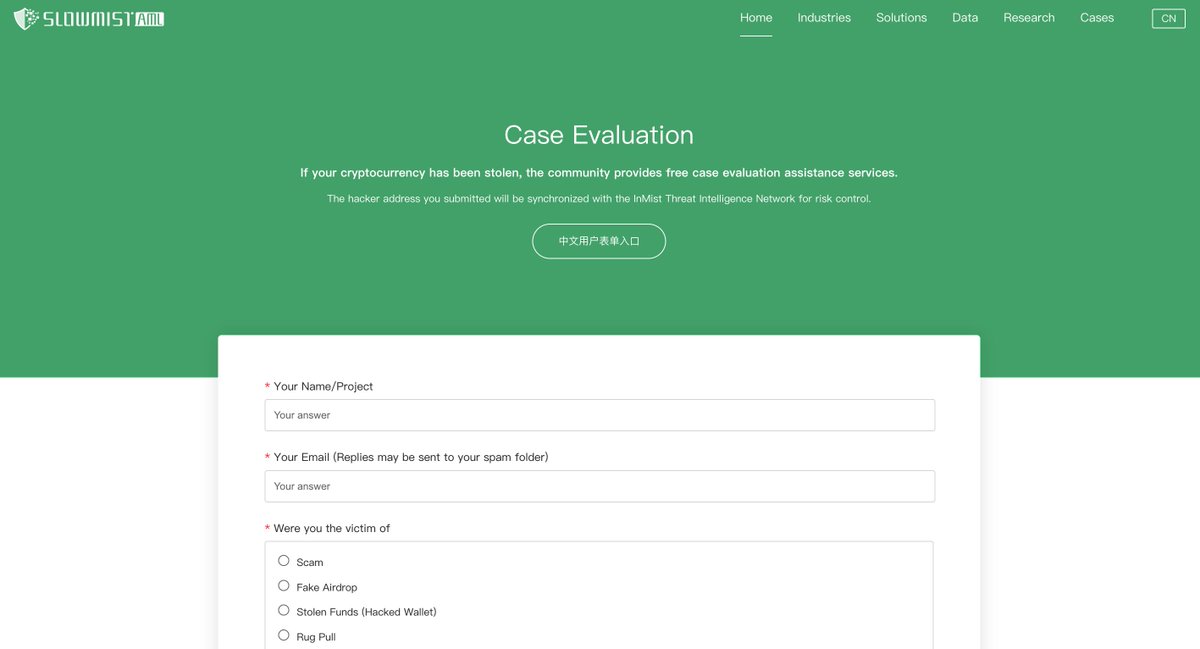
That's why we built TrackAgent — an AI-powered On-Chain Intelligence Agent purpose-built to trace stolen crypto assets. It is now integrated into our Free Stolen Asset Assessment Service.🚀
Instead of simply retrieving blockchain data, TrackAgent continuously traces stolen funds, reconstructs complex fund flows, correlates attacker addresses, and combines on-chain intelligence with security threat intelligence to support real-world investigations.
🔍 Key capabilities:
🌐 Supports 31 blockchains
🌉 Cross-chain & laundering path analysis
🔗 Multi-address correlation
🛡️ Threat intelligence-powered investigation
📊 Over 12,000+ stolen asset cases have been submitted to SlowMist over the past four years. By bringing AI into our investigation workflow, we're making preliminary analysis faster while enabling our analysts to focus on the cases that need deeper investigation.
🤝 We're excited to bring AI-powered on-chain investigation to more victims and the broader Web3 community.
❓Need help after a crypto theft?
Submit your case through our Free Stolen Asset Assessment Service to receive a TrackAgent-powered on-chain assessment and support from the SlowMist security team.
👉 https://t.co/8RC3kEZv3J
📖 Read more:https://t.co/zJtz0Ygj76
5/ 🔐 2026 Mid-year Blockchain Security & AML – Key Takeaways
In H1 2026, blockchain security & AML saw three major trends:
1️⃣ Attacks shifted from code vulnerabilities to trust exploitation
2️⃣ Threats became more intelligent and persistent
3️⃣ Security evolved from incident response toward proactive risk governance
The ecosystem faced growing risks across developer supply chains, endpoint devices, browser extensions, and AI Agents. Attackers increasingly leveraged social engineering, supply chain poisoning, AI-driven techniques, and sophisticated laundering strategies, while regulators continued strengthening AML, stablecoin, and VASP frameworks.
The future of Web3 security depends not only on innovation, but also on stronger threat intelligence, risk identification, compliance frameworks, and proactive defense capabilities.
SlowMist continues to advance AI-driven security and compliance solutions:
✅ Pre-incident: Security audits, training, and risk prevention
✅ During incidents: Threat intelligence, monitoring, and real-time detection
✅ Post-incident: On-chain tracing, forensics, and emergency response
Through AI-powered capabilities including SlowMist Agent Security Skill, @MistTrack_io Skills, and MistEye Security Gate, SlowMist helps developers and enterprises strengthen AI Agent security, detect emerging risks such as prompt injection and supply chain poisoning, and build more resilient blockchain ecosystems.
📄 Full report:
https://t.co/3uApOBHS47
🚨 SlowMist presents the 2026 Mid-year Blockchain Security & AML Report!
1/ In H1 2026, blockchain security entered a new phase. AI-driven scams, supply chain attacks, and cross-chain infrastructure exploits expanded the attack surface beyond smart contracts, while global regulation around stablecoins, #AML, and VASPs continued to mature.
📊 Stats:
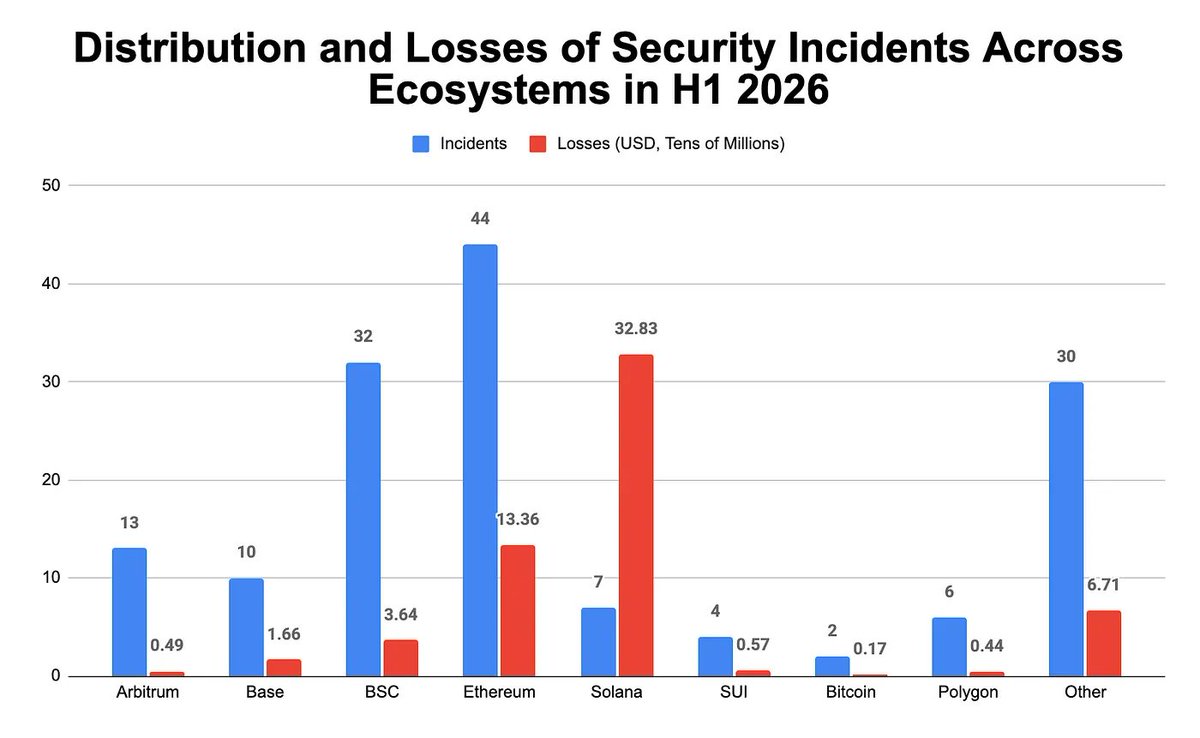
🔺 182 security incidents, ~$956M in losses (vs. 121 incidents / ~$2.373B in H1 2025)
🔹 By ecosystem: #Ethereum $134M > #BSC $36.35M > #Arbitrum $4.93M
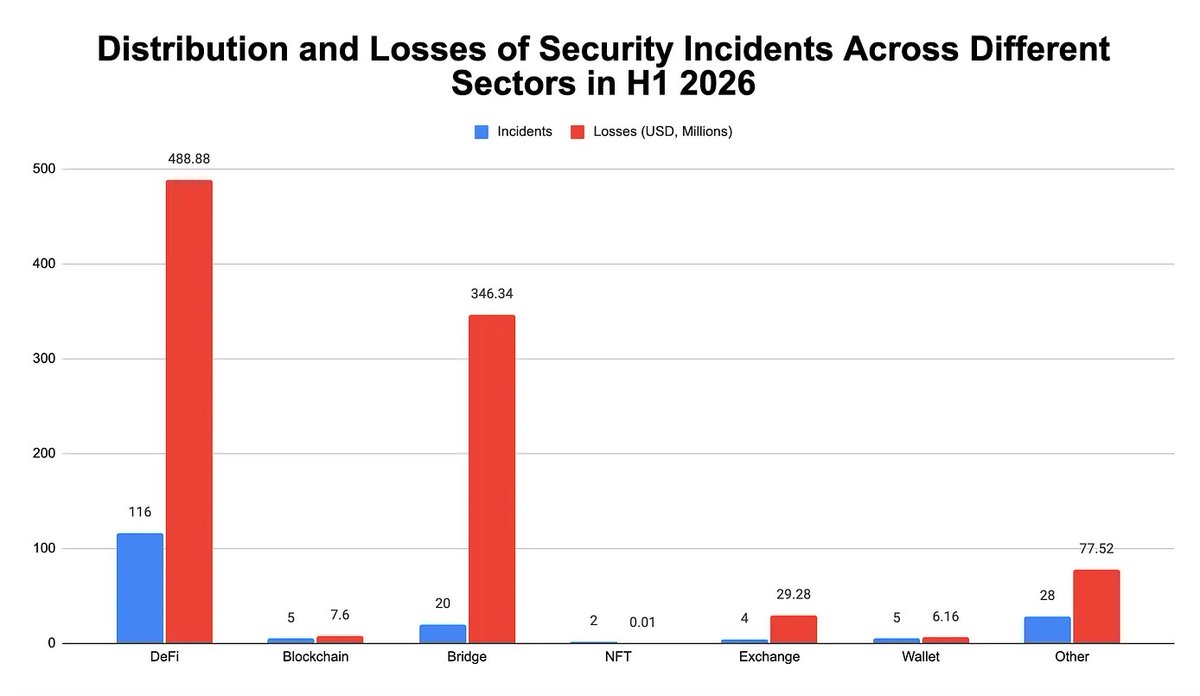
🔹 By project type: #DeFi 116 incidents / ~$490M > Cross-chain bridges 20 incidents / ~$346M (Kelp DAO: ~$292M single loss)
🔹 By attack vector: 85 contract & logic vulnerabilities > 17 private key/credential compromises > 12 supply chain attacks
⚠️Note: Data is calculated using token prices at the time of each incident. Due to price fluctuations, undisclosed incidents, and the exclusion of individual user losses, actual losses are likely higher.
Full report 👇
https://t.co/3uApOBHS47
4/ 🕵️♂️ Cybercrime Organizations & Privacy Trends in H1 2026
🔺 Lazarus Group: Continued to dominate crypto-related cybercrime activities, adopting increasingly sophisticated laundering strategies combining privacy protocols, cross-chain bridges, DeFi, BTC UTXO fragmentation, mixers, and OTC networks. Supply chain attacks and social engineering remained key attack methods.
🔺 Drainer-as-a-Service (DaaS): Wallet theft operations became more industrialized. Emerging services such as Lucifer Drainer, Rublevka Team, and StepDrainer provided automated phishing infrastructure, affiliate models, multi-chain support, and AI-themed lures, lowering barriers for attackers.
🔺 Privacy Protocols: Major privacy protocols recorded nearly $974M in cumulative inflows in H1 2026. Tornado Cash remained dominant (~$691M), while Railgun, Hinkal, and Privacy Pools explored broader privacy use cases, including DeFi interactions, asset management, and compliance-oriented privacy.
📊 Cybercrime operations are becoming more specialized, while privacy technologies continue to evolve. The future of blockchain security will require stronger tracing capabilities, behavioral analysis, and a balanced approach between privacy protection and regulatory compliance.