Welcome to SM Research Labs.
I’m in my early 20s and have been passionate about markets since I started trading equities at 14. I eventually moved into crypto, where I was fortunate enough to make some good money. I now focus primarily on equities, with an emphasis on fundamental research, valuation and building proper investment theses.
I started this account to document that process in a more formal way, learning as I go, improving with every thesis, and building a portfolio of my work that I can look back on years from now.
Appreciate everyone who comes along for the journey.
OpenAI, $ANT and $GOOGL are all in the same race, and still at the proof of concept stage.
NONE of them has a drug in human trials yet.
$IAM is not a proof of concept. They already have AI-designed drug in human trials.
Isomorphic Labs is valued $50B.
Iambic is valued $0.8B.
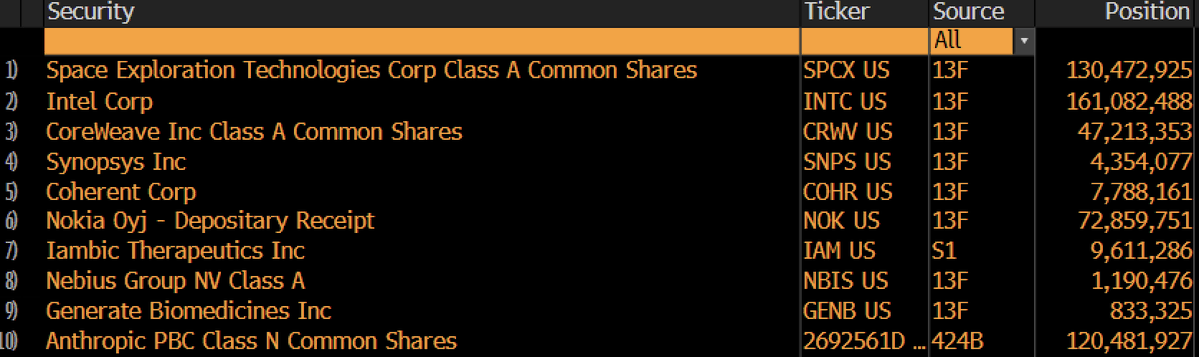
$IAM is one of only 10 listed stocks $NVDA owns, alongside $ANT, and its biggest AI<>Bio stock.
AbbVie says the Iambic deal targets programs with "first-in-class and best-in-class potential." Iambic's NeurIPS model beats AlphaFold 3 on PoseBusters, the test Oxford researchers built. AlphaFold's co-builder, Isomorphic, is reportedly valued at up to $50B, ~70x Iambic.
NFA, DYOR
$IAM's AI model got accepted at NeurIPS, the top AI research conference, and in the paper it beats Google's AlphaFold 3 on the harder test.
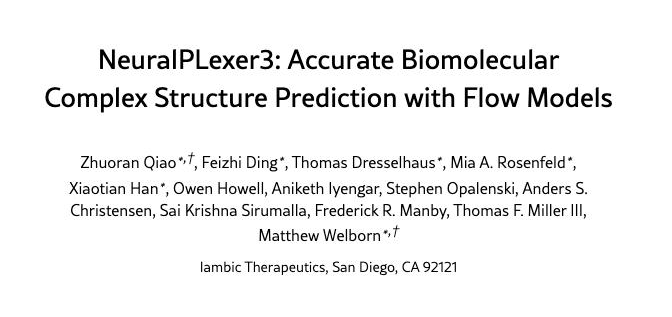
NeurIPS is where $GOOGL , $META and OpenAI publish their research. The model is NeuralPLexer3, and every one of the 13 authors on the paper is listed at Iambic.
The test: predict exactly how a drug locks into its target. That's one of the core problems in designing a new medicine.
Getting the position right: dead level with AlphaFold 3 (Iambic 80.2%, Google 80.4%)
Getting it right and physically realistic: Iambic 78.4%, Google 73.1%
And it does it in about 30 seconds on one GPU. AlphaFold 3 reports around 6 GPU-minutes.
This is a big find, and the market is not pricing it in. Isomorphic Labs, the Alphabet company that co-built AlphaFold 3, just raised $5B at a reported ~$50B valuation, and it has no drug in human trials yet.
Iambic is worth under $1B and already has a drug in the clinic with over 100 patients dosed. Isomorphic is valued at almost 80x Iambic.
TLDR; You are buying the better model, with a drug in clinic, at 1/80th the price of its competitor.
NFA, DYOR
Looks like the dots were right.
Last week I said $IAM was quietly building towards obesity. Their November investor deck just put it in a footnote.
What I had:
→ Old job ads showed an in-house GPCR team. Ozempic, Wegovy and Mounjaro all work through GPCRs
→ The Q3 release says Iambic runs its own programs in "oncology, metabolic and endocrine diseases"
→ Enchant v3 is trained on peptide data
What the deck adds: three undisclosed programs (I&I/endocrinology, oncology, metabolic disease), sized at >$75B.
The footnote shows what that number is built on: 2025 sales of Mounjaro, Zepbound, Wegovy, Ozempic, Trulicity and Tepezza.
This isn't just a cancer company. Iambic makes small molecules, the kind you take as pills, and it's sizing its next wave against the GLP-1 market. Obesity pills look like where it's heading.
No obesity drug has been named yet. But the direction is now in their own deck.
NFA, DYOR
The future of pharma is AI-designed drugs. $IAM's investor deck shows why.
Hit-to-lead failure rate
Industry: 25%
Iambic: 7%, about 1 program in 15
Preclinical failure rate
Industry: 40%
Iambic: 0%. None of its 3 preclinical programs has failed
Most of pharma's money gets burned on drugs that die along the way. Cut the failures and you change the economics of the whole industry.
What's doing it, per the same deck:
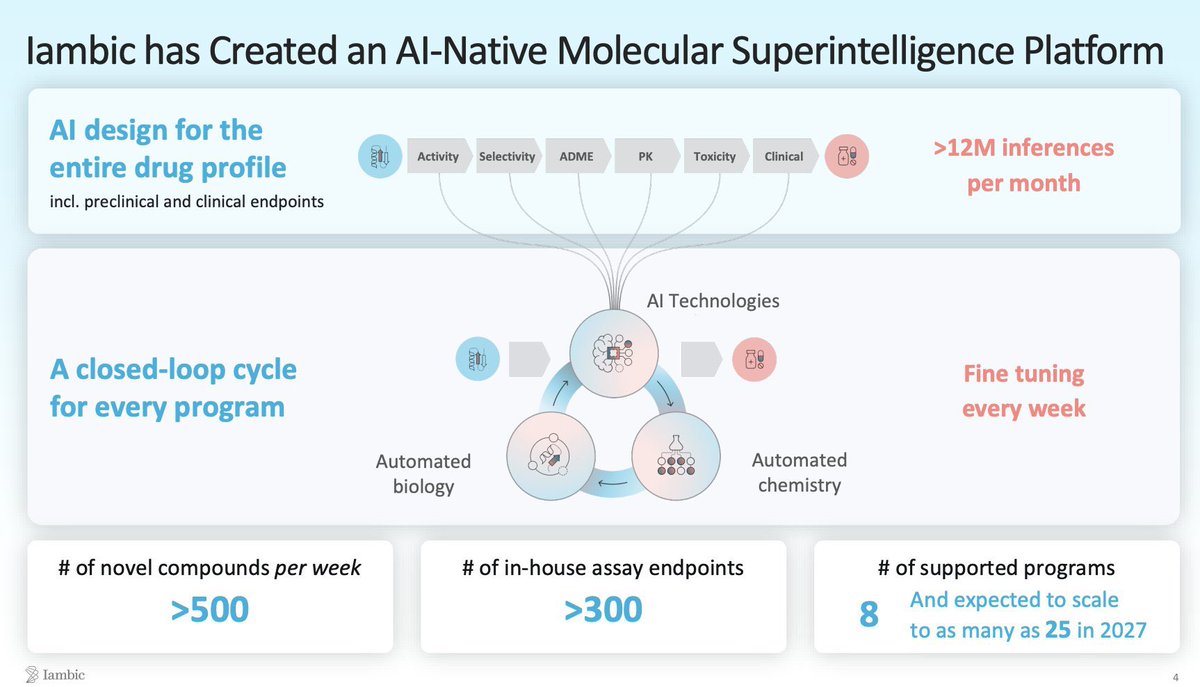
→ 500+ new compounds made every week
→ 300+ in-house assays
→ 12M+ model predictions a month
→ Models fine-tuned every week
Takeda's CSO, quoted on the same slide: Iambic could help "de-risk candidate selection, improve probability of success".
There is a reason why $NVDA sold their whole $RXRX stake and doubled down on Iambic.
NFA, DYOR
A lot surfaced on $IAM today. Here’s all of it in one place.
1. New data, out this morning
Iambic unveiled its next two AI-discovered drugs at the EORTC-NCI-AACR symposium in Barcelona. Both wholly owned.
IAM-C1 goes after the drug class behind Ibrance, Verzenio and Kisqali, the standard first treatment for the most common type of advanced breast cancer.
• Tumour already resistant to Ibrance-type drugs: 78% vs Ibrance’s 24%
• Vs the lead drug in Roche’s $850M CDK deal: 97% vs 76% in CDK2-driven tumours, 94% vs 83% in CDK2/4-driven
• White blood cell loss, this class’s biggest side effect: 13% vs Ibrance’s 69%
One pill matching what Pfizer needs two drugs to do.
IAM217 is the brain drug.
• ~90% shrinkage of breast tumours growing inside the brain
• Volastra’s rival, already in the clinic, at twice the dose: tumours kept growing
2. Oxford researchers
A review in npj Drug Discovery (Nature Portfolio) mapped the next era of AI drug discovery, TechBio 3.0: AI designs the drug, robots test it, results go straight back into the model.
Their example: “One actionable example of the TechBio 3.0 thesis is Iambic Therapeutics.”
Only three companies made their comparison table. Iambic got a yes on all four criteria. Isomorphic, reportedly worth ~$50B, got a partial and no disclosed pipeline.
3. UK government compute
Isambard-AI is Britain’s £225M national AI supercomputer, running 5,448 NVIDIA chips.
Iambic was awarded time on it to build NeuralPLexer4, the next version of its model that predicts how a drug locks onto its target. NeuralPLexer3 was published at NeurIPS.
At this year’s Isambard Summit, the UK’s AI minister opened proceedings. Next keynote on the programme: Iambic’s co-founder.
4. $NVDA
In yesterday’s earnings, NVIDIA said it’s helping “accelerate drug discovery.”
Look at its drug discovery bets. It sold every $RXRX share. It’s been an Iambic shareholder since 2023, co-owns a NeuralPLexer patent family, and its Iambic stake is bigger than its only other biotech holding.
NFA, DYOR
Something else to add which I find interesting.
$NVDA completely exited $RXRX, the AI drug discovery stock it backed in 2023.
A few months later, it bought more $IAM.
Now look at how small NVIDIA’s public portfolio is. Its latest 13F shows just eight US-listed stocks, led by SpaceX, Intel and CoreWeave. Iambic listed in October with pre-IPO holders locked up until April, so Iambic is the ninth.
Out of a tiny public portfolio, Iambic is very likely NVIDIA’s biggest AI drug discovery bet. A ~$700M company sitting next to SpaceX and Intel.
Are you ready for $IAM gap up tomorrow?
$NVDA higlighting accelerating drug discovery as priority in todays earnings release after investing to Iambic at $17 per share valuation.
Iambic gives early $ABCL vibes, but with much bigger potential. 🔥🚀
Proper alpha from the main account.
$IAM's GPCR team is led by a Lefkowitz-trained head who runs Iambic's non-oncology programs.
That points to a possible second pipeline that isn't priced in.
Migraine? Weight loss? Hormones?
All on top of the cancer drug pipeline.
To add to this, I found some alpha in $IAM’s old job listings, since taken down from its careers page.
Iambic has an in-house GPCR drug team.
GPCRs are the receptors behind about 1 in 3 FDA-approved drugs, including Ozempic, Wegovy and Mounjaro.
In late 2025 Iambic hired a GPCR team: a director-level lead (role now filled), plus scientists screening small molecules against GPCRs, tasked with taking programs “from hit ID through development candidate selection.”
Iambic’s Head of GPCR Biology runs its non-oncology programs. His background is in metabolic, renal, liver, respiratory and cardiovascular drugs.
Small molecules can be pills. GPCR pills already sell in every area Iambic is linked to:
• Obesity: Lilly’s Foundayo (GLP-1 pill)
• Hormones: Crinetics’ Palsonify
• Migraine: Nurtec, Ubrelvy (Iambic has a migraine deal with Lundbeck)
• Immunology: Zeposia (AbbVie and Takeda partner with Iambic here)
The prospectus lists Iambic’s own discovery programs in metabolic disease and endocrinology. All 3 of its named drugs are cancer drugs, and none hits a GPCR.
If one of those metabolic programs is a GPCR pill, that’s the market Ozempic sells into. Iambic hasn’t said it is. For scale: GLP-1s did ~$73B in 2025, and Novo signed a deal worth up to $2.2B with Septerna for preclinical GPCR obesity pills.
No GPCR program has been named yet. But you don’t hire a GPCR team and a Lefkowitz-trained head unless you plan to run GPCR programs. So the call option is: a possible path into commercial medicines like obesity and migraine, on top of the cancer pipeline.
NFA
$IAM picked up a lot of new eyes yesterday with four banks starting coverage. Here’s what you get for ~$665M, with ~$410M of that in cash.
The AlphaFold comparison.
NeuralPLexer was built with NVIDIA researchers at Caltech. NVIDIA co-owns a patent family and put $25M into the company
~15x faster than AlphaFold 3 by Iambic’s numbers. An independent benchmark clocked the first version at ~100x on the same chip
Isomorphic, Alphabet’s AlphaFold drug company, is reportedly raising at ~$50B (Bloomberg) with no drug in humans
Iambic, with a drug in 122 patients, is ~$665M. That’s about 1/75th of Isomorphic’s price, and the business beyond cash (~$255M) is under 1/190th, for a model that’s arguably on par on accuracy and ~15x faster by Iambic’s numbers.
The drug
IAM1363, a HER2 pill, 122 patients dosed. Iambic says it’s the only one known to bind the inactive form of HER2
It concentrates in tumours: 20-30x more drug in the tumour than in the blood, in biopsies from two patients
3 confirmed brain responses in breast cancer patients who’d already failed Enhertu and Tukysa. Nothing is approved for them
Registrational trial as early as 2027, and two more drugs entering the clinic
The flywheel
Molecules designed Monday, made Tuesday, tested by Friday. A traditional pharma design cycle takes weeks to months. Iambic puts ~1,000 molecules through one every 7-10 days, and the CEO puts its pace at ~50x a typical pharma programme
Every result goes straight back into the models, so each week’s designs start smarter than the last. More data makes better models, which make better molecules, which make more data
That’s how IAM1363 went from programme start to the clinic in under 2 years, with the drug candidate found by month 7. The industry norm is ~6 years
Enchant v3: 41B parameters, 4.5T tokens of training data, 6,000+ properties predicted, ~12M predictions a month. Google’s TxGemma tops out at 27B
Against TxGemma, by Iambic’s numbers: kinase activity 0.69 vs 0.55, rat clearance 0.70 vs 0.35
With ~5% of the human training data, Enchant matched the best published human PK models trained on 100%
The coverage
All four of the banks that took Iambic public started coverage on Monday, all at Buy or Overweight
Jefferies $35, BofA $30, JPMorgan $22, Citi $22. The average is ~$27, about 95% above $14
BofA’s case: Iambic uses AI to design new drugs, not just to find targets, and it trades below its listed AI peers
The stock closed up 31.6% on the day
Jefferies has the CEO on its AI drug discovery panel on 18 Nov
Commercial validation
AbbVie signed up the day Enchant v3 launched: $40M upfront, up to $670M in milestones
Bayer’s deal names Enchant and NeuralPLexer. RevMed paid ~$25M for NeuralPLexer alone. Takeda signed a separate technology agreement on top of its drug deal
Upfronts keep climbing: $10M (Lundbeck) → $27M (Takeda) → $40M (AbbVie). ~$2.4B in potential milestones across the book
Isomorphic’s Lilly and Novartis deals brought $82.5M upfront. Iambic’s bring ~$77M. A similar deal book, at roughly 1/75th of the valuation
Last December the CEO told investors more deals were coming. Three signed within nine months.
The balance sheet
~$410M pro forma cash, plus AbbVie’s $40M upfront still to come. No debt
Funded into late 2028: enough to start the registrational programme for IAM1363 and take two more drugs into the clinic
The company is locked up too. No new shares before April without its banks’ sign-off
Partner money stretches it further. The CEO says every new deal adds quarters of runway
Therefore minimal dillution risk.
Who’s buying
IPO 5x oversubscribed (Bloomberg)
Cathie Wood’s ARK has bought on 8 of 15 days since the IPO, ~2.4M shares across its funds (~5%)
Druckenmiller’s Duquesne indicated interest in the IPO
A director’s fund bought $11.5M in the IPO. No insider has sold
The flow
80% of shares locked until April. The 10 biggest IPO buyers took 80%+ of the rest.
Possible Russell add: preliminary list Friday, index buying 11 Dec
CEO on Jefferies’ AI drug discovery panel, 18 Nov
Of course NFA, Dyor
$IAM’s AI drug-discovery flywheel:
Monday: AI designs new drug molecules.
Tuesday: Automated robots synthesise them.
Wednesday–Friday: The lab tests them and feeds results back into the AI.
Next Monday: The model is smarter and the cycle starts again.
Traditional drug discovery: Months of design, synthesis and testing, with far slower feedback loops and more manual work.
Iambic: A continuous design → make → test → learn cycle, potentially compressing years of discovery into months.
Every cycle generates more data, better predictions and a potentially stronger competitive moat.
IAM1363 went from programme start to clinical candidate in just 7 months.
3 drugs expected in the clinic by year-end 2026.
The flywheel is spinning.
$IAM: Nvidia has been working with Iambic’s CEO since he was a professor at Caltech. They’ve written papers and filed patents together, and $NVDA engineers helped scale the models. On where that ended up: “they’ve also become major investors in the company and strong supporters.”
That’s Tom Miller on Care Shift with Vik, filmed about 4 months ago, pre-IPO. A few other things I didn’t know.
The lab runs on a weekly cycle. Molecules get designed on Monday, made on Tuesday by their automated chemistry setup, and tested later in the week. The results go straight back into the next design round.
IAM1363 came out of that process. They found the clinical candidate in about 7 months and had human data at ESMO 3.5 years after starting the programme. The industry average to even reach the clinic is around 6 years. It was built to get into the brain, and by his numbers 40%+ of HER2 breast and lung patients end up with brain tumours.
He also said they expect 3 drugs in the clinic by the end of 2026. If one candidate took 7 months, I doubt they stop at three.
Iambic’s HER2 pill puts 20-30x more drug in the tumour than in the blood. They tested about six other HER2 drugs. None do this. $IAM
From Tom Miller’s keynote at the Broad Institute, November 2025.
The biopsy data comes from two patients. Iambic ran the same test on about half a dozen other HER2 drugs. None of them concentrate in the tumour. Most have less drug in the tumour than in the blood.
Miller ties that to the safety: no significant rash or liver toxicity, the side effects that cap the dose on other HER2 pills. Clean safety is what lets you combine, and they’ve already started combinations with antibodies and ADCs in earlier-line breast cancer.
One patient with leptomeningeal disease, where progression usually comes within about 6 weeks, had been on IAM1363 for 7+ months.
On Enchant: with lots of cheap lab data and only ~5% of the human training data, it matched the best published human PK predictions trained on 100%. In one of their own programmes, standard lab assays couldn’t predict which compounds would last in dogs. Enchant could, and the programme moved forward towards an IND.
Miller said readouts for a potential accelerated approval could come as early as mid-2028. The prospectus has a registrational trial starting as early as 2027.
I finally picked up shares of $IAM this morning
I read the research by @SmResearchLab & @rk8215 and decided to wait until the IPO banks initiated coverage, which they did this morning
I bought a starter position around $10.50 this morning and price is already running away from me, so I'm hoping we see some dips soon to add more
If you want to buy a lotto ticket that AI continues to revolutionize drug discovery, $IAM is the best high odds powerball
"Not an AI infrastructure play."
That line sums up $IAM.
Most AI money is chasing picks and shovels. Iambic is using AI to make the actual product: medicines. Citi calls the early HER2 data "very encouraging."
Three banks initiated today. Three Buys, targets ranging from $22 to $30.
CEO Tom Miller will speak about AI drug discovery on a panel at Jefferies London, Nov 18.
Good days are ahead…
Several banks initiated coverage of $IAM today:
Citi: Buy, $22 price target
JPMorgan: Overweight, $22 price target
Bank of America: Buy, $30 price target
Citi views the company as “differentiated” given its ability to use AI to design better medicines and called the early clinical data in HER2-driven cancers “very encouraging.”
JPMorgan sees Iambic “at a key inflection point”, noting that its AI-driven discovery platform is beginning to gain traction through new partnerships and clinical results.
BofA said Iambic, which uses AI to design new molecules, is “not an AI infrastructure play”, but is applying AI to create real medicines for patients. The bank added that real-world applications of AI in high-revenue areas like drug development is “where the industry is headed.”
Separately, Iambic announced today that Co-Founder and CEO Tom Miller will attend the Jefferies Global Healthcare Conference in London (Nov 16–19).
He will speak on a panel about AI in drug discovery on November 18.