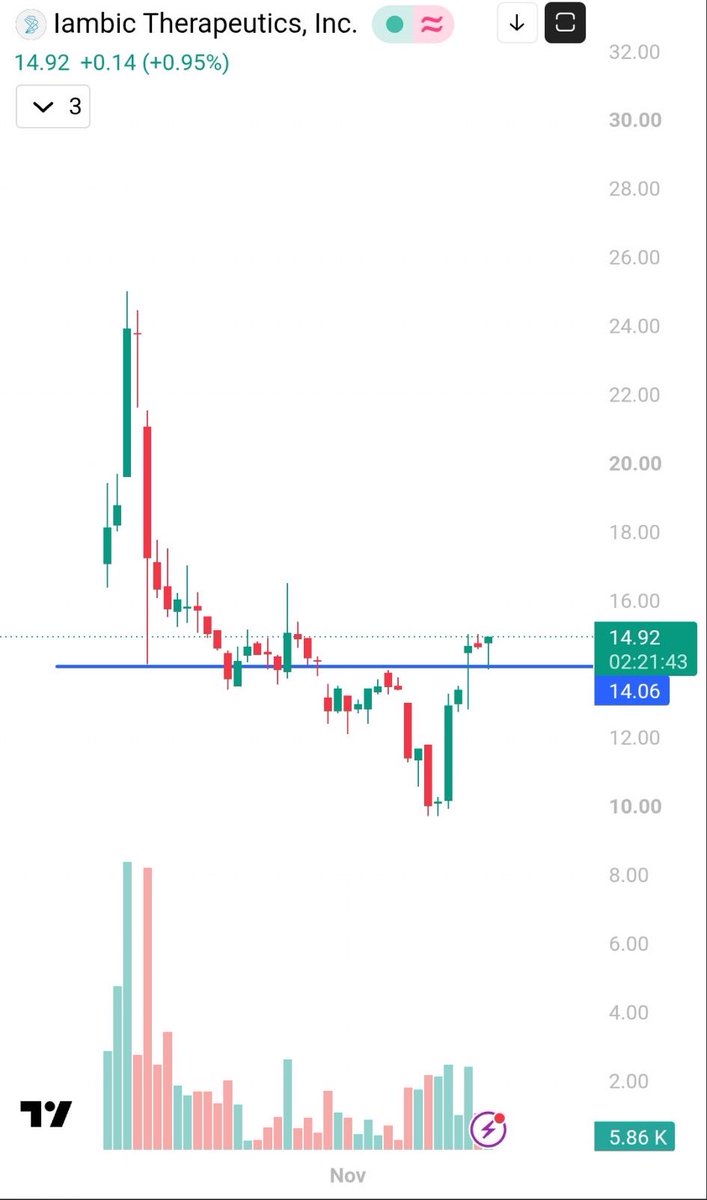
$IAM picked up a lot of new eyes yesterday with four banks starting coverage. Here’s what you get for ~$665M, with ~$410M of that in cash.
The AlphaFold comparison.
NeuralPLexer was built with NVIDIA researchers at Caltech. NVIDIA co-owns a patent family and put $25M into the company
~15x faster than AlphaFold 3 by Iambic’s numbers. An independent benchmark clocked the first version at ~100x on the same chip
Isomorphic, Alphabet’s AlphaFold drug company, is reportedly raising at ~$50B (Bloomberg) with no drug in humans
Iambic, with a drug in 122 patients, is ~$665M. That’s about 1/75th of Isomorphic’s price, and the business beyond cash (~$255M) is under 1/190th, for a model that’s arguably on par on accuracy and ~15x faster by Iambic’s numbers.
The drug
IAM1363, a HER2 pill, 122 patients dosed. Iambic says it’s the only one known to bind the inactive form of HER2
It concentrates in tumours: 20-30x more drug in the tumour than in the blood, in biopsies from two patients
3 confirmed brain responses in breast cancer patients who’d already failed Enhertu and Tukysa. Nothing is approved for them
Registrational trial as early as 2027, and two more drugs entering the clinic
The flywheel
Molecules designed Monday, made Tuesday, tested by Friday. A traditional pharma design cycle takes weeks to months. Iambic puts ~1,000 molecules through one every 7-10 days, and the CEO puts its pace at ~50x a typical pharma programme
Every result goes straight back into the models, so each week’s designs start smarter than the last. More data makes better models, which make better molecules, which make more data
That’s how IAM1363 went from programme start to the clinic in under 2 years, with the drug candidate found by month 7. The industry norm is ~6 years
Enchant v3: 41B parameters, 4.5T tokens of training data, 6,000+ properties predicted, ~12M predictions a month. Google’s TxGemma tops out at 27B
Against TxGemma, by Iambic’s numbers: kinase activity 0.69 vs 0.55, rat clearance 0.70 vs 0.35
With ~5% of the human training data, Enchant matched the best published human PK models trained on 100%
The coverage
All four of the banks that took Iambic public started coverage on Monday, all at Buy or Overweight
Jefferies $35, BofA $30, JPMorgan $22, Citi $22. The average is ~$27, about 95% above $14
BofA’s case: Iambic uses AI to design new drugs, not just to find targets, and it trades below its listed AI peers
The stock closed up 31.6% on the day
Jefferies has the CEO on its AI drug discovery panel on 18 Nov
Commercial validation
AbbVie signed up the day Enchant v3 launched: $40M upfront, up to $670M in milestones
Bayer’s deal names Enchant and NeuralPLexer. RevMed paid ~$25M for NeuralPLexer alone. Takeda signed a separate technology agreement on top of its drug deal
Upfronts keep climbing: $10M (Lundbeck) → $27M (Takeda) → $40M (AbbVie). ~$2.4B in potential milestones across the book
Isomorphic’s Lilly and Novartis deals brought $82.5M upfront. Iambic’s bring ~$77M. A similar deal book, at roughly 1/75th of the valuation
Last December the CEO told investors more deals were coming. Three signed within nine months.
The balance sheet
~$410M pro forma cash, plus AbbVie’s $40M upfront still to come. No debt
Funded into late 2028: enough to start the registrational programme for IAM1363 and take two more drugs into the clinic
The company is locked up too. No new shares before April without its banks’ sign-off
Partner money stretches it further. The CEO says every new deal adds quarters of runway
Therefore minimal dillution risk.
Who’s buying
IPO 5x oversubscribed (Bloomberg)
Cathie Wood’s ARK has bought on 8 of 15 days since the IPO, ~2.4M shares across its funds (~5%)
Druckenmiller’s Duquesne indicated interest in the IPO
A director’s fund bought $11.5M in the IPO. No insider has sold
The flow
80% of shares locked until April. The 10 biggest IPO buyers took 80%+ of the rest.
Possible Russell add: preliminary list Friday, index buying 11 Dec
CEO on Jefferies’ AI drug discovery panel, 18 Nov
Of course NFA, Dyor
$IAM's hidden metabolic bet: what the filings show, what they don't, and what it's worth
Disclosure: I am long $IAM at an average of $9.95. Research, not advice.
The short version
• Iambic told investors it works on metabolic disease, and its CEO repeated it on the record. That line was added to the IPO filing late, between the July and August drafts.
• The clue is GPCRs, the receptor family that GLP-1 and every other big obesity target belongs to. Iambic has a head of GPCR biology, and its audit chair sits on the board of a company with a $2.2B Novo Nordisk obesity deal.
• Peptides are a model capability, not a program. The prospectus never uses the word.
• The obesity pill race has moved on. The liver problem that killed Pfizer's pills has been solved by at least four groups. The open lanes are oral amylin, next-gen receptor targets and longer-lasting peptides.
• One typical early obesity deal pays about $80M to $110M upfront. That is a quarter to a third of Iambic's enterprise value. Nothing is priced in today.
1. Iambic said "metabolic". Then it said it again.
The confidential IPO draft of 24 July 2026 does not mention metabolic disease. The next draft, on 28 August, adds this sentence, which survives unchanged into the final prospectus:
"we are engaged in a number of discovery stage programs in indications, including oncology, metabolic disease and endocrinology, which we estimate represent an over $70 billion in aggregate global commercial opportunity."
The same draft adds that Iambic has eight discovery programs, wholly owned and partnered, and expects up to 25 in 2027. It also says partnerships are expanding the platform to new target classes, "for example, G protein-coupled receptors".
On 16 October the CEO, Tom Miller, was asked about moving beyond cancer. About the wholly owned pipeline, he said: "It includes metabolic disease. It includes endocrinology." (BioPharma Dive)
The company's own documents do not all agree:
• The Enchant v3 page (21 September) lists the pipeline areas as oncology, neuroscience and inflammation and immunology. Metabolic is not listed.
• The risk factor on moving beyond cancer names neurology, gastrointestinal and inflammation only.
• There is no use-of-proceeds line for metabolic work and no metabolic row on the pipeline page.
My read: something metabolic existed or was planned by late August, and Iambic chose to name it before the IPO. It has not said what.
2. Why GPCRs are the tell
A GPCR (G protein-coupled receptor) is a switch on the surface of a cell. The big obesity targets are GPCRs: the GLP-1, GIP, glucagon, amylin and MC4R receptors. Lilly's new obesity pill, Foundayo, is a small molecule that flips the GLP-1 switch.
What Iambic has:
• A GPCR team. An "Executive Director, Head of GPCR Biology" has appeared on Iambic's LinkedIn page since at least February 2025.
• GPCR agonist work. From March 2025 to March 2026 the pipeline page showed a partnered "GPCR target / allosteric agonist / neurological" program. That is very likely Lundbeck (my inference). It is the only disclosed work in which Iambic designs a pill that switches a GPCR on, which is the same job an oral GLP-1 does. It is in brain disease, not obesity.
• A boardroom view of the playbook. Audit chair Shalini Sharp has been a director of Septerna since January 2024. In May 2025 Septerna signed an obesity deal with Novo Nordisk worth up to about $2.2B, with more than $200M upfront and near-term. It covers oral small molecules on GPCR targets "including GLP-1, GIP, and glucagon receptors".
None of this proves a program. It shows the skills, the people and the template are in the building.
3. Peptides: the capability is real, the program isn't
• Enchant v3 (September 2026) lists peptides as a new capability, citing "the success of GLP-1s". It publishes no peptide results.
• In NeuralPLexer3's paper, protein–peptide docking was its strongest category: 85.1% against 76.6% for AlphaFold-Multimer. That is 47 cases with overlapping uncertainty ranges, and AlphaFold 3 was not compared.
• The prospectus never uses the word "peptide". I found no peptide patent, no peptide program and no peptide job post in the live board or 65 archived ones.
So "dark horse in peptides" is a stretch today. "Dark horse in oral metabolic pills" fits the evidence better.
4. Where the obesity market actually is
The market is enormous:
• Lilly's tirzepatide (Mounjaro and Zepbound) sold about $36.5B in 2025 and $43.8B in the first nine months of 2026.
• Novo's semaglutide franchise sold about DKK 228B (roughly $35B) in 2025.
Pills are coming, but the peptide pill is winning so far. In the first nine months of 2026 the Wegovy pill (oral semaglutide, a peptide) sold DKK 10.9B, roughly $1.7B. Foundayo (a small molecule) sold $281M. Part of that is timing: the Wegovy pill launched in January, Foundayo in April.
Oral peptides are wasteful. The FDA label puts oral semaglutide's absorption at about 0.4% to 1%. The Wegovy pill is 25 mg a day against 2.4 mg a week injected.
The liver problem is mostly solved. Pfizer stopped lotiglipron in 2023 and danuglipron in April 2025 over liver safety. Since then, orforglipron (Foundayo), Structure's aleniglipron, AstraZeneca's elecoglipron and MindRank's MDR-001 have reported no liver signal. MDR-001 was designed with AI property prediction and has been in Phase 3 in China since January 2026. "AI fixes the GLP-1 pill" is already a crowded story.
What is still open:
• Weight loss. Pills take off about 11% to 15%, while injections reach 20% to 29% (retatrutide 28.7%).
• Oral amylin. Amylin is the hottest next-generation target. The only oral small-molecule amylin drug in human trials is Structure's ACCG-2671, in Phase 1 since December 2025.
• Longer-lasting peptides. Monthly shots and better half-lives. Half-life prediction is exactly what Enchant's first benchmark measured.
That is where an AI chemistry platform with a GPCR group could matter.
5. What it could be worth
What pharma paid upfront for early-stage (discovery or preclinical) obesity assets, 2023 to 2026:
• Novo – Lexicon (2025), preclinical, oral: $45M
• Lilly – Nimbus (Jan 2026), discovery, oral: $55M incl. near-term
• Merck – Hansoh (Dec 2024), preclinical, oral: $112M
• Novo – Valo (Jan 2025), discovery, AI: $190M incl. equity and near-term
• Novo – Septerna (May 2025), discovery, oral: >$200M incl. near-term
• Novo – Hengrui (Sep 2026), Phase 1-ready, oral: $300M
The median across seven early deals is about $112M. Counting only clean upfronts (four deals), it is about $79M.
For IAM: one such deal is $1.65 to $2.35 a share, about 25% to 36% of today's roughly $313M enterprise value. The market pays nothing for it today.
The reality check: Structure Therapeutics. Structure has a Phase 3-ready oral GLP-1 and the only oral amylin pill in the clinic. Its enterprise value on 11 November was about $276M ($1.51B market value less $1.24B of cash), below Iambic's. The market is not handing out multiples for oral obesity pipelines. For Iambic, the value of a metabolic program arrives as partner cash, not as a re-rating.
6. What to watch
• Patents. International applications publish about 18 months after filing, so anything filed after about May 2025 is still invisible. A GPCR or incretin family appearing in 2027 would be the first hard proof.
• SEC comment letters. Once released, they may show whether the SEC asked about the August metabolic addition.
• The first 10-Q (around 30 November) and the J.P. Morgan conference (January): any named metabolic target.
• The job board. In vivo obesity pharmacology or GPCR metabolic roles.
• Bayer. The June 2026 deal's therapeutic area is still undisclosed. Bayer's focus is cardio-renal, oncology and women's health.
Bottom line
There is no named metabolic program, no peptide program and no metabolic partner. There is a late-added prospectus line, a CEO who said it twice in one breath, a GPCR team, a director who has seen a $2.2B Novo GPCR deal from the inside, and a deal market that pays about $80M to $110M upfront for exactly this stage.
At about $313M of enterprise value, that is a free option on top of the HER2 drug, not the thesis. Size it that way.
Long $IAM at $9.95. Not advice.
One $IAM drug that's already been synthesised could be worth more than the whole company.
In 2024 Genentech paid $850M upfront for Regor's CDK cancer drugs. The lead had been tested in just 12 patients.
https://t.co/49QhgRslK6
Iambic has its own: IAM-C1. Same targets, CDK2 and CDK4, designed by Iambic's AI to avoid the problem that sank Pfizer's version. Heading into the clinic next, IND guided this quarter.
Price IAM-C1 like Regor's:
~$17.90 a share
+ ~$8.60 of cash per share
= ~$26.50, vs $15.50 today
And that ignores everything else:
IAM1363, the lead drug
- Already in 122 patients across 53 sites in 8 countries
- Brain disease controlled in 21 of 22 patients
- Registrational trial guided for as early as 2027
IAM217, built to reach the brain
- Shrank brain tumours ~90% in mice where a rival drug did nothing
- Designed by Iambic's AI without a lab structure of its target
The AI platform
- $77M upfront from AbbVie, Takeda and Lundbeck, with ~$2.4B more in potential milestones
- NeuralPLexer matches AlphaFold 3's accuracy at ~15x the speed (Iambic's figures)
- Enchant v3: 41B parameters, more accurate with every version
- Google's AI drug company Isomorphic is reportedly valued at ~$50B
One drug out of three, priced like Regor's, is worth more than all of Iambic today, cash included.
NFA
$IAM vs Isomorphic, side by side. What’s a fair price for the small one?
Isomorphic is $GOOGL drug company:
AlphaFold 3, built with Google DeepMind
IsoDDE, an in-house engine it says more than doubles AlphaFold 3’s accuracy on the hardest cases (its own numbers)
Lilly and Novartis: $82.5M upfront, up to ~$2.9B in milestones
$2.7B raised, ~$5B more reportedly coming
No drug in human trials yet
Valued at ~$50B. Take out roughly $5B of cash and the business is ~$45B.
Iambic has:
NeuralPLexer3: ~30 seconds per prediction vs ~6 minutes for AlphaFold 3, and more physically valid predictions (77.9% vs 73.1%, Iambic’s numbers)
Enchant v3, 41B parameters
Its own automated lab, ~1,000 molecules a week on a 7-10 day loop
AbbVie, Takeda, Lundbeck: ~$77M upfront, up to ~$2.4B in milestones, plus Bayer and RevMed
A HER2 drug in 122 patients, and two more entering the clinic
Valued at ~$665M. Take out ~$410M of cash and the business is ~$255M.
The deal books are about the same size. The market values Isomorphic’s at ~545x its upfront cash, and Iambic’s at ~3x.
Iambic’s business is priced at ~0.6% of Isomorphic’s.
Isomorphic earns a premium: Alphabet, DeepMind, the AlphaFold name, a far bigger war chest. The question is how big.
Iambic at a share of Isomorphic’s business:
1% → ~$18 a share
2% → ~$28
3% → ~$37
5% → ~$56
Wall Street’s targets ($22-35) put it at 1.4-2.8%. It trades at 0.6%.
The next phase of the obesity boom is pills. $IAM is built for pills.
Ozempic and Mounjaro are injections. Lilly's new pill, Foundayo, was approved in April, and Lilly is paying AI companies for more (Nimbus: $55M upfront, up to $1.3B).
To design a pill you need the exact shape of the lock it has to fit. For GLP-1 drugs, that lock belongs to a receptor family AI has struggled to map.
Iambic's AI maps them:
- 32 recent receptors from that family, mapped at near lab-quality accuracy (Iambic, 2024)
- It designed its KIF18A cancer drug without a lab-made 3D picture of the drug in its target
- Iambic already runs discovery programs in metabolic disease
- Pills are what Iambic makes. Its lead cancer drug is one.
Again there is no obesity target yet, however the more I look into the company the options are endless with what they can produce.
NFA
$IAM could be a dark horse in the peptides arms race.
The race
- GLP-1s did $72.7B in 2025 from just two molecules: $LLY's tirzepatide ($36.5B) and Novo's semaglutide ($36.2B). Each outsold Keytruda.
- Forecast to pass $250B by 2030 (BCC Research). Approved for weight, diabetes, heart, kidney, liver and sleep apnoea.
- It's gone consumer: $HIMS, a 2.8M-subscriber telehealth platform, has sold Novo's branded GLP-1s since March.
- Pfizer paid up to ~$10B for Metsera after a bidding war with Novo.
- Lilly is paying AI drug companies: Nimbus (up to $1.3B, oral obesity), Insilico (~$2.75B).
The engine
Enchant: 1B → 7B → 41B parameters in two years, more accurate every version. v3 is the most accurate yet, used 4.5x less compute than a standard model needs, and is the first to cover peptides.
The dark horse
- Prospectus lists discovery programs in metabolic disease and endocrinology
- Core is small molecules, the same format as Lilly's new obesity pill, Foundayo
- Peptides break down fast. Enchant's headline results are predicting half-life and clearance.
No peptide program named yet. That makes it a very interesting call option on an already strong thesis.
NFA
$IAM could be a dark horse in the peptides arms race.
The race
- GLP-1s did $72.7B in 2025 from just two molecules: $LLY's tirzepatide ($36.5B) and Novo's semaglutide ($36.2B). Each outsold Keytruda.
- Forecast to pass $250B by 2030 (BCC Research). Approved for weight, diabetes, heart, kidney, liver and sleep apnoea.
- It's gone consumer: $HIMS, a 2.8M-subscriber telehealth platform, has sold Novo's branded GLP-1s since March.
- Pfizer paid up to ~$10B for Metsera after a bidding war with Novo.
- Lilly is paying AI drug companies: Nimbus (up to $1.3B, oral obesity), Insilico (~$2.75B).
The engine
Enchant: 1B → 7B → 41B parameters in two years, more accurate every version. v3 is the most accurate yet, used 4.5x less compute than a standard model needs, and is the first to cover peptides.
The dark horse
- Prospectus lists discovery programs in metabolic disease and endocrinology
- Core is small molecules, the same format as Lilly's new obesity pill, Foundayo
- Peptides break down fast. Enchant's headline results are predicting half-life and clearance.
No peptide program named yet. That makes it a very interesting call option on an already strong thesis.
NFA
"Iambic’s business is priced at ~0.6% of Isomorphic’s."
In $IAM you get superior tech with fraction of price and drug already in trial.
The valuation gap does not make sense.
Iambic is $100 stock minimum.
$IAM vs Isomorphic, side by side. What’s a fair price for the small one?
Isomorphic is $GOOGL drug company:
AlphaFold 3, built with Google DeepMind
IsoDDE, an in-house engine it says more than doubles AlphaFold 3’s accuracy on the hardest cases (its own numbers)
Lilly and Novartis: $82.5M upfront, up to ~$2.9B in milestones
$2.7B raised, ~$5B more reportedly coming
No drug in human trials yet
Valued at ~$50B. Take out roughly $5B of cash and the business is ~$45B.
Iambic has:
NeuralPLexer3: ~30 seconds per prediction vs ~6 minutes for AlphaFold 3, and more physically valid predictions (77.9% vs 73.1%, Iambic’s numbers)
Enchant v3, 41B parameters
Its own automated lab, ~1,000 molecules a week on a 7-10 day loop
AbbVie, Takeda, Lundbeck: ~$77M upfront, up to ~$2.4B in milestones, plus Bayer and RevMed
A HER2 drug in 122 patients, and two more entering the clinic
Valued at ~$665M. Take out ~$410M of cash and the business is ~$255M.
The deal books are about the same size. The market values Isomorphic’s at ~545x its upfront cash, and Iambic’s at ~3x.
Iambic’s business is priced at ~0.6% of Isomorphic’s.
Isomorphic earns a premium: Alphabet, DeepMind, the AlphaFold name, a far bigger war chest. The question is how big.
Iambic at a share of Isomorphic’s business:
1% → ~$18 a share
2% → ~$28
3% → ~$37
5% → ~$56
Wall Street’s targets ($22-35) put it at 1.4-2.8%. It trades at 0.6%.
$IAM vs Isomorphic, side by side. What’s a fair price for the small one?
Isomorphic is $GOOGL drug company:
AlphaFold 3, built with Google DeepMind
IsoDDE, an in-house engine it says more than doubles AlphaFold 3’s accuracy on the hardest cases (its own numbers)
Lilly and Novartis: $82.5M upfront, up to ~$2.9B in milestones
$2.7B raised, ~$5B more reportedly coming
No drug in human trials yet
Valued at ~$50B. Take out roughly $5B of cash and the business is ~$45B.
Iambic has:
NeuralPLexer3: ~30 seconds per prediction vs ~6 minutes for AlphaFold 3, and more physically valid predictions (77.9% vs 73.1%, Iambic’s numbers)
Enchant v3, 41B parameters
Its own automated lab, ~1,000 molecules a week on a 7-10 day loop
AbbVie, Takeda, Lundbeck: ~$77M upfront, up to ~$2.4B in milestones, plus Bayer and RevMed
A HER2 drug in 122 patients, and two more entering the clinic
Valued at ~$665M. Take out ~$410M of cash and the business is ~$255M.
The deal books are about the same size. The market values Isomorphic’s at ~545x its upfront cash, and Iambic’s at ~3x.
Iambic’s business is priced at ~0.6% of Isomorphic’s.
Isomorphic earns a premium: Alphabet, DeepMind, the AlphaFold name, a far bigger war chest. The question is how big.
Iambic at a share of Isomorphic’s business:
1% → ~$18 a share
2% → ~$28
3% → ~$37
5% → ~$56
Wall Street’s targets ($22-35) put it at 1.4-2.8%. It trades at 0.6%.
SCOOP: Isomorphic Labs’ latest fundraise is progressing — with a $50 billion valuation attached.
The Google DeepMind spinout is in talks for ~$5B in new funding, per our sources.
w/ @nmasc_👇
ai and biotech is the sector i think the market is mispricing the most right now. two small caps show it well.
$IAM (Iambic) -> up 31% today to $13.38, market cap $634m, cash $409m, enterprise value about $225m, funded to q4 2028
$NAUT (Nautilus) -> $2.38, market cap $303m, cash $114m, enterprise value about $189m, runway into q1 2028 with a raise planned before mid-2027
before today's move Iambic was trading close to its cash, with an enterprise value around $75m. i've already been in and out of $NAUT for a 60% profit, and it has gone from under $1 to $2.38 since early october. a price like that is usually when a company raises, so dilution is the risk to watch.
of the two i still prefer $IAM cash is 65% of its market cap against 38% for $NAUT and it is funded two years out.
which one would you rather own going into a raise?