imagine it is october 2025 and $IREN is $61.78. now imagine it is october 2026 and $IREN is $23.95. here is what the company did in between.
what it built and signed
-> $9.7b, 5 year contract with microsoft for 200 MW of gb300 gpus
-> horizon 1 delivered to microsoft in august, horizon 2 commissioning, horizons 3 and 4 targeted for q4 2026
-> new contracts with a frontier ai lab, cohere, perplexity, figure ai, fal ai and higgsfield ai
-> recent 3 year contracts above $20m revenue per MW, with talks at about $25m
how it funded it
-> $3.6b of investment grade gpu financing at 6% for the microsoft contract
-> $2.8b of new gpu financing for other customers
-> $5.9b of cash at 30 june
what it earned
-> revenue $707m, up 41% from $501m
-> ai cloud revenue $128.8m, up about 8x from $16.4m
what it targets
-> $1b of operating ai cloud arr as of 26 august
-> $4b of contracted arr for 2026 capacity, due to be live by 31 december
the price is down about 61% while the business went from bitcoin miner to ai cloud with a $9.7b microsoft contract.
$SNDK has an 85% gross margin and samsung made a 55% operating margin last quarter, and this group still trades under 3.5x operating profit. either margins fall back hard or the market has this wrong.
my bet is on the second one, because data centres are only the first wave of demand and physical ai is not in the numbers yet.
so the demand is fine and the problem is who pays for it. if the anthropic credit story is true, that worries me more than any capex number, because when the biggest buyers cannot borrow cheaply the small builders feel it first. that is why i keep separating the ones with signed leases from the ones still waiting on a tenant
compute and power providers have been nuked for a month or two, and i think the market is pricing the wrong risk.
the demand side
-> $GOOGL cfo said they are supply constrained and started using third-party compute at the end of Q3
-> $AMZN says customers are using new capacity almost as fast as it installs it
-> $MSFT said some third-party capacity deliveries slipped, and still guided capex above $50b next quarter
-> all three still guide capex up
the price side
-> spot: the H100 rental index went from $2.00 an hour in december to $2.88 on 24 october, up 44%
-> the forward curve for gpu rentals now shows little or no discount for longer contracts, so the market is not pricing rentals to fall
-> $IREN has $9.7b over 5 years with Microsoft for 200 MW, about $1.94b a year once fully running
-> $NBIS has $17.4b over 5 years with Microsoft, plus Meta deals worth up to $27b
-> $GLXY's CoreWeave leases run 15 years, and colocation rent is about $2m to $3m per MW
-> the contracts lock the price at signing, so a higher spot price only helps capacity that is not yet contracted
the real risk is the build out and financing imo
-> power has to energise on time
-> every delay pushes revenue out while the financing cost keeps running
-> $NUAI just sold about 20% more stock at $2.75 to clear a loan before a lease is signed
-> one tenant can be most of the revenue
-> $NBIS said in its august letter that it had delivered every capacity tranche to Microsoft so far, so it can be done
how i split the group
-> secured power and signed leases: $IREN, $NBIS, $GLXY
-> power but no tenant yet: $NUAI
-> $GLXY also has 830 MW at Helios II that is still unleased, which is upside if it signs
if $IREN, $NBIS, $GLXY and $NUAI turn their power on, the demand will be there to meet it. the prices look like the market doubts that they will.
these are what change my mind
-> hyperscaler capex guides cut
-> a signed lease repriced lower
-> power delivery slipping by more than a few quarters
being a stock picker right now
-> company beats earnings, stock falls 15%
-> company guides a little light, stock falls 25%
-> you read 40 earnings calls this week
-> the index buyer has not opened the app in a month and is sleeping fine
are my $INTC bag holders still breathing?
@DiligentPlane a week where almost everything beat and almost everything fell. i have stopped trying to make this market make sense
its pricing absolute perfection and then some more.
datacenter grew 78% and the guide is weak because of pcs, which is a real problem, but -27% looks harsh to me. revenue is guided about 9% under and eps about 42% under for one quarter, while the part ai is driving is growing fastest.
how much of the old high was priced for a clean quarter?
the capex story flipped with the price. in august it meant demand and now it means a bubble. azure +48%, google cloud +103%, aws +39%, and every 2027 capex plan still points up
great read
There is nothing special about this pullback.
Much of the panic surrounding neoclouds, AI capital expenditures, and the sustainability of the infrastructure buildout is simply the market searching for explanations for falling stock prices.
When AI stocks were rising, record capex was evidence of extraordinary demand. When those same stocks started falling, suddenly the same spending became evidence of an impending financial disaster.
One fact with two interpretations that depend entirely on the price action of the market.
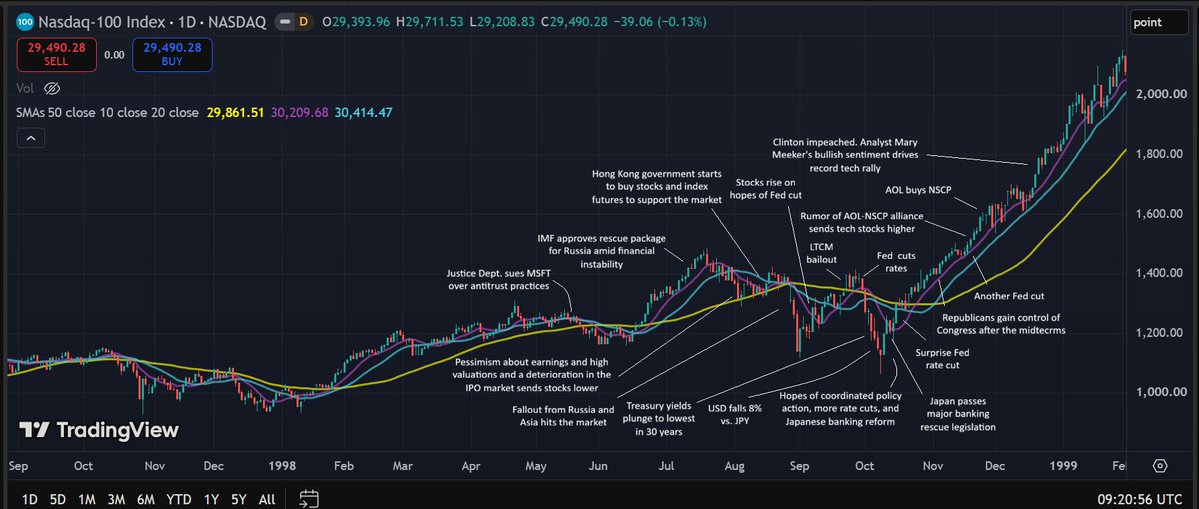
Go back to August 1998.
The technology bull market had been running for about three years.Amid fallout from the Asian financial crisis and Russian ruble crisis, earnings expectations were deteriorating, valuations were elevated, and investors were becoming increasingly concerned about unprofitable Internet companies.
On August 6, the New York Times published an article titled "Market Gyrations May Point to Shift in Investor Strategy." One fund manager declared, "Boring is going to outperform sexy."
Investors were supposedly abandoning momentum and speculative technology shares in favor of profitable businesses, balance sheets, dividends, and traditional valuations.
Russia defaulted on its debt. The Asian financial crisis was spreading internationally. The yen carry trade had imploded as the USD plunged 8% against the yen in a single day. US embassies were being bombed.
President Clinton ordered missile strikes against Afghanistan and Sudan while simultaneously facing a scandal that would result in his impeachment. Major financial institutions suffered enormous losses, and the spectacular collapse of Long-Term Capital Management threatened the stability of the global financial system.
Corporate earnings forecasts were falling. Investors feared a U.S. recession. Many of the same technology companies that had driven the bull market were now leading the decline. Many of them had fallen 40-60% from their 1998 highs.
Even the Federal Reserve's first interest-rate cut on September 29 initially disappointed investors. The Dow fell that day and plunged another 238 points the following session.
The news seemed almost uniformly terrible.
But the market didn't care forever.
After a violent reversal in early October, improving confidence in corporate earnings, Japanese banking reforms, and a surprise emergency Fed cut on October 15 helped restore risk appetite.
By November, the Dow was making new all-time highs. Internet stocks were exploding higher again.
What had looked like the end of the internet trade was, within about a month, actually a correction preceding one of the most extraordinary speculative advances in stock-market history.
In today’s market, Microsoft just reported 48% Azure growth. Google Cloud revenue more than doubled. Meta expects $135–145 billion in capex this year and has announced plans for a potentially record-sized $97.5 billion equity capital raise.
If the market really was that concerned over capex spending, instead of using it as an excuse to explain the pullback, the market would have sold off on the META news.
Anthropic has now filed its IPO registration statement. We have midterm elections approaching, another consequential round of earnings, and a Fed that just held rates steady even as another hike is widely anticipated in December.
There are plenty of potential catalysts over the coming two months.
More importantly, this does not resemble the sentiment backdrop of a speculative bubble climax. Generational bull markets don't die midway through a basing period, but typically after euphoric saturation and a parabolic rally in leading names.
Consensus on AI is deeply divided. Being loudly anti-AI has practically become fashionable. Some AI critics have even built enormous audiences around the idea that the economics of the industry are unsustainable. Plenty of investors seem almost eager to watch the entire trade collapse.
That isn't the sentiment or narrative around which tops are typically made.
The Internet trade didn't end in the panic of 1998. It ended after the extraordinary acceleration of 1999 and early 2000 when being bearish was the market equivalent of wearing a dunce cap.
History never repeats perfectly, and today's rate environment is very different. But I think the resemblance in investor psychology is striking.
I’d be genuinely surprised if we don't have at least one more months-long rally into new highs during this cycle.
Whether it begins into the midterms, after the elections, around Anthropic's anticipated listing, or following further earnings confirmation, I suspect this correction will eventually look more like an interruption in a generational bull market than the bursting of a "bubble."
The $NDX took four months to bottom in 1998. With the exception of a handful of leaders, most stocks that are holding up have been basing out since the May-July period. We could certainly go lower, but most of the signs point to another new high before this cycle rolls over.
However, I’d place the odds of any additional powerful rallies afterward as increasingly unlikely given the fact we are already about to enter the fifth year of this bull market. I'd be careful about buying the dips next year, at least with meaningful size.
@lesse_jivermore 1998 had awful news and the market still made new highs by november. now no big capex guide has been cut and the ai bears are getting the most likes. that does not look like a top to me
@TheProfInvestor everyone wants to be a trader now and half of them refresh the app every 5 seconds. if the reason you bought it has not changed, the morning price does not matter.
fundamentals should be 99% of the decision
BREAKING: World's largest crypto exchange Binance hacked with over $5.6 billion stolen:
• $1.45 billion $BTC
• $875 million $ETH
• $234 million $TRX
• $50 million $XAUT
• $1.57 billion $USDT
• $823 million $USDC
• $75 million $WBETH
• $88.5 million $RLUSD
+ $447.5 million additional cryptocurrencies
This is the largest hack in crypto history.
@nanotitan28 so they opened an atm near $7 in september and then did a pipe at $2.75 five weeks later. that is what annoys me.
a signed lease fixes it but until then there is about $24m of cushion and another $82.8m of security due $NUAI
$150 to $110 in a day after a revenue beat. the quarter was fine, subscription revenue up 21%, and the fall followed an 18.5% crpo growth guide that management says is partly timing.
$150 was about 37x annualised non-GAAP eps, so there was no room for a softer guide. at $110 it is about 27x